
14 min 52 sec
Available in: English
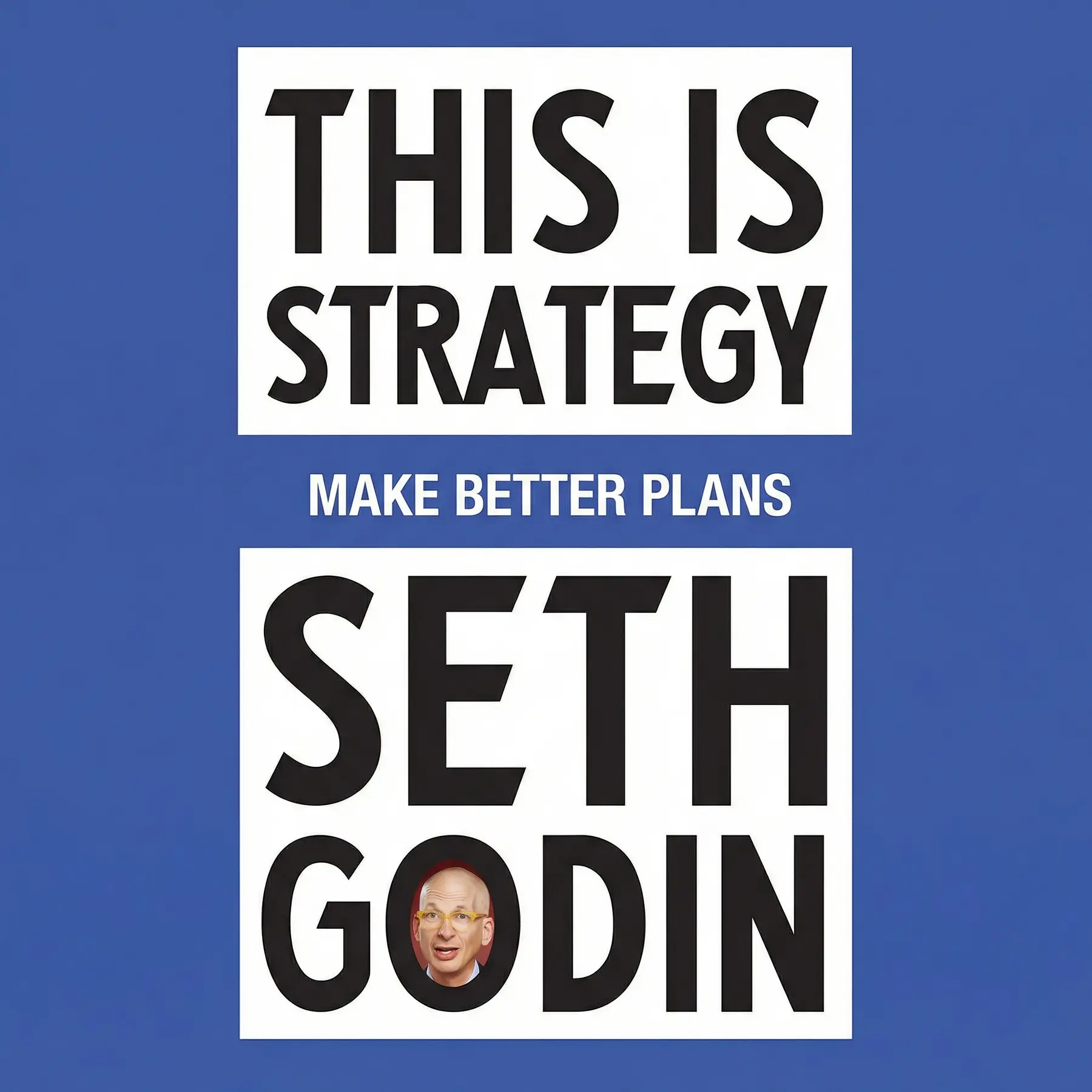
This Is Strategy: Make Better Plans
By Seth Godin
Shows how to build plans that work with the systems, cultures and people around them, using clear priorities, small tests and the discipline to refuse tempting shortcuts that weaken long-term goals.
Table of Content
1. Introduction
1 min 06 sec
Many plans fail because what passed for strategy was really a wish list or a pile of busy tasks. In This Is Strategy, author and entrepreneur Seth Godin argues that strategy is a way of thinking about systems and people, one that keeps adapting long after the document is written. His first step is to pull apart two things most teams blur together: the long-term choices about what comes first, and the short-term moves that carry those choices out.
Godin built the book from 297 short pieces he calls riffs, and they circle one claim. Plans that last work with the systems and cultures around them, push where a small effort counts, and keep changing as feedback arrives. The evidence runs from the humble shipping container to an ethical chocolate maker and a tire that repair shops fought. What follows is a way to test any plan you own: whose needs it serves, which system it rides on, and what it should refuse.
2. Tell your strategy apart from your tactics
1 min 54 sec
A team can work hard every day and still drift. The cause is often a quiet mix-up between two kinds of decisions, and a business expansion shows how easily one swallows the other.
3. See why stubborn systems refuse to budge
1 min 45 sec
A plain metal box changed world trade, and a household gadget can change how much power a family uses. Both reveal what keeps systems standing long after people start complaining about them.
4. Bend a system instead of breaking against it
1 min 45 sec
One company built a tire that could never go flat, and the market turned it away. Another took on an entire industry’s ethics and won. The gap between them comes down to who they asked to change.
5. Turn rankings and status into allies for change
1 min 48 sec
A magazine’s list changed how colleges behave, and a set of breed rules has shaped generations of dogs. The same forces that lock in bad habits can be turned around, if you know where to look.
6. Simple tools that show where to focus
1 min 53 sec
A two-by-two chart can reveal an empty corner in a crowded market, and a single number can align a whole team. One of the strongest tools on the list, though, is a word most people avoid.
7. Spot the traps that sink good plans
1 min 47 sec
Strong ideas die in execution more often than in the meeting where they were born. Four quiet mistakes explain most of those deaths, and at least one of them is probably in your current plan.
8. A long view that survives quick temptations
1 min 42 sec
A volatile market promises big profits, and a rival seems ready to grab them. Godin’s test for whether to follow is simple to state and hard to live by, and early movers in one industry show why it pays.
9. Conclusion
1 min 12 sec
What Godin offers in the end is a habit of seeing. A plan is never drawn on blank paper. It lands inside a web of shipping standards, repair shops, rankings, breed clubs and buyers’ values, and each of those has reasons to stay as it is. The strategist’s job is to understand those reasons well enough to find the channel that moves the river, then to stay committed while the water finds its way.
That habit can start this week. Take one plan you are responsible for and name the system it depends on, along with the people who profit from things staying the same. Look at what that system measures, and ask whether a different number, made visible, would change behavior the way the Higg Index changed what fashion brands compete on. Then run the smallest test you can, and drop one attractive option that does not serve your long-term aim.
Michelin built a tire that could not go flat and still lost. Tony’s Chocolonely won by moving with what buyers already wanted. In the source’s account, the deciding factor was whether each approach worked with the existing system or against it. It was the map.
About this book
What is this book about?
Plenty of teams have a strategy document. Far fewer have a strategy, which Seth Godin describes as deliberate choices made today that shape what becomes possible tomorrow. Without those choices, people end up reacting to events, busy but going nowhere in particular. Godin's angle is that every plan lives inside systems: industries, markets, cultural norms, rankings and status games that resist change for reasons of their own. He explains why systems last, how feedback keeps them steady, and why working with them usually beats fighting them. His examples include the shipping container, Wedgwood's eighteenth-century china, Tony's Chocolonely, Michelin's ill-fated puncture-proof tire, college rankings and the Higg Index in fashion. Readers get practical tools for turning that view into action. These include a positioning grid, sharper goals, the habit of saying no and small pilots that test ideas before scaling. Godin also names the traps that sink good plans, from confusing a goal with a strategy to analysis paralysis, and shows how a long-term vision helps teams resist quick wins that cost them later.
Book Information
Who it's for
Leaders whose plans stall
Founders and managers whose plans keep stalling between the strategy meeting and real results.
Team leads facing resistance
Team leads trying to push change through a company, market or industry that resists it.
Professionals weighing priorities
Professionals who want simple tools for deciding what to focus on and what to drop.
About the Author
Seth Godin
Seth Godin, born in 1960, is an American author, entrepreneur and blogger who has also published under the pen name F. X. Nine. He started Yoyodyne, an early online company, and sold it to Yahoo!, where he served as Vice President of Direct Marketing. He later founded Squidoo.com and the altMBA, an online education program. His books include Linchpin, Purple Cow and The Practice, and he has been inducted into the Marketing Hall of Fame.
Linchpin: Are You Indispensable?
Seth Godin

The Practice: Shipping Creative Work
Seth Godin
Tribes: We Need You to Lead Us
Seth Godin
Ratings & Reviews
Ratings at a glance
What people think
Listeners find this book both valuable and thought-provoking, with one review emphasizing its sophisticated grasp of systems and organizational evolution. They further appreciate its perspective on navigating change and industry disruption. Nevertheless, opinions on readability are split, as some find the material hard to get through. The arrangement and concepts also draw varied reactions; one listener points out the incredible density of useful ideas per page, whereas another views it as 250 disconnected thoughts. Finally, the book’s professional utility is debated, with one listener highlighting beneficial marketing concepts for small firms, while another finds the format non-traditional for a business guide.
Top reviews
Rin
Strategy isn't a fixed formula, and this book embodies that truth perfectly through its unique and provocative structure. Seth Godin has delivered a work that feels more like a toolkit for the mind than a standard business text. I particularly appreciated the focus on how positioning grids and metrics can reshape entire industries. It’s a thought-provoking journey that demands active engagement from the reader. You can't just passively consume this; you have to think about your own leverage points. This is easily one of the best non-fiction books of the year for anyone seeking meaningful change.
Show moreTim
What does it actually take to stay relevant when the world is constantly shifting under your feet? Godin answers this by focusing on long-term vision and the power of feedback loops. The way he describes 'systemic advantage' versus 'heroic effort' changed how I view my daily tasks. This book is a deep exploration of the motivations—connection, recognition, safety—that drive human behavior. Not gonna lie, the 297 short chapters are a bold choice, but they allow for a very high density of valuable ideas per page. It’s a brilliant guide for those who want to create remarkable work.
Show moreAiden
Picked this up because I wanted to understand how to move beyond simple tactics and into actual systemic change. I’m glad I did, as the density of ideas here is remarkable. Godin’s focus on systems, feedback loops, and how toxic structures endure is incredibly nuanced. The example of Tony’s Chocolonely was a highlight for me. However, the readability is a bit of a mixed bag due to the vignette style. It isn't a book you sit down and read cover-to-cover in one afternoon. You have to sip it like a strong espresso, or you’ll get lost in the abstraction.
Show moreNarumon
The chapter on the 'four quadrants'—time, games, empathy, and systems—finally made the concept of strategy click for me. Seth argues that we often mistake heroic effort for a real plan, which is a trap I’ve fallen into many times. The book challenges the 'corporate industrial complex' and pushes you to serve a niche rather than chasing scale. Look, it’s definitely unconventional and some might find the short chapters annoying. But if you’re looking for a masterclass in challenging the status quo, this is it. It’s a rousing nudge for any aspiring entrepreneur.
Show moreSamuel
Finally got around to finishing Godin's latest, and it's certainly a different beast than his earlier work. It’s structured as a manifesto of vignettes, which makes it perfect for a daily reading habit but difficult for a deep dive. I loved the emphasis on 'emotional labor' and the way he uses artists like Andy Warhol to illustrate leverage. The writing is clear and punchy, though some sections feel a little repetitive after a while. If you can handle the disjointed nature, there is deep wisdom about how cultural systems resist change. It is worth the money for the perspective shift.
Show moreKenji
Not what I expected, but perhaps exactly what I needed to hear regarding my own project's direction. The distinction between strategy and tactics is often blurred, but this book draws a hard line that is very helpful. I found the sections on the 'smallest viable audience' to be the most practical part of the text. To be fair, the book wanders all over the place and doesn't always provide a step-by-step formula. But strategy is rarely linear, so the structure actually reflects the subject matter well. It’s a solid 4-star read for the insights alone, even if the flow is messy.
Show moreArthit
After hearing Seth talk about this on a podcast, I knew the 'riffs' format would be polarizing for many readers. I personally enjoyed the bite-sized nature of the chapters, even if the continuity felt a bit lacking at times. It forces you to pause and reflect on how your choices today shape your tomorrow. The insights on how cultural norms reinforce existing systems were particularly eye-opening for me. It’s not your typical business book, but it’s packed with marketing wisdom for those willing to do the work. A very insightful, if slightly fragmented, read.
Show moreChloe
As a long-time follower of Seth's daily blog, I found the content here felt a bit like expensive déjà vu. The information is inspiring, focusing on the 'smallest viable market' and the importance of empathy, yet the flow is totally non-existent. It reads like a compilation of 297 meditations rather than a structured business manual. To be fair, some gems are buried in the drier sections, but the lack of a clear framework makes it difficult to apply. It’s a good collection of nuggets, but I’d probably recommend his podcast interviews over the actual book. It’s just too scattered for my brain.
Show moreAnawin
Is this a book or a loosely organized folder of blog posts? I’ve read pretty much all of Seth’s work, and The Icarus Deception remains a personal favorite, but this was a major letdown. The structure is too abstract and disjointed to be useful for someone actually trying to run a business. I struggled through the first sixty chapters hoping for a thread of continuity, but I eventually threw in the towel at chapter 72. Truth is, the ideas are okay, but the delivery is so fragmented that it’s exhausting to read. It lacks the punch and focus of his earlier work.
Show moreEarn
This book represents everything that is frustrating about modern non-fiction. It feels like a collection of random thoughts assembled with zero editing work or overarching logic. Frankly, it’s hard to shake the feeling that this was mostly AI-generated, which the author even hints at in the intro. I expected a cohesive guide on how to build a better plan, but instead, I got 250+ disjointed riffs that read like a disorganized Reddit thread. Even though there are a few interesting points on systems, the reader has to do way too much heavy lifting to find them. If you want strategy, look elsewhere.
Show moreQuestions about this book
What is the main idea of This Is Strategy by Seth Godin?
Godin argues that strategy is an adaptable way of thinking rather than a fixed formula. Good strategy sets clear long-term priorities, understands what people need, and works with the systems and cultures that shape outcomes. It finds small points where pressure creates large shifts, tests ideas before scaling them, and resists short-term wins that damage the future. His examples range from the shipping container to Tony’s Chocolonely and the Higg Index.
What is the difference between strategy and tactics according to Godin?
Strategy sets the overall frame and the long-term priorities, while tactics are the specific steps that solve immediate problems. For a business planning to expand, choosing which markets come first is strategy, and picking advertising channels or negotiating local partnerships is tactics. Without the strategic choice, tactical decisions lose their focus and success becomes much harder to reach.
Why do better ideas sometimes fail, according to This Is Strategy?
A better idea can fail when it threatens the people who control the system around it. Michelin introduced puncture-proof tires, but garages and repair shops resisted because their profits were at risk, and Michelin underestimated how embedded they were. Tony’s Chocolonely succeeded by matching its ethical chocolate supply chain to values consumers already held, so it never had to fight the whole industry at once.
How can I apply This Is Strategy at work?
Start by writing one sentence that names your long-term priority and check every task against it. Map who benefits from the current way of doing things before you propose a change. Use a positioning grid to find open space among competitors, set specific targets such as a 15 percent sales increase, and run a small pilot before committing fully. Finally, choose one tempting opportunity to decline.
Readers also enjoyed



A Year with Peter Drucker: 52 Weeks of Coaching for Leadership Effectiveness
Joseph A. Maciariello



Acting with Power: Why We Are More Powerful Than We Believe
Deborah Gruenfeld

All In: How Great Leaders Build Unstoppable Teams
Mike Michalowicz



7 Powers: The Foundations of Business Strategy
Hamilton Helmer
AUDIO SUMMARY AVAILABLE
Listen to This Is Strategy in 15 minutes
Get the key ideas from This Is Strategy by Seth Godin, plus 5,000+ more nonfiction titles.
- 5,000+ titles
- Listen as much as you want
- 7-day free trial
- Cancel anytime









