
15 min 04 sec
Available in: English
 ไทย
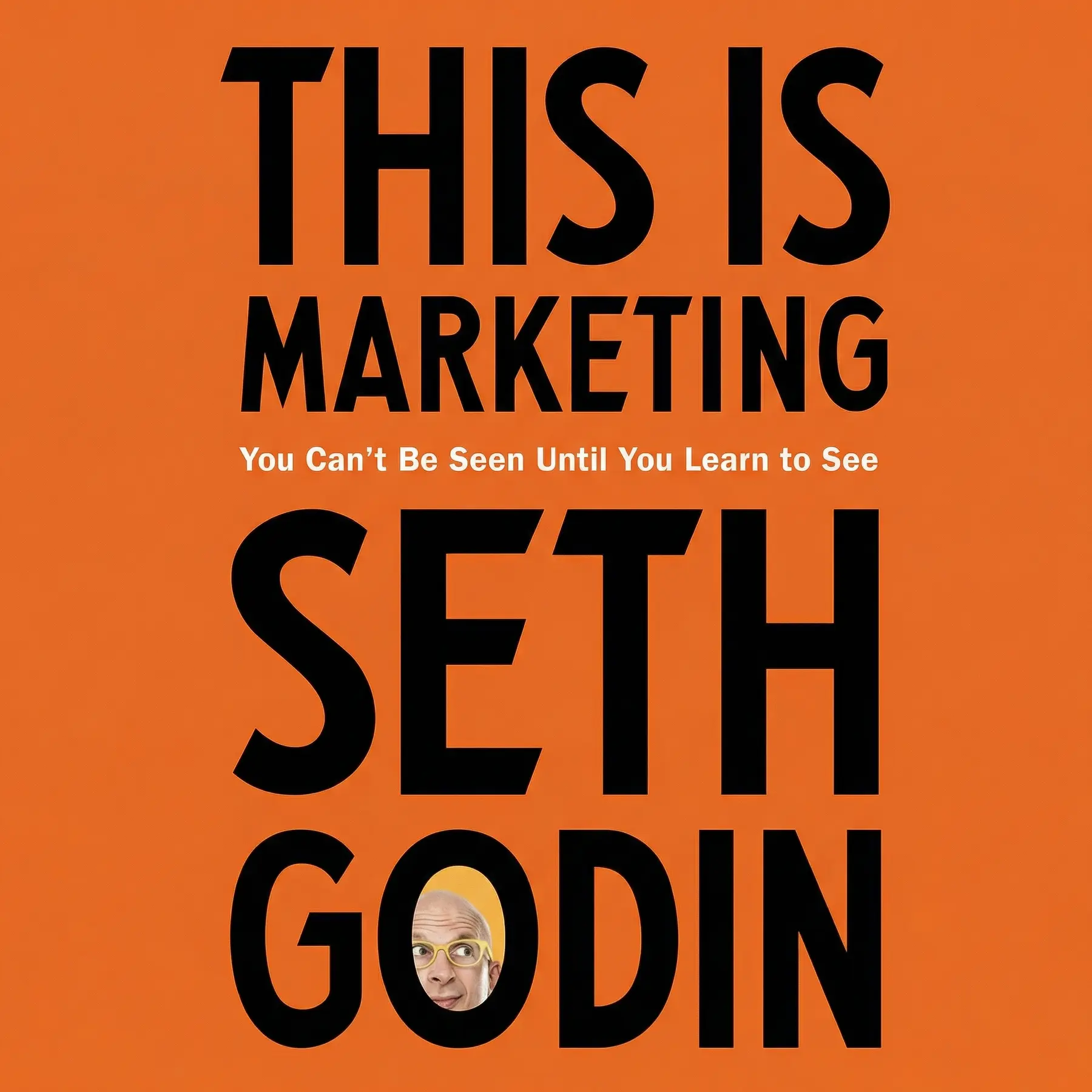
EnglishไทยThis Is Marketing: You Can't Be Seen Until You Learn to See
By Seth Godin
Seth Godin explains why buying ads to reach everyone has stopped working. He shows how to build for a small group that wants change, earn its trust and let it spread your product.
Table of Content
1. Introduction
57 sec
If your marketing plan still begins with buying more ads, you are working from a map drawn for a world that has disappeared. In This Is Marketing, entrepreneur and author Seth Godin argues that advertising has shrunk from the main road to a side street, and that one of the smartest moves left is to stop trying to persuade most people at all.
His case is simple to state and hard to practice. Find a small group of people who welcome change, understand what they truly want and believe, build something that keeps its promise to them, and let them carry it to everyone else.
Along the way come a rock band with a single Top 40 hit and more than $450 million in record sales, a department store that lost over half its sales by tidying up its image, and a chat tool that spread from one desk to the next. Each one becomes a step you can take with your own product, service or idea.
2. Stop chasing a crowd that has scattered
2 min 00 sec
Online ads let you pick exactly who sees your message and count every click. So why do so many precisely targeted campaigns still vanish without a trace? The answer starts with a famous TV series almost nobody watched.
3. Sell the feeling behind the drill bit
1 min 46 sec
Nobody walks into a hardware store wanting a piece of metal. Follow the purchase a few steps further and you reach something far more personal, and it changes when marketing should begin.
4. Find the few who want something new
1 min 44 sec
Some customers line up overnight for a new phone while others cling to the old one for years. Godin argues that one of these groups should be ignored at first, and the reason saves money.
5. Claim an empty corner of the values map
2 min 06 sec
A rock band with almost no radio hits became one of the most commercially successful acts in history. Its trick was standing where nobody else dared, sometimes in two opposite places at once.
6. Speak the language your tribe already trusts
1 min 47 sec
A new chief executive looked at his stores, decided the coupons looked cheap and removed them. It seemed like a sensible upgrade. What happened next shows how much a few small symbols can carry.
7. Turn status worries into a reason to buy
1 min 52 sec
Fans who like a product often never get around to buying it. Godin’s fix plays on a pressure everyone feels inside a group, and it works differently for people who want to belong and people who want to win.
8. Let early fans carry you into the mainstream
1 min 42 sec
The very thing that makes early fans love a product makes everyone else wary of it. One workplace tool crossed that gap without persuading the doubters at all, and the method can be designed in.
9. Conclusion
1 min 10 sec
This Is Marketing turns the usual order of selling upside down. The old method started with a message and searched for as many ears as possible. Godin starts with people: the need beneath the product, a small group that shares it and enjoys new things, the values and symbols that group already trusts. Reach comes last, earned through the fans rather than bought.
That is why the JCPenney story stings. The company had a tribe, a promise and a language, and it lost more than half its sales by putting its own taste ahead of its customers’ worldview.
To act on the book this week, follow your product down the drill-bit chain until you hit a human need, then sketch the values graph and look for a corner nobody else holds. Name the smallest group that could keep you in business, along with the symbols they would recognize you by. Then ask whether each new user makes the product better for the ones already there.
The Grateful Dead never needed the whole country to listen. They needed a core of people who felt the band was made for them, and those people did the rest.
About this book
What is this book about?
Most people hear the word marketing and think of advertising. Seth Godin argues that this habit belongs to the era of three television channels, when one ad could reach millions. Today attention is split across countless screens and feeds, and even precisely targeted online ads mostly get ignored. Godin offers a different way to work. Start with the deep human need your product answers, the way a drill bit really answers a wish for safety and respect. Choose the smallest group that could make you profitable, made of people who enjoy trying new things. Position yourself on extremes that rivals have left empty, tell a story in the symbols your tribe already trusts, and use status to move fans to act. His examples range from the Grateful Dead's more than $450 million in record sales to JCPenney's slump after dropping its coupons and Slack's spread from a small group of early fans to whole offices. Readers get a step-by-step way to think about who a product is for, where it should stand and how it can reach the mainstream through its first fans.
Book Information
Who it's for
Founders and small businesses
Founders and small business owners whose ad budgets keep buying attention that never turns into sales.
Product and marketing teams
Product and marketing professionals deciding who a launch is really for and where it should stand.
Wanting a loyal following
Creators and freelancers trying to build a loyal following instead of chasing everyone.
About the Author
Seth Godin
Seth Godin, born in 1960, is an American author, entrepreneur and blogger who also writes as F. X. Nine. He built an early online company, Yoyodyne, sold it to Yahoo! and became its Vice President of Direct Marketing. He went on to found Squidoo.com and the altMBA, an online education program. His books include Purple Cow, Linchpin and The Practice, and he has been inducted into the Marketing Hall of Fame.
Linchpin: Are You Indispensable?
Seth Godin
The Practice: Shipping Creative Work
Seth Godin

This Is Strategy: Make Better Plans
Seth Godin
Tribes: We Need You to Lead Us
Seth Godin
Ratings & Reviews
Ratings at a glance
What people think
Listeners find the work insightful and full of wisdom, with one mentioning it provides bite-sized portions of marketing philosophy. The book is easy to consume and listen to, clarifying complex ideas and acting as a practical guide that listeners believe is highly relevant today. They admire the writing style and feel it is worth the cost, with one listener stating it's more valuable than college textbooks on marketing.
Top reviews
Bird
After hearing so much hype about Seth Godin, I finally dove into this, and it’s a breath of fresh air compared to dry academic texts. Instead of focusing on cold metrics and spamming people, Godin centers the conversation on human connection and finding your smallest viable market. Truth is, most marketing books try to teach you how to trick people, but this one teaches you how to serve them with dignity and respect. The short, punchy chapters make it incredibly easy to consume, almost like a collection of daily meditations for a modern business owner. It is more of a philosophical guide than a technical manual, which might frustrate some, but for me, it provided the mindset shift I desperately needed. I’d take these bite-sized nuggets of wisdom over a thousand-page college textbook any day of the week.
Show moreSook
This book is a masterclass in shifting your perspective from 'how do I get more likes' to 'how do I make a difference for a specific group of people.' Seth Godin has a way of distilling complex psychological concepts into simple, accessible language that anyone can understand, regardless of their background. I particularly appreciated the focus on the smallest viable market, which is such a counter-intuitive but powerful way to look at growth. It’s a practical guide in the sense that it changes how you think, even if it doesn't tell you exactly which buttons to click on Facebook. Not gonna lie, some sections felt a bit repetitive, and the style is definitely 'Godin-esque' with those short paragraphs. However, the core message of sincerity and transparency is something every modern professional needs to hear.
Show moreSoontorn
Ever wonder why some brands just seem to 'get it' while others feel like they're shouting into a void? Godin explains this phenomenon beautifully by breaking down the emotional labor and storytelling required to actually move people. I loved how he emphasized that we aren't for everyone, and that trying to appeal to the masses is actually a recipe for being boring and average. This book feels more like a philosophical meditation on what it means to lead a tribe than a standard business text. The writing is punchy, poetic, and packed with insights that I’ve already started applying to my creative business. It’s easily more valuable than most college courses I’ve taken on the subject because it deals with the reality of human connection. If you're tired of the 'hustle' culture, this is the manual you’ve been waiting for.
Show moreNum
Picked this up on a whim, and it’s easily the most insightful thing I’ve read this year. Marketing has such a bad reputation for being manipulative, but this book completely flips the script by arguing that marketing is actually an act of leadership. It’s about finding the people who care about what you do and ignoring the rest, which is such a liberating concept for any creator. The way Godin talks about the psychology of change and status is brilliant and deeply practical for anyone trying to launch a new idea. While it doesn't offer a step-by-step technical guide, it provides a strategic framework that is far more durable than any temporary hack. It’s a beautiful, humane look at how we interact with the world through the products and services we create.
Show moreSai
As someone who has spent a decade in the corporate grind, I found Godin’s approach to be a necessary reminder of why we do this work in the first place. He moves away from the aggressive tactics of 'classic' marketers and focuses on the idea that marketing is the generous act of helping someone solve a problem. The chapter on positioning as a service really stood out to me as a game-changer for my current projects. While some might complain that the writing is too pithy or lacks a traditional structure, I found the format allowed me to reflect on each idea individually. It isn't a technical checklist, and to be fair, that’s exactly why it works so well in a world that changes every few months. This is about the roots of human behavior, not just the latest algorithm hacks.
Show moreCharlotte
The chapter on 'Who are you for?' really changed the way I look at my freelance business. Personally, I found the bite-sized chapters quite refreshing because I could read a few pages during my commute and have something substantial to chew on for the rest of the day. Godin avoids the technical jargon that usually clutters these types of books, making the content accessible to people who might not even consider themselves marketers. My only gripe is that the layout can feel a bit disjointed at times, almost like he’s trying too hard to be pithy with those one-sentence paragraphs. But the underlying message of respect and dignity in business is so strong that it outweighs the stylistic quirks. It’s a solid investment for anyone who wants to build something that lasts.
Show moreNina
Wait, is this actually a marketing book or a collection of motivational posters? While I respect Godin’s past work, this specific title occasionally feels like it was written in a hurry, with very little technical data to back up the grand claims. I found the lack of a traditional narrative thread slightly frustrating, as the book jumped from one topic to another with almost no transition between paragraphs. To be fair, there are dozens of incredible nuggets about empathy, but they are sometimes buried under generalities and repetitive aphorisms. It’s clearly meant for the modern professional who wants to feel inspired, but for anyone looking for specific technical tips, it might be a bit of a letdown. I’m giving it four stars because the core philosophy is absolutely transformative, even if the execution feels a bit coy.
Show moreA
Finally got around to reading this one, and I have to say I’m caught right in the middle. On one hand, the wisdom regarding empathy and permission marketing is top-tier and should be required reading for anyone in the attention economy. On the other hand, the delivery is so fragmented that it feels more like a summary of his previous books than a new, cohesive work. It’s a quick read, which is a plus, but I often found myself wishing he would dive deeper into the case studies instead of just skating over the surface. The truth is, it’s a great book for a mindset shift, but don’t expect to walk away with a detailed marketing plan. It’s more about the 'why' than the 'how,' which has its place, but it left me feeling slightly underwhelmed.
Show moreYui
Look, I really wanted to like this book because Godin is such a big name, but it felt like a series of disjointed blog posts strung together without a coherent narrative. Every time he started to get into a meaty concept, he’d pivot to a one-sentence paragraph that sounded like a fortune cookie. It’s frustrating because you can tell he’s brilliant, yet he refuses to give you any tangible steps or actual marketing theory to apply. I found myself scrolling through pages of repetitive observations about the 'attention economy' without ever finding a solid 'how-to' guide. If you’re a complete beginner, you might find some of the aphorisms inspiring, but experienced professionals will likely find it too vague to be useful. It’s a fast read, but unfortunately, it’s a forgettable one that lacks the punch I was looking for.
Show moreIngrid
Not what I expected at all, and frankly, it felt like a waste of my time and money. I was looking for a practical guide to help me understand the fundamentals of modern advertising, but instead, I got a book full of proverbs and vague metaphors about axes and spectrums. The lack of flow is jarring; one minute he's talking about what a car is for, and the next he's listing random words that don't seem to connect to any actual strategy. Reading this was like watching a series of unrelated YouTube clips on 2x speed without any context or vetting for quality. I don't need to be told to 'be authentic' ten different ways in ten different chapters without a single case study that goes into depth. If you want actual marketing education, look elsewhere, because this is just a collection of cute sayings that don't translate to real-world results.
Show moreQuestions about this book
What is the main idea of This Is Marketing by Seth Godin?
Godin argues that mass advertising made sense when everyone watched the same few TV channels, but no longer works now that attention is scattered and every company can target ads. Instead, marketers should find a deep human need, serve a small group of people open to change, speak in symbols that group trusts and let those fans spread the product to the wider public.
What is the smallest viable market?
It is Godin’s term for the fewest customers who can make a product profitable. He suggests building it from adopters, people who enjoy trying new things, and ignoring adapters, who prefer the familiar, until later. Adopters are far easier to persuade, and if there are enough of them, they keep the business alive and can later carry the product to everyone else.
How does Seth Godin suggest positioning a product?
He pairs values with their opposites, such as affordability and exclusivity or sustainability and extravagance, and draws them on two axes of a graph. Rather than sitting in the crowded middle, you look for extremes or unusual combinations nobody has claimed. The Grateful Dead did this by offering both loose concert jams and polished studio albums.
What does the JCPenney example teach about marketing?
JCPenney’s loyal shoppers loved hunting for bargains, and coupons and clearance sales were the symbols that made the store’s promise believable. When Ron Johnson became chief executive in 2011, he removed them as tacky. The bargain hunters left and sales fell by more than 50 percent. Godin’s lesson is that changing a tribe’s familiar symbols can break the promise itself.
Who should read This Is Marketing?
It suits founders, marketers and creators who feel that buying ads no longer gets results and want another way to grow. It is especially useful for anyone launching something new, because it shows how to choose a small first audience, find an open position, use status and tension to prompt action, and reach the mainstream through network effects.
Readers also enjoyed


AUDIO SUMMARY AVAILABLE
Listen to This Is Marketing in 15 minutes
Get the key ideas from This Is Marketing by Seth Godin, plus 5,000+ more nonfiction titles.
- 5,000+ titles
- Listen as much as you want
- 7-day free trial
- Cancel anytime









