


13 min 57 sec
Available in: English
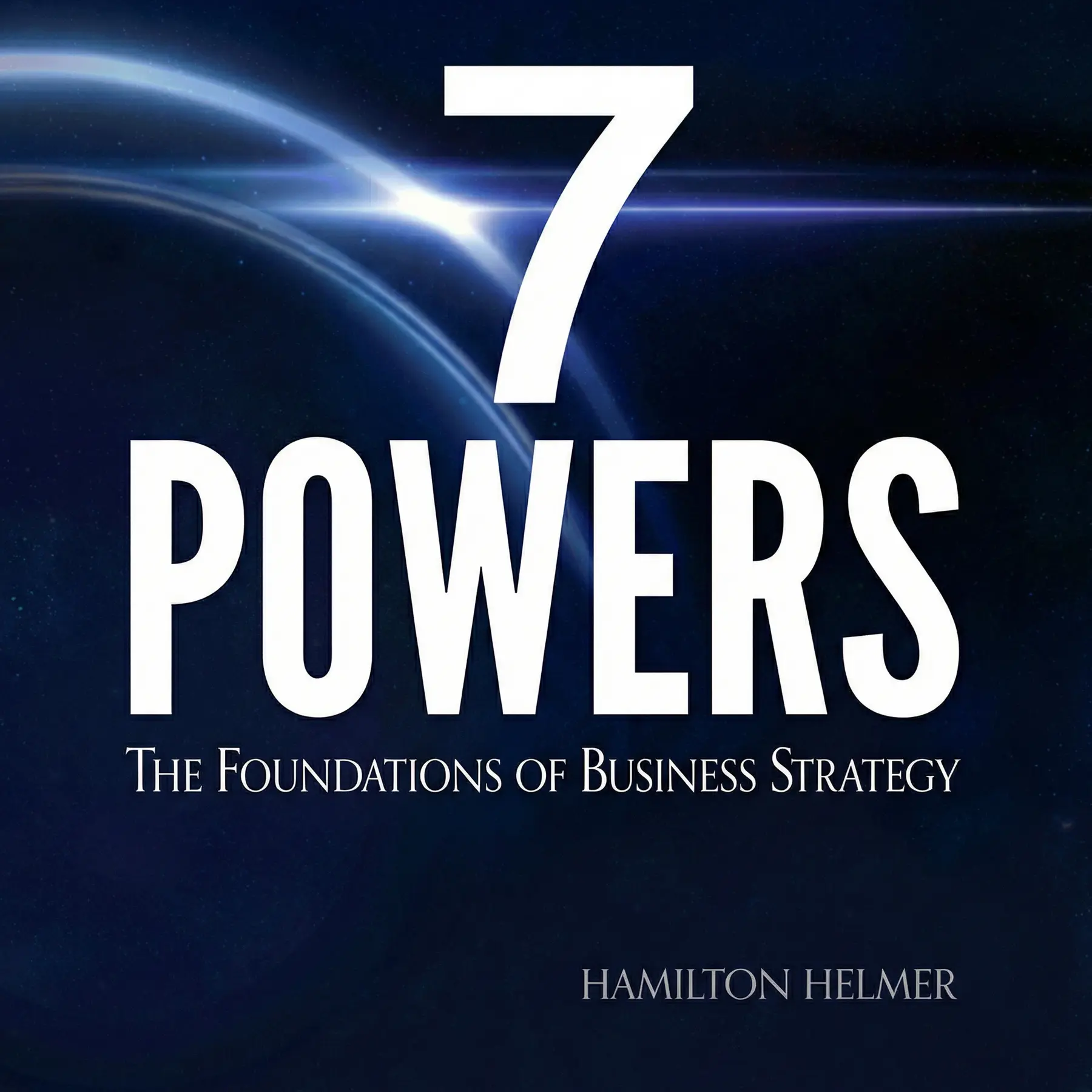
7 Powers: The Foundations of Business Strategy
Helmer explains the seven strategic positions that let a company stay ahead for years. Each one pairs a benefit with a barrier, so you can see when to build, when to attack and when to walk away.

Table of Content
1. Introduction
57 sec
Most business plans explain what a company will do, but they rarely say why rivals won’t simply copy it. In 7 Powers, strategist Hamilton Helmer argues that lasting success needs a power: a position that gives a business a real benefit and puts up a barrier competitors can barely cross. Without at least one, he warns, even a clever strategy will not hold.
Helmer names seven such positions. He shows each one through a company that built it or ran into it: Netflix, LinkedIn, Kodak, SAP, Tiffany, Pixar and Toyota. The whole book rests on one pairing. A benefit plus a barrier is what separates a business that lasts from one that gets copied. Once you can recognize the seven, you can test whether your own company has a defensible position, judge when a challenger has a chance against a leader, and drop a weak idea before it costs you years.
2. Beat a giant that cannot follow you
1 min 41 sec
Kodak saw its threat coming years ahead, spent heavily trying to respond, and lost anyway. Its fall shows the one opening that lets a small challenger beat a leader, and the mistake that wastes it.
3. Make every new customer cheaper to serve
1 min 40 sec
One episode of a Netflix drama cost millions to make, yet the company barely felt it. The same show would have crushed a smaller rival. The difference comes down to one division sum.
4. Spot when a network makes a rival unbeatable
1 min 47 sec
A startup went after LinkedIn by riding on a platform nearly ten times its size. It was the smartest route available, and it still stalled. The reason shows both how networks protect leaders and where challengers misread customers.
5. Learn how switching costs keep unhappy customers paying
1 min 39 sec
Nearly half of one software giant’s customers dislike its service, and almost all of them plan to stay. Their reasons reveal a power that holds buyers in place, and its limits.
6. Turn one rare team into a lasting edge
1 min 41 sec
When Disney bought Pixar, it took care to buy the brain trust along with the studio. What Pixar owned that no rival could get explains a power that is often overlooked.
7. Build a process rivals can watch but never copy
1 min 54 sec
Toyota made no secret of how it worked, and it even assisted with explaining the method so other companies could adopt it. General Motors studied them closely, and nobody managed to repeat the results. The reason sits far below the factory floor.
8. Earn the trust that lets a brand charge more
1 min 29 sec
An expert valued a cheaper ring above its price and a famous-name ring well below its own. Buyers still choose the expensive one. Their reason shows what a brand really sells, and why it takes so long to build.
9. Conclusion
1 min 09 sec
What Helmer offers is a way to read any company, including your own, through two questions. What does this position give the business, and what stops others from taking it? The seven powers are seven answers. Some come from size: a show’s cost spread across millions of viewers, a network too large to rebuild. Some come from the customer: the pain of leaving SAP, the trust behind a Tiffany box. Some live inside the company, like Pixar’s brain trust or the methods Toyota could show the world without giving them away. And counter-positioning is the challenger’s opening, a move the leader cannot or will not follow.
The same lens tells you when to stop. Before you launch or attack, name the power you hold or plan to build. If you cannot name one, Helmer suggests changing direction or moving on. If you face a leader, name its power and look for the rare path around it, as BranchOut did by borrowing Facebook’s crowd. Then check that customers want what you offer, because a sound strategy can still meet a market that says no.
A good idea can be copied. A power is what stays yours.
About this book
What is this book about?
Plenty of companies have a good product and a sensible plan, and they still get copied, undercut or overtaken. Hamilton Helmer argues that what keeps a business on top over the long run is a power: a strategic position that gives the company a real benefit and blocks rivals with a barrier they can barely cross. He describes seven of these powers. Scale economies, network economies, counter-positioning, switching costs, branding, cornered resources and process power each get a company story. Netflix spreads the cost of House of Cards across millions of viewers. BranchOut tries to get around LinkedIn's network. Kodak sees digital photography coming and still has nowhere to go. SAP customers complain but keep paying. A Tiffany ring sells for far more than an equal one from Costco. Pixar is built on a rare team, and Toyota explains its methods openly to rivals who still cannot copy them. Readers learn to name the power behind a successful company, to test whether their own business has one, and to judge when challenging a leader is realistic and when it is better to pivot.
Book Information
Who it's for
Founders testing an idea
Founders testing whether a business idea can hold off competitors once it works.
Explaining wins and losses
Managers and strategists who need a clear way to explain why their company wins or keeps losing ground.
Choosing companies that last
Investors and career builders who want to judge which companies have lasting advantages.
About the Author
Hamilton Helmer
Hamilton Helmer is a business strategist who has worked as an adviser, an investor and a teacher. After Bain and Company, he founded the consulting firm Helmer and Associates, later renamed Deep Strategy, and led more than 200 strategy projects for clients including Adobe, Netflix and Spotify. He co-founded Strategy Capital, where he is Chief Investment Officer. He holds a PhD in Economics from Yale University, graduated from Williams College and has taught Business Strategy in Stanford University's Economics Department.
Ratings & Reviews
Ratings at a glance
What people think
Listeners find this work offers a handy structure for grasping corporate strategy and consider it essential reading for investment professionals. Furthermore, the prose is described as brief and useful, as one listener points out it offers multiple strategic benefits for companies. Listeners also value how easy the book is to read, with one individual remarking that it improves as you go along.
Top reviews
Prim
Quite simply the cleanest framework on competitive moats I've encountered. While Michael Porter gave us the broad terrain and Clayton Christensen mapped disruptive threats, Hamilton Helmer isolates why certain companies generate sustained, abnormal returns. The core architecture—pairing a distinct benefit with an impenetrable barrier—instantly clarifies complex business decisions. Look, you do not need an MBA to grasp how Netflix weaponized scale economies with original content like House of Cards, or why SAP retains enterprise clients despite notorious customer frustration. To be fair, Helmer includes formal mathematical appendices to prove his theorems, which will bore pragmatic operators to tears. You can safely skip those proofs without losing an ounce of strategic value. In my experience, having a shared terminology for concepts like switching costs and process power makes executive planning infinitely sharper. It is concise, lucid, and remarkably actionable.
Show moreWit
As a venture investor evaluating early-stage defensibility, Helmer’s work has essentially become required reading. Our partnership regularly references the 7 Powers to filter pitch decks because it provides an objective rubric for identifying sustainable moats before capital gets deployed. The section dissecting network economies—illustrated by the failed attempt of BranchOut to challenge LinkedIn's professional dominance—perfectly captures why distribution scale alone is never sufficient. You need an insurmountable structural barrier. Helmer communicates these critical insights with economy and zero filler, making it a fast read that pays dividends for years. To be fair, some readers might find the tone clinical, but strategy should be treated as an analytical discipline rather than motivational cheerleading. Absolutely essential for anyone allocating capital.
Show moreAria
Strategy books often suffer from dreadful corporate bloat, but this volume cuts straight to the core mechanics of enduring value. Helmer avoids the usual fluff by rigorously proving that operational efficiency without strategic power is merely a treadmill leading to competitive parity. The dual-component definition of power—demanding both a persistent cost or price benefit and an explicit barrier preventing imitation—is an elegant diagnostic tool. I especially loved the dissection of process power through the Toyota Production System, showing why visible operational best practices cannot simply be transplanted into a rival manufacturing culture overnight. Every senior leader in our organization now reads this prior to our annual budget and strategy meetings. It provides a common language that eliminates endless circular debates about what actually constitutes a durable business moat.
Show moreYuwadee
Finally got around to reading this after letting it sit on my nightstand for six months. What an extraordinary distillation of corporate strategy! The analysis of Netflix’s shift into proprietary content production offers the definitive masterclass on building scale economies in real time. Helmer shows precisely how spreading multi-million dollar production budgets over an expanding subscriber base squeezed traditional competitors who lacked the subscriber volume to justify identical capital expenditure. It makes high-level economics feel tangible and immediately applicable to modern product design. Gotta say, Reed Hastings' glowing foreword is entirely justified here. It is rare to find a strategy book that balances analytical rigor with brevity so masterfully. If you want to understand how elite companies protect their profits over decades, buy this immediately.
Show moreConnor
Picked this up on Audible after a colleague recommended it for our quarterly executive offsite. Strategy literature usually floats in high-altitude vagueness, but Helmer keeps things pragmatic and grounded in reality. Listening to the audio format made the denser academic sections fly by, especially since the narrator avoids bogging down in the underlying math. The breakdown of how Vanguard used counter-positioning against active managers like Fidelity was an absolute lightbulb moment for our leadership team. We immediately applied the benefit-barrier dynamic to evaluate our own pipeline, asking whether our current pricing models actually protect us from well-funded incumbents. Truth is, some concepts like process power remain slightly murky and difficult to systematically replicate, but the general vocabulary is worth its weight in gold. A brisk, high-impact listen that will permanently change how you evaluate your competitive footing.
Show moreJom
The chapter on counter-positioning alone justifies the cover price. Watching how newcomer businesses exploit the structural orthodoxies of legacy giants—like Vanguard pioneering low-cost index funds while Fidelity sat paralyzed by its high-fee margins—is brilliantly analyzed. Helmer defines power not as generic operational excellence, but as the deliberate conditions that yield persistent differential returns. That distinction matters immensely. Most founders confuse working hard with building structural barriers. My only critique is that the book occasionally slips into dry, lecture-hall prose that drags down the momentum. Still, the case studies on Netflix's content scaling and Kodak's tragic missteps make the theoretical concepts concrete and unforgettable. If you are launching a startup into an entrenched market, study this before you write your first line of code.
Show moreTitiluck
Ever wonder why enterprise software vendors with abysmal customer satisfaction remain completely untouchable? Helmer explains this brilliantly through switching costs, pointing out that customer annoyance matters very little when tearing out the system would paralyze operational continuity. That kind of unvarnished economic realism makes this book refreshing. It strips away feel-good marketing platitudes and forces you to confront cold, hard structural defenses. I gotta say, the book gets substantially better as it progresses. The opening chapters feel stiff and academic, but once Helmer dives into network economies and the brutal dynamics of winner-take-all markets, the reading becomes utterly absorbing. The heavy algebraic appendix in the back is completely unnecessary for ordinary business leaders, so do not let it intimidate you. A sharp, compact toolkit that belongs on every manager's shelf.
Show moreNongnuch
Not what I expected from a book stuffed with economic algebra in the appendices. Once you look past the formal equations, Helmer delivers an accessible, highly useful manual for understanding durability in modern business. His treatment of branding—especially the fascinating pricing gap between identical Costco and Tiffany diamonds—proves that psychological positioning creates genuine pricing power when executed properly. That said, I found the explanations of cornered resources somewhat superficial. Simply attributing Pixar’s run of blockbuster animated films to an elusive group of geniuses doesn't provide much tactical guidance for leaders trying to build an advantage from scratch. Nevertheless, the framework as a unified whole is incredibly coherent. It is far more digestible than Porter’s dense tomes while delivering far more practical utility than typical airport business books.
Show moreMuk
Frankly, the introductory chapters feel a bit heavy on academic posturing, but the text finds its true rhythm halfway through. Once Helmer transitions from theoretical preliminaries into live commercial examples, the analytical power of his framework shines brightly. The discussion surrounding switching costs and counter-positioning provides immense clarity on how challengers can systematically dismantle sleepy industry incumbents. Personally, I found the book's treatment of passive index investing versus active stock picking slightly contradictory given the author’s investment claims, but that is a minor quibble against an otherwise robust work. The prose is economical, purposeful, and mercifully free of self-congratulatory anecdotes. A very solid four-star read that I find myself referencing across multiple client consulting engagements.
Show moreKwan
After hearing endless Silicon Valley hype and seeing Reed Hastings praise it, I walked away underwhelmed. Strip away the neat taxonomy, and much of this book is conventional economic theory repackaged in overly complicated jargon. The author spends pages drafting microeconomic equations to prove things that should be intuitive to any seasoned executive. Worse, two of the pillars—cornered resource and process power—function as circular logic rather than operational blueprints. Pointing to Pixar’s Brain Trust or the Toyota Production System does not explain how to build sustainable advantage; it merely observes that elite talent and decades of cultural habituation are hard to copy. Frankly, counter-positioning is the only framework here that feels fresh, yet even that borrows heavily from Christensen's work on disruption. If you want a quick cheat sheet on strategic moats, this serves a basic purpose. Just don't expect groundbreaking original scholarship.
Show moreQuestions about this book
What is the main idea of 7 Powers by Hamilton Helmer?
Helmer argues that long-term business success depends on holding a power, a strategic position that combines a benefit with a barrier rivals can barely cross. He names seven: scale economies, network economies, counter-positioning, switching costs, branding, cornered resources and process power. Without at least one of them, he says, even a good strategy will not protect a company from competitors.
What are the seven powers in business strategy?
Scale economies mean costs per unit fall as a company grows, as with Netflix’s original shows. Network economies mean users create the value, as at LinkedIn. Counter-positioning is a model incumbents cannot or will not copy. Switching costs keep customers from leaving, as with SAP. Branding earns trust and higher prices, like Tiffany. Cornered resources are exclusive assets, like Pixar’s team. Process power is a way of working rivals cannot reproduce, as at Toyota.
Who should read 7 Powers?
It suits founders deciding whether an idea can be defended, business leaders weighing whether to challenge a larger competitor, and investors judging which companies have durable advantages. Helmer’s examples range from streaming and software to jewelry, film and cars, so the framework applies well beyond tech companies.
How can I use the 7 Powers framework in my own business?
Start by naming the power your business holds or could build, and check both parts: the benefit to you and the barrier to rivals. If you cannot name one, Helmer suggests pivoting or moving on. When challenging a leader, identify its power first, look for a route around it the way BranchOut used Facebook’s network, and make sure customers actually want what you are offering.
What is counter-positioning according to Helmer?
Counter-positioning is when a newcomer takes a position that wins a real market and the incumbent either cannot follow or will not, because following would cost too much or damage its existing business. Kodak is Helmer’s example: it saw digital photography coming but had no footing in digital cameras or photo storage, so it had nowhere to move.
Featured in
Readers also enjoyed

A Bigger Prize: How We Can Do Better Than the Competition
Margaret Heffernan





A Year with Peter Drucker: 52 Weeks of Coaching for Leadership Effectiveness
Joseph A. Maciariello



Acting with Power: Why We Are More Powerful Than We Believe
Deborah Gruenfeld
AUDIO SUMMARY AVAILABLE
Listen to 7 Powers in 15 minutes
Get the key ideas from 7 Powers by Hamilton Helmer, plus 5,000+ more nonfiction titles.
- 5,000+ titles
- Listen as much as you want
- 7-day free trial
- Cancel anytime









