A Force for Good: The Dalai Lama's Vision for Our World
Daniel Goleman
 English
 ไทย
Shows why reading other people's feelings and paying them real attention shapes your relationships, your health and children's growth, and how the skill can be trained even when the brain starts out wired for shyness.
53 sec
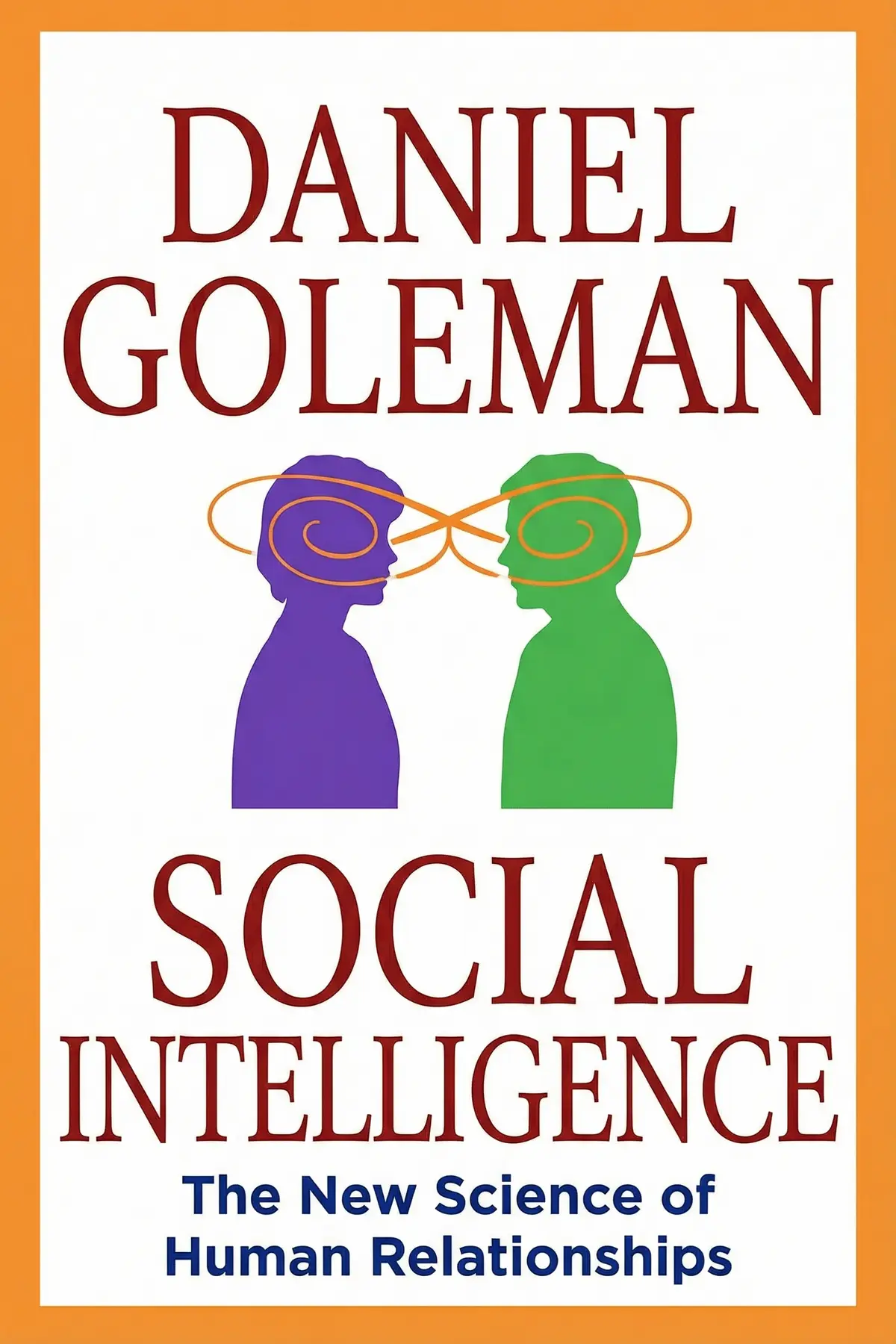
Plenty of brilliant people stall the moment a conversation calls for warmth, because reading a room is a different skill from solving a problem. In Social Intelligence, former New York Times science writer Daniel Goleman gives that skill a name: understanding yourself and others in social situations, and responding in a way that fits.
He argues it decides far more than popularity. It shapes whether couples last, whether patients heal, whether shy children grow bold and whether a struggling student learns to read. The case running through the book is that social intelligence is wired into the brain but not locked there, and that the bonds it builds protect health, love and learning, even though using it every day takes a real toll. Each idea ends in something you can try with the people around you this week.
1 min 38 sec
Two strangers chat in a waiting room, then guess each other’s thoughts. One guess is spot on, another wildly wrong. The gap between them predicts more about your relationships than you might expect.
1 min 42 sec
An opera singer tired of self-absorbed dates started timing one small thing on every first evening out. The man who passed fastest became her husband, and her test works far beyond dating.
1 min 44 sec
Babies who cry at a new toy often become shy adults, and brain scans show the alarm system behind it. Yet most of them escape that fate, and one factor makes the difference.
1 min 40 sec
A two-year-old’s favorite film was one she herself called scary. A study of young monkeys suggests that was no mistake, as long as one simple warning sign stays absent afterward.
1 min 58 sec
A man expected a woman he had known for two weeks to cancel her holiday plans for him. Goleman traces a line from that kind of entitlement to something far darker, and names one risk factor.
1 min 48 sec
A devoted husband cared for his sick wife with endless cheer, until one night he didn’t. Research on caregivers shows the cost reaches into their cells, and one teacher’s plan shows how to share it.
1 min 46 sec
Hospitals in India leave the cooking to someone other than the kitchen, on purpose. The reason points to a simple act that many people avoid exactly when a friend needs it most.
1 min 43 sec
Teachers warned a newcomer that one girl was trouble, and her first weeks seemed to prove them right. What the new teacher found by sitting down with her changed the girl’s results and the story.
1 min 11 sec
What Goleman describes is a skill that does its work in very different rooms. It helps a stranger judge a mugger’s mood, a partner understand a sadness and a teacher find the reading problem hidden behind defiance. The brain hands each of us a starting point, as Kagan’s sensitive babies showed, yet practice and the people around us decide where we end up. The rewards are physical and measurable: calmer patients, faster recovery, better grades, longer lives. The cost is physical too, as Borden’s restless night showed, which is why even the most caring people need a circle of their own.
Several habits follow. Ask your you question early, and once you notice a feeling, look for the reason behind it. Visit the friend who is ill, even when it feels awkward. And when you get something wrong, say so. In a 1982 experiment by psychologist G. R. Semin, people who knocked over supermarket displays and openly showed regret were treated far more gently than those who shrugged and walked away.
Owning a mistake, it turns out, is one more way of reading the room.
Some people with dazzling test scores freeze when a conversation needs warmth. Daniel Goleman argues that this is a separate kind of intelligence. His name for it is social intelligence, meaning the ability to read yourself and the people around you in social settings and to react in a fitting way. Goleman draws on psychology and brain research to show what the skill does. It helps couples stay together, helps patients recover faster and helps struggling students find their footing. Its absence is linked to narcissism and sexual coercion. He follows Harvard research on shy babies into adulthood, a monkey study on early fear and a study of caregivers whose immune systems weakened under strain. Readers get a clear picture of how sensing feelings, noticing their causes and simply paying attention change outcomes at home, in hospitals and in classrooms. They also get practical habits: a first-date test built on one small word, a way to judge how much fear is good for a child, and how to organize support before a caregiver burns out.
Professionals who are sharp on paper but struggle to read people in meetings, on dates or at home.
Parents, teachers and managers working with shy, difficult or struggling children and colleagues.
Anyone caring for a sick relative or supporting an ill friend who wants to help without burning out.
Daniel Goleman reported on the brain and behavioral sciences for The New York Times for twelve years. He was twice nominated for the Pulitzer Prize and received a Lifetime Achievement Award from the American Psychological Association for his media writing. His book Emotional Intelligence spent eighteen months on the New York Times bestseller list and is in print in 40 languages. He also wrote Working with Emotional Intelligence and Focus, and co-wrote Primal Leadership.
Daniel Goleman
Daniel Goleman
Daniel Goleman
Daniel Goleman

Listeners find the book enlightening, pointing to the numerous studies mentioned and commending its clear, high-quality prose. The details are shared effectively, with one listener highlighting that the content is anchored in evidence-based research, and they prize the focus on human connections and emotional intelligence. However, opinions are split on the speed of the narrative, with several listeners noting that the material feels quite repetitive.
Wow, this really changed how I view my daily interactions with colleagues and family. The concept of 'emotional contagion' resonated deeply, explaining how one person’s toxic mood can spread like a virus through an entire room. Goleman argues that we are biologically wired for connection, and he backs this up with fascinating studies on everything from marriage to the immune system. Not gonna lie, I was surprised to learn that social isolation can be as damaging to your health as a vitamin C deficiency. The writing is clear and authoritative, making high-level psychology accessible to those of us without a PhD. It’s a profound reminder that our relationships are the primary architects of our well-being.
Show moreFinally got around to reading this, and I'm honestly struck by how much of our mental life is just a series of chemical reactions. Objectifying my anger as a neurological response, rather than a personal failing, has already helped me stay calmer during arguments. The book is packed with insights about how we 'catch' emotions from others, making it a must-read for anyone in a caregiving or teaching profession. In my experience, the chapters on exposure therapy and overcoming fear through social support were the most practical parts of the text. While it's long and occasionally repetitive, the core message about the power of human connection is incredibly life-affirming. It’s a brilliant, science-backed look at the ties that bind us.
Show moreThe chapter on empathic accuracy alone makes this book worth the price of admission. It’s not just about knowing what someone is feeling; it’s about understanding the 'why' behind their emotions to build deeper bonds. Goleman’s writing is authoritative yet accessible, even when he’s explaining the intricacies of the amygdala and its role in first impressions. I’ve been thinking a lot about the 'socially intelligent' way to handle conflict ever since I finished it. In my view, seeing our relationships as a biological necessity rather than just a social preference changes everything about how you treat people. This is a masterful follow-up to his work on emotional intelligence and provides a much-needed map of the human heart’s social landscape.
Show moreDaniel Goleman has a knack for making complex neuroscience feel applicable to everyday life. I was particularly fascinated by the distinction between the 'high road' and the 'low road' of social interaction. The idea that our brains are constantly scanning others for emotional cues, often without our conscious awareness, is both empowering and a bit scary. While the book is dense with research and case studies, it provides a solid foundation for understanding why we react the way we do in crowds. To be fair, some sections felt a bit like a textbook, especially when diving deep into brain anatomy. However, the insights into how our social connections directly impact our physical health made the denser parts worth the effort.
Show moreAfter hearing so much praise for Goleman, I finally dove into this exploration of how our brains are 'wired to connect.' The chapters on how parents influence a child's social development through mirror neurons were eye-opening for me. It’s comforting to know that our genes aren't our destiny and that we can actually reshape our neural pathways through conscious effort. Personally, I think the book shines when it discusses the 'low road'—that split-second emotional intuition handled by the amygdala. The only downside is that the author tends to bury his best advice under layers of anatomical descriptions. It requires a bit of patience, but the perspective shift on human empathy is absolutely worth the slog.
Show moreAs someone who works in a high-stress management role, I found the section on socially intelligent leadership to be incredibly relevant. Goleman illustrates how a leader’s mood can either foster a creative, bonded group or stifle productivity through fear. The research on how eye contact and physical rhythm create 'attunement' between people provides a scientific basis for what we usually call 'chemistry.' While the book is heavily grounded in evidence-based research, it occasionally feels like it’s trying to cover too much ground at once. I would have preferred more 'how-to' guidance rather than just the 'why' behind our behaviors. Still, it’s a high-quality read that offers a lot of food for thought regarding workplace dynamics.
Show moreDirectly addressing the way we interact with others, Goleman proves that social intelligence is just as vital as IQ. I loved the anecdote about Indian hospitals and how the presence of family actually speeds up the healing process. It’s a powerful testament to the idea that humans are built for cooperation, not just competition. Got to say, the technical bits about the brain's left side doing the heavy emotional lifting were a bit over my head at times. However, the overarching theme that we can literally change our brain's wiring by changing our behavior is very inspiring. It’s a dense read, but if you enjoy evidence-based psychology, you won’t find a better resource on the subject.
Show moreEver wonder why some people just 'get' social cues while others seem completely oblivious? Goleman explores this through a mountain of evidence-based research, focusing on the neurological basis of human connection. Truth is, the book follows a very rigid formula that becomes quite repetitive by the halfway mark. You get a case study, a technical term, a brain location, and then an interpretation over and over again. It’s definitely more of an academic literature review than a quick self-help guide for the average reader. I did appreciate the sections on 'empathic accuracy' and how mirror neurons allow us to feel what others feel. If you can push through the dry pacing, there are some real gems hidden in the data.
Show moreThis book is definitely an interesting deep dive into the 'anatomy' of our social lives, though it lacks the focus of Goleman's previous hits. It feels like a collection of fascinating essays that never quite coalesce into a single, unified argument. One moment we are talking about the biology of a cold, and the next we are analyzing the gaze of an attractive stranger. I did learn that the 'high road' of social interaction is much slower and more conscious than the 'low road,' which explains a lot about my own social anxiety. To be fair, Goleman is an expert in his field, but the length of the book deludes some of the most valuable information. It’s a bit of a marathon to finish.
Show morePicked this up expecting a practical toolkit for improving my social skills, but I found myself drowning in a sea of technical jargon instead. The author spends way too much time on the 'sociopath next door' and deviant behaviors rather than focusing on everyday relationships. Look, the science is clearly there, but the delivery is painfully slow and often feels like it's going in circles without a clear destination. It lacks the incisiveness of his earlier work on emotional intelligence and feels bloated with unnecessary case studies. Frankly, I struggled to stay engaged past the first hundred pages because the tone is just too academic for a general audience. This might be great for psychology students, but it wasn't my cup of tea.
Show moreGoleman argues that social intelligence, meaning the ability to read yourself and other people in social settings, matters far beyond popularity. Its core is empathic accuracy, sensing what someone feels and why, plus real attention. The brain sets a starting point, but experience shapes the skill, and the bonds it creates help couples last, patients recover faster and struggling students succeed.
It is the ability to read what another person is feeling and understand the reason behind it. In a 2001 study, William Ickes filmed strangers chatting and asked each to guess the other’s thoughts; some guessed right, others were far off. Goleman cites research suggesting partners who read each other well have happier, longer relationships, and that trouble starts when a partner notices sadness without knowing its cause.
Yes. Jerome Kagan found that babies upset by new toys often became shy adults, with a highly reactive amygdala. Yet only one third of sensitive children ended up very shy, mostly those shielded by overprotective parents. Children whose parents supported them and even forced them into new situations kept the same wiring but could learn to engage with the world instead of retreating.
Goleman cites at least 18 medical studies linking strong social networks to longer life and faster recovery. A 1997 study by Gump and Kulik found patients with supportive friends and family were less anxious before surgery and healed sooner. He urges people to keep visiting sick friends, since stigma around illness often leaves patients isolated, as happened to Laura Hillenbrand.
Notice how quickly you ask about the other person in a conversation, as opera singer Allison did on her dates. Look for the cause behind a loved one’s mood. Visit ill friends often, and offer caregivers concrete help organized in advance. When you make a mistake, admit it openly; a 1982 experiment by G. R. Semin found people who showed remorse were treated more leniently.


Deborah Gruenfeld


Anthony Pratkanis






Richard Wiseman
AUDIO SUMMARY AVAILABLE
Get the key ideas from Social Intelligence by Daniel Goleman, plus 5,000+ more nonfiction titles.