


14 min 17 sec
Available in: English
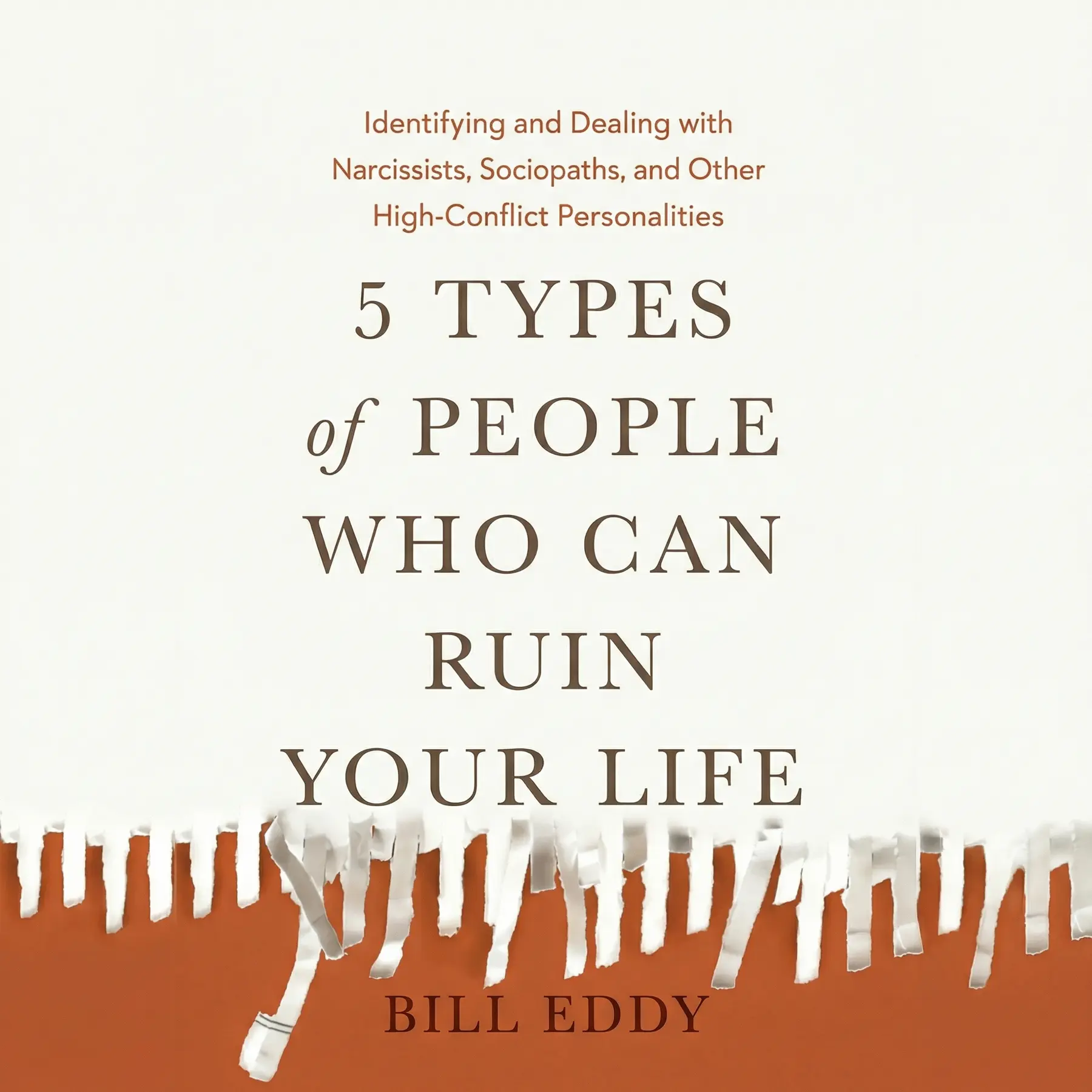
5 Types of People Who Can Ruin Your Life: Identifying and Dealing with Narcissists, Sociopaths, and Other High-Conflict Personalities
By Bill Eddy
A field guide to the narcissists, con artists and drama-makers who turn disagreements into wars. It shows how to recognize five high-conflict types early, what to say to each, and how to leave safely.

Table of Content
1. Introduction
1 min 02 sec
Most people who make your life hard are just having a bad day. A few are different: they escalate every disagreement and choose one person to blame for it. In 5 Types of People Who Can Ruin Your Life, lawyer, therapist and mediator Bill Eddy argues that these high-conflict people follow patterns predictable enough to spot early and handle safely.
Eddy reckons that 80 to 90 percent of people are trustworthy and behave as you expect. The remaining few include five types who can damage a career, savings, health and sanity, often while charming everyone except the person they target. His case is that their behavior is predictable, and so is the response that protects you: learn four warning signs, recognize which of the five types you face, then answer with calm connection, plain facts and firm limits. What you gain is practical. You get words for a difficult boss, relative or partner, and a safer way out when staying no longer makes sense.
2. Read the four signs before you become the target
1 min 44 sec
Some people turn every small disagreement into a war, and they rarely show it to anyone but you. Of the four warning signs, one stands out as the most telling: a fixation on blaming others.
3. Stay calm with someone who thinks they're superior
1 min 51 sec
A champion athlete and a dictator share a trait that often hides behind charm and prestige. Arguing with it makes things worse, yet a few calm moves can keep you out of its line of fire.
4. Keep your footing when admiration turns to rage
1 min 49 sec
A mentor who opens doors for you one week threatens your job the next. The switch looks random, but Eddy traces it to one trigger, and knowing it changes how you respond.
5. Protect your kindness from the charming con artist
1 min 46 sec
The most dangerous person in a room may be the one asking for your help. Eddy shows why empathy, normally a strength, becomes the very tool this type uses against you.
6. Answer suspicion without feeding it
1 min 40 sec
A neighbor, a colleague and a partner all accuse you of things you never did. Challenging them backfires and agreeing makes it worse, so Eddy offers a third way to reply.
7. Step off the stage a drama-maker builds
1 min 38 sec
A grieving daughter hoped for comfort at her father’s funeral and got an accusation of murder instead. Eddy uses the scene to show how to stay kind without becoming someone’s permanent audience.
8. Leave without becoming the next target
1 min 42 sec
Ending contact calls for care, because with some of these types a careless exit can provoke a harsh reaction. Eddy matches the exit to the personality, and the wrong one can turn a quiet goodbye into open retaliation.
9. Conclusion
1 min 05 sec
Eddy’s book changes the question you ask. Instead of wondering why this person keeps fighting with you, you ask which pattern they are running and which reply gives it nothing to feed on. Across all five types, the person escalates and the target is tempted to escalate back, to defend, explain or appease, the way Andy kept trying to please Miranda. Eddy’s alternative is steadier and duller by design: connect briefly, stay with facts, hold limits that would apply to anyone, and plan the way out before you need it.
Start by holding the four signs up against the hardest relationship in your life. If they fit, prepare one calm sentence for the next flare-up, an acknowledgment of the feeling followed by a turn back to the task. Decide the limit you will keep and what happens if it is crossed, then follow through the first time.
Most of the people around you, Eddy reminds readers, can be trusted. The few who cannot are counting on a reaction. A calm, plain reply is how you stop being the one they blame.
About this book
What is this book about?
Most conflicts at work and at home pass. Some never do, because one person keeps escalating and keeps blaming the same target. Bill Eddy, a lawyer, therapist and mediator, argues that these high-conflict people are a small minority, but they follow patterns predictable enough to spot and handle. He starts with four signs they share: all-or-nothing thinking, intense and unmanaged emotions, extreme behavior, and a fixation on blaming others. He then describes five types built on that base: the superior narcissist, the borderline type who swings from adoration to rage, the antisocial con artist, the paranoid type who sees plots everywhere, and the histrionic type who needs an audience. Each comes with examples, from Lance Armstrong and Ted Bundy to a mother who turned her husband's funeral into a scene. Readers get a clear way to tell which type they face, short sentences to use when tension rises, boundaries that hold, and an exit plan matched to each personality, so they can protect their career, money, health and peace of mind.
Book Information
Who it's for
Employees undermined in private
Employees stuck with a charming coworker or boss who undermines them in private.
Adults managing family drama
Adults managing a parent, sibling or partner who uses guilt, rage or constant drama.
Managing a high-conflict employee
Managers and HR leads who must handle, or let go of, a high-conflict team member.
About the Author
Bill Eddy
Bill Eddy is a lawyer, therapist and mediator who co-founded the High Conflict Institute in San Diego and developed High Conflict Personality theory. Before becoming an attorney in 1992, he spent twelve years as a licensed clinical social worker. He became a Certified Family Law Specialist in California, served as a Senior Family Mediator at the National Conflict Resolution Center and teaches at Pepperdine University School of Law. He has trained lawyers, judges, mediators and managers, and has written or co-written twenty books.
Ratings & Reviews
Ratings at a glance
What people think
Listeners find the content educational and simple to follow, offering thorough details on high-conflict personality types and delivering practical guidance for both private and career settings. The presentation is direct, and listeners value the empathetic tone regarding toxic interactions, with one listener highlighting that the book saved them years of mental struggle.
Top reviews
Rin
Finally, a straightforward manual that prioritizes de-escalation over clinical psychoanalysis. Too many self-help texts suggest that you can fix toxic dynamics with empathy or open communication. In reality, attempting to reason with an active HCP often paints a bullseye directly on your back. Eddy gets this completely. His breakdown of the five distinct archetypes is remarkably clear, giving readers the necessary discernment to spot predatory or dramatically erratic habits early. The core takeaway is crystal clear: avoid becoming their Target of Blame, stay calm, and exit stage left quietly. A vital resource for safeguarding your peace of mind.
Show morePloy
Ever wonder why modern society suddenly feels so combative and polarized on a daily basis? Toward the final third of the book, Eddy explores the broader cultural mechanisms driving this rise in high-conflict behavior, and it is easily the most compelling part. He outlines how our modern media ecosystem rewards grievance, paranoia, and grandstanding, effectively training audiences to mimic the behaviors of severe personality disorders. Pair that societal analysis with actionable interpersonal techniques like the CARS method, and you have an exceptionally thoughtful read. It helped me reframe not just personal interactions, but also how I process public discourse.
Show moreLuckana
Reading this felt like a massive weight lifting off my shoulders. I spent nearly two years walking on eggshells around a vindictive supervisor, constantly second-guessing my competency while trying to soothe her volatile outbursts. Within two chapters of this book, I had a name for the dynamic and a practical roadmap to extricate myself. The author’s advice on setting firm, unemotional boundaries without sounding accusatory worked like a charm. It stopped the drama in its tracks. Learning how to disengage safely preserved my health and career.
Show moreCaleb
Consider this essential preventive medicine for adulthood. Most folks wait until they are embroiled in an expensive lawsuit, an ugly smear campaign, or a destroyed business venture before trying to understand manipulative behavior. This book teaches you how to recognize the warning signs long before the house catches fire. It is accessible, concise, and grounded in decades of real-world legal and mediation practice. Personally, I appreciated that Eddy emphasizes staying composed and dignified while maintaining unyielding boundaries against chaos. If you interact with ambitious or combative people, keep this on your desk.
Show moreSara
Picked this up after watching a toxic neighbor turn our entire block against each other. What surprised me most was how precisely the author captured the exact dynamic playing out on my street. Seeing the subtle signs of manipulation laid out in plain terms gave me immense clarity on how to disengage safely without escalating tensions. The guidance on dealing with 'negative advocates'—those third parties who get weaponized by the agitator—was particularly illuminating. Gotta say, the middle chapters do become somewhat bloated with repetitive case studies, and some classifications blur together. Nevertheless, the tactical scripts alone made this purchase worthwhile.
Show moreNutnicha
Bill Eddy’s dual background as a social worker and family lawyer provides a very distinct, tactical lens. Rather than attempting to reform or psychoanalyze destructive individuals, this book equips readers with pragmatic armor. The focus remains squarely on emotional self-regulation, firm limit-setting, and brief, neutral communication. To be fair, readers seeking a compassionate clinical exploration of personality disorders won't find it here; the text is fundamentally an operational defense manual for potential targets. I knocked off one star purely because the writing style is rather dry, almost reading like legal training modules at points. Still, for anyone facing relentless interpersonal hostility, the tools provided are top-tier.
Show moreSaengdao
Where was this guide three years ago when my custody battle first exploded? Navigating a high-conflict divorce while protecting young children is an isolating, terrifying ordeal that drains your soul. For months, I believed I was losing my grip on reality because of the constant gaslighting and fabricated legal accusations. Eddy’s clear categorization of high-conflict behavior made me realize I wasn't at fault. His pragmatic rules for keeping correspondence brief, informative, and neutral completely revolutionized how I communicate with opposing counsel. It literally spared me years of agonizing mental struggle. Anyone currently drowning in family court litigation needs to read this immediately.
Show moreAdam
As someone who deals with combative personalities in corporate management, I found Eddy's framework somewhat useful, if flawed. His central concept—identifying High-Conflict Personalities before becoming their primary 'Target of Blame'—is undeniably practical for any modern workplace. In my experience, difficult colleagues often operate on distinct patterns of emotional projection rather than rational disagreement, so having a taxonomy helps. Still, the tone occasionally feels overly litigious. Eddy’s background in high-stakes legal mediation is obvious here; he seems to presume every awkward interaction is one step away from a bitter court hearing. Useful boundaries, certainly, but take the extreme alarmism with a grain of salt.
Show moreRafael
The premise caught my eye during a chaotic family squabble, but the execution wears thin remarkably fast. The initial chapters offer some genuinely fascinating observations regarding personality clashes and defensive routines. Yet, past the hundred-page mark, the text turns into a repetitive cycle of recycled anecdotes and slight variations on the exact same core concept. Frankly, Eddy could have condensed this whole manual into a brisk, punchy twenty-page white paper without losing any critical substance. You get introduced to his trademarked CARS method, and then you watch it applied to scenario after scenario with negligible difference. It is not utterly useless, but you will definitely find yourself skimming entire sections out of sheer boredom.
Show moreLucia
Talk about an irresponsible, wildly reductive approach to complex mental health conditions. While I recognize that interpersonal conflict is exhausting, packaging severe psychiatric struggles like Borderline Personality Disorder into a handbook of human boogeymen does real damage. Look, millions of people battling BPD or trauma responses actively fight every day to heal and unlearn survival mechanisms. Labelling them as walking biohazards who exist solely to 'ruin your life' merely fuels cruel social stigma and encourages people to treat struggling human beings like monsters. The author effectively weaponizes pop psychology to justify callous paranoia.
Show moreQuestions about this book
What is the main idea of 5 Types of People Who Can Ruin Your Life?
Bill Eddy argues that the large majority of people, between 80 and 90 percent, can be trusted, yet a small group of high-conflict personalities can damage your career, finances, health and sanity. They share four traits: all-or-nothing thinking, unmanaged emotions, extreme behavior and a fixation on blaming one target. Recognizing which of five types you face lets you respond calmly and protect yourself.
What are the five high-conflict personality types Bill Eddy describes?
Eddy describes the narcissistic type, who feels superior; the borderline type, who swings from adoration to rage when afraid of abandonment; the antisocial type, a deceitful risk-taker without remorse; the paranoid type, who believes others are out to harm them; and the histrionic type, who needs to be the center of attention and manufactures drama.
How do you deal with a high-conflict person at work?
Eddy’s approach is to connect calmly and acknowledge feelings without agreeing, steer toward options and the task at hand instead of blame, answer false claims with short neutral facts, and set limits that are fair for everyone. With a paranoid colleague, point to outside rules such as evidence requirements. With an antisocial employee being fired, have briefed security on hand.
How do you end a relationship with a narcissist or borderline personality?
With a narcissist, Eddy advises leaving without criticism or blame, which would make you a target, and framing the change around your own evolving needs. With a borderline personality, he recommends phasing out contact gradually so you do not trigger their fear of abandonment, which can provoke rage, rumors, legal action or worse.
Who should read 5 Types of People Who Can Ruin Your Life?
It suits anyone who suspects a coworker, boss, relative or partner keeps escalating conflict and blaming them, and who wants to recognize the pattern early. It also helps managers who must handle difficult employees. The book focuses on spotting warning signs, using neutral language, setting boundaries and exiting safely.
Readers also enjoyed

A Liberated Mind: How to Pivot Toward What Matters
Steven C. Hayes


Acting with Power: Why We Are More Powerful Than We Believe
Deborah Gruenfeld


Age of Propaganda: The Everyday Use and Abuse of Persuasion
Anthony Pratkanis




59 Seconds: Change Your Life in Under a Minute
Richard Wiseman
AUDIO SUMMARY AVAILABLE
Listen to 5 Types of People Who Can Ruin Your Life in 15 minutes
Get the key ideas from 5 Types of People Who Can Ruin Your Life by Bill Eddy, plus 5,000+ more nonfiction titles.
- 5,000+ titles
- Listen as much as you want
- 7-day free trial
- Cancel anytime









