

The Alignment Problem: Machine Learning and Human Values
Brian Christian
 English
 ไทย
Shows how the rules computers use to search, sort, schedule and predict can guide everyday human choices, from when to stop apartment hunting to how to order a crowded to-do list.

58 sec
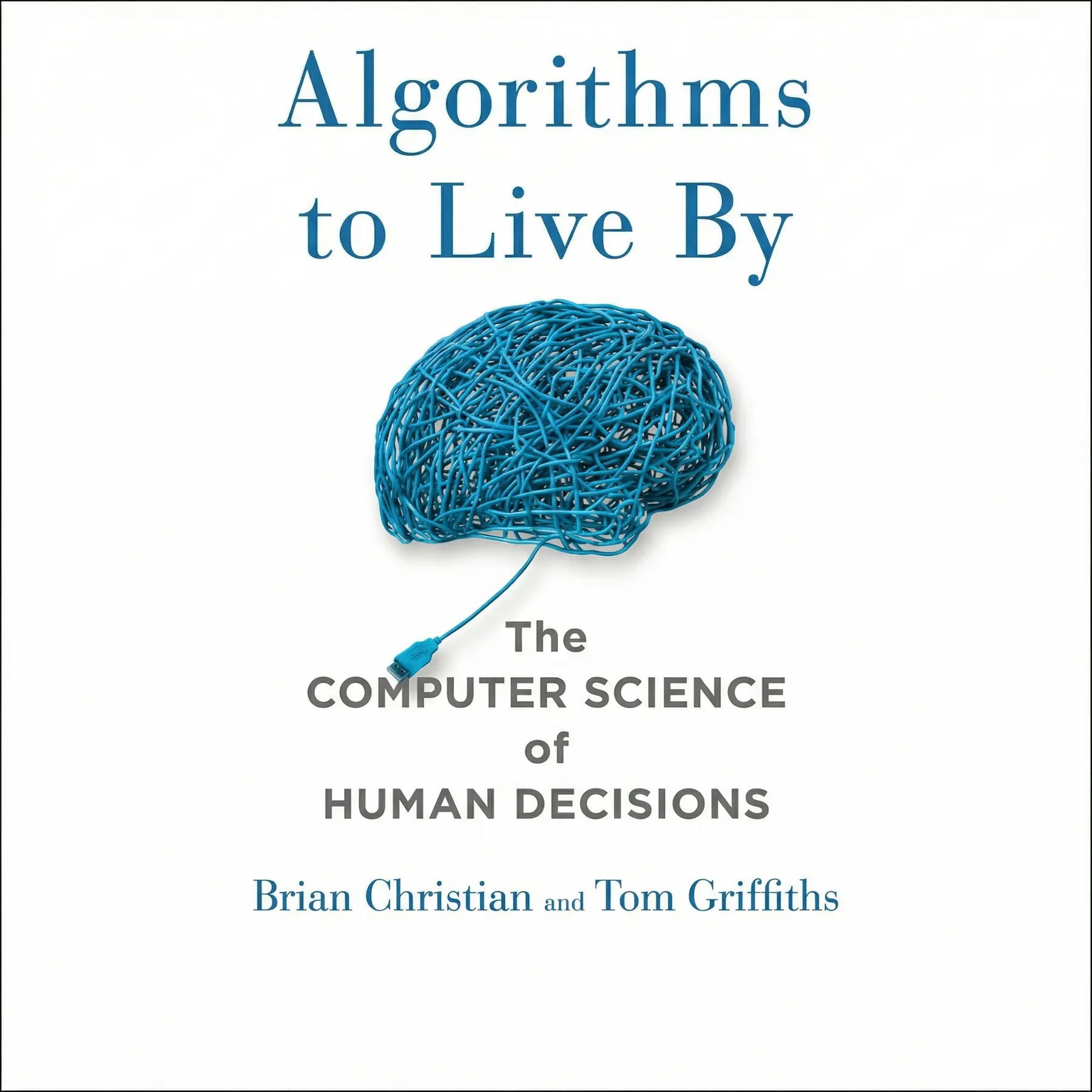
Many daily choices, from which apartment to rent to which task to start first, are problems computers were built to solve. In Algorithms to Live By, writer Brian Christian and Princeton professor Tom Griffiths show how machine methods can sharpen human decisions. Their opening example is a number: in a long search, look at the first 37 percent of your options without choosing, then commit to the first one that clears the bar.
An algorithm, the authors explain, is a finite set of steps for solving a problem. The word traces back to the ninth-century Persian mathematician Muhammad al-Khwarizmi, and even a recipe counts. Their case is that the hard choices people blame on themselves are computing problems in disguise, with tested rules attached. Those rules tell you when to stop looking, how to arrange your desk and your day, how to guess well from scraps of evidence and when good enough beats perfect.
1 min 32 sec
Commit too early and you miss something better; wait too long and the best is gone. A single number tells you when to switch from looking to choosing, and a coin game shows where numbers fail.
1 min 34 sec
One bad result tempts you to walk away from a good option. A casino puzzle and the way some drug trials are run point to a better test for deciding when to stay.
1 min 38 sec
Three lucky scratch cards can tell you a surprising amount about every ticket in circulation. An eighteenth-century reverend’s reasoning shows how, and why knowing the shape of the data matters just as much.
1 min 38 sec
Tidy people may be wasting their afternoons. The way computers decide what to keep within reach suggests your untidy pile could be smarter than it looks, and it hints at the best moment to review your notes.
1 min 36 sec
Long lists tempt you to start anywhere. A handful of scheduling rules show which task should come first, which one to drop, and the habit that saves more time than any rule.
1 min 40 sec
Hitting refresh on a jammed server rarely helps. A puzzle about two generals and the rules that keep networks moving show a calmer way to keep trying, with people as well as machines.
1 min 38 sec
Two bank robbers would both be better off staying silent, yet almost certainly neither will. A failed thousand-dollar bonus at Evernote shows what managers can do instead of pleading.
1 min 42 sec
A model that explains every detail of the past can be the worst at predicting the future. The traveling salesman problem shows why lowering your standards on purpose can get you somewhere faster.
1 min 01 sec
The authors end up offering a kind of relief. Endless searching, a cluttered desk and a list that never shrinks are hard problems for machines too, and machines meet them with plain rules and room for error. You already run rough versions of these rules whenever you weigh pros and cons; the computer’s versions are just sharper.
So the next time you face a long search, give the first 37 percent of your options or time to looking only, then take the first one that meets the standard you set. When the to-do list grows, sort it by shortest task or nearest deadline, close the inbox and finish one item before starting another. Leave the recent pile on your desk alone. And when a plan explains your past perfectly, loosen it before new facts do it for you.
None of this asks for perfect math. The triple-or-nothing gambler follows the averages and loses everything. The salesman who accepts passing through a town twice gets home in good time.
Choosing an apartment, deciding whether to stay with a disappointing option, clearing a packed schedule: these feel like personal struggles that call for better judgment. Brian Christian and Tom Griffiths argue that they are also well-studied problems in computer science, and that the methods machines use to solve them can guide people too. The authors explain optimal stopping and its 37 percent rule, the slot-machine math behind exploring versus sticking, Bayes's way of predicting from a few results, and why caching suggests a messy desk may already be well organized. They cover scheduling rules for crowded days, the backoff methods that keep networks running, the prisoner's dilemma and the case for changing rules instead of offering bonuses. They also mark the limits. Pure math can lead a gambler to ruin, overly complex models fail on new data, and some problems only become manageable once you relax your standards. Readers get a set of plain rules to try on real decisions, along with permission to settle for good enough.
Professionals facing big choices about jobs, homes or partners who want a clear rule for when to stop searching.
Knowledge workers buried in tasks and email who want a better way to order their day.
Team leads and founders curious how computing ideas can sharpen everyday judgment.
Brian Christian studied computer science, philosophy, poetry, psychology and computational neuroscience at Brown University, the University of Washington and the University of Oxford. He also wrote The Most Human Human and The Alignment Problem, has written for The New Yorker, The Atlantic and Wired, and spent nine years as Director of Technology at McSweeney's. Tom Griffiths is a professor of psychology and computer science at Princeton University, where he directs the Computational Cognitive Science Lab. His research on how people make decisions has appeared in Science and Nature.
Brian Christian
Listeners find the book stimulating and captivating, with one review mentioning how computer science reflects human cognition. Furthermore, the information is practical and applicable to daily routines, as one listener notes it offers tools for interpreting reality. Additionally, the work provides incredible perspectives on decision-making tactics and is skillfully written. However, reactions to the explanations are divided; while some listeners consider them lucid, others feel they lack sufficient detail.
This book changed how I view my messy closet and my dating life. It’s rare to find a text that successfully maps complex computer science principles onto the mundane struggles of a Tuesday afternoon. The authors illustrate how computer science mirrors human thought, providing tools for analyzing reality that go far beyond simple logic. For instance, the discussion on the 37% rule for optimal stopping was a total revelation for my decision-making process. While some of the math gets a bit dense, the prose remains accessible and engaging for a general audience. I found myself highlighting passages on the explore/exploit tradeoff to share with friends. It’s a thought-provoking read that suggests our seemingly irrational quirks might actually be optimal strategies for an uncertain world.
Show moreAs someone who toggles between the humanities and tech, I found the bridge built here between these disciplines absolutely fascinating. Brian Christian and Tom Griffiths argue that the problems we face are often just versions of what computers solve daily. They dive into game theory and scheduling with a clarity that is refreshing and well-written. I particularly loved the section on computational kindness, which suggests that we should structure our requests to minimize the mental load on others. It’s not just a book about being a 'capitalist cog' aiming for maximum efficiency; it’s about understanding the fundamental constraints of time and space. Look, if you want a new lens through which to view your life’s biggest choices, this is it. It’s a rare gem that makes you feel smarter for having read it.
Show moreFinally got around to finishing this, and the chapter on scheduling alone was worth the time invested. I’ve always been overwhelmed by my to-do list, but learning about 'Earliest Due Date' versus 'Shortest Processing Time' changed my workflow. The book offers amazing insights into how the structure of computer algorithms mirrors human thought patterns. While it’s true that some of the real-world applications strike me as being as useful as textbook economic models, the general principles are solid. Not gonna lie, the prose can be a bit dense in the middle sections where the math takes center stage. However, the authors' ability to weave in philosophy and literature keeps it from becoming too dry. It’s a stellar read for anyone who likes a bit of 'how-to' with their 'why'.
Show moreWow, this is easily one of the most practical applications of theoretical math I've ever encountered. The central thesis—that we should use shortcuts to improve our probability of success—is a great reminder that perfection is the enemy of the good. I was particularly impressed by how the authors handle Game Theory in the later chapters. They move beyond the usual prisoner's dilemma to discuss how we can actually change the 'rules' of our social interactions to reach better outcomes. It's engaging, thought-provoking, and deeply relevant to anyone navigating a complex society. Some critics say it lacks organization, but I found the 'rinse and repeat' structure of the chapters quite helpful for reinforcing the concepts. This is a must-read for geeks and non-geeks alike who want to live more efficiently.
Show morePicked this up on a whim after seeing it recommended for its unique perspective on productivity. I've always struggled with balancing new experiences versus old favorites, and the Explore/Exploit chapter provided the exact framework I needed. Truth is, the book offers amazing insights into how we can conserve cognitive energy for the things that truly matter. I appreciated the varied sentence lengths and the conversational tone, though I must admit some explanations lacked detail. Sometimes they move so quickly between topics that you lose the thread of the underlying math. Still, the idea that being 'computationally kind' to others can reduce social friction is a beautiful takeaway. It’s definitely an informative and relevant read for anyone who enjoys thinking about thinking.
Show moreFrankly, I didn't expect a book about computer science to give me better advice than most self-help gurus. The authors tackle the 'Optimal Stopping' problem with such wit that I found myself reconsidering how I approach everything from apartment hunting to job searching. In my experience, the book strikes a decent balance between hard math and chatty anecdotal moments, though it occasionally veers into the theoretical. The chapter on sorting and caching was surprisingly practical for organizing my home office. Why spend hours filing papers when a simple 'Least Recently Used' stack is mathematically superior? While some sections felt like filler, the core message is incredibly powerful. It provides a toolkit for reality that acknowledges our limitations rather than demanding perfection.
Show moreNot what I expected, but in the best way possible because it made me rethink my daily routines. I previously thought algorithms were just for programmers, but this book shows they are actually just intuitions formalized. The discussion on 'Relaxation' for complex trip planning was eye-opening. Personally, I appreciated how the authors relate computer science to everyday problems like deciding who to sit where at a wedding. It isn’t always a perfect fit—some of the analogies feel a bit forced—but the overall effort to bridge the gap is admirable. It’s a well-written exploration of how we can use math to be more 'computationally kind' to ourselves and others. If you want a book that challenges your decision-making strategies, give this one a go.
Show moreTruth is, I’ve always been a bit of a perfectionist, but this book gave me permission to be 'good enough' in the face of impossible problems. The authors explain that many real-life tasks are 'intractable,' meaning there is no perfect solution, only better or worse shortcuts. This insight alone relieved a lot of my decision-making anxiety. The book is informative and relevant, though I agree with some other reviewers that the explanations receive mixed feedback depending on your math background. Some parts were clear as day, while others felt like they could have used more detail. Despite that, I found the caching theory particularly useful for organizing my physical space. It’s a solid read that offers a refreshing, data-driven perspective on the chaos of life.
Show moreEver wonder if we're just overcomplicating things with math that doesn't actually work in the wild? To be fair, there is some valuable material here, but the authors often force a square-peg-into-a-round-hole approach. They start with oversimplified history and then jump into algorithms that require too many assumptions to be truly practical. The example of finding a parking spot felt particularly disconnected from my actual experience; even the expert cited in the book admits he just rides a bike! Additionally, the audiobook narrator speaks at a glacial pace, requiring at least 2x speed just to feel normal. While the insights into decision-making strategies are interesting, the book lacks the organization needed to really function as a guide. It feels more like an extended essay than a cohesive toolkit.
Show moreAfter hearing so much hype about how this book 'redefines' human behavior, I found the actual content to be quite a stretch. The authors seem to assume that we all want to live our lives solely to produce as much as possible, as quickly as possible. This worldview is never really challenged, which I found frustratingly narrow and capitalistic. Many of the algorithms are very theoretical and impossible to apply without making leaps that just aren't valid in the real world. For example, the advice on finding a spouse using a 37% cutoff ignores the messy, non-binary nature of human emotion. It felt like a collection of nerd theories looking for a problem to solve. If you're looking for deep neurological or psychological analysis, you won't find it here. It’s mostly computer science trivia masquerading as life advice.
Show moreBrian Christian and Tom Griffiths argue that many everyday decisions, such as when to stop searching, what to do first or how to predict an outcome, are problems computer science has already studied. An algorithm is a finite set of steps for solving a problem, and people use rough ones all the time. Borrowing sharper versions from computing, while respecting their limits, can make human choices clearer and less driven by perfectionism.
It comes from optimal stopping. If you have 100 options, such as apartments, look at the first 37 without choosing any and use them to set a standard. After that, take the first option that meets it. The authors say this cannot guarantee the very best choice, but its odds are far better than guessing, and they apply the same 37 percent to cars, jobs and partners.
Largely, yes. Sorting exists to make things easy to find, so if you already know where everything is, tidying can waste time. Computers keep recently used data in a fast cache using a rule called Least Recently Used, and a pile of papers with the latest items on top works much the same way. The brain also forgets what goes unused for long.
Start with the task that has the nearest deadline, the Earliest Due Date rule. If time is short, drop the task needing the most time, as Moore’s Algorithm suggests. To finish as many items as possible, order them from quickest to slowest. Watch for minor tasks crowding out important ones, limit time spent planning, and work on one thing at a time without checking email.
It suits professionals and students who face hard choices under uncertainty, from apartment hunting to job decisions, and anyone overwhelmed by tasks and messages. Managers will find the prisoner’s dilemma and the case for mandatory vacation useful. Readers who tend toward perfectionism get a reasoned case, from overfitting and the traveling salesman problem, for accepting good enough.


Deborah Gruenfeld


Anthony Pratkanis



Richard Wiseman


AUDIO SUMMARY AVAILABLE
Get the key ideas from Algorithms to Live By by Brian Christian, plus 5,000+ more nonfiction titles.










