

14 min
Available in: English
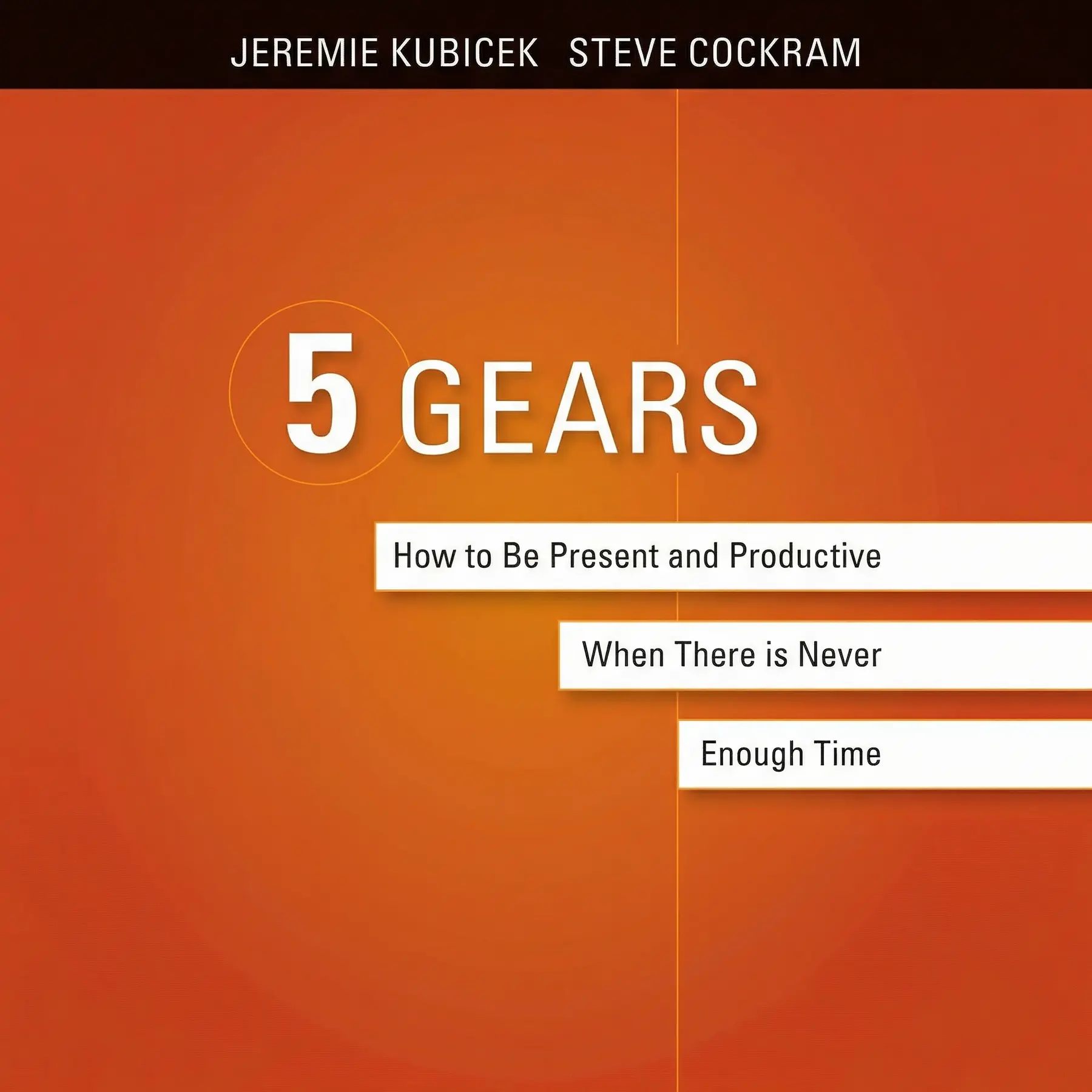
5 Gears: How to Be Present and Productive When There's Never Enough Time
Shows why busy people end up mentally elsewhere and how to match five gears, from deep focus to rest, plus an honest reverse, to each part of the day so you are present wherever you are.

Table of Content
1. Introduction
56 sec
If your body leaves the office but your mind stays there, the trouble may be the speed you are running at. In 5 Gears, Jeremie Kubicek and Steve Cockram, co-founders of GiANT Worldwide, argue that people feel absent because they run at one pace in places that need another. Their picture comes from a manual car, with five forward gears that each suit some roads and cause damage on others, plus a reverse.
The idea that runs through everything here is simple: being present means choosing the right gear for each setting and shifting between gears on purpose. The authors build the case from their clients and colleagues, including a Ford manager whose open door helped nobody, a Minnesota man who worked himself nearly to death and an unexpected evening at a wrestling match. By the end, you can name the gear you are in at any moment and follow a short routine for rebalancing the ones you lean on too hard.
2. Match your speed to the place you're in
1 min 26 sec
A man who loved his family kept arriving at dinner as if he were still at his desk, and his marriage began to pay for it. A simple picture from driving explains what went wrong.
3. Get deep work done without shutting people out
1 min 25 sec
Total focus is the state most professionals chase, yet it cost one man a kiss on live camera and made a manager’s open door useless. The fix took a single sentence.
4. Avoid burnout by stepping out of task mode
1 min 28 sec
Most leaders say they spend their days in one particular gear, and it is the one that gets the most done. For one client, staying in it nearly ended his life.
5. Recharge in a way that actually restores you
1 min 34 sec
An evening on the sofa feels like rest, yet the authors say it often leaves you just as empty. What counts as a real recharge depends on a trait you already know about yourself.
6. Turn small talk into real opportunities with curiosity
1 min 24 sec
Plenty of people dread lunches, mixers and dinner parties full of strangers. One question asked out of curiosity once sent an author to a place he never expected to spend an evening.
7. Be truly present with the people closest to you
1 min 34 sec
A family can share a house every evening and still never meet. The gear that fixes it is the one people most often believe they are in when they are not.
8. Earn respect by backing up when you're wrong
1 min 31 sec
A comical-looking 1970s British car had several drawbacks, the most notable being one missing part. The authors see the same flaw in people, and it shapes how much colleagues and family trust them.
9. Rebalance your own gears and feel present this week
1 min 40 sec
Understanding the gears changes nothing until you see your own habits clearly. A four-step process, an honest ranking and a landmark on the way home do most of the work.
10. Conclusion
1 min 02 sec
Kubicek and Cockram turn a vague guilt into a precise diagnosis. Feeling absent, in their account, usually comes down to a gear mismatch: fifth gear in a conversation someone needed, fourth gear at the dinner table, first gear when a child wanted second. Once you can name the gear, you can change it, and the people around you can help you notice.
The model also refuses to crown a winner. Focus, juggling, small talk, closeness and rest all earn their place, and even reverse belongs in the gearbox. Trouble begins when one gear takes over the whole day, as fourth did for Joe Hill before his lungs nearly gave out.
So rank your gears honestly tonight and pick the one you starve. Give the first and last minutes of each day to a low gear before email pulls you into fourth. And the next time someone asks whether you are really there, check your gear before you answer.
The fix for Kubicek’s late dinners was never more hours. It was arriving in the right gear.
About this book
What is this book about?
Many busy people are physically in a room and mentally somewhere else. They answer email at breakfast, replay work problems at dinner and never fully rest. Jeremie Kubicek and Steve Cockram argue that the cause is running at the wrong speed for the setting, like driving at highway pace through a quiet neighborhood. Their answer borrows the gearbox of a manual car. First gear is recharging alone, second is deep connection with the people closest to you, third is casual socializing, fourth is juggling many tasks and fifth is total focus on one project. Each has a right and a wrong place, and reverse, a sincere apology, repairs the damage when you choose badly. The authors bring each gear to life with stories from clients and colleagues, from a Ford manager whose open door clashed with his focus to a realtor whose family shared the house without ever connecting. Readers get a shared vocabulary for the office and the home, a way to see which gears they overuse and which they avoid, and a four-step routine, the CORE Process, for rebalancing their days.
Book Information
Who it's for
Taking work home mentally
Managers and professionals who bring work home in their heads and feel absent with family.
Team leads juggling interruptions
Team leads whose open door keeps colliding with the focused work they also need to do.
Overloaded and near burnout
Overloaded people near burnout who want a simple way to balance focus, connection and real rest.
About the Author
Jeremie Kubicek
Jeremie Kubicek co-founded GiANT Worldwide and the GiANT companies and wrote the bestselling Making Your Leadership Come Alive. He speaks to organizations around the world on leadership, emotional intelligence and personal growth, and his other books include 5 Voices and The Communication Code. Steve Cockram, also a co-founder of GiANT Worldwide, has worked with executive teams and organizations worldwide and is known for his knowledge of personality development, applied leadership learning and culture change. He teaches on apprenticeship and team building and lives in London with his wife and three children.
Ratings & Reviews
Ratings at a glance
What people think
Listeners find this book accessible and easy to grasp, with one listener describing it as essential reading for today’s technology-driven world. The content offers a deep metaphor along with functional productivity techniques; one listener highlights its success in helping them manage time without interruptions. Listeners value the book's impact, as one mentions how it reshaped their habits while another notes how it helps them maximize relationships. Listeners feel the material is remarkably simple and easy to recall, making it a useful asset for growth in both life and career.
Top reviews
Pun
Terrific, transformative read that gave me back control over my chaotic daily schedule. In a modern culture where everyone wears frantic multitasking as a badge of honor, this book makes a compelling case for intentional living. The stick-shift metaphor is pure genius because it creates an instantaneous mental picture that never leaves your head. Protecting my morning Fifth Gear has doubled my output at work, while respecting First and Second Gear has completely revitalized my marriage. It is concise, delightfully accessible, and profoundly relevant for our hyper-distracted world. If you find yourself constantly drained and disconnected, buy this immediately.
Show moreOscar
Few leadership manuals bridge the gap between office productivity and family health quite as gracefully as this one. The authors demonstrate clearly that burnout is not caused by working hard, but by failing to shift down when circumstances demand empathy and presence. The section on mastering Reverse—recognizing when your emotional engine has run over someone and promptly apologizing—was worth the purchase price alone. Personally, adopting this shared vocabulary with my spouse has eliminated our evening bickering over distracted device usage. It is brilliantly simple, deeply convicting, and easily one of the most actionable self-development guides I have picked up in years. A vital read.
Show moreLevi
This book delivers an exceptionally clear blueprint for anyone struggling to unplug when the workday ends. Living in a hyper-connected culture means our brains are constantly pinging between urgent Slack messages and family obligations, leaving us entirely exhausted by 8 PM. Kubicek and Cockram offer a remarkably tangible mental model to combat that perpetual fog. Learning to consciously downshift from high-speed production into genuine social connection made an immediate impact on my evening routines. To be fair, the writing style occasionally veers into corporate cheerleading, and the early chapters take a while to define each gear properly. Nonetheless, the central habit of diagnosing your current gear before entering a room is a legitimate game-changer for maintaining healthy relationships.
Show moreSun
The concept of 'First Gear' as intentional personal recharge rather than just passive television consumption completely shifted my perspective on rest. As someone managing adult ADHD, regulating attention across diverse settings has always felt like a messy guessing game. Having a structured visual continuum—moving deliberately from deep focus down through casual social interactions—gives me a concrete vocabulary to monitor my internal battery. Frankly, the authors hit upon something profound regarding presence: being physically in the room means nothing if your engine is still revving at highway speed. My sole criticism is that the diagnostic exercises felt somewhat basic. Still, for anyone fighting constant distraction in today's noisy professional climate, this book provides memorable guardrails that actually stick in your memory weeks later.
Show moreYothaka
After introducing the five gears framework to my department last month, our meeting culture noticeably improved. Establishing a common shorthand allowed my direct reports to defend their fifth gear deep-focus blocks without feeling guilty about ignoring emails for two hours. It also forced leadership to acknowledge that keeping staff permanently locked in fourth-gear task-switching destroys creative output. Gotta say, the endless client testimonials and humblebragging got on my nerves during the first fifty pages, and you can tell this was written primarily to sell executive coaching packages. But if you can look past the promotional fluff, the organizational utility is undeniable. It provides clean, accessible boundaries for high-stress corporate environments.
Show moreJoshua
Simple ideas are usually the hardest to implement, and this quick read proved no exception. I loved how easily the transmission analogy translated into domestic life. How often do we pull into the driveway, walk through the front door, and immediately unload work stress onto our spouse because our brain is still firing in fourth gear? The book helped me establish a quiet transition buffer before stepping into my house. Not gonna lie, the material probably could have been summarized in a lengthy manifesto rather than padded into a full volume, but the sticky phrasing makes it remarkably easy to recall under stress. Highly useful for workaholics.
Show moreMo
Modern technology has erased the physical borders between career and personal life, creating an urgent need for books like this one. What makes Kubicek and Cockram’s contribution valuable is their insistence that productivity cannot exist without deliberate rest and interpersonal connection. Shifting gears isn't just about cranking out deliverables; it is about matching your relational presence to the people sitting directly in front of you. While I agree with critics who argue that forcing five distinct gears feels slightly artificial—especially when splitting casual social interactions from deeper family time—the overall paradigm functions brilliantly. It has prevented numerous miscommunications with my partner. An accessible, highly practical read for the digital era.
Show moreFort
Can a mechanical metaphor really fix our broken attention spans in an era dominated by relentless digital notifications? Yes and no. Kubicek and Cockram provide a practical taxonomy for categorizing our daily energy output, from deep single-task immersion to solitary recharging. Where the system stumbles, in my experience, is nuance. The book never clearly delineates how much time an introvert should spend navigating small-talk niceties in third gear before burning out, versus retreating to deep second gear conversations. More frustratingly, the methodology almost demands that your entire family or workplace adopt the exact same vocabulary to work effectively. Truth is, unless your entire team reads this, walking into an open-plan office announcing you need uninterrupted fifth gear just sounds pretentious.
Show moreFang
Picked this up on the recommendation of a mentor who swore it revolutionized his calendar. The core framework is undeniably memorable and easy to grasp within five minutes of reading. Recognizing that I spend 80% of my week stuck in chaotic fourth gear multitasking was a genuine wake-up call for my domestic life. I also appreciated the chapter on "Reverse"—knowing how to back up and apologize when you bring frantic office energy into family time is invaluable. That said, the chapters drag considerably. The authors repeat identical points using slightly rephrased terminology across multiple chapters. It works well as a personal self-reflection guide, but be prepared to skim past the repetitive case studies.
Show moreSomboon
Not what I expected from the glowing executive recommendations. While the foundational thesis makes intuitive sense—most professionals fail to shift mental states between the boardroom and the dinner table—the execution feels padded. The authors constantly name-drop high-profile clients and frame every anecdote around a "close personal friend," giving significant chunks of the book an uncomfortable, consultant-pitch vibe. Furthermore, forcing everyday emotional states to fit a five-speed manual transmission stretches the metaphor past its breaking point. Look, teaching managers to shout "shift into fifth gear" isn't a miraculous productivity hack; it is just corporate jargon repackaged. If you strip away the repetitive motivational slogans, there is really only enough novel insight here for a solid blog post.
Show moreQuestions about this book
What is the main idea of 5 Gears?
Jeremie Kubicek and Steve Cockram argue that people feel disconnected because they run at the wrong speed for their setting, like driving at highway pace through a neighborhood. They describe five gears, from recharging alone to total focus, plus a reverse for apologizing. Being present, in their view, means matching the right gear to each part of your day and shifting between gears deliberately instead of staying stuck in one.
What are the five gears in 5 Gears?
First gear is time alone to recharge. Second gear is deep connection with a partner, family or close friends. Third gear is casual socializing, such as coffee or a client lunch. Fourth gear is the busy work mode of juggling many tasks, where 85 percent of leaders say they spend most of their time. Fifth gear is full focus on a single project. Each has a right and a wrong place.
What does reverse gear mean in 5 Gears?
Reverse is the ability to apologize. The authors use the Reliant Robin, a 1970s British three-wheeler with no reverse gear, as a picture of someone who can only push forward. Responsive people own their mistakes and make amends; resistant people shift blame and fight. An apology only counts when it is sincere, never as a tactic to end an argument or get your way.
How do you apply 5 Gears at work and at home?
The authors suggest their CORE Process: Call, Own, Respond, Execute. Rank your gears honestly from most to least used, decide what the ranking should be, plan the changes and carry them out. Small steps help, like keeping your phone away at dinner, spending a few minutes in a low gear morning and night, using a landmark on the way home to leave fourth gear and sharing the gear language with colleagues and family.
Who should read 5 Gears?
It suits leaders and professionals who struggle to switch off, team leads whose availability clashes with their focused work, and anyone heading toward burnout from nonstop multitasking. It also helps families who spend time together without really connecting, since the gear vocabulary gives everyone a quick, inoffensive way to say what kind of attention a moment needs.
Readers also enjoyed




AUDIO SUMMARY AVAILABLE
Listen to 5 Gears in 15 minutes
Get the key ideas from 5 Gears by Jeremie Kubicek, plus 5,000+ more nonfiction titles.
- 5,000+ titles
- Listen as much as you want
- 7-day free trial
- Cancel anytime









