

15 min 19 sec
Available in: English
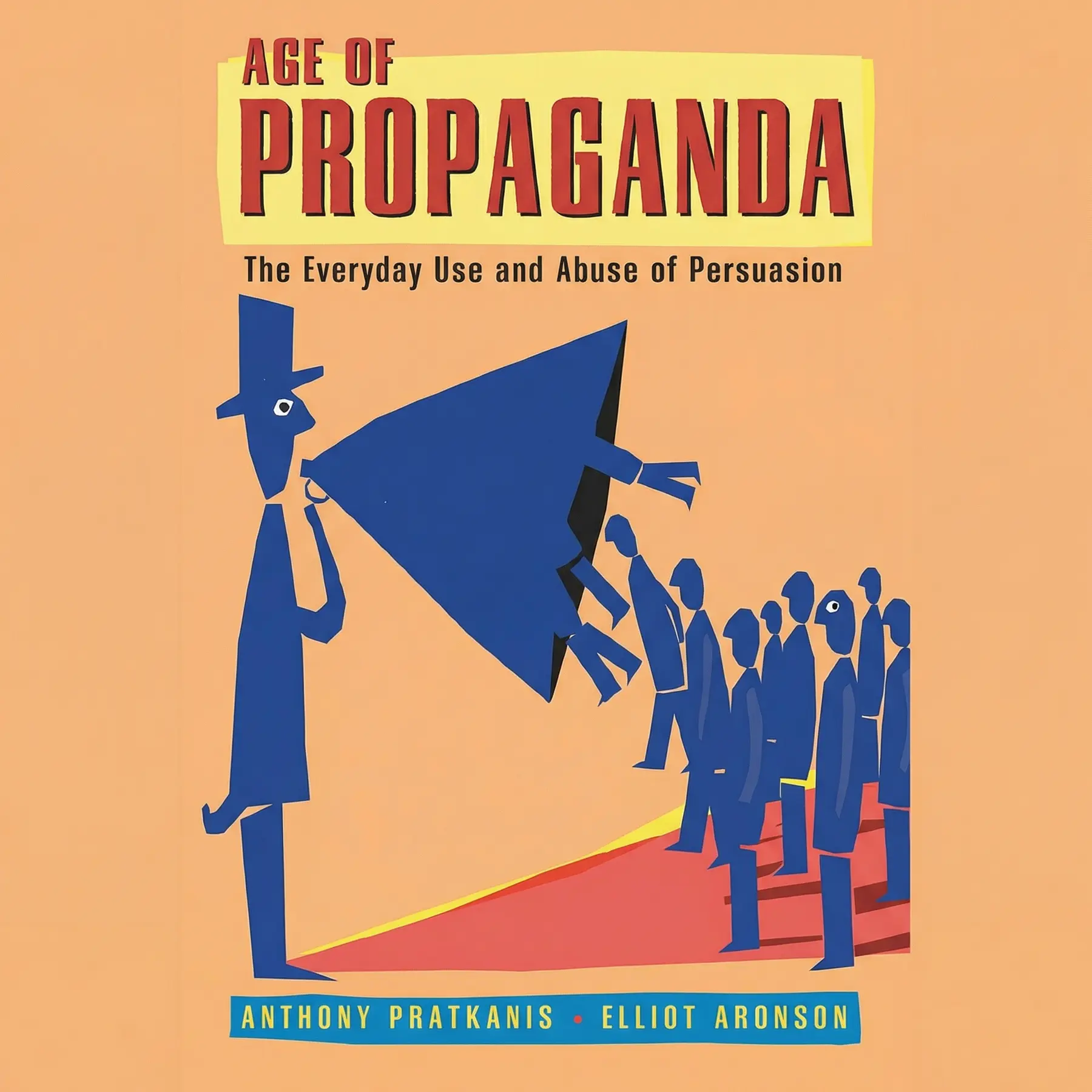
Age of Propaganda: The Everyday Use and Abuse of Persuasion
Shows how advertisers, politicians and cults move people with trusted faces, empty claims, fear, guilt and group loyalty instead of reasons. It also shows how to spot those moves and ask for real arguments.

Table of Content
1. Introduction
1 min 08 sec
If you think ads and slogans slide off you because you barely pay attention, two psychologists argue the opposite: half-attention is exactly what propaganda needs. In Age of Propaganda, Anthony Pratkanis and Elliot Aronson separate persuasion, which gives you arguments to weigh, from propaganda, which makes sure you never weigh them. Shoppers reach for beef marked 75 percent lean before the identical package marked 25 percent fat. The meat is the same. Only the frame changed.
Their case is that propaganda gets around careful thought. It uses trusted faces, flattering words, fear and guilt, along with our hunger to belong and to look consistent. Learning to name those moves is the first defense. The examples run from cereal boxes and aspirin ads to talk radio, war and cults. By the end, you will have a test for any message that moves you, and practical ways to push politicians, companies and even your children’s wish lists back toward real reasons.
2. Tell honest persuasion from manipulation in one test
1 min 54 sec
A gas station’s cash discount and a jingle you never meant to learn have something in common. Both reach you by a back road that most people assume they have closed off.
3. See past famous faces and claims that say nothing
1 min 45 sec
An aspirin ad can be completely true and still lead you to pay more for nothing. The trick sits inside a single boast, and once you hear it, many slogans start to sound different.
4. Catch the fear that sets you up to agree
1 min 47 sec
Volunteers who believed they had hurt a stranger became far more willing to help a cause that had nothing to do with him. That experiment explains why the moment you feel bad is the moment to wait.
5. Make vague slogans spell out what they mean
1 min 44 sec
A presidential candidate won votes from people who wanted opposite things, using one short phrase he never had to explain. The reason has as much to do with the audience as with the politician.
6. Guard against your need to belong and be right
1 min 56 sec
A radio host gave his fans a proud nickname, and in return they defended him against every attack. The same instinct keeps smokers smoking, and it works on careful people too.
7. War shows every propaganda tool working at once
1 min 51 sec
A superpower kept fighting a war long after its goals had faded, for a reason any individual would recognize. Three conflicts show what happens when fear, pride and group hatred combine.
8. Recognize a cult's recruiting methods early
1 min 49 sec
A flower handed to a stranger, cheerful group singing, a friend who never leaves your side. Each looks harmless alone, and together they form a sequence that can end somewhere very dark.
9. Conclusion
1 min 25 sec
Propaganda, as Pratkanis and Aronson describe it, often misleads by making an ordinary truth sound impressive. It arranges the moment instead: a famous face, a true but empty claim, a fear planted in advance, guilt looking for relief, a team to join and an enemy to look down on. Each of these moves us without asking us to think. The defense is to bring the thinking back.
That starts at home. Children take in toy and fast food ads during weekend cartoons and even during educational programming at school, and they learn early to be moved by the wrapping. When a child insists that a new toy will make them happy, ask why, and keep asking. You are teaching them the central route.
It continues in public life. Rather than giving up on politics, the authors suggest writing to politicians and asking them to support their claims with facts, and pressing news outlets for deeper coverage of issues that matter. Do the same with companies: question a product claim and look closely at the reply. A real answer is a good sign. A stack of brochures tells you where not to spend your money next time.
Propaganda depends on people who only half-listen. When people ask for reasons, persuaders have to give them.
About this book
What is this book about?
Most of us think we are hard to fool. We half-watch the ads and roll our eyes at the slogans. Two social psychologists, Anthony Pratkanis and Elliot Aronson, argue that this half-attention is exactly what propaganda needs. Honest persuasion gives you arguments to weigh. Propaganda arranges things so that you never weigh anything at all. The authors set out four main tools of influence: a credible messenger, a cleverly worded message, a mood prepared in advance, and strong emotion. On top of these they add our habit of defending past choices and our hunger to belong to a group. Their examples run from beef labels, aspirin ads and athlete-endorsed cereal to Richard Nixon's campaign slogan, talk radio, the wars in Iraq and Vietnam, Nazi propaganda and cult recruiting. Readers learn how persuasion differs from propaganda and how emotions can be used to steer their decisions. They also get practical steps for pushing back: teaching children to question ads, pressing politicians and news outlets for facts, and challenging companies on their claims.
Book Information
Who it's for
Wary consumers and voters
Shoppers, voters and news readers who suspect they are being steered but cannot say how.
Parents wanting skeptical kids
Parents who want to teach children to question the ads they see.
Marketers and managers
Managers and marketers who want to persuade honestly and recognize manipulation when others use it.
About the Author
Anthony Pratkanis
Anthony R. Pratkanis is an emeritus psychology professor at the University of California, Santa Cruz. His research covers social influence, fraud, subliminal persuasion and propaganda, and he founded the journal Social Influence. He has consulted for law enforcement and government agencies and testified as an expert in many trials. Elliot Aronson, who earned his Ph.D. at Stanford, has taught at Harvard and other universities. He studies attitude change and cognitive dissonance and invented the Jigsaw Classroom. He is the only person to have won all three major awards of the American Psychological Association.
Ratings & Reviews
Ratings at a glance
What people think
Listeners find the material educational and skillfully composed, highlighting its success in making complex media theories accessible. They characterize it as an excellent analysis of propaganda that attempts to clarify the topic, with one listener noting it serves as essential reading for mature thinkers. The book receives conflicting feedback regarding ease of use, as one listener found the text exceptionally hard to finish. Listeners also express disagreement over the writing quality, factual precision, and inherent bias.
Top reviews
Cherry
This book remains an essential deep dive into the psychological machinery behind social influence and mass persuasion. While some examples feel a bit anchored in the late 20th century, the underlying theories about how media manipulates our perceptions are still incredibly sharp. Pratkanis and Aronson manage to take high-level social psychology and make it digestible for anyone who watches the news or scrolls social media. It functions as a necessary defense manual against the constant bombardment of "factoids" and manufactured credibility we face daily. Honestly, if you want to understand why certain political slogans stick or why we buy things we don't need, this is the blueprint. It’s dense in parts but rewards the patient reader with a much clearer view of the world’s hidden agendas.
Show moreLeah
Wow. This is easily one of the most frighteningly relevant books I’ve ever read, despite being written decades ago. The authors perfectly describe how demagogues take power by exploiting the "willing" through a steady diet of lies and emotional manipulation. Reading about the "committed heart" and how requests slowly escalate makes you realize how easily any of us could be pulled into a cult or an extremist movement. It almost feels like a how-to manual that recent political leaders have been following to the letter. If you want to understand the current polarized landscape of "we-they" distinctions, you absolutely need to pick this up immediately. It’s a masterclass in social psychology that will change how you view every 30-second ad or political speech.
Show moreMoon
Finally got around to reading this classic, and I’m genuinely impressed by how well the authors explain high-end media theory without being overly condescending. It’s a great work of propaganda itself, in the sense that it persuasively argues for the necessity of a more skeptical and educated citizenry. The breakdown of how "one-sided" versus "two-sided" debates are used depending on the audience’s existing bias was a huge "aha" moment for me. It’s the kind of book that should be required reading in every high school civics class to help students separate news from entertainment. Even though it's an older text, the warnings about centralized communication and the erosion of democratic discussion feel more urgent today than ever before.
Show morePalm
Look, if you’ve ever felt like your emotions were being played on by a "free gift" or a "today only" deal, this book will tell you exactly why. It’s a fascinating look at the "everyday use and abuse of persuasion" that covers everything from cult recruitment to toothpaste advertisements. I loved the emphasis on monitoring your own emotional responses—if you feel a sudden surge of guilt or fear, someone is likely trying to sell you something. The authors don't just point out the problems; they provide actual solutions, like demanding better campaign spending reform and supporting media literacy. It’s a dense, brilliant, and ultimately empowering read that gives you the tools to fight back against the noise. A must-read for anyone who values their mental independence.
Show moreJiraporn
Ever wonder why you suddenly feel a weird sense of loyalty to a brand or a political group based on nothing but a shared hobby? That is the "Granfalloon" effect in action, and this book breaks it down with surgical precision. It’s a great piece of work that attempts to demystify the complex strategies used by advertisers and politicians to bypass our rational minds. I found the sections on emotional appeals—specifically how fear and guilt are weaponized—to be the most eye-opening and slightly terrifying. Some of the writing feels a little dry, and I did struggle with the pacing during the middle chapters, but the core message is vital. It’s required reading for any thinking adult who wants to maintain some level of autonomy in a world of constant spin.
Show moreAnna
After hearing Ramit Sethi mention this on a podcast, I decided it was time to finally understand how my own strings are being pulled. The book lives up to the hype by providing a comprehensive list of tactics used to cloud our judgment, from "lowballing" to the use of "gift" obligations. I particularly appreciated the practical checklist at the end for keeping yourself from being influenced by malicious propaganda. Gotta say, it really makes you rethink your media consumption habits and why you choose to trust certain sources over others. My only gripe is that it can feel a bit repetitive; the authors really hammer home the same points about communicator credibility. Still, it's a very valuable tool for anyone trying to navigate the modern information landscape.
Show moreSamroeng
The chapter on how scarcity is used to spark artificial interest was worth the price of the book alone. Pratkanis and Aronson do a fantastic job explaining how we are wired to want things simply because they are "limited" or "exclusive." I also enjoyed the deep dive into how "repair people" or experts use fear to manufacture a need for immediate, expensive services. Personally, I found the advice on teaching children to develop counterarguments against TV commercials to be incredibly practical for parents. The book is a bit long-winded at times, but the "Summary of What You Can Do" section is a goldmine of defensive strategies. It’s a solid 4-star read that will definitely make you a more skeptical consumer of information.
Show moreUdom
Picked this up because it’s frequently cited in persuasion circles, but I have to say it felt quite dated in 2024. Most of the case studies, like the tragedy of Jim Jones or old movie theater subliminal messaging, have been covered extensively in dozens of other books like "Mistakes Were Made." While the breakdown of the four persuasion phases—pre-persuasion, credibility, delivery, and emotional appeals—is solid, it didn't offer many fresh insights for someone already familiar with basic psychology. To be fair, the advice on how to protect children from exploitative marketing is still very relevant and well-argued. It's a decent foundational text, but if you’ve already read Cialdini or similar authors, you might find yourself skimming large portions of this one.
Show moreChamp
To be fair, the science behind the "Age of Propaganda" is rock solid, but the presentation is often quite tedious and academic. I found myself frequently losing interest during the long-winded explanations of research studies that felt like they belonged in a textbook rather than a book for the general public. While the information on "pre-persuasion" and setting the context is brilliant, the book desperately needs a modern update to account for social media and the internet. It was written in a time when TV ads were the primary threat, and while the principles apply today, the examples feel ancient. It’s an informative read if you can push through the dry prose, but it’s definitely not a page-turner by any stretch of the imagination.
Show moreAndrew
As someone who enjoys reading about media theory, I found this particular volume incredibly difficult to get through and arguably quite biased. The authors seem to have a specific political axe to grind, often framing anyone they disagree with as a purveyor of "Hitler-esque" propaganda while ignoring similar tactics from their own side. I found the "factoids" section ironically lacking in solid evidence, relying more on anecdotes than rigorous scientific data in several key chapters. Truth is, the book feels like it’s trying to be a scholarly text while behaving more like a partisan manifesto. If you’re looking for an objective, academic look at persuasion, there are much better, more modern resources available that don't feel so heavily slanted.
Show moreQuestions about this book
What is the main idea of Age of Propaganda?
Pratkanis and Aronson separate persuasion, which offers arguments you consciously weigh, from propaganda, which gets around careful thought. Propaganda uses four main tools: a credible messenger, a misleading message, a mood prepared in advance and strong emotion. It also exploits our need to justify past choices and to belong to a group. The authors argue that once people learn to recognize these moves, they can resist them and demand real arguments.
What is the difference between persuasion and propaganda?
In the authors’ account, persuasion uses the central route. It presents a case, deals with the counterarguments using facts, and leaves you aware of how and why your view changed. Propaganda uses the peripheral route. It wraps a message in music, color, famous faces or flattering wording so that you never examine the claim itself. A half-watched ad with a catchy jingle can still shape what you buy.
What is the granfalloon technique?
It is a way of sorting people into a proud in-group and a scorned out-group. The authors’ example is radio host Rush Limbaugh, who called his loyal fans dittoheads and set them against groups he insulted. Members cling to the flattering label to avoid the insulting one and defend the group fiercely. Cults use the same method when they teach members that outsiders are evil.
How can you protect yourself and your children from propaganda?
The authors suggest learning how propaganda works and teaching it to your children, who see constant ads for toys and fast food. When a child wants a new toy, ask why it would make them happier. As an adult, write to politicians and news outlets asking for facts and in-depth coverage. Question companies about their product claims, and take your business elsewhere if they reply with more advertising instead of an answer.
Readers also enjoyed



A Liberated Mind: How to Pivot Toward What Matters
Steven C. Hayes

A Promised Land
Barack Obama


A River in Darkness: One Man’s Escape from North Korea
Masaji Ishikawa

Acting with Power: Why We Are More Powerful Than We Believe
Deborah Gruenfeld

A Theory of Justice
John Rawls
AUDIO SUMMARY AVAILABLE
Listen to Age of Propaganda in 15 minutes
Get the key ideas from Age of Propaganda by Anthony Pratkanis, plus 5,000+ more nonfiction titles.
- 5,000+ titles
- Listen as much as you want
- 7-day free trial
- Cancel anytime









