

14 min 39 sec
Available in: English
Ask: The Counterintuitive Online Formula to Discover Exactly What Your Customers Want to Buy...Create a Mass of Raving Fans...and Take Any Business to the Next Level
A step-by-step method for finding out what online customers will buy by asking about their struggles, sorting them by problem and shaping every pitch, upsell and follow-up email around their answers.
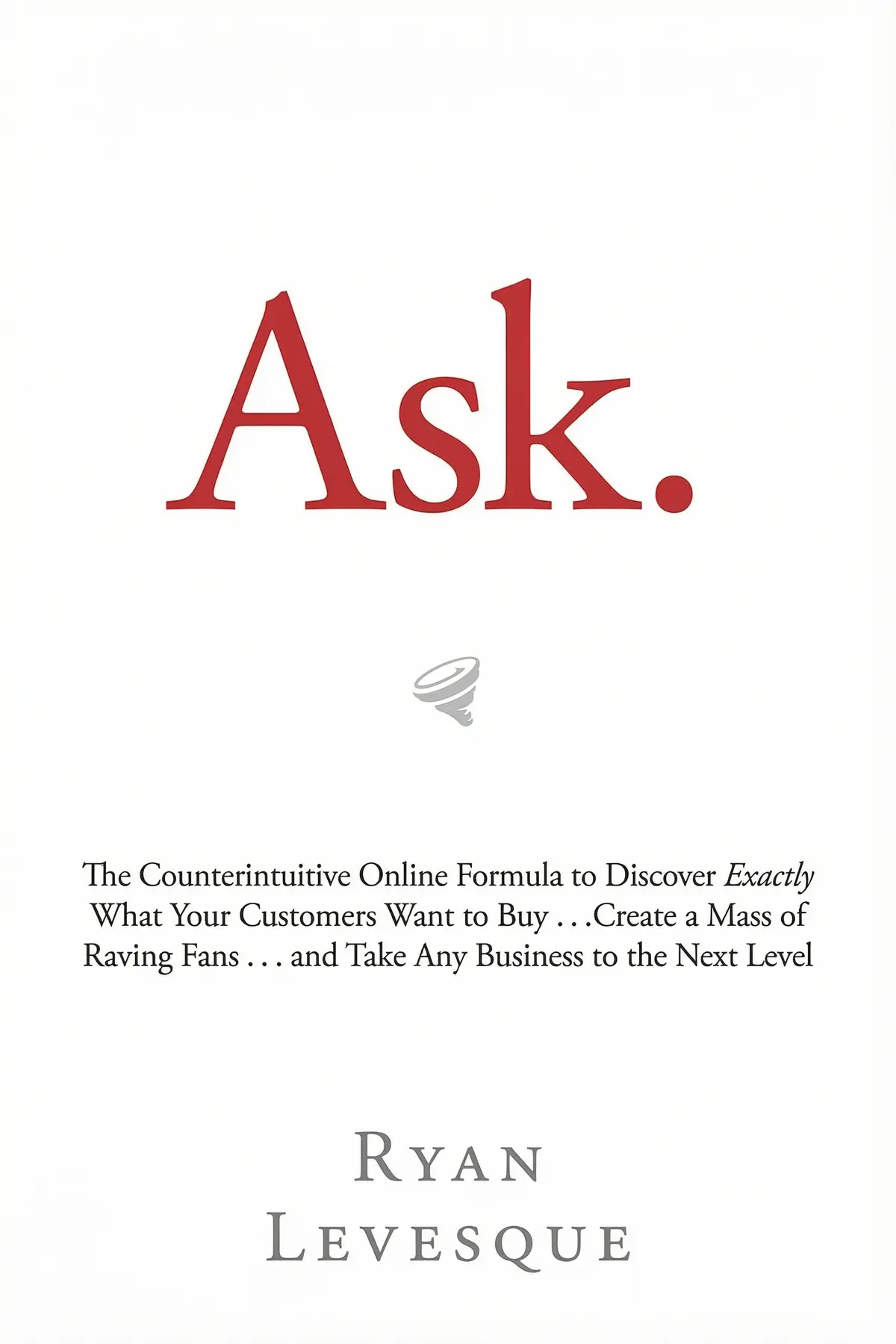
Table of Content
1. Introduction
1 min 00 sec
If you sell anything online, you are probably guessing what customers want, and most of your visitors leave without buying. In Ask, entrepreneur Ryan Levesque argues that asking them directly will not fix this, because people are good at only two things: naming what they don’t want and describing what they already have. So the useful question is never what would you like to buy. It is what are you struggling with.
From that swap Levesque builds the Ask Formula, a chain of surveys that moves a stranger toward a sale. Its logic is simple: ask about problems in the right order, sort people by the problem they name, and let every later step, from the pitch to the upsell to the follow-up email, speak to that problem. Along the way come a landing page that earns answers, a survey that wins trust one small click at a time, a sales video built like a doctor’s visit and a subject line people find hard to leave unopened.
2. Ask about struggles to learn what sells
1 min 48 sec
Customers will happily answer a survey and still leave you none the wiser. The fault lies less with them than with one ordinary question nearly every business asks, and swapping it changes what you hear.
3. Sort your prospects by the problems they name
1 min 49 sec
One early survey, sent only once, can tell you who your prospects really are and how each group talks. The hard part is what you do with the pile of answers once they arrive.
4. Build a landing page people want to answer
1 min 48 sec
Getting strangers to volunteer for a second, longer survey sounds unlikely. A memory-training site, a short video and one carefully built sentence for doubters show how a single screen can make it happen.
5. Win personal answers from prospects without scaring them off
1 min 51 sec
Ask for an email address too early and people vanish. Ask for it at the right moment and it feels like the obvious next step. The difference lies in the order and tone of the questions before it.
6. Diagnose the problem before you name a price
1 min 52 sec
Nobody trusts a doctor who talks about the bill before the diagnosis. Levesque turns that instinct into a sales video, complete with a catchy name for the customer’s problem and a careful order of reveals.
7. Offer the fries while the wallet is open
1 min 38 sec
The moment right after someone pays is the moment most sellers waste. A fast-food counter, a tub of protein powder and a salary course show three ways to turn one purchase into several.
8. Win back the ninety percent who walked away
1 min 38 sec
Most prospects will say no to the first offer, and many businesses simply let them go. Levesque treats that no as the start of a second conversation, with emails built for doubters and for happy buyers alike.
9. Conclusion
1 min 15 sec
Ask is, in the end, a book about humility in selling. Levesque starts from the admission that customers cannot tell you what they want, and that you cannot reliably guess it either. What people can give you is their struggles, in their own words, and that proves to be enough to build everything else on. The named diagnosis, the fries at the counter and the unfinished subject line all rest on one earlier act of listening.
His closing advice is that no single solution fits everyone. Each customer’s situation is different, so the answer they need is different too, and sorting people by problem is how a business can respect that without meeting each buyer in person.
To start this week, change one question. Wherever you now ask people what they want, ask what is hardest for them right now, then group the answers by problem and keep their exact phrases. When you next make an offer, name the problem before the price. And for everyone who says no, plan a second conversation rather than a closed door.
The best way to learn what customers will buy is still to ask. Levesque’s gift is knowing which question comes first.
About this book
What is this book about?
Most visitors to an online business leave within moments because nothing they see fits them. The obvious fix, asking people what they want, rarely helps, because most people cannot say. Ryan Levesque argues that customers are reliable on only two subjects: what they don't want and what they already have. His Ask Formula works around that limit. It is a chain of surveys and pages that asks prospects about their struggles, sorts them into groups by the problem they name, and then answers each group in its own language. A deep first survey maps who your prospects are. A landing page and a gentle second survey collect details one small click at a time. A post-survey video diagnoses the problem before any price appears, and one-click upsells and two email sequences carry the relationship forward. Readers get a full funnel they can rebuild for their own business, with concrete examples throughout: a memory-training headline, a diagnosis called the Cold Traffic Curse, an upsell borrowed from McDonald's, a one-dollar trial for hesitant buyers and a subject line that leaves its last word unsaid.
Book Information
Who it's for
Curious why visitors leave
Online business owners whose visitors leave without buying and who want a clear way to learn why.
Marketers who need sales
Marketers building surveys, landing pages and email sequences who need them to produce sales, not just data.
Looking for upsell ideas
Course creators and coaches looking for upsell and follow-up ideas grounded in customer problems.
About the Author
Ryan Levesque
Ryan Levesque is a founder and CEO whose companies have appeared on the Inc. 5000 list seven times. He has generated more than $100 million in revenue, sold two of his companies and helped businesses in 23 industries improve conversion and revenue, earning the nickname "conversion genius." Ask was his first book, and he later wrote Return to Real. His weekly newsletter, The Digital Contrarian, has more than 100,000 subscribers. He lives on a family farm in Vermont.
Ratings & Reviews
Ratings at a glance

What people think
Listeners describe the work as deeply researched and educational, with chapters that provide significant detail. Furthermore, the sequential directions are straightforward to implement, leading listeners to view it as essential for online marketers. The core idea is also seen as both simple and deep, with listeners valuing the actionable tips and the overall return on investment.
Top reviews
Noah
Ever wonder why your email list isn't buying despite your best efforts at providing value? This book revealed the massive blind spots I had in my business and offered a clear path to fixing them. Ryan does a fantastic job of explaining why we shouldn't just ask customers what they want—like Henry Ford’s faster horse quote. The step-by-step process for discovering 'hyper-responsive' buyers is worth much more than the price of the book. I’ve already seen a huge uptick in my engagement rates after applying just the first few chapters. This is essential reading for serious entrepreneurs.
Show moreYongyut
In my experience, most marketing books are all theory and no action, but this one provides a clear blueprint for success. I first heard about this through a funny podcast interview where the host’s accent made the title sound like 'Ass,' and I’m so glad I investigated further. The system for using open-ended surveys to collect consumer language is pure gold for copywriting. It’s a well-researched and informative guide that empowers you to stop making assumptions about your market. If you follow the instructions, you will gain a deep, honest understanding of who your customers actually are.
Show moreKomsan
Look, this book will change your life if you are willing to put in the work and ignore the critics. I used to rely on my gut feeling for product launches, but now I rely on the 'Ask Formula' and the results are undeniable. The level of detail provided—from the types of questions to the timing of the emails—is exactly what I needed. It’s a profound system that turns vague market research into a predictable sales machine. Don't let the autobiographical parts distract you from the fact that this is one of the most practical business books available today.
Show moreAmy
Finally got around to reading this and it's actually a very practical guide for segmenting customers into specific buckets. The step-by-step instructions are clear and make the process easy to follow, even for those of us who aren't tech-savvy. I particularly appreciated the concept of the 'Single Most Important Question' to identify market hot buttons and objections. To be fair, there is a lot of personal backstory to wade through before you get to the actionable data. However, the value for money is high once you start applying the actual survey templates to your own business.
Show moreElla
Ryan Levesque offers a solid, well-researched framework for anyone looking to understand their audience on a granular level. The book stimulated some useful thought around my own email automation processes and how I categorize my leads. Instead of taking a one-size-fits-all approach, I’m now using his methods to speak to different segments of my market quite differently. Some of the claims about the formula being 'dangerous' or 'evil' are definitely hyperbole, but the core strategy is sound. It’s an informative read that provides substantial information for internet marketers looking to scale their profitability and reach.
Show morePia
As someone who has always struggled with market research, I found the practical advice here to be incredibly helpful for my boutique business. The idea that people don’t know what they want, but they know what they hate, is a simple yet profound realization. This book helps you fine-tune your demographics so you aren't wasting money on Google AdWords or Facebook ads. I discovered my ideal customer avatar was nearly a decade older than I had originally assumed! While the autobiography felt unnecessary, the actual system for gathering open-ended data is brilliant and relatively easy to implement.
Show moreJoe
Picked this up after hearing about it at an online conference, and despite some initial skepticism, the methodology is robust. The instructions are laid out in a way that takes the guesswork out of writing automation sequences and survey questions. I’ve started using the 'Do You Hate Me?' survey on my non-buyers, and the honesty of the responses has been eye-opening. It’s definitely a must-read for anyone in the digital space, provided you have the patience to skip the fluff. The focus on using natural consumer language to mirror your audience’s needs is a complete game-changer for conversion.
Show morePraepimon
Not what I expected given the hype, especially with that long-winded email to his mother included right in the middle. While the 'Deep Dive Survey' provides some genuine nuggets of wisdom regarding hyper-responsiveness, the follow-up strategy is incredibly aggressive. Can you imagine sending twelve emails to someone regardless of whether they actually purchased anything? I found the technical advice on segmenting customers into 'buckets' useful, but the tone of the book is very 'salesy.' Look, it’s a decent resource if you can ignore the massive ego, but please don’t spam your audience the way he suggests.
Show moreMonthon
The chapter on customer surveys promised something revolutionary, but it ultimately felt like a watered-down version of a first-year marketing textbook. Truth is, most of the 'Ask Formula' is common sense—if you want to know what people want, you simply ask what they don’t like. Ryan Levesque spends half the book on an autobiography that has zero connection to the business strategy he is trying to sell. It is a very long-winded way to get to a simple concept of market segmentation. You are better off buying a classic marketing manual instead of this glorified sales funnel for his software.
Show morePrapaiwan
Wow, I really wanted to like this, but the first sixty pages felt like a narcissist's diary entry. Between the bizarrely detailed letter to his mother and the constant mentions of 'neuroscience' without any actual brain science, I felt like I was being conned. The author basically teaches you how to be a professional internet spammer. He suggests emailing people until they break down and give you money. Frankly, it’s a lot of fluff designed to sell his high-priced consulting programs rather than provide genuine value. If you value your customers' privacy and your own time, stay far away from this aggressive and repetitive approach.
Show moreQuestions about this book
What is the main idea of Ask by Ryan Levesque?
Levesque argues that customers cannot say what they want, though they can name what they don’t want and what they already have. So instead of asking about wants, his Ask Formula asks about struggles, sorts people into buckets by the problem they name, and then shapes the landing page, sales pitch, upsells and follow-up emails around each group’s problem and language.
What is the Deep Dive Survey in the Ask Formula?
It is the first survey, run only once at the start. You email your list of fans or former customers, introduce your company briefly and ask open questions about their biggest current challenge. You then study the answers for patterns and group similar people into buckets, which also reveal the natural words each group uses, so you can speak to them in their own language.
How does Levesque structure the sales pitch after the survey?
He uses a short video on a Post-Survey page built on Problem, Agitate, Solution. First comes a diagnosis with a memorable name, such as the Cold Traffic Curse. Then you explain why the problem is serious and urgent and show you care. Finally you make an offer covering the benefit, what the buyer gets, the special price and the reason to act now.
How does Ask suggest following up with people who did not buy?
Levesque expects perhaps only ten percent to buy at first, so he sends non-buyers engaging follow-up emails. Rather than repeated discounts, he suggests lowering the commitment, such as a one-dollar trial with the rest due later, sending urgency reminders as an offer closes, and restarting the formula around a different product for those the first offer did not suit.
Who should read Ask?
It suits people who sell online and cannot tell why visitors leave: small business owners, marketers, course creators and coaches. Its value is a complete, ordered funnel, from the first survey to upsells and email follow-ups, with concrete examples such as a memory-training headline, protein powder upsells and a subject line that stops mid-sentence.
Readers also enjoyed




Be Our Guest: Perfecting the Art of Customer Service
Disney Institute
Buyology: Truth and Lies About Why We Buy
Martin Lindstrom
AUDIO SUMMARY AVAILABLE
Listen to Ask in 15 minutes
Get the key ideas from Ask by Ryan Levesque, plus 5,000+ more nonfiction titles.
- 5,000+ titles
- Listen as much as you want
- 7-day free trial
- Cancel anytime









