
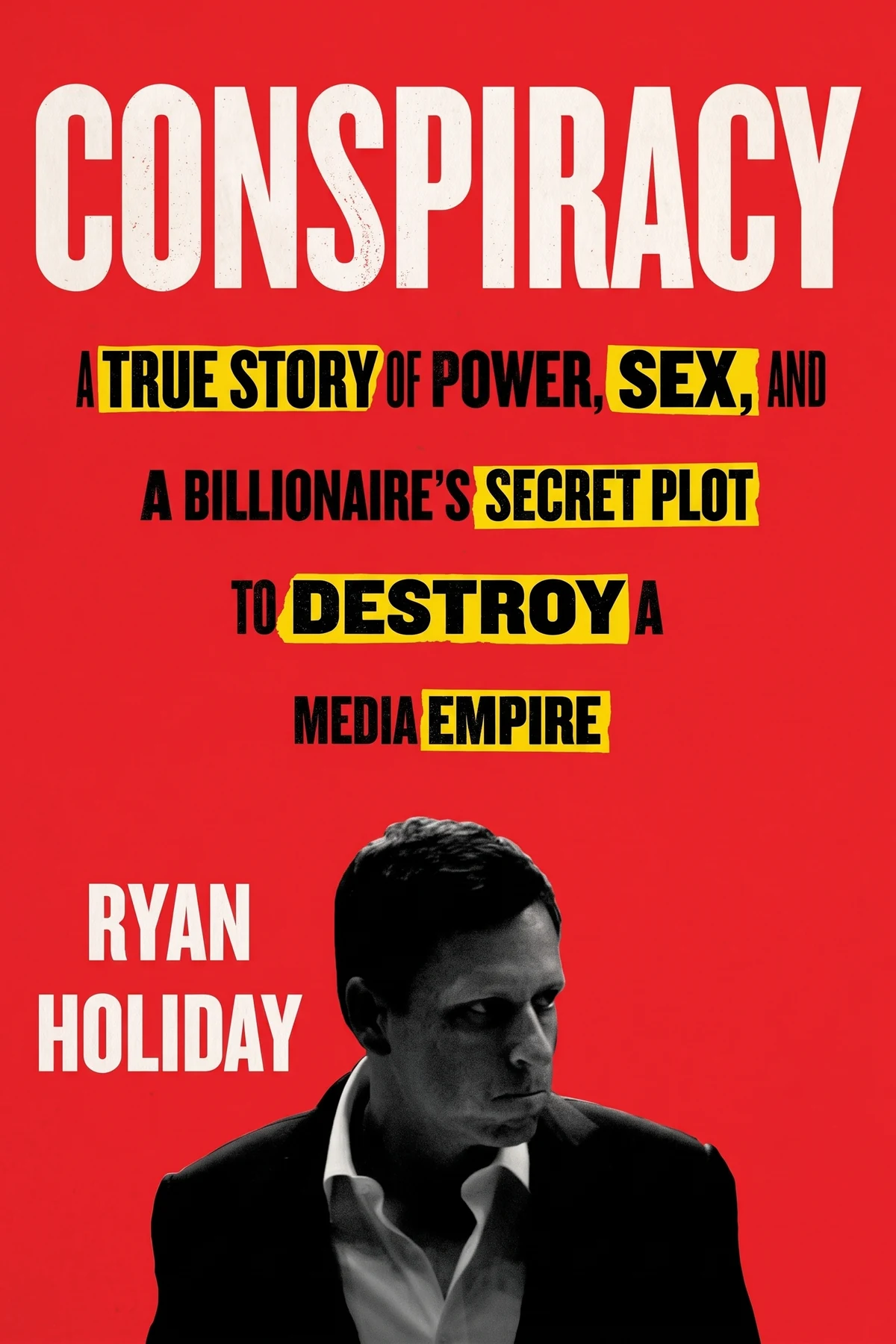
Courage is Calling: Fortune Favors the Brave
Ryan Holiday
 English
The true story of how Peter Thiel secretly funded Hulk Hogan's privacy lawsuit to bankrupt Gawker, and what it shows about long-term strategy, overconfidence and the fragile line between accountability and revenge.
1 min 02 sec
If someone powerful has ever embarrassed you in public, the usual advice is to let it go, because nobody beats people who publish for a living. In Conspiracy, Ryan Holiday tells the story of a man who ignored that advice. Tech investor Peter Thiel spent about nine years and roughly $10 million on a secret campaign against the gossip site Gawker, which ended after his hidden backing of Hulk Hogan’s lawsuit drove the company into bankruptcy.
The spark was a blog post of only 400 words. Holiday’s account shows that an outlet everyone thought untouchable fell to patience, secrecy and a carefully chosen legal angle, with money as the fuel, and he leaves open whether that was justice or revenge. Follow the plot from one cruel headline to a $140 million verdict in a Florida courtroom and you get a case study in long-range strategy, in the overconfidence that blinds the strong, and in a press-freedom question with no easy answer.
2 min 06 sec
A short, snarky blog post seemed like routine work to the people who wrote it. To the man it described, it was an unforgivable intrusion, and he had the means and the memory to answer it.
1 min 58 sec
Gawker had mocked rock stars and published stolen tapes without paying a price. That record made its writers feel safe, and it made a quiet billionaire decide they were something far worse than rude.
2 min 02 sec
Free-speech law, a taste for public feuds and an owner who refused to sell made Gawker look impossible to touch. Thiel’s answer began with deciding which battles he would refuse to fight at all.
1 min 57 sec
Years of digging turned up plenty to dislike and nothing a court would punish. Then a wrestler’s private humiliation went online, and a subtle legal distinction turned it into exactly the weapon Thiel wanted.
2 min 03 sec
Gawker’s lawyers did the math on Hogan’s bank account and felt safe. They had missed who was really paying, and where the case would be heard, two errors that turned a nuisance into a catastrophe.
1 min 59 sec
Thiel saw himself as a defender of ordinary people against a bully. Much of the press saw a vindictive billionaire silencing critics. Holiday lays out both sides and asks you to choose.
1 min 12 sec
Holiday’s story begins with a headline and ends in bankruptcy court, and what joins them is time. The whole conspiracy took about nine years, and Thiel’s spending, by the author’s figure, came to somewhere near $10 million, a small sum next to a $140 million judgment and the end of a publisher once both admired and feared. Gawker had legal armor, a loud voice and an owner who would not sell. It lost because it never imagined an opponent willing to wait that long and stay that hidden.
There are uses here even if you never face a media company. When a powerful rival seems untouchable, list its real defenses and look for the ground they leave open, as Thiel did by choosing privacy over free speech. When you feel safe, ask whom you might be underestimating and how your conduct looks to outsiders, the lesson Gawker learned from a Florida jury. And if you win by hidden means, expect people to judge the method as harshly as the result.
To the writers who published it, a 400-word post was nothing. To the man it described, it was the start of everything.
In 2016 a Florida jury ordered the gossip site Gawker to pay Hulk Hogan $140 million over a leaked sex tape, and the company went bankrupt. Only afterwards did the world learn who had paid for the lawsuit: Peter Thiel, the PayPal founder and early Facebook investor whom a Gawker site had outed as gay in 2007. Ryan Holiday reconstructs the plot behind that verdict. He shows why Gawker looked untouchable, protected by free-speech law, immune to shame and owned by a founder who would not sell. Then he follows the secret company Thiel set up with an associate known only as Mr. A, its years of searching for a legal weakness, and the privacy case that finally gave it one. Gawker's own overconfidence, and a jury far from New York, did the rest. Holiday does not hand down a verdict. He lays out the backlash against Thiel and the case in his favor, and asks readers to judge. What they get is a gripping lesson in patient strategy and a hard question about power and the press.
Founders and operators curious how a determined outsider can outmaneuver an entrenched institution.
Readers following debates about privacy, free speech and the power of billionaires over the press.
Fans of true business drama who want the full story behind Hogan versus Gawker.
Ryan Holiday left college at 19 to apprentice with the strategist Robert Greene and went on to advise authors and musicians. His first book, Trust Me, I'm Lying, came out in 2012 and drew on his own marketing techniques. He later became known for presenting Stoicism as a practical way of life, in books including The Obstacle Is the Way and Ego Is the Enemy, and Stillness Is the Key reached number one on the New York Times bestseller list. He has hosted The Daily Stoic Podcast since 2018.
Ryan Holiday
Ryan Holiday
Ryan Holiday
Ryan Holiday

Listeners find this work exceptionally engaging and skillfully composed, offering an intriguing account of a conspiracy that integrates historical details and philosophical background throughout. They value the author's tactical narrative style and feel the book is a valuable investment of their time, with one listener describing it as a "kick-a** read from cover to cover."
Wow. This is easily one of the most compelling pieces of narrative non-fiction I’ve picked up in years. Holiday takes the Gawker versus Hulk Hogan trial and peels back the layers to reveal a sophisticated, multi-year conspiracy orchestrated by Peter Thiel. The way he weaves in historical parallels and Stoic philosophy makes the legal drama feel like a grand strategy game played for the highest stakes imaginable. It's a kick-ass read from cover to cover that forces you to question the ethics of power and secrecy. Even if you think you know the story from the headlines, the level of behind-the-scenes access here is staggering. I couldn't put it down.
Show moreFinally got around to reading this and it’s a total knockout. I didn't expect a book about a lawsuit involving a sex tape to be so intellectually stimulating, but Holiday pulls it off by framing it as a masterclass in strategy. The storytelling is cinematic; you can almost see the gears turning in the shadows as the plot to bankrupt Nick Denton unfolds. It’s a fascinating look at the "hidden hand" in modern media and how one person with deep pockets can reshape the landscape. Frankly, it’s one of those rare books that changes how you view the news. Highly recommended for anyone interested in power dynamics.
Show moreRyan Holiday has a knack for making modern history feel like an epic myth. This isn't just a book about a website getting sued; it’s a meditation on the nature of secrecy and the vulnerability of institutions. The pacing is perfect, and the way the author connects the dots between Silicon Valley culture and the legal system is masterful. I particularly liked how he handled the complexity of Nick Denton—he isn't just a villain, but a tragic figure who didn't see the storm coming. It’s a kick-ass read that manages to be both a fun page-turner and a serious piece of cultural commentary. Absolutely brilliant.
Show morePeter Thiel is a polarizing figure, and this book doesn't shy away from the Machiavellian nature of his campaign against Gawker. Holiday writes with a propulsive energy, using the present tense to make the years of litigation feel like a ticking time bomb. Truth is, the philosophical diversions into the "anatomy" of conspiracy are sometimes a bit much, bordering on pretentious. However, the core reporting is top-notch. Seeing how Terry Bollea was essentially a pawn in a billionaire’s revenge quest is both fascinating and slightly chilling. It’s a well-written profile of how money can be weaponized in the digital age. Definitely worth your time.
Show moreAs someone who followed the Gawker trial closely back in 2016, I thought I knew everything there was to know about this case. I was wrong. Holiday provides incredible context by showing how the conspiracy actually began years before the sex tape even surfaced. The book succeeds by treating the takedown not just as a legal victory, but as a historical event with massive implications for free speech. My only gripe is that the Gamergate section felt a little rushed, almost like it was an afterthought to keep the narrative moving. Still, the strategic insights are brilliant. It’s a very entertaining and well-researched deep dive.
Show moreIs this a manual for revenge or a history book? Holiday seems to argue it's a bit of both. The way he details the secret meetings and the calculated silence of the "Mr. A" figure is genuinely thrilling. You get a sense of the immense patience required to pull off a move this big. To be fair, the author’s admiration for Thiel’s intellect is very apparent, which might put some readers off. However, the writing style is so engaging that it’s easy to overlook the occasional lack of objectivity. It’s a fascinating study of how a small group of people can change the world from the shadows.
Show moreAfter hearing Holiday discuss this on a podcast, I was worried the book wouldn't have much more to offer, but I was pleasantly surprised. The narrative depth is impressive, especially regarding the psychological toll the battle took on everyone involved. It’s a well-written exploration of what happens when the digital world crashes into the old-school legal system. Not gonna lie, the present-tense prose takes a second to get used to, but it eventually adds a sense of urgency to the plot. While I don't agree with all of the author's conclusions about the "greater good," the story itself is undeniably fascinating. A solid four stars.
Show moreWhile the narrative is undoubtedly gripping, I found myself increasingly frustrated by the author's clear bias toward the "Great Man" theory of history. Holiday frames Thiel as a mythic strategist, often glossing over the more unsavory aspects of the legal maneuvers or the collateral damage involved. The constant references to ancient philosophers felt like an attempt to add depth to what was essentially a very expensive grudge match. Also, the decision to write in the present tense was distracting for a historical account. It’s a fast-paced page-turner, but I wish there had been more critical distance from the subjects. It feels a bit shallow in its final analysis.
Show moreThe chapter on the strategy behind the lawsuit was easily the highlight for me, showing the meticulous planning involved. However, the rest of the book struggled to maintain that same level of focus. I found the frequent jumps to historical facts about other conspiracies to be hit-or-miss—some were insightful, others felt like padding. Terry Bollea comes across as a very sympathetic figure, but I wanted more on the legal precedents this case set for the First Amendment. It’s a decent read if you like Ryan Holiday’s style, but it lacks the weight of a truly definitive account. A bit too much style over substance in parts.
Show moreLook, I wanted to like this more because the subject is inherently interesting, but the execution felt thin. For a book titled "Conspiracy," there wasn't nearly enough investigation into the actual mechanics beyond "rich guy pays for lawyers." Holiday relies heavily on a few key interviews and fills the gaps with repetitive philosophical quotes that don't always land. It honestly felt like a long-form magazine article that was stretched out to meet a book contract. The analysis of Nick Denton and Gawker’s culture was surface-level at best. If you want a quick summary of the drama, this is fine, but don't expect a deep, objective investigation.
Show moreIt tells the true story of how tech investor Peter Thiel secretly funded Hulk Hogan’s privacy lawsuit against the gossip site Gawker. The feud began in 2007, when a Gawker-owned site outed Thiel as gay. Years later, a hidden company searched Gawker’s archive for a legal weakness, found it in Hogan’s leaked sex tape, and helped win a $140 million verdict that bankrupted the publisher.
Thiel saw the 2007 Valleywag post outing him, at a time when the world was far less accepting of gay people, as an attack on his privacy. Later posts named and pictured his boyfriend, and stories about him drew 500,000 views. Learning how Gawker routinely published stolen material and mocked anyone who objected, he began calling it the Manhattan Based Terrorist Organization.
Holiday explains that America’s First Amendment gave journalists near-total protection, so cases about speech were very hard to win. Thiel’s team, led by an associate known only as Mr. A, deliberately looked for wrongdoing in other areas of law. Hogan’s complaint was about a tape recorded without his consent, which made it a privacy claim and gave him a much better chance in court.
Holiday leaves the final judgment to readers. He describes the media backlash that painted Thiel as a vindictive billionaire threatening free speech. He also notes that Thiel broke no laws despite his vast resources, and he praises Thiel’s long-term focus and drive, even suggesting the world may need more conspiracies, not fewer, to bring about change.
The story suggests mapping a powerful opponent’s real defenses and looking for ground they do not cover, as Thiel did with privacy law. Gawker’s fall warns against assuming you know who is really behind an opponent, and against assuming outsiders share your values, as the Florida jury showed. And secret methods tend to be judged once they come to light.



Barack Obama

Masaji Ishikawa

John Rawls



Miles Taylor


AUDIO SUMMARY AVAILABLE
Get the key ideas from Conspiracy by Ryan Holiday, plus 5,000+ more nonfiction titles.









