

AI 2041: Ten Visions for Our Future
Kai-Fu Lee
 English
 ไทย
Kai-Fu Lee explains why the AI race now favors data, fierce entrepreneurs and active governments, where China leads and trails across four waves of AI, and how societies should respond as machines take over tasks.

1 min 03 sec
If artificial intelligence feels like a headline you can follow but not explain, Kai-Fu Lee offers a map. In AI Superpowers, the computer scientist and investor argues that China is well placed to lead in AI, thanks to masses of everyday data, battle-hardened entrepreneurs and a government eager to clear the road. On those terms, he believes, China is ready to overtake Silicon Valley.
Lee has worked in both places, and he builds his case from what he has seen. Deep learning made AI a business tool, Chinese founders learned to compete by copying, and super-apps gathered data on a scale no one else has. Then comes the harder part. The same machines that decide who leads will take over millions of tasks people do today, so the real test is how we value the work that remains human.
Along the way you get a scorecard for four kinds of AI, a better test for which jobs are at risk, and the story of how a cancer diagnosis changed one of the field’s leading figures.
1 min 42 sec
For decades, AI belonged in science fiction and university labs. Then two missing ingredients arrived at once, and a single contest result in 2012 told the world that everything had changed.
1 min 48 sec
For years the West dismissed Chinese tech companies as clones of American hits. One founder copied four famous products before building his own, and the company he built ended up outgrowing the original.
1 min 46 sec
One ride-hailing company stops at matching drivers with passengers. Its Chinese rival also runs gas stations and repair shops. That difference in appetite explains why China may be sitting on the richest raw material in AI.
1 min 49 sec
Talk of a single AI race hides the real picture. Split the field into waves and the leader changes from one to the next, including in places most people would not guess.
1 min 46 sec
A shopping cart that recognizes your face and a city built for cars with no drivers are closer than they sound. Who builds them first depends on privacy attitudes, factories and how fast rules get written.
1 min 48 sec
One respected study said nearly half of American jobs could vanish. Another put the figure under one in ten. Lee explains the gap, then points to a kind of job loss none of the reports counted.
1 min 49 sec
A stage IV cancer diagnosis made a self-described workaholic question everything he had worked for. What he concluded changed how he thinks societies should pay people once AI takes over the routine work.
1 min 14 sec
Lee’s argument travels from a 2012 contest about recognizing pictures to a question about what a decent society chooses to pay for. In between sits his central claim. The AI economy is projected to reach $15.7 trillion across the globe, and the winners will be those with the most everyday data, entrepreneurs toughened by fierce competition and governments eager to push new technology forward. China, by his count, has all of these, plus a manufacturing hub that makes smart devices cheap. That is why he expects it to lead in internet and perception AI and to narrow the gap elsewhere.
The same machines that make a country powerful also absorb the tasks behind millions of jobs. Lee’s illness taught him that what machines do well was never the part that made him human.
His case suggests a way to listen to AI news: ask which wave a story describes, because the answer about who leads changes with it. It also suggests a way to plan a career, by putting more weight on work that rests on trust and care. A machine can approve a loan in seconds. Sitting beside someone who is frightened is still a job for a person.
Artificial intelligence is everywhere in the headlines, yet few people can say who is actually winning the race to build it, or what it will do to their work. Kai-Fu Lee, who spent many years working in Silicon Valley as well as in its Chinese counterpart, Zhongguancun, offers a clear answer. Since the deep learning breakthrough, he argues, AI has become a practical business tool, and China has the data, government support and manufacturing to exploit it. Lee traces how Chinese founders went from copying American products to beating them, how super-apps like WeChat built the world's largest pool of everyday data, and how government support speeds things up. He then scores the US and China across four waves of AI: internet, business, perception and autonomous, with his own forecasts for each. The book ends on a personal turn. A cancer diagnosis led Lee to rethink what makes people human, and he argues that the AI economy should push us to value caregiving and community work far more highly. Readers get a map of the race and a sharper way to think about their own place in it.
Professionals who want a clear picture of the US and China AI race beyond the headlines.
Founders and investors weighing how data, competition and government support shape tech markets.
Workers wondering which parts of their job AI could take over, and what to build instead.
Kai-Fu Lee is a Taiwanese computer scientist, investor and author with more than three decades in AI research, development and investment. He holds a PhD from Carnegie Mellon, held executive roles at Apple, SGI and Microsoft, where he founded Microsoft Research China, and led Google China from 2005 to 2009. He founded the venture firm now called Sinovation Ventures in 2009 and the AI company 01.AI in 2023. He also wrote AI 2041 with Chen Qiufan.
Kai-Fu Lee
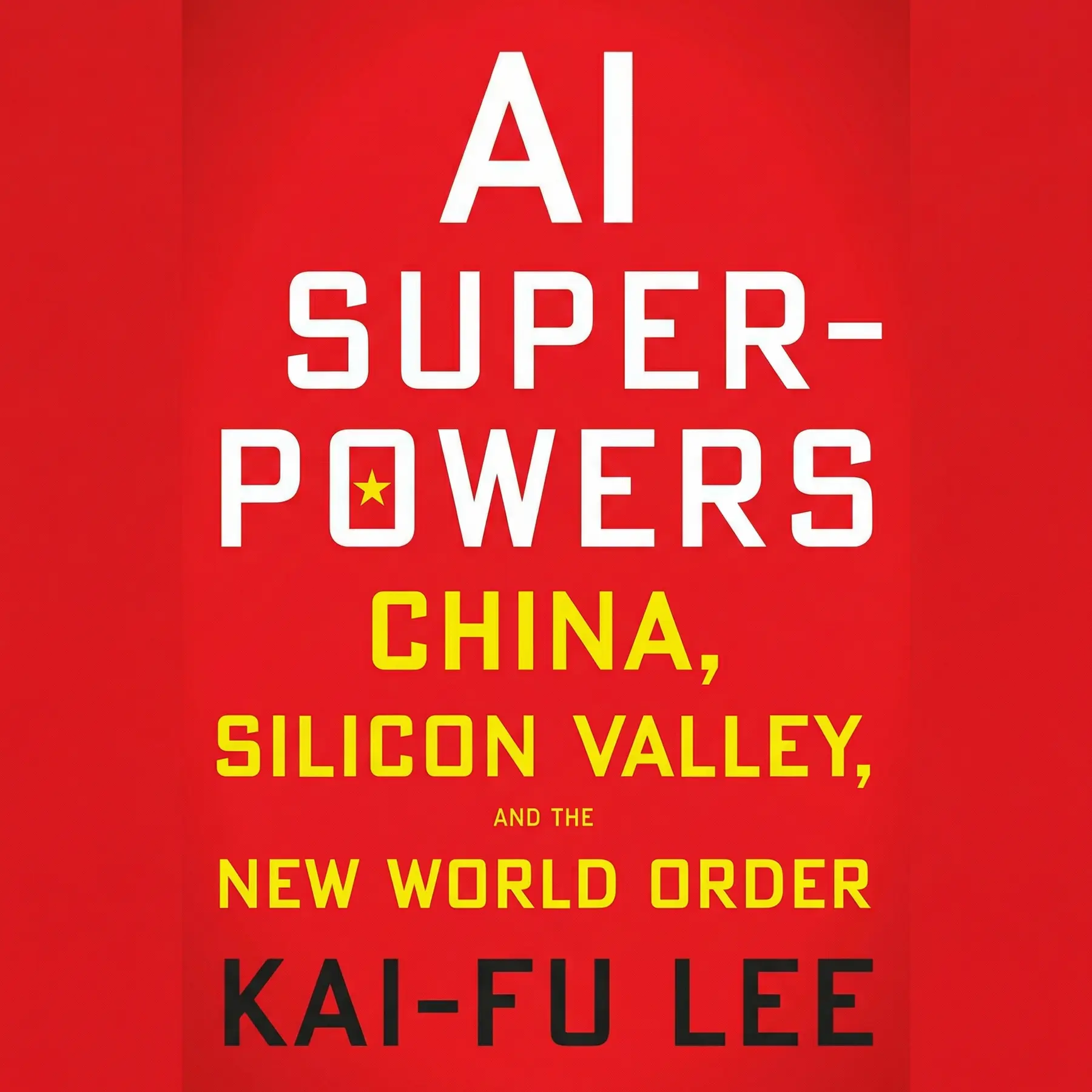
Listeners find the work provides significant observations regarding AI history and enjoy its efficient, brief structure. Furthermore, the prose is expertly written, and listeners appreciate the human-centered perspective applied to the subject. The text also delivers a gripping story and solid outlook on what’s ahead, with one listener pointing out its geopolitical context for AI. Listeners feel the material is a valuable use of their time, with one mentioning its cost-effectiveness for consumers.
This book provides a masterclass in the shifting global landscape of technology and economic power. Kai-Fu Lee leverages his incredible background at Google and Apple to explain why China has moved from a copycat culture to a world-class innovator. He argues that data is the new oil, and China currently possesses the biggest reserves on the planet. I found the sections on the 'four waves' of AI development particularly enlightening for understanding where we are heading as a species. While some readers might find his optimism about the Chinese model jarring, his logic regarding implementation over pure research is hard to ignore. It’s a well-crafted narrative that perfectly balances technical trends with profound societal impacts. Every policy maker and tech enthusiast should have this on their shelf to understand the 21st-century's defining struggle.
Show moreWhat separates this from other dry tech books is the profound humanistic approach the author takes halfway through. About two-thirds of the way through, Lee shifts from geopolitical strategy to his personal battle with stage IV lymphoma. This experience clearly changed his outlook on what machines can and cannot do for us in the long run. He argues that while AI will replace many routine tasks, it can never replicate true human compassion or love. This realization shapes his proposals for a new social contract to handle the coming job displacement crisis. It’s an emotional and thought-provoking read that goes far beyond just algorithms and market shares. I walked away feeling both terrified of the economic shifts and hopeful about our inherent human potential to adapt.
Show moreWow, Kai-Fu Lee has written something that feels like an urgent briefing for the entire world. The way he describes the 2017 AlphaGo victory as China’s 'Sputnik moment' really puts current technological tensions into perspective. This isn’t just a book about robots; it’s about a fundamental shift in economic power and our social structure. I loved the concise format and how he categorized AI into four distinct waves to make the future feel tangible. It helped me visualize the timeline of when these changes will actually hit our daily lives and our bank accounts. The book is exceptionally well-crafted, blending high-level strategy with grounded examples of Chinese super-apps like WeChat. If you want to know where the global economy is going, you really need to read this now.
Show moreThe chapter on the four waves of AI alone makes this book worth the price of admission. Lee categorizes the evolution of the technology in a way that is incredibly easy for anyone to follow. You move from internet AI and business AI to perception and autonomous systems with total clarity. His writing style is fluid and keeps the reader engaged, even when discussing complex economic shifts or historical failures. Personally, I found the discussion on the 'un-marketable' value of human care to be the most touching part of the narrative. It’s rare to find a high-level tech executive who writes with this much heart and vulnerability. Highly recommended for anyone curious about the intersection of technology, politics, and our collective human future.
Show morePicked this up on a whim after seeing it mentioned in a tech newsletter during my morning commute. It’s surprisingly quick to get through, which I appreciated given how dense this topic can often become. Lee does a great job of breaking down complex concepts like deep learning into something a layperson can easily grasp. To be fair, he definitely has a pro-China lean, but that’s exactly why the perspective is so valuable for a Western reader. We often live in a Silicon Valley bubble and ignore the 'gladiatorial' competition happening in the East. My only minor gripe is that the middle sections occasionally feel a bit like a PR piece for his venture capital firm. Still, the historical context and the 'Sputnik moment' of AlphaGo are top-notch additions.
Show moreAfter hearing so much about the 'AI arms race,' I wanted to understand the actual mechanics of the competition between nations. Lee delivers a compelling narrative that highlights how the US excels in research while China thrives on rapid implementation. His breakdown of how white-collar jobs—like radiologists or underwriters—are just as vulnerable as blue-collar ones was particularly eye-opening. The writing style is punchy and accessible, making it easy to digest the entire book in just a few sittings. I didn’t agree with every single conclusion, especially his take on data privacy and government integration, but his perspective remains essential. It’s a very cost-effective way to get a high-level education on a topic that will define the next fifty years of human history.
Show moreFinally got around to reading this after seeing it on several 'best of' lists for the year. It manages to deliver a very compelling narrative about the future of global power without getting bogged down in academic jargon. To be fair, Lee's predictions about the speed of automation are quite alarming and might keep you up at night. I found his perspective on the geopolitical context of AI to be the most valuable part of the whole experience. It’s a well-crafted look at how the rivalry between the US and China will shape our lives. Even if you aren't a 'tech person,' the sections on job displacement are relevant to everyone in the workforce today. It is definitely worth the read for the perspective shift alone.
Show moreEver wonder why China suddenly seems to be winning at tech despite starting so far behind? Lee explains that the secret sauce isn’t just government support, but a culture of hyper-competition and massive data collection. He contrasts the 'mission-driven' Silicon Valley with 'market-driven' Chinese entrepreneurs who will do whatever it takes to win. This book provides a much-needed geopolitical context for the AI debate that we often miss in Western media. It’s not just about who has the best math, but who can deploy the technology the fastest to the most people. I appreciated the humanistic lens he uses to look at the future of work after his health scare. It’s a sobering but necessary look at how the global hierarchy is currently being rewritten.
Show moreTruth is, Kai-Fu Lee has a unique perspective that almost no one else in the industry can offer. Having led divisions at Apple, Microsoft, and Google, he understands the Western mindset perfectly while being an insider in the Chinese boom. However, the book feels a bit lopsided, focusing heavily on his own successes and the inevitability of Chinese dominance. The writing is well-crafted, but it often glosses over the ethical concerns of the surveillance state he describes so casually. Not gonna lie, I expected more technical depth regarding the limitations of deep learning, rather than just its business applications. It serves as a good perspective on the future, but it should be read alongside other more critical tech analyses. It's an interesting, quick read that sparks debate even if you don't agree with the premise.
Show moreWhile the insights into the Chinese tech scene are fascinating, the book left me wanting much more technical substance and less personal fluff. It starts strong, detailing the intense competition in China’s startup world, but quickly devolves into a repetitive memoir. By the final chapters, it felt more like a long cover letter for Lee's current investment portfolio than an objective analysis. The pivot to discussing his health felt disconnected from the earlier rigorous analysis of global superpowers and economic models. Frankly, the solutions he proposes for massive job loss, like paying people to care for others, felt incredibly idealistic and economically underdeveloped. It’s a decent introductory text for absolute beginners, but industry experts will likely find it a little light on data and heavy on anecdotes.
Show moreLee argues that deep learning turned AI into a practical business tool, and that China’s data, government backing and manufacturing put it in a strong position to lead. That rewards huge amounts of everyday data, entrepreneurs hardened by fierce competition and supportive governments. China has all three, so he believes it is well placed to overtake Silicon Valley in several areas. He also argues that societies must revalue human work, such as caregiving, as AI takes over routine tasks.
Lee describes internet AI, such as video and news recommendations; business AI, which mines records to make decisions on loans and investments; perception AI, which recognizes faces and voices; and autonomous AI, such as drones and driverless cars. He scores each one. China is expected to lead in internet and perception AI, while the US leads in business and autonomous AI, with China narrowing the gap.
He takes the threat seriously. Estimates range from 9 percent of US jobs at risk, from the OECD, to 47 percent in a 2013 Oxford study. Lee leans toward the 38 percent figure from PricewaterhouseCoopers and thinks the real number may be higher, because firms like Smart Finance and Toutiao never hire loan officers or editors at all, which he calls ground-up displacement.
Break your work into tasks rather than thinking about your job title. Tasks that follow clear patterns, like calculating or checking, are the ones AI handles well. Tasks built on trust, real-time judgment and care for others are much harder to automate. Lee’s own illness convinced him that human relationships are what matter most, and he argues those skills will grow in value.
Lee argues that copying taught Chinese founders how to build products and survive a brutal market. Wang Xing cloned Friendster, Facebook, Twitter and Groupon before building Meituan, which outgrew Groupon by 2014. AlphaGo’s 2016 win over Lee Sedol, watched by 280 million people in China, then pushed the government to aim for world leadership in AI within ten years.


Yanis Varoufakis



Pankaj Mishra

Jacinda Ardern

Anthony Pratkanis
James Comey
AUDIO SUMMARY AVAILABLE
Get the key ideas from AI Superpowers by Kai-Fu Lee, plus 5,000+ more nonfiction titles.









