

A River in Darkness: One Man’s Escape from North Korea
Masaji Ishikawa
 English
Explains why the rules that kept the peace after World War II no longer hold, how American action and inaction deepened the disorder, and what an order built on duties between states could look like.

58 sec
If foreign news feels like a pile of unconnected crises, Richard Haass offers the pattern underneath. In A World in Disarray, the longtime president of the Council on Foreign Relations argues that the rules which kept the peace after World War II have largely worn out. In 1990, President George H.W. Bush spoke of a new world order. A quarter century later, Haass sees a new world disorder instead.
The cause, he argues, is that power has spread to more hands than ever, while the United States made matters worse by acting rashly in some places and failing to act in others. His repair is World Order 2.0, in which states owe duties to one another as well as enjoying rights, led by an America that first fixes itself at home. Expect a framework for reading any headline about war, trade or climate, and a sharper sense of what stability really takes.
1 min 38 sec
A treaty signed in 1648 still shapes how countries treat each other. Haass uses it to show what holds any international system together, and what happens to the world when one of those supports gives way.
1 min 53 sec
Two superpowers with enough weapons to end civilization spent four decades without fighting each other directly. Haass credits a quality most people overlook, and it explains why the calmer-looking world that followed proved harder to manage.
1 min 35 sec
After 1991 the great powers stopped being each other’s main threat, which should have made the world calmer. It did the opposite. Haass names three reasons, and they explain why so many global problems now stall.
2 min 00 sec
One American president went to war on a threat that might never come. Another drew a public line and then let it be crossed. Haass argues both mistakes fed the same disorder, and the lesson applies far beyond diplomacy.
1 min 51 sec
After a genocide the world watched happen, nations agreed they could step inside another country’s borders to stop mass killing. Then a war came along that fit the rule exactly, and almost nothing was done.
1 min 27 sec
Viruses, carbon and hackers cross borders without asking, yet the world’s rules still mostly protect borders. Haass proposes an update to the system itself, and one critic doubts many countries are ready for it.
1 min 56 sec
A massacre in Beijing, a trade relationship that grew thirtyfold and a Russia that relies on force: Haass draws working rules from all three for keeping rival powers competing without crossing into open conflict.
1 min 22 sec
Haass ends his tour of a troubled world with one more country in disarray, and it is the one he says the rest of the world cannot do without. His fixes are surprisingly domestic.
1 min 10 sec
In 1990, the first President Bush could picture a new world order. Haass shows why that hope gave way to disarray, and why the slide was never fated. Order, in his telling, is built and kept up by people. The Cold War built it from alliances, institutions and fear of nuclear ruin. Then power scattered, problems began crossing every border, and American errors in both directions widened the cracks.
What he leaves you with works the next time a crisis fills your screen. Ask which support has failed, the shared rules or the power behind them. Judge an intervention by whether the danger was imminent and whether the commitment will be kept to the end. Ask what a country owes the people on the far side of its border, the question at the heart of World Order 2.0. And count a government’s debt, gridlock and sudden reversals as foreign policy problems too.
Chaos, Haass warns, moves into whatever space complacency leaves behind. Keeping that space filled is ongoing work, and it starts at home.
In 1990, President George H.W. Bush spoke hopefully of a new world order. A quarter century later, Richard Haass argues, the world looks more like a new world disorder. The arrangements that held through the Cold War, from NATO and nuclear deterrence to Bretton Woods and the United Nations, have largely run their course. Haass, a former president of the Council on Foreign Relations, explains why. Power is now spread across more hands than ever, including many actors that are not states. Problems such as climate change, cyberattacks, terrorism and nuclear proliferation ignore borders. And the United States made things worse both by acting rashly, as in Iraq in 2003, and by failing to act, as when Syria used chemical weapons. His answer is World Order 2.0: states keep their sovereignty but accept obligations to other countries for what happens on their soil. He pairs it with advice on managing China and Russia, and with a warning that America cannot lead abroad until it repairs its politics and finances at home. Readers get a clear framework for making sense of world crises and judging the policies offered to fix them.
Professionals who follow world news but struggle to connect wars, trade fights and climate talks into one picture.
Students of international relations who want a clear frame from Westphalia to Syria.
Readers judging debates over intervention, China, Russia or America First.
Richard Haass led the Council on Foreign Relations as its president until he stepped down in June 2023. Before that he directed policy planning at the State Department and advised Secretary of State Colin Powell. Earlier he was special assistant to President George H.W. Bush and a senior director on the National Security Council staff. He served as US coordinator for policy on Afghanistan's future and as envoy to the Northern Ireland peace process, chaired multiparty talks there in 2013, and received the Tipperary International Peace Award. He is a Rhodes scholar educated at Oberlin College and Oxford University.
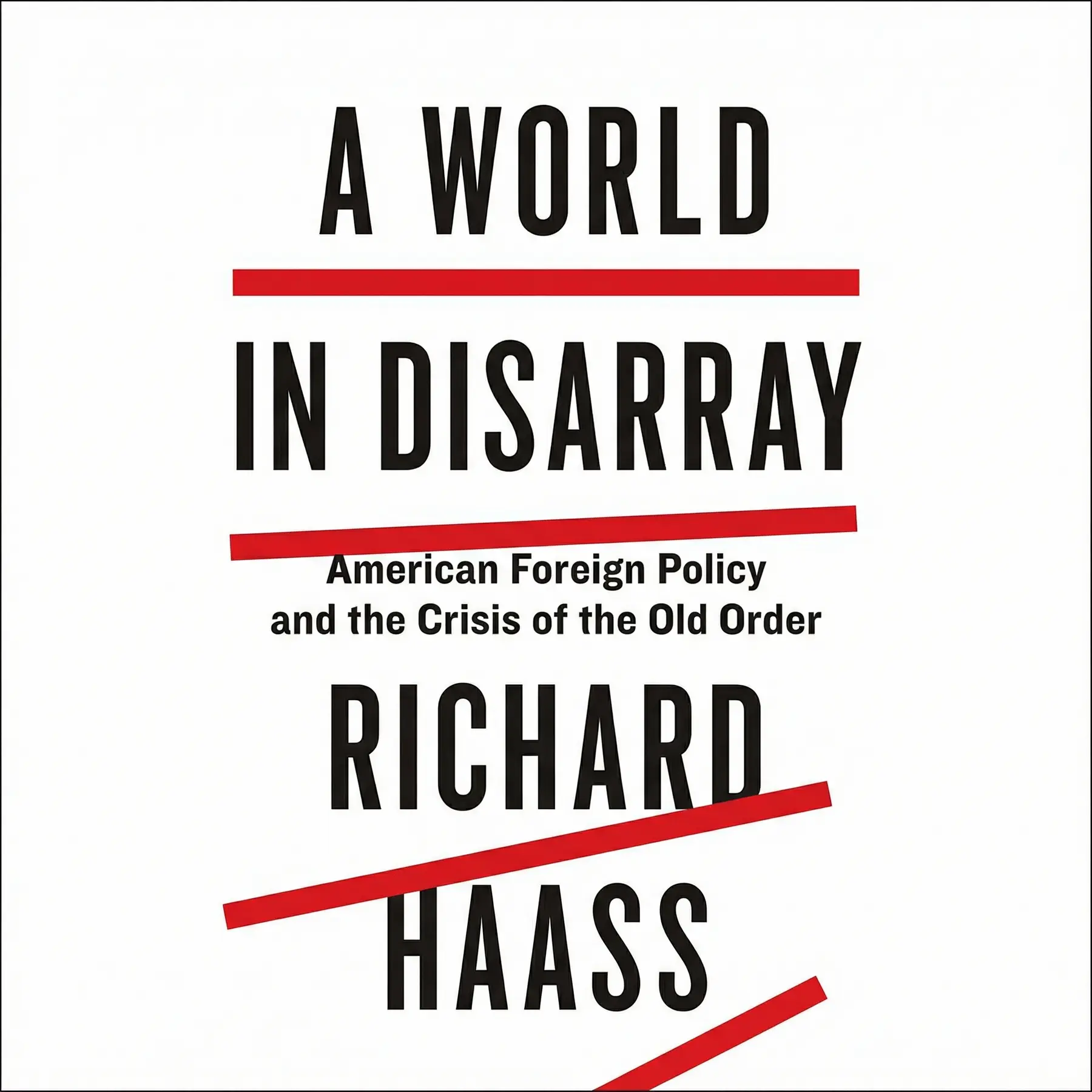
Listeners find the work deeply researched and educational regarding foreign policy, with one listener observing its encyclopedic command of history and politics. Furthermore, the writing is straightforward and easy to track, whereas the information is both eloquent and stimulating. Listeners also value the book's outlook, as one listener stresses how it effectively weaves global happenings together.
Finally got around to reading this, and it works perfectly as a comprehensive guide for anyone feeling lost in the current geopolitical landscape. Haass possesses an encyclopedic knowledge of history. He manages to explain the transition from the Cold War to the present day without drowning the reader in jargon. I particularly appreciated the section on regional realities, which helped me understand the specific challenges facing Asia and the Middle East. The book is incredibly well-researched. It serves as a necessary refresher for those of us who haven't studied this since college. While some critics say it’s too basic, I think the clarity is its greatest strength. It’s an informative look at why the world feels so messy right now. Highly recommended for any citizen who wants to be better informed about our role in the world.
Show moreThis book is a masterclass in synthesis, bringing together decades of historical shifts into a single, readable narrative. Haass explains the 'disarray' not as a random series of events, but as a systemic failure of the old Westphalian model to keep up with globalization. I loved how he connects the dots between climate change, global health, and traditional statecraft. His style is clear and easy to follow, which is a rare feat for such a dense subject. The encyclopedic knowledge on display here is staggering. It’s a thought-provoking work that challenges the reader to think about what countries owe to one another in an interconnected age. Even the minor criticisms of his hawkishness don't detract from the overall value of the history presented. It is easily one of the best foreign policy books I've read in years.
Show moreAs a student of international relations, I found Haass’s breakdown of the shift from the Westphalian system to our current state of 'nonpolarity' to be remarkably lucid. The prose is clear, and the author does a fantastic job of synthesizing centuries of history into a cohesive narrative that explains why the old order is crumbling. He introduces the concept of 'sovereign obligation,' which suggests that being a state involves duties to the world, not just rights. It is a compelling, if slightly idealistic, framework. However, the book does feel somewhat U.S.-centric, and he tends to skip over the more controversial aspects of American interventionism. Still, for anyone wanting to understand the 'Global Gap' between our challenges and our institutions, this is a thought-provoking and well-articulated read. It brings disparate world events together into a single, understandable picture.
Show moreRichard Haass provides an incredibly articulate look at why the world feels like it is falling apart right now. He argues that the diffusion of power among non-state actors has created a 'nonpolar' world where no one is truly in charge. I found his analysis of the 'Global Gap'—the distance between global problems like climate change and our current ability to solve them—to be particularly sharp. The book is informative and easy to follow, making it accessible even if you aren't a policy wonk. My only real gripe is that he can be a bit dismissive of criticisms regarding U.S. hegemony. He views the world through a very traditional Washington lens. Regardless, the perspective he offers is vital. It is a clear-eyed assessment of the crisis of the old order that everyone should read.
Show moreEver wonder why the rules that used to govern international politics don't seem to apply anymore? This book answers that question by tracing the evolution of sovereignty from the 17th century to the present. Haass is a master of clear writing. He takes complex topics like nuclear proliferation and cyber security and explains them in a way that feels urgent and relevant. The chapter on 'Sovereign Obligation' is the highlight, proposing a new set of rules for a globalized world. I appreciated the non-biased tone of the historical sections, though his policy recommendations definitely lean toward a specific brand of realism. There are a few moments where he relies on catchy lines that feel a bit thin, but overall, it is a well-researched and necessary addition to any bookshelf. It provides a great perspective on how we got here.
Show morePicked this up after seeing Haass on a talk show, and while his tone can be a bit dry, the content is undeniably important. The idea that sovereignty should come with obligations to the international community is a fascinating concept that deserves more attention. He does a decent job of laying out both sides of major arguments, particularly regarding the intervention in Libya and the rise of China. The writing is articulate, though I did find the structure a bit repetitive toward the end. One minor gripe: the audiobook narrator was a bit listless, which made the historical sections feel longer than they were. However, if you stick with it, you’ll gain a much better understanding of the challenges facing our world. It is a solid, informative look at American foreign policy and the crisis of the old order.
Show moreTruth is, the current state of global affairs is terrifying, but Haass provides a much-needed map through the chaos. He moves from the history of world order to the current 'Global Gap' with the precision of a seasoned diplomat. Some might find his reliance on Kissinger-style realism a bit dated, but his call for a new 'World Order 2.0' is well-reasoned and necessary. The prose is clear and the chapters are manageable. I particularly liked the section on how globalization has disordered the world in unexpected ways. It is a well-researched book that manages to be both encyclopedic and accessible. While it doesn't offer a magic solution, it provides a thought-provoking framework for how we might start to fix the mess. Definitely worth the read for anyone interested in politics.
Show moreThe first half of the book is a solid refresher on the history of global order, but things get a bit muddled when Haass starts prescribing solutions. He hammers on about Obama’s 'red line' in Syria repeatedly without providing much new insight into that specific failure. His main thesis—World Order 2.0—rests on this idea of sovereign obligation, but I struggled to see how this would actually work in practice with countries like Russia or China. Look, the writing is articulate and the structure is appealing, especially the early chapters on the lessons of the World Wars. But by the end, I felt like I was reading a collection of talking points rather than a deep strategic analysis. It’s an okay primer, but it lacks the 'thrust' of his more academic essays. A decent read, but not necessarily a groundbreaking one.
Show moreNot what I expected from the President of the Council on Foreign Relations. While the historical summary in the first half is adequate, the latter parts of the book devolve into uninspired platitudes that lack any real teeth. He uses these bizarre metaphors—comparing the Middle East to Humpty Dumpty and calling Goldilocks the 'ultimate centrist'—which feels patronizing given the gravity of the subject matter. It is pure pablum. If you are looking for a deep dive into how to actually implement his solutions, you won't find it here. Instead, you get a list of modest goals that feel like squandered opportunities for a thinker of his caliber. To be fair, the writing is clear, but the content is too basic for anyone already initiated in international affairs. It felt like a 'World Order for Dummies' guide.
Show moreFrankly, this felt like 'International Relations for Dummies' and offered very little to anyone who has read a newspaper in the last decade. Haass spends way too much time recounting the Westphalian system and the Cold War without offering any fresh insights. The book is heavily U.S.-centric. His refusal to be candid about American failings in Iraq—an administration he was part of—is a massive blind spot that undercuts his authority. It's a boring read. I expected a serious thesis, but what I got was a monotone recount of events without any real structural argument. His solutions are nothing unprecedented or surprising. If you want a basic refresher, it is fine, but don't expect to walk away with a deep understanding of the current global crisis. His Foreign Affairs essays are much more insightful than this book.
Show moreRichard Haass argues that the order which kept the peace after World War II has largely worn out. Power has spread to more players than ever, including many that are not states, and problems like climate change and cyberattacks cross every border. American mistakes, from the 2003 Iraq invasion to inaction in Syria, widened the cracks. He proposes World Order 2.0, built on states accepting duties to one another.
Sovereign obligation keeps respect for borders and sovereignty but adds duties. A government must avoid activities on its soil that harm other countries and do all it can to stop others from carrying them out from its territory. Haass contrasts it with the responsibility to protect, which looks inward at a state’s own citizens, and presents it as realism updated for a globalized era.
Haass describes the Cold War as predictable, a quality he thinks is underrated. Alliances like NATO, the Marshall Plan, nuclear deterrence and arms control treaties balanced power. Institutions such as Bretton Woods, the International Monetary Fund, the trade agreement known as GATT and the United Nations supplied agreed rules. Both superpowers also showed restraint, as when Washington held back during the 1956 Hungarian uprising.
He treats them as opposite errors. The 2003 Iraq invasion was a preventive war against a threat that had not materialized, which he considers illegitimate, and its aftermath fed civil war and later ISIS. In Syria, Obama warned against chemical weapons but did not respond firmly after the August 2013 attack that killed about 1,500 people. Haass argues threats must be honored and commitments not abandoned early.
Haass wrote it for students of foreign policy and international relations as well as general readers and experts. It suits anyone who wants a framework for understanding global crises, from great-power rivalry with China and Russia to climate and cyber threats, and anyone weighing whether the United States should engage abroad or turn inward. Its closing argument links foreign policy to repairing politics and debt at home.
Masaji Ishikawa

John Rawls



Miles Taylor


Tracy Rosenthal

Jessica Valenti

Yanis Varoufakis
AUDIO SUMMARY AVAILABLE
Get the key ideas from A World in Disarray by Richard Haass, plus 5,000+ more nonfiction titles.









