
15 min
Available in: English
Smarter Not Harder: The Biohacker's Guide to Getting the Body and Mind You Want
By Dave Asprey
Shows how to get fitter, more energetic, sharper and calmer by working with your body's urge to save energy, using short, targeted biohacks in place of punishing workouts and crash diets.
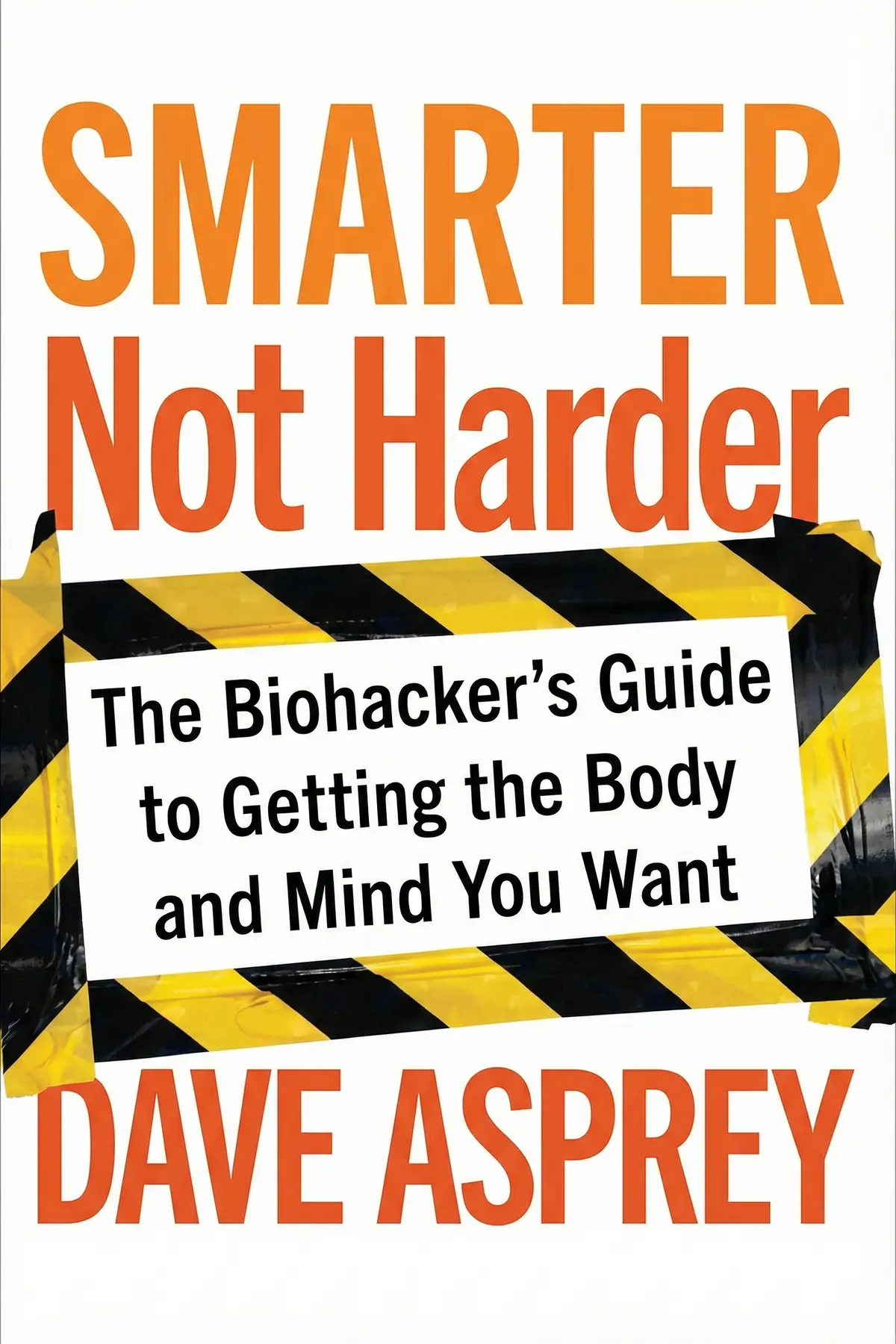
Table of Content
1. Introduction
57 sec
If your plan for a better body runs on punishing workouts and crash diets, Dave Asprey thinks you are fighting the wrong opponent. In Smarter Not Harder, the tech executive turned biohacker argues that your body is designed to spend as little energy as possible, and that this laziness can work in your favor. Send it short, precise signals of hardship, he says, and it upgrades itself.
That idea runs through everything here: you get stronger, sharper and calmer by working with your body’s urge to save effort. Asprey starts with food, moves through strength, cardio, energy, the brain and stress, and ends somewhere unexpected, with forgiveness. On the way come routines you can try this week, from a ten-second rule for lowering weights to a three-minute eye exercise. Asprey also advises seeing your doctor before changing diet, exercise or health habits, and that advice covers everything below.
2. Let your lazy body do less and gain more
1 min 22 sec
Every cell in you is trying to get away with the minimum. Most fitness plans treat that as the enemy. Asprey sees it as the most useful fact about your biology, and builds his whole method on it.
3. Fix your plate before you try any hack
1 min 43 sec
Some of the foods most often praised as healthy sit at the top of Asprey’s list of things to cut. His case for what to remove, and what to add, sets the base for everything else he recommends.
4. Pick one target and give it a number
1 min 28 sec
Asprey has found that almost everyone wants the same handful of things from their body. Fix those, he says, and goals like weight loss and longevity take care of themselves. The hard part is knowing where to start.
5. Build strength and stamina in shorter, sharper sessions
1 min 47 sec
Sensors in your body are telling your brain you are weaker than you are. Asprey explains how to get past them safely, and why he thinks the treadmill is one of the least useful machines in the gym.
6. Trick your cells into making more energy
1 min 45 sec
A long hum, a small trampoline and a held breath all appear in Asprey’s plan for more energy. Each one works, he says, by convincing your body of something that is not quite true.
7. Give your brain a mirror to learn from
1 min 35 sec
A gorilla meeting its reflection for the first time does something surprising within seconds. Asprey uses that moment to explain why your brain rarely improves itself, and what kind of feedback changes that.
8. Ease stress with sleep, sunlight, herbs and heat
1 min 33 sec
When stress runs high, Asprey says the last thing you need is a harder workout. His alternatives are simple ones: better sleep, some daily sunlight, a few herbs and regular time in the sauna.
9. Forgive the memory that keeps draining you
1 min 44 sec
A breakup or a lost job can leave you shaken long after the event. Asprey’s answer is a three-step practice that ends with a question put to an imaginary figure, possibly even a lightbulb.
10. Conclusion
1 min 06 sec
Smarter Not Harder adds up to a new attitude toward your own body. Asprey treats it less as a stubborn animal to beat into shape and more as a cautious operating system that upgrades itself when it gets the right inputs: a heavy weight lowered slowly, a 30-second sprint, a held breath, a long hum, a far horizon, a hot room, a forgiven memory. The body does the rest.
The way to use the book is to run your own small experiment. Pick the one quality that matters most to you now and tie it to a number, such as resting heart rate or heart rate variability. Try a single hack aimed at it, give it time to show a trend, and talk to your doctor before any big change to diet, exercise or supplements. Asprey wants you to personalize, keeping what works for you and dropping what does not.
When the number finally moves, resist settling. In his view a new baseline is never the finish line. It is where the next small, lazy improvement begins.
About this book
What is this book about?
Most people try to improve their bodies by force: longer gym sessions, stricter diets, more willpower. Dave Asprey argues that this fights the wrong battle. Your body, he says, runs on a kind of operating system whose main goal is to stay alive while spending as little energy as possible. Push against it and it pushes back. His alternative is to hack that system. Asprey lays out a food foundation first, then five qualities most people want: strength, cardiovascular fitness, energy, brain function and lower stress. For each he offers specific routines, from lowering heavy weights slowly and sprinting in 30-second bursts to humming, breath holds, eye exercises, sunlight and sauna sessions. He ends with a three-step forgiveness practice for the emotional shocks that drain energy. Readers get a menu of hacks at several levels of difficulty, a way to choose which goal to work on first, and a simple measure for checking whether each one is working. Asprey advises talking to a doctor before any major change.
Book Information
Who it's for
Time-pressed professionals
Busy professionals who want more energy and fitness but have no time for long gym sessions.
Biohacking explorers
People curious about biohacking who want a menu of routines, from free to gadget-based.
Stress-weary adults
Anyone worn down by stress who wants low-effort ways to sleep and recover better.
About the Author
Dave Asprey
Dave Asprey, born in 1973, worked in technology before turning to health and wellness, holding executive and director roles at Trend Micro, Blue Coat Systems and Citrix Systems. In 2013 he founded Bulletproof 360 and created Bulletproof Coffee and the Bulletproof Diet, a low-carbohydrate, high-fat eating plan, though dietitians have criticized some of his claims about it as pseudoscientific. He hosts the podcast The Human Upgrade, formerly Bulletproof Radio, started the Biohacking Conference, and also wrote The Bulletproof Diet and Head Strong.
Ratings & Reviews
Ratings at a glance

What people think
Listeners find this work delivers high-quality, scientifically grounded insights combined with useful guidance for enhancing health and daily life. The subject matter is fascinating and the author earns praise, yet listeners are divided regarding how accessible the concepts are. While some listeners believe it offers excellent value, others mention that various suggested supplements are quite costly.
Top reviews
Tee
Wow, this is a game-changer for my daily routine. I’ve always been interested in health, but I simply don’t have two hours a day to spend at the gym. Asprey’s focus on high-intensity intervals and "hypoxia" breathing techniques allows me to get results in a fraction of the time. The chapter on Heart Rate Variability (HRV) was particularly enlightening, as it gave me a concrete way to measure my stress levels. I appreciate that he covers spiritual growth and forgiveness alongside the physical stuff, because mental health is just as important. Some of the supplement advice is a bit pricey, but you can choose what fits your budget. If you want to stop wasting energy on things that don't work, you need to read this book. It’s definitely one I’ll be keeping on my shelf for a long time.
Show moreFatou
The concept of the MeatOS is absolutely brilliant. It changed my entire perspective on why my body resists certain types of exercise and craves specific foods. I particularly enjoyed the section on spiritual recovery and the three-step process for forgiveness. Most health books ignore the soul, but Asprey realizes that spiritual stress can wreck your physical health just as fast as a bad diet. I’ve started using the "gratitude reset" he describes and my sleep has never been better. Look, you might not agree with every single claim he makes about seed oils or raw milk, but the overall framework is solid. This is about taking control of your biology and living a longer, more vibrant life. It’s an essential read for anyone who wants to be better than normal and stop fighting their own biology.
Show morePhichai
Ever wonder why you’re working so hard at the gym with zero results? This book completely flips the script on the "no pain, no gain" mentality that we've been fed for decades. Asprey explains how our bodies are programmed to be "lazy" to survive, and how we can use that to our advantage. I loved the section on resistance bands and how they can trigger muscle growth three times faster than traditional weightlifting. The idea of "hacking" your own operating system is fascinating and honestly quite empowering. I do think some of the high-end tech he mentions is a bit out of reach for most, but he usually provides a low-cost alternative. My energy levels have already improved just by tweaking my mineral intake and focusing on better sleep hygiene. It’s a solid resource for anyone tired of the traditional fitness grind.
Show moreKom
After hearing Dave on a podcast, I decided to give this a shot to see if I could boost my afternoon energy. The insights into how industrial farming has stripped our food of essential minerals were eye-opening and made a lot of sense. I’ve started being more mindful of phytic acid and antinutrients, and I can actually feel a difference in my digestion. The book is very well-written and moves at a fast pace, though I did find myself skimming some of the more "woo-woo" sections. For example, the part about sonic feedback and binaural beats felt a little thin on evidence compared to the nutrition chapters. Still, the core message of working with your body instead of against it is incredibly valuable. It’s a great guide for anyone looking to navigate the confusing world of modern health and anti-aging.
Show morePrapaiwan
Finally got around to reading this and I’m impressed by the scope of what Asprey covers. He breaks health down into five manageable domains: strength, cardio, energy, stress, and the brain. This structure makes it easy to focus on what you actually need most right now. I’ve been struggling with brain fog, so the sections on neurofeedback and vagus nerve stimulation were exactly what I was looking for. There is a lot of information to digest, and yes, some of it feels like it’s on the fringe of science. However, the "smarter not harder" approach is a breath of fresh air in a world of extreme diets. You don't have to do everything in the book to see a benefit. Just picking two or three "hacks" can make a significant difference in how you feel daily. I'll definitely be keeping the hard copy for reference.
Show moreJirapat
Not what I expected, but in a good way. I thought this would be another boring fitness book, but it’s actually a very practical manual for life optimization. The print version is excellent because it has helpful charts and emphases that make it easy to scan for information when I'm in a hurry. I appreciate that he includes "accessible" hacks for people who can't afford the high-tech gadgets he uses. For instance, you can do the breathing exercises or the vision drills for free. To be fair, I did find the sections on supplements a bit repetitive after a while. I also think he could have backed up some of the more "out there" claims with better citations. Despite those minor gripes, the book is incredibly motivating and provides a clear path to optimization. It’s definitely worth the investment for the time-saving tips alone.
Show moreIsabelle
Direct and provocative, this book will definitely make you rethink your habits. Asprey isn't afraid to challenge mainstream health advice, which I find refreshing even if I don't always agree with his stance on saturated fats. The advice on using cold plunges and saunas for recovery has been a game-changer for my muscle soreness. I also appreciate the focus on "mitogenesis" and improving the powerhouses of our cells. Sometimes the technical jargon gets a little thick, but the core advice remains actionable for the average person. My only real complaint is that it can feel a bit like a sales pitch for his own line of supplements at times. If you can filter through the marketing, there is a wealth of life-changing information hidden in these pages. It’s a high-energy read that delivers on its promise to help you work smarter, not harder.
Show moreVera
As someone who has followed the biohacking scene for a while, I found this to be a bit of a mixed bag. The concept of the "MeatOS" is a clever way to think about our biology, and some of the mineral advice—especially regarding Vitamin D and K—is solid. However, the book gets bogged down in technical details that might confuse a newcomer. While Dave clearly knows his stuff, I felt like I needed a practical workbook to actually implement any of this. Some sections read like a laundry list of gadgets and supplements without enough guidance for the average person to get started. To be fair, the writing style is engaging and Asprey’s personality shines through, but the barrier to entry is high. It’s an interesting read if you want to know what’s possible, but don’t expect a simple step-by-step guide you can start tomorrow.
Show moreOscar
Picked this up hoping for a streamlined health guide, but it ended up being incredibly overwhelming. For a book that claims to make life "easier," it spends a lot of time listing basic foods you can’t have anymore. Finding out that chicken and nuts are suddenly "no-go" items made me want to close the book immediately! I'm all for optimizing my health, but some of these suggestions feel completely inaccessible to a regular person with a normal budget. Not everyone can afford a hyperbaric oxygen chamber or expensive vibration plates in their living room. Frankly, it’s frustrating to read a book about being "lazy" that requires a massive financial investment and a PhD to follow the diet. I stopped about 20% of the way through because I just couldn't see myself adopting such a restrictive and expensive lifestyle.
Show moreTen
This book is a massive disappointment for anyone seeking actual scientific rigor. While I appreciate the sentiment of wanting to improve performance, Asprey makes countless unsubstantiated claims that feel more like personal ideology than medical fact. I struggled to get past the early chapters because the lack of quality proofreading for his "hacks" was genuinely alarming. He lists twenty pages of references at the end, but many feel like cherry-picked studies that don't support the sheer weight of his recommendations. Truth is, parading a single biased study as a universal health truth is dangerous territory. If you're looking for a book that has been through a proper medical review process, look elsewhere. It feels like 80% snake oil and 20% common sense, and it is simply not worth the time it takes to filter through the fluff.
Show moreQuestions about this book
What is the main idea of Smarter Not Harder by Dave Asprey?
Asprey argues that your body runs on a background program he calls the meat operating system, or MeatOS, which aims to survive while using as little energy as possible. Instead of fighting that laziness with punishing workouts and crash diets, he recommends hacks: short, targeted signals of hardship that push the body to upgrade itself, improving strength, cardio, energy, brain function and stress.
What are the five qualities Asprey says people want to improve?
In Asprey’s experience, most people want more strength, better cardiovascular fitness, higher energy and a better metabolism, sharper brain function, and lower stress with easier recovery. He says longevity, sexual function and weight loss improve on their own once these five are addressed. He suggests starting with energy, then the brain, strength, stress and cardio, adjusted to your own priorities.
What workouts does Smarter Not Harder recommend?
For strength, Asprey suggests heavy weights lowered over at least ten seconds and repeated to exhaustion, isometric holds such as planks, and resistance bands. For cardio, he prefers intervals to steady treadmill work: one version alternates hard, medium and very easy effort, and a harder one mixes 30-second sprints with very slow walking for about 20 minutes.
How can I apply Smarter Not Harder to reduce stress?
Asprey offers four levers. Improve sleep with dim evening light, blackout curtains and devices off two hours before bed. Get 15 to 20 minutes of sun on your skin daily. Consider ashwagandha, ginseng or rhodiola, after checking with a doctor if you take medication. Build up to 20-minute sauna sessions three times a week.
How do I know if biohacking is working?
Asprey ties each goal to a measure. Track resting heart rate for cardio, your one-rep maximum for strength, how you feel for energy, memory and reaction-time tests for the brain, and heart rate variability for stress. For aging, he mentions the mirror or a DNA methylation test. He also urges you to keep improving rather than settle at a new baseline.
Readers also enjoyed



AUDIO SUMMARY AVAILABLE
Listen to Smarter Not Harder in 15 minutes
Get the key ideas from Smarter Not Harder by Dave Asprey, plus 5,000+ more nonfiction titles.
- 5,000+ titles
- Listen as much as you want
- 7-day free trial
- Cancel anytime









