

15 min 20 sec
Available in: English
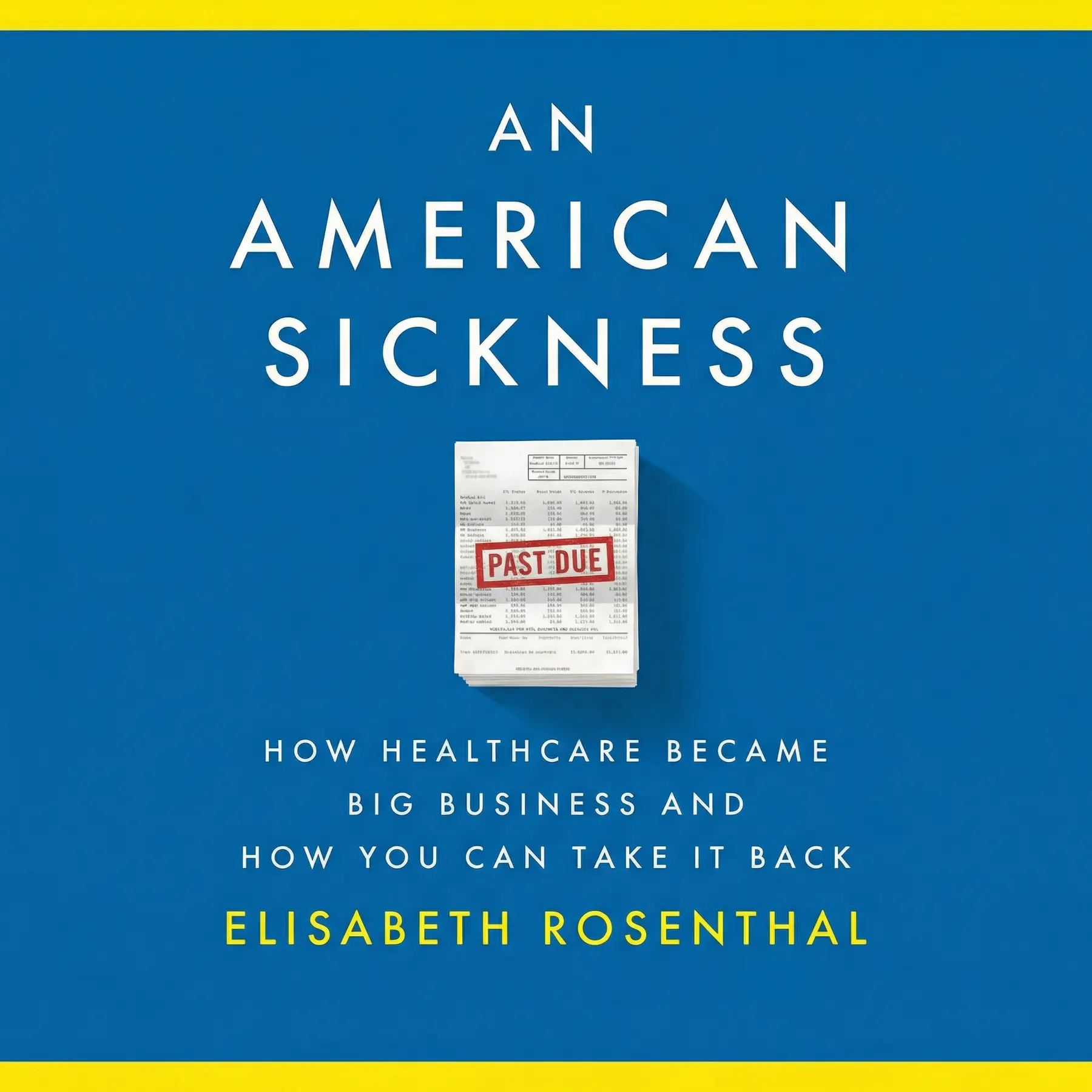
An American Sickness: How Health Became Big Business and How You Can Take It Back
Shows why American medical bills climb so high, tracing the profit motive through insurers, hospitals, doctors, drug makers and device companies. It also gives patients practical ways to question, compare and negotiate their costs.

Table of Content
1. Introduction
59 sec
Most people handed a large medical bill assume the price reflects the care they received. In An American Sickness, doctor turned journalist Elisabeth Rosenthal shows that in the United States it usually reflects something else: what each business along the chain has learned to extract. Insurers, hospitals, doctors, drug makers and device companies all earn more when care costs more, and the patient pays for every one of those incentives.
Follow that thread and the strange numbers start to make sense, from an ulcer drug that costs $12 a month in the United Kingdom and up to $1,200 in the US, to a child’s stomachache that ended in a $7,000 scan. The same thread points to the remedy. A system that runs on money responds to patients who ask about money, and a few well-timed questions, a network check, an itemized bill and a counteroffer can shrink what you pay this year.
2. Learn why a bigger bill can suit your insurer
1 min 55 sec
A teacher’s drug infusion jumped from $19,000 to $130,000 overnight, and his insurer paid without a single question. The reason sits in a rule that was meant to protect patients.
3. Read a hospital bill like a business plan
2 min 06 sec
A routine emergency operation in Seattle produced a bill of more than $44,000, filed under a single vague word. Behind it lies a decision hospitals made decades ago about what they really are.
4. Spot the specialist fees you never agreed to
1 min 41 sec
Some of the largest charges on a hospital bill come from doctors the patient never meets. How did people who work behind the scenes end up sending the biggest invoice of all?
5. Spot how old drugs return with new prices
1 min 51 sec
A painkiller that costs nine dollars to make sells for more than sixteen hundred. It contains nothing new, and the way it got its price reveals a routine trick of the drug business.
6. Understand who profits from the device inside you
1 min 49 sec
A man offered to pay for his brother’s heart device, then discovered that neither the hospital nor the maker would tell him the price. What he finally paid shows how layers of profit stack up.
7. See the true cost of profit-first medicine
2 min 06 sec
A Harvard researcher with a possible treatment for type 1 diabetes could not get funding, even from diabetes charities. Her story shows what a money-driven system chooses not to pay for.
8. Cut your costs by asking before you sign
1 min 49 sec
Hospitals let even junior clerks approve large discounts, yet most patients never ask for one. A few questions at the right moment can change what you owe, before treatment and after the bill arrives.
9. Conclusion
1 min 04 sec
An American Sickness works like a chart for a whole system. Rosenthal’s diagnosis is that the absurd prices are not accidents. The $130,000 infusion, the $9 pill sold for $1,600 and the $30,000 defibrillator nobody would quote are what happens when every player earns more as costs climb. Once you can see the incentive, the bill stops looking random.
That diagnosis also carries the hope. The patient who asks what a scan will change, signs only the limited consent clause, demands the itemized bill and then makes an offer is playing by the same rules the hospital plays by. Even far from American hospitals, the habit travels: whenever a price looks impossible to explain, find out who gains when it rises.
Rosenthal trained as a doctor before she became a reporter, and her book ends where good medicine begins, with careful questions. Ask them before anyone hands you a form, because the bill you question early is the one most likely to shrink.
About this book
What is this book about?
Almost everyone in the United States agrees health care is not working, but few can say exactly why a short hospital stay or a monthly prescription costs what it does. Elisabeth Rosenthal, a Harvard-trained doctor who became a health reporter, follows the money to answer that question. Her diagnosis is that American medicine has turned from a set of charities and nonprofits into big business. Insurers, hospitals, doctors, pharmaceutical firms and medical-device makers have each found ways to profit from higher prices: strategic billing, facility fees, recycled drug patents, device markups and tests nobody needed. She builds the case from patients' stories, such as a $130,000 infusion, a $44,000 emergency operation and a $30,000 defibrillator whose price nobody would reveal. The book then turns practical. Rosenthal looks at how countries such as Germany, Japan and Canada keep prices in check, and she gives patients concrete moves: ask what each test costs and why, check your insurer's network, sign only a limited consent clause, demand an itemized bill, negotiate, and shop around for drugs and lab work.
Book Information
Who it's for
US patients and families
Patients and families in the US facing large medical bills or confusing insurance choices.
On costly prescriptions
People on costly prescriptions who want ways to pay less for the same treatment.
Curious about medical costs
Readers who want a clear, story-driven explanation of why American health care costs so much.
About the Author
Elisabeth Rosenthal
Elisabeth Rosenthal trained as a doctor at Harvard Medical School and also studied biology at Stanford and English literature at Cambridge. She spent more than twenty years at the New York Times, covering science, health and hospitals, reporting from Beijing and Rome, and writing on the environment. Her two-year series Paying Till It Hurts won many prizes. In 2016 she became editor-in-chief of Kaiser Health News, a nonprofit newsroom focused on health policy. An American Sickness is her first book.
Ratings & Reviews
Ratings at a glance
What people think
Listeners view this book as a necessary read that is both extensively documented and clearly articulated, serving as a vital tool for grasping the healthcare industry. Additionally, the work offers practical perspectives and is especially advantageous for price haggling, with one listener reporting that it helped them cut costs on their prescriptions. Listeners also characterize the account as eye-opening, with one review praising its broad analysis of what drives medical costs. On the other hand, the book’s precision is met with differing opinions; some listeners find the content factual, while others disagree with its findings.
Top reviews
Tang
Ever wonder why a single aspirin at the hospital costs more than a whole bottle at the drugstore? Rosenthal’s investigation into the "Economic Rules of the Dysfunctional Medical Market" provides the chilling answers. This book is a masterclass in muckraking, exposing how the shift from "first do no harm" to "first leave no money on the table" has gutted our system. I was particularly floored by the section on how medical device manufacturers avoid the same FDA rigor as drugs, essentially using patients as test subjects. While the second half offers practical advice for negotiating bills, the sheer scale of the greed described is enough to make anyone feel ill. It’s a dense read, and the level of detail regarding billing codes can be overwhelming, but the knowledge is power. I’ve already started asking for itemized bills every time I visit the clinic.
Show moreLaor
Wow, this was a punch to the gut. I was familiar with the idea that US healthcare is expensive, but the "billing chicanery" detailed here is on a whole different level of corruption. Rosenthal exposes how doctors have moved away from ethical pledges to embrace complex coding systems that maximize revenue. It’s a frightening look at how we are all one diagnosis away from financial ruin. The personal stories sprinkled throughout kept me engaged even when the data got dry. To be fair, some of the advice on how to fight back feels a bit dated in the era of digital portals, but the core principles of price transparency are timeless. Every American needs to read this to understand why our insurance premiums keep skyrocketing while our care feels increasingly transactional and cold. Truly an essential, eye-opening piece of journalism.
Show moreNiramai
Picked this up on a whim and it actually saved me three hundred dollars on my last prescription refill. The chapters on how big pharma manipulates patents to prevent generic competition are infuriating but extremely helpful for understanding the market. Rosenthal doesn't pull any punches, targeting the lobbying at the federal level that keeps our representatives in the pocket of hospital networks. I loved the appendix with sample letters to insurance companies; it makes the daunting task of fighting a bill feel much more manageable. The book reveals a system that is essentially random in its pricing, which is why we have to be hyper-vigilant. It’s a thick tome and not exactly a beach read, but it’s the most practical book I’ve read this year. If you want to know how the gears of the American medical machine actually turn, look no further.
Show moreWillow
An American Sickness should be mandatory reading in every high school civics class. It’s a comprehensive look at the drivers of our healthcare crisis, from the unbundling of services to the lack of price transparency. I was particularly struck by the fact that hospitals now act like luxury hotels, focusing on aesthetics to lure in wealthy patients while the poor are left with astronomical debts. Rosenthal’s background as an ER doctor shines through in her ability to explain complex medical billing in a way that’s easy to digest. Personally, I found the section on medical manufacturers to be the most shocking—realizing how little testing goes into implants was terrifying. It’s an infuriating read, but one that equips you with the tools to defend your wallet. Don't go to the hospital again without reading the last three chapters of this book.
Show moreNutnicha
The sheer depth of research Rosenthal poured into these pages is staggering. She tracks the evolution of healthcare from a service-oriented field to a predatory industry with surgical precision. I appreciated that she took aim at both sides of the political aisle, showing how Democrats and Republicans alike are in hock to the AMA and big pharma. The book highlights the "American Sickness" as a systemic failure where more treatment is always billed as better, regardless of the patient outcome. My experience with the healthcare system has always felt like a confusing maze, and this book finally gave me the map to understand why. It’s a heavy, depressing subject, but the author’s clear prose and compelling real-life examples make it a page-turner. It is a brilliant call to action for anyone tired of being treated as a profit center instead of a human being.
Show moreBook
Finally got around to finishing this massive tome, and I’m still reeling from the revelations about medical device manufacturers. The fact that a piece of mesh or a hip replacement can be sold for a 1000% markup with minimal oversight is insane. Rosenthal does a fantastic job of breaking down the "chicanery" that happens behind the scenes of every surgery and consultation. This book is a loud, clear siren alerting us to the fact that profit is king in American medicine. While some critics say she doesn't offer enough systemic solutions, I think the value lies in the individual empowerment she provides. I’ve started questioning every test my doctor orders, and I’m no longer afraid to ask for the cash price. It’s an eye-opening, essential guide for the modern patient. If you value your health and your bank account, you need this book on your shelf.
Show moreSomsri
After hearing so much buzz about this title, I finally dived in to understand the American healthcare quagmire. Rosenthal, both a physician and a journalist, brings incredible weight to her argument that profit has completely eclipsed patient care. The history of how Blue Cross transitioned from a teacher-led non-profit to the corporate giant it is today was a real eye-opener for me. The truth is, our system isn't just broken; it's designed to be a cash cow for everyone except the person in the gown. My only real gripe is that the author places a massive burden on the patient to act as their own private investigator. Who has the energy to track every single person entering their hospital room while they are recovering from surgery? It's a vital resource, though I wish there were more focus on systemic policy shifts rather than just individual resistance.
Show moreWit
As someone who has worked in medical administration for a decade, I found the chapters on the AMA and 'coding' to be disturbingly accurate. Rosenthal perfectly captures how the business of medicine has detached itself from the actual science of healing. The way hospitals use "extenders" to double-bill for a single surgery is a scandal that doesn't get enough mainstream attention. Frankly, the book can be a bit of a slog because there is just so much information to process, but it is worth the effort for the perspective it provides. I did find her dismissal of the insurance industry as the "least of our worries" to be a bit provocative, considering how much they dictate treatment. However, her focus on hospitals and physicians as profit-drivers is a necessary correction to the usual narrative. A solid, well-researched critique that should be on every medical student's desk.
Show moreOscar
This book is essentially muckraking of the highest order, but it left me feeling more exhausted than empowered. While the first two-thirds provide a shocking look at how hospitals and big pharma extract every possible cent, the solution section feels like a second full-time job. Rosenthal suggests we should be challenging every line item and questioning every doctor's ownership in surgical centers. Look, I appreciate the transparency, but the average person is too sick or too busy to navigate this level of bureaucracy. The writing is sharp, yet it occasionally feels like a repetitive list of grievances. I also felt the political analysis was a bit one-sided, failing to fully acknowledge that the problem isn't just one party—it's the entire lobbying machine. It is an important read, certainly, but it’s a depressing one that offers few easy exits for the country at large.
Show moreSom
Not what I expected from a Harvard-trained physician. While the book is clearly well-researched, the tone feels overly cynical and at times borders on sensationalism. Rosenthal paints almost every player in the healthcare field with the same brush of greed, which feels unfair to the many providers truly trying to help. The truth is that the system is complex, and reducing it to a few "economic rules" of dysfunction ignores the innovations that make American care high-quality in many areas. I found the advice in the second half to be largely impractical for anyone facing a real medical emergency. I disagree with her assertion that patients can simply "shop around" for better prices when most of the time you don't even know what you're being charged until weeks later. It's a provocative read, but it lacks the nuance I was hoping for in such a serious discussion.
Show moreQuestions about this book
What is the main argument of An American Sickness?
Elisabeth Rosenthal argues that American health care has turned from a largely charitable, nonprofit system into big business. Insurers, hospitals, doctors, drug makers and device companies each profit when prices go up, so costs keep climbing while patients carry the burden. She supports this with cases such as a $130,000 drug infusion, a $44,000 emergency operation and a painkiller that costs $9 to make but sells for over $1,600.
Why are prescription drugs so expensive in the United States, according to Rosenthal?
Rosenthal says drug companies raise prices as high as the market will bear and protect them with patents. When a patent nears expiry, firms win new ones by making small non-obvious changes to old ingredients or by combining existing drugs, as Horizon did with ibuprofen and famotidine in Duexis. She contrasts an ulcer drug costing about $12 a month in the United Kingdom with $700 to $1,200 in the US.
How can I lower a hospital bill using this book's advice?
Rosenthal recommends asking what each test and treatment costs and why it is needed, checking that every provider is in your insurer’s network, and signing a limited consent clause at admission. After treatment, request a fully itemized bill. If the total is too high, negotiate: she reports that even junior clerks can approve large discounts, because hospitals prefer payment to sending debts to collectors.
How does Rosenthal suggest saving money on medications and lab tests?
Ask your doctor about cheaper alternatives that work as well, and check whether two smaller-dose pills cost less than one larger one. Compare pharmacy prices on GoodRx.com, which also provides coupons. For blood and other samples, ask that they be sent to a commercial lab in your insurer’s network, since hospital labs usually charge much more.
What solutions does An American Sickness propose for the US system?
Rosenthal points to other countries. Germany, Japan and Belgium use national fee schedules for some drugs, procedures and devices, set by doctors, academics and officials, so prices cannot rise overnight. Canada, Australia and Taiwan use single-payer systems in which government covers most basic care. She credits the Affordable Care Act with cutting the uninsured rate but says it did little to reduce costs.
Readers also enjoyed

21 Lessons for the 21st Century
Yuval Noah Harari
A Different Kind of Power: A Memoir
Jacinda Ardern
Age of Anger: A History of the Present
Pankaj Mishra
A Higher Loyalty: Truth, Lies and Leadership
James Comey

Age of Propaganda: The Everyday Use and Abuse of Persuasion
Anthony Pratkanis


A Promised Land
Barack Obama
AUDIO SUMMARY AVAILABLE
Listen to An American Sickness in 15 minutes
Get the key ideas from An American Sickness by Elisabeth Rosenthal, plus 5,000+ more nonfiction titles.
- 5,000+ titles
- Listen as much as you want
- 7-day free trial
- Cancel anytime









