All In: How Great Leaders Build Unstoppable Teams
Mike Michalowicz
 English
Shows business owners stuck in constant firefighting how to find the one problem holding everything else back. The tool is a five-level ladder of business needs that runs from sales and profit up to impact and legacy.
59 sec
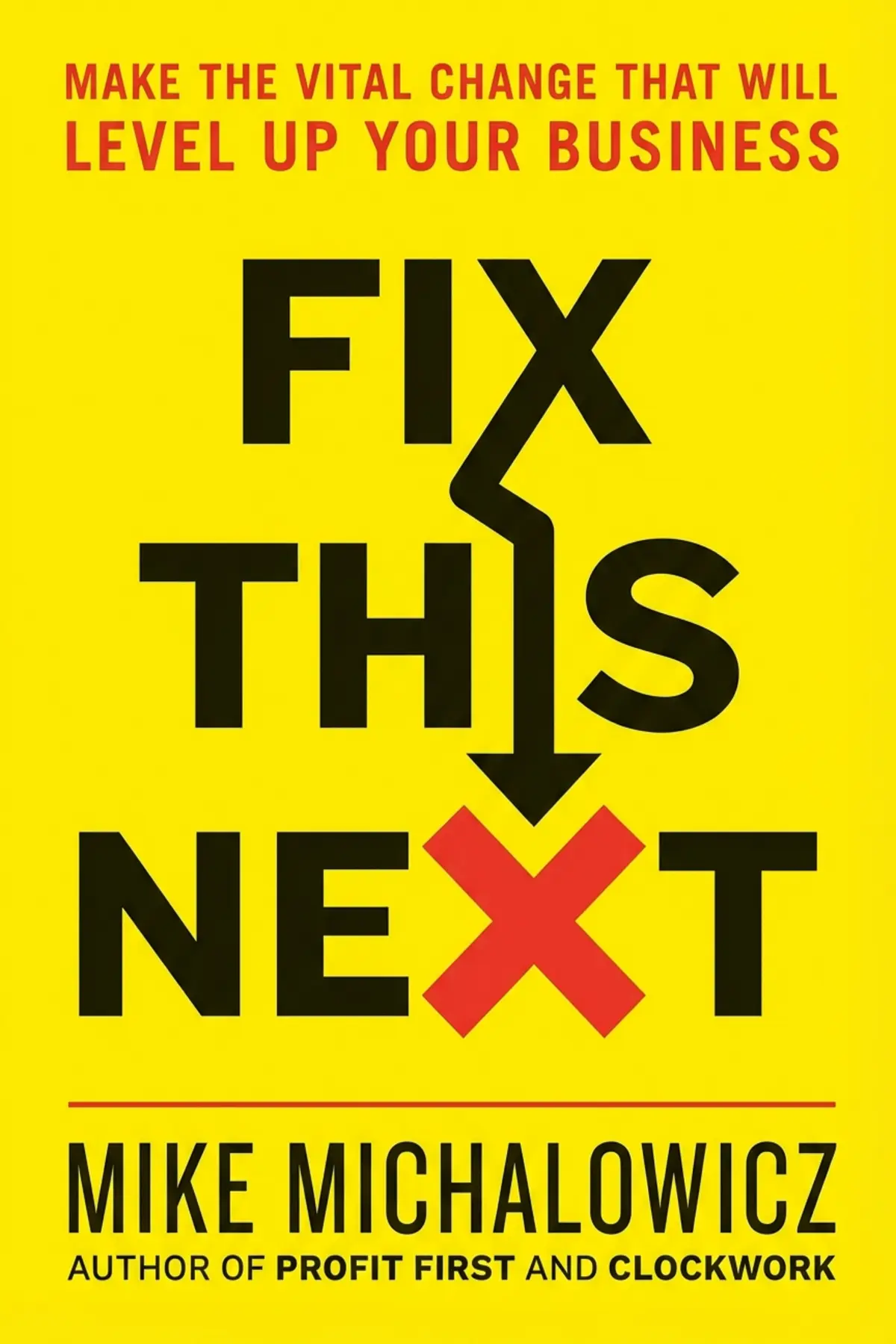
Most small business owners spend their days putting out fires, and Mike Michalowicz argues that fighting them harder only keeps them burning. In Fix This Next, the entrepreneur behind the Profit First method shows that a company, like a person, has a ladder of needs. Progress comes from repairing the lowest broken rung, not from attacking every problem at once. He learned this the hard way, with $365,000 in personal debt and a jammed printer.
His case is simple to state. A business in crisis moves forward when its owner stops reacting on instinct, finds the most basic need that is going unmet, fixes it with a measurable goal, and then repeats the process. The five levels run from Sales to Profit, Order, Impact and Legacy. Learn them, and fifteen minutes of honest diagnosis will tell you which problem deserves your Monday morning, and which ones can wait.
1 min 27 sec
An owner deep in debt was doing everything his instincts told him, and sales were even rising. A stubborn office machine showed him why all that effort was aimed at the wrong target.
1 min 35 sec
A diagram many people met in school turns out to describe businesses as well as humans. It explains why some of your most pressing problems should be left alone for now.
1 min 35 sec
Being stronger than your rival means nothing if one part of your business snaps. A short four-step diagnosis shows where the break will come, and what to measure until it holds.
1 min 34 sec
Hitting the monthly target can still leave a company sinking. One early contract nearly ended the author’s first business, and the lesson concerns promises made on both sides of a sale.
1 min 38 sec
Pouring every spare dollar back into growth feels responsible. Michalowicz argues it is one of the surest ways to stay broke, and he offers a different order for handling incoming money.
1 min 26 sec
Somewhere a fast-food franchise is serving customers right now while its owner is nowhere near it. The same can be true of a small firm, and it starts with something most teams already do.
1 min 38 sec
A restaurant swamped with requests made its booking problem part of the meal, and a café sent a customer to its rival. Both moves earned something worth far more than one sale.
1 min 29 sec
When a network dropped a comedy, its audience refused to accept the decision, and the show was back within a day. Any business can earn that kind of loyalty, but only if it keeps changing.
1 min 11 sec
Fix This Next swaps the firefighter’s question, which problem is loudest, for a better one: which foundation is missing. Michalowicz’s printer never needed more force. It needed someone to look calmly at the back and find one scrap of paper. Most stalled businesses, in his telling, work the same way. The owner has energy, money and skill, spreads them across every problem equally, and leaves untouched the one that holds the rest up.
The first move is small. Sit down for fifteen minutes with the five levels and mark each need your business is not meeting. Choose the lowest and give it a number using OMEN: an objective, a measure, a rhythm for checking it and a way to adjust. If the lowest level is Profit, move your chosen percentage out of income before any bill is paid. If it is Order, ask the person the company depends on most, perhaps you, to write down one process this week.
Then run the analysis again. A business climbs the way the pyramid is built, one sound layer at a time.
Many owners work harder every year and still spend their days in crisis: a cash shortfall before payroll, an angry customer, a missed deadline. Mike Michalowicz argues that the problem is not effort. It is trying to fix every problem at once, by gut feel, without knowing which one actually matters most. His answer is a Business Hierarchy of Needs, modeled on Maslow's famous pyramid. Its five levels are Sales, Profit, Order, Impact and Legacy, and each needs the ones beneath it to hold. A short four-step analysis shows which unmet need sits lowest, so the owner can fix that one with a measurable goal before moving up. Along the way Michalowicz draws on his own costly mistakes, from $365,000 in personal debt to a phone installation that nearly got him sued. He also looks at a McDonald's franchise that runs without its owner, a restaurant booked by postcard and a TV show its fans saved overnight. Readers get a diagnosis they can run in about 15 minutes and a clear order for the work that follows.
Small business owners who work long hours yet stay stuck in crisis mode.
Founders whose sales grow while debt and stress grow with them.
Managers and operators who need a clear order for fixing many problems at once.
Mike Michalowicz is an American entrepreneur and author who founded and sold two multimillion-dollar companies before he turned 35. He later lost his whole fortune as an angel investor in small businesses and started again. He created the Profit First method for managing profit and the Clockwork method for making a company run without its owner's constant input. He has written a small business column for The Wall Street Journal and presented a business rescue segment on MSNBC, and his books have been translated into more than 27 languages.
Mike Michalowicz
Mike Michalowicz

Mike Michalowicz

Listeners find that this guide offers a blueprint for launching or expanding a company, using straightforward and accessible ideas that allow for a quick read. Furthermore, the material is intelligent and organized, with one listener pointing out that it utilizes the Maslow hierarchy model. They also value the way it assists in identifying business priorities, and one review emphasizes how useful it is for entrepreneurs. The title earns praise for being focused and direct, with one listener stating it aids in managing time as a business owner.
Finally got around to reading Mike’s latest, and it’s exactly the compass most entrepreneurs are missing. While many business books provide vague strategies, this one offers a concrete roadmap based on a Maslow-style hierarchy. It’s refreshing to see someone admit that you shouldn't worry about legacy when you haven’t even stabilized your sales foundation. To be fair, some of the analogies feel a bit stretched, but the core logic is undeniable and easy to grasp. I found the specific Vital Needs at each level to be the most practical part of the entire system. It’s a fast read that helps you cut through the noise of daily operations. If you are tired of feeling like your business is one massive mess, this is the fix.
Show moreWow. I didn’t think anything could top Mike's previous books, but this framework is an absolute game-changer for my daily focus. Instead of guessing what to do next, I now have a diagnostic tool to identify the biggest bottleneck in my company. The distinction between sales and profit is particularly well-explained, showing why more revenue isn't always the solution to your problems. Not gonna lie, I was skeptical about the Legacy stage at first, but the book does a great job showing how it builds naturally. The writing is punchy, funny, and keeps you moving through the chapters at a very rapid pace. Every entrepreneur should have this on their shelf to keep them from wasting time on the wrong priorities.
Show moreMike Michalowicz has a way of taking complex business concepts and stripping them down to their most essential, digestible parts. This book is no exception, providing a clear hierarchy that guides you from survival mode all the way to leaving a legacy. I loved how it emphasizes that sales are the foundation; without them, nothing else on the pyramid even matters. The chapters on Order were particularly eye-opening for me as I realized my internal systems were actually hindering my growth. Gotta say, the tone is perfectly balanced between professional advice and relatable entrepreneur struggles. It’s a quick read, but the impact of implementing the One Next Thing strategy is long-lasting. This is definitely a book I will return to every quarter for a business health check.
Show moreThis book provides the framework I didn’t know I needed to finally stop spinning my wheels. When you’re running a business, it feels impossible to decide which of your numerous problems to tackle first, and Mike solves that. Using the hierarchy of needs approach, he shows you exactly how to sequence your efforts for maximum efficiency and growth. Personally, I found the Vital Needs checklist at each level to be the most helpful tool in the entire book. It prevents you from guessing and gives you data-driven reasons to focus on one specific area of the company. The book is well-structured and moves quickly, never getting bogged down in too much technical jargon. It’s an essential guide for anyone who wants to build a business that can run without them.
Show moreAs a small business owner, I often feel like I am drowning in a sea of urgent tasks that don't actually move the needle. This book changed my perspective by introducing a logical sequence to tackle problems. You start with Sales, move to Profit, then Order, Impact, and finally Legacy. It’s a simple system that prevents you from jumping to advanced efficiency before your cash flow is actually healthy. Frankly, it isn't quite as revolutionary as Profit First, but it serves as an excellent companion piece for growth. The tone is encouraging and non-technical, making it accessible for people who aren't MBA types. I wish there was a bit more depth in the later chapters, but the early sections are gold.
Show moreEver wonder why you’re working 60 hours a week but still feel like your business is standing still? This book answers that question by forcing you to identify the one single thing that needs fixing before you move on. The hierarchy model is brilliant because it stops you from over-investing in staff or systems before the foundation is truly solid. In my experience, most owners try to do a little bit of everything, which results in nothing getting done well. Mike’s non-technical language makes complex organizational theory feel like a conversation with a friend over coffee. There are some tangents about other authors’ ideas that felt unnecessary, but the overall structure is incredibly smart. It’s a great roadmap for anyone looking to scale without losing their sanity.
Show moreTruth is, I was skeptical about whether I needed another how-to book for my small business. I’ve read so many that all say the same thing, but this one actually forced me to sit down and do the work. The Fix This Next assessment showed some glaring holes in my profit margins that I had been ignoring while chasing new sales. It’s a simple but effective way to stop the One Massive Mess cycle that many of us find ourselves trapped in. While the writing can be a bit repetitive, the clarity it provides is worth the price of admission alone. I would recommend this specifically to owners who feel overwhelmed by their own to-do lists. It helps you say no to the distractions that don't serve your growth.
Show moreInstead of doing a little bit of everything, what is the one thing I should fix next to move forward? That is the question at the heart of this book, and the answer is surprisingly easy to find using Mike’s system. The foundation level starts with Sales, then moves up through Profit and Order before ever worrying about things like Legacy. It’s a very logical and practical method of assessing the current health of your operations without getting overwhelmed. My only gripe is that some sections feel a bit like exploratory exposition that could have been more concise. However, the Objective Merit Matrix idea is fantastic and helps take the emotion out of decision-making. Overall, it’s a smart, easy-to-read guide that will definitely help you prioritize your limited attention.
Show moreThe concept is solid, but it feels like a long blog post stretched into a full-length book. I appreciate the focus on prioritization, yet I felt the author spent too much time on fictional success stories rather than deep-dive mechanics. If you already have a strong grasp of business fundamentals, you might find yourself skimming large portions of the text. Look, the hierarchy of needs is a clever framework, but it isn't exactly reinventing the wheel for seasoned managers. It’s a decent guide for beginners who don't know where to look first. However, the repetitive nature of the writing style occasionally made it hard for me to stay engaged. It’s helpful, but certainly not Mike’s best work compared to his other titles.
Show moreNot what I expected after the brilliant simplicity of his earlier books on cash flow and marketing. It felt like the author took a very basic idea—prioritize your problems—and added a lot of filler to meet a page count. The Maslow analogy is okay, but it results in a lot of cliché managerial nonsense that doesn't offer much in the way of actionable tactics. I’m honestly disappointed by the lack of substance in the later sections regarding impact and legacy. It felt like reading a series of motivational speeches rather than a practical business manual for serious growth. If you already have a decent system for managing your time, you can probably skip this one. It definitely feels like a step backward in terms of utility.
Show moreMike Michalowicz argues that businesses, like people, have a hierarchy of needs: Sales, Profit, Order, Impact and Legacy. Owners in crisis mode try to fix everything at once by instinct, which keeps them firefighting. Instead, they should find the lowest unmet need in that pyramid, fix it with a measurable goal and then repeat, because every higher level depends on the ones beneath it.
Sales is the base, the cash coming in. Profit adds stability and the ability to scale. Order covers the systems that make a company efficient and let staff work without the owner. Impact turns transactions into experiences that transform customers and employees. Legacy, at the top, is a brand strong enough to outlive its founder. Michalowicz links each level to a layer of Maslow’s pyramid.
Michalowicz describes four steps that take about 15 minutes. List every need in the pyramid your business is not meeting. Pick the one closest to the base. Set a measurable target and work on it until the need is met, for example converting four prospects into clients each month. Then repeat the analysis to find the next weakest link.
OMEN is a way to make any fix measurable. Set an Objective, the result you want. Choose how to Measure progress toward it. Decide how often you will Evaluate those measurements. Then Nurture the goal by planning how you will adjust the objective or the measures if needed. Without a measure, Michalowicz notes, you cannot tell when a need has been met.
It suits owners of small companies and nonprofits who feel trapped in constant crisis, especially those whose sales rise while debt stays high. It also helps operators who face many problems at once and need a clear order for tackling them, from steadying cash flow and setting aside profit to documenting processes so the business can run without them.



Duncan Clark



Hamilton Helmer

John Carreyrou
AUDIO SUMMARY AVAILABLE
Get the key ideas from Fix This Next by Mike Michalowicz, plus 5,000+ more nonfiction titles.