All In: How Great Leaders Build Unstoppable Teams
Mike Michalowicz
 English
Shows small business owners how to stop being the bottleneck by designing the work instead of doing it: protect the role that matters most, document key tasks, hire well, narrow the market and track four numbers.
50 sec
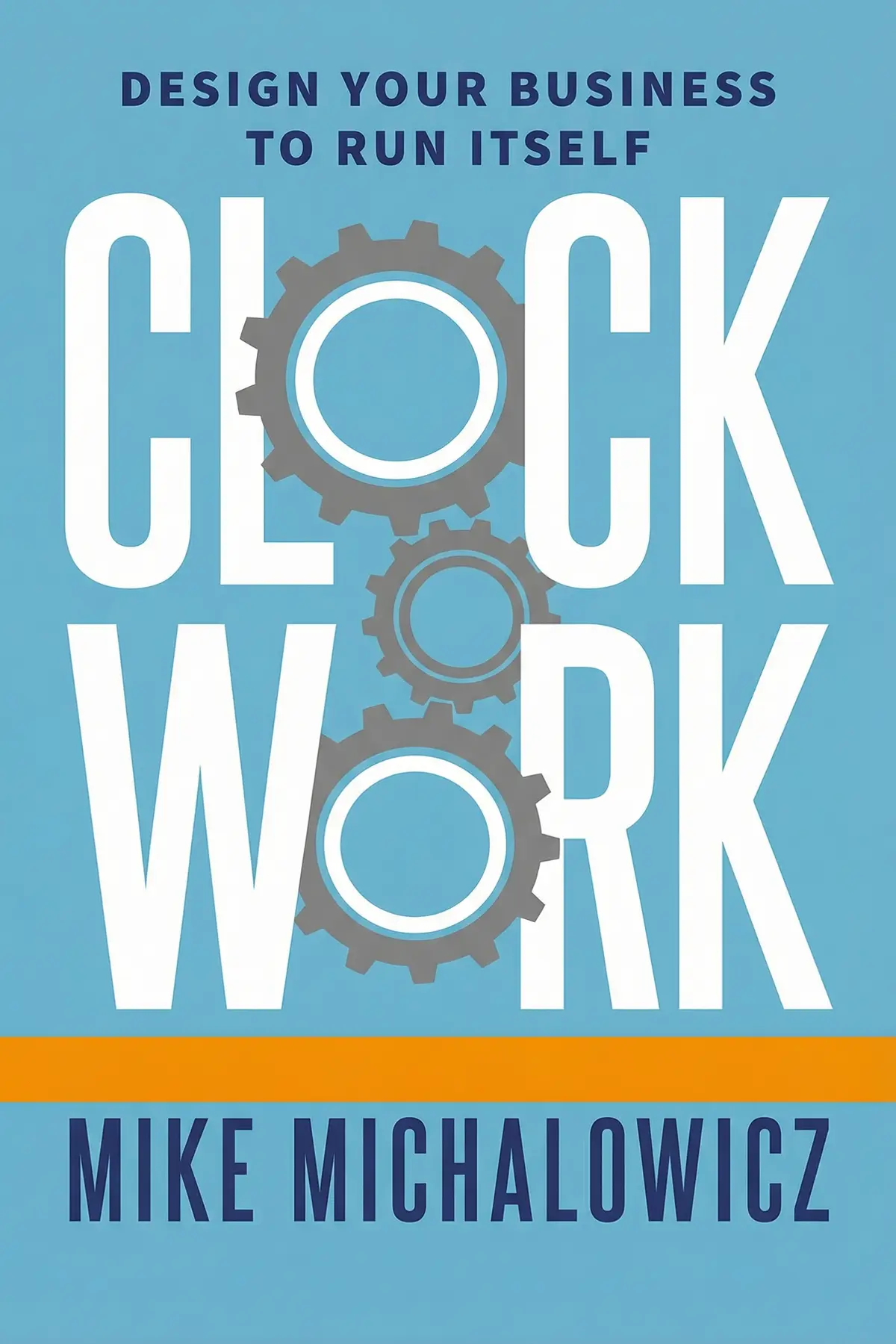
Plenty of small business owners work longer hours than anyone they employ, can’t hand anything off and still don’t pay themselves a salary. In Clockwork, entrepreneur Mike Michalowicz argues that the cure is not more productivity, because time saved by working faster simply fills up with new work.
What he proposes instead is a company that keeps running when its owner steps away. The route there is to stop being the person who does everything and become the person who designs how everything gets done. That means finding the single role your business cannot survive without, writing down how key tasks are done, hiring and marketing with focus, and watching a handful of numbers. Follow his plan and your hours shift from fighting daily fires to the work only an owner can do.
1 min 34 sec
Working faster feels like the obvious cure for an overloaded week. One law about how we consume resources explains why it so often leaves owners just as busy, and what to aim for instead.
1 min 30 sec
Most owners hire help and still end up just as busy, stuck in a stage that eats as much time as the work itself. A simple four-part map shows where the hours go and where they should.
1 min 31 sec
In a busy restaurant, servers face a choice between clearing tables and carrying food. The right answer reveals how to rank every task in your company, and why the person you protect matters less than you think.
1 min 40 sec
If you often think it is quicker to do things yourself, a lesson from monkeys and bananas suggests the problem may not be your team at all. A four-letter model shows exactly which tasks to fix first.
1 min 30 sec
Given a choice between fifty dollars an hour and five, the answer looks obvious. Michalowicz shows why the obvious answer keeps solo owners stuck, and what kind of hire makes the smaller number pay off.
1 min 32 sec
Selling to everyone feels like the safest way to grow. A magnifying glass and a simple test of which clients you enjoy suggest the opposite, and point to where your best customers already gather.
1 min 29 sec
Once you stop doing the daily work, you lose the feel for how things are going. Many owners dread metrics, yet a single figure for each stage of the business can replace hours of checking in.
1 min 35 sec
Stepping out of the daily work should please everyone. Instead, partners, staff and clients may push back, and further resistance may come from a source most owners never expect.
1 min 09 sec
Only a founder can turn an idea into a working company, Michalowicz says, and the same founder can run it into the ground by refusing to let go. Clockwork is his plan for the stage after the start, when the owner’s job changes from carrying the business to building the machine that carries it. Every tool he offers moves knowledge and judgment out of one tired person and into roles, procedures and numbers that others can use.
He also counsels patience. Growing a business doesn’t mean charging ahead at 100 miles an hour. A new hire might cope with major responsibilities on day one, but your trust has to grow first, and a team you don’t trust won’t thrive.
A sensible first week is modest. Name your Queen Bee Role and stop pulling its people into side jobs. Record one task you do well and pass it on with every decision that comes with it. Then pick one number each for attracting, converting, delivering and collecting.
The goal is not an owner who disappears. It is an owner with time, at last, to sit in the coach’s box and draw up the next play.
Many people start a business hoping for flexible hours, pride in their work and financial freedom. Many end up working around the clock, convinced nobody else can do the job properly, and still not paying themselves years later. Mike Michalowicz argues that the escape is not greater productivity, since time saved by working faster tends to fill up with more work. His aim is a company that keeps running without constant input from its owner. He sorts all work into four kinds, doing, deciding, delegating and designing, and urges owners to climb toward designing. Along the way he shows how to spot and protect the Queen Bee Role, the one task a business cannot survive without. He explains how to turn key tasks into recorded procedures using the attract, convert, deliver and collect model, why accepting a smaller hourly cut to hire can grow income, how to find a niche among your best clients, and which simple numbers reveal the health of each stage. Readers get a step-by-step route out of daily firefighting, plus a frank warning about the resistance, including their own, that comes with stepping back.
Small business owners who work longer hours than their staff and still can't take a vacation.
Solo founders weighing their first hire and worried about losing income.
Managers in growing firms who want clear priorities, written procedures and simple numbers to run by.
Mike Michalowicz is an American entrepreneur and author. He built two companies worth millions and sold both before he was 35, then lost his whole fortune as an angel investor in other small businesses and started again. He developed Profit First, a system for managing a company's profit, and the Clockwork approach to building companies that function without their owner's constant involvement. His book Fix This Next was an instant Wall Street Journal bestseller, and his books have been translated into more than 27 languages. He has written a small business column for The Wall Street Journal, presented the Business Rescue segment on the MSNBC show Your Business, and speaks at events and in university entrepreneurship programs.
Mike Michalowicz
Mike Michalowicz

Listeners find this work to be essential for business owners, applauding its straightforward take on entrepreneurship and functional tactics for optimizing systems. They appreciate its transparency, as one listener identifies it as a crystal-clear blueprint, while another mentions the revised edition fulfills its commitments. Listeners hold the material’s quality in high regard, with one pointing to complex concepts explained in detail, and find the experience transformative, with one noting how it completely reframed their mindset.
Mike Michalowicz has a way of taking complex operational chaos and turning it into a clear, manageable blueprint. I walked into this feeling like the "Doing" was my only path to success, but the shift toward "Designing" has been a total game-changer for my mental health. Personally, the Queen Bee Role concept is worth the price of admission alone because it forced me to identify the one thing that actually keeps my company alive. My team is now empowered to make decisions without me hovering over their shoulders every five minutes. While the author’s high-energy writing style might be a bit much for some, the practical steps for streamlining are undeniable. It isn't just about working less; it’s about making the business resilient enough to survive a one-month vacation.
Show morePicked this up because I was tired of being the only person in my company who knew how to fix anything. I was stuck in a loop of making every single decision, which meant I could never actually step away. Clockwork completely reframed my mindset on what a CEO actually does. The author makes a compelling case that your job isn't to do the work, but to design the system that does the work. I’ve already started implementing the debriefing strategies he mentions, and for the first time in years, I don't feel like the business will collapse if I turn off my phone for a weekend. It's a must-read for anyone who wants their life back.
Show moreAfter hearing so much hype about the revised edition, I finally dove in and I’m so glad I did. This isn't just theory; it’s a crystal-clear blueprint for entrepreneurship that actually delivers on its promises. I’ve read a lot of business books that tell you to 'delegate' but never explain the mechanics of how to do it without losing quality. Michalowicz breaks it down into actionable steps that anyone can follow. The idea of the one-month vacation is such a powerful metric for business health. I'm currently on week two of my own transition plan, and the clarity I have now regarding our primary function is worth more than any MBA course I've taken.
Show moreFinally got around to reading Clockwork and it’s basically a manual for regaining your sanity. If you've ever felt like your business is a cage you built for yourself, you need this. The way Mike explains the 4Ds makes it impossible to ignore where you're failing as a leader. I stopped making every decision for my staff last month, and the results have been staggering. They are more confident, and I am significantly less stressed. In my experience, most business books are 90% fluff, but the application steps here are actually doable. It's an empowering read that makes the dream of a self-sustaining business feel like a realistic goal rather than a fantasy.
Show moreNot what I expected, but exactly what I needed. I thought this would just be another book about 'hustling' more, but it’s actually the complete opposite. It’s about building a machine that doesn't need you. The transition from 'Doing' to 'Designing' is the hardest thing I've ever done in my career, but it's working. I love how Mike uses real-world case studies to show how the QBR works in different industries. This book simplifies the mess of entrepreneurship into a series of logical steps. If you want to stop working 60-hour weeks and actually start leading, this is the book. It’s easily one of the most actionable guides on my shelf.
Show moreThe core premise here is brilliant, though I must say the book feels significantly longer than it actually needs to be to get the point across. If you can look past the repetitive anecdotes and the occasionally flippant jokes, you’ll find a masterclass in true delegation. The 4D Matrix—Doing, Deciding, Delegating, and Designing—provided the exact framework I needed to stop being the bottleneck in my own agency. Truth is, I was terrified of letting go, but the systematic approach to empowering my staff has already yielded more free time in my calendar. It’s a solid follow-up to Profit First, even if the delivery is a bit more eccentric this time around. I recommend it to any founder who feels like they are drowning in daily tasks.
Show moreAs someone who works for a business owner, I didn't expect this to resonate as much as it did. My boss handed this out to the whole management team, and at first, I was skeptical about a book designed to help the owner take a vacation. However, the section for employees actually makes a lot of sense. It talks about empowerment and how to take ownership of outcomes rather than just waiting for instructions. Not gonna lie, the writing style is a bit loud—it feels like the author is shouting at you through the pages—but the concepts of the Queen Bee Role helped us align as a team. It’s a very practical guide for scaling, even from the middle of the ladder.
Show moreLook, the Queen Bee Role is a concept that every entrepreneur needs to understand immediately. Most of us are busy being 'busy' without actually protecting the core function that drives our revenue. This book helped me identify that I was wasting 80% of my time on 'Doing' when I should have been 'Designing.' To be honest, I think the author repeats himself quite a bit to fill the pages, but the core strategy is powerful. It’s less about being lazy and more about being efficient. I’m giving it four stars instead of five because the flippant tone can be distracting, but the actual systems are incredibly valuable for streamlining operations.
Show moreTo be fair, I struggled with the tone of this one compared to Mike's previous work. I absolutely loved Profit First, but some of the humor in Clockwork feels a bit forced and, frankly, a little offensive in places. There’s a specific bit about slapping the reader that felt weirdly aggressive. My biggest gripe is that the book claims to be for everyone, but if you’re a solopreneur with no immediate plans to hire, a lot of this advice is basically useless. It all centers on having a team to offload work onto. If you have employees, the QBR stuff is solid, but otherwise, this could have been a much shorter PDF or a blog post.
Show moreEver wonder if these business frameworks actually apply to the tiny, one-person shops? I found the content quality to be a bit hit-or-miss for my specific situation. While I appreciate the 4D matrix for organizing my own time, the book’s obsession with hiring and delegating left me feeling a bit left out as a freelancer. It feels like a lot of these ideas were lifted from places like 'The E-Myth' or Jim Collins, just repackaged with Mike’s signature 'wacky' personality. It’s not a bad book, but it’s certainly not the revolutionary text the marketing makes it out to be. If you already have a team of five or more, buy it. If it’s just you, maybe skip it.
Show moreMichalowicz argues that a small business should be able to run without constant input from its owner. Working harder or faster does not get you there, because saved time fills with new work. Instead, the owner should shift from doing the work to designing it: protecting the one role the business depends on, documenting key tasks, hiring well, focusing on a niche and tracking a few numbers.
The Four D’s are doing, deciding, delegating and designing. Founders usually start out doing everything, then get stuck deciding once they hire staff. Michalowicz urges owners to delegate whole tasks, including the decisions around them, so they can design. For the business as a whole he suggests roughly 80 percent doing, 10 percent designing, 8 percent delegating and 2 percent deciding.
It is the single task a business cannot survive without, the way a hive depends on its egg-laying queen. For a restaurant known for excellent food, it is the chefs’ cooking, so servers deliver hot meals before clearing tables, and chefs never get pulled away to scrub pots. Everyone else serves that role first, whoever happens to fill it.
Begin by naming your Queen Bee Role and shielding the people who fill it. Then use the attract, convert, deliver and collect model to list your key tasks, record how the best person does each one, and hand them over with the related decisions. Add one simple number for each of those four stages, and hand over responsibilities gradually as trust grows.
It suits small business owners who feel indispensable and exhausted, solo founders hesitating over a first hire, and managers who want clear priorities and procedures. Its advice is concrete, from recording a task on video to judging clients as a crush or a cringe, so it fits readers who want a usable plan rather than general motivation.



Duncan Clark



Hamilton Helmer

John Carreyrou
AUDIO SUMMARY AVAILABLE
Get the key ideas from Clockwork by Mike Michalowicz, plus 5,000+ more nonfiction titles.