All In: How Great Leaders Build Unstoppable Teams
Mike Michalowicz
 English
Shows small business owners how to win attention without a big budget by running cheap marketing experiments that break the expected pattern, offer a clear opportunity to a chosen hundred prospects and ask for one action.
1 min 04 sec
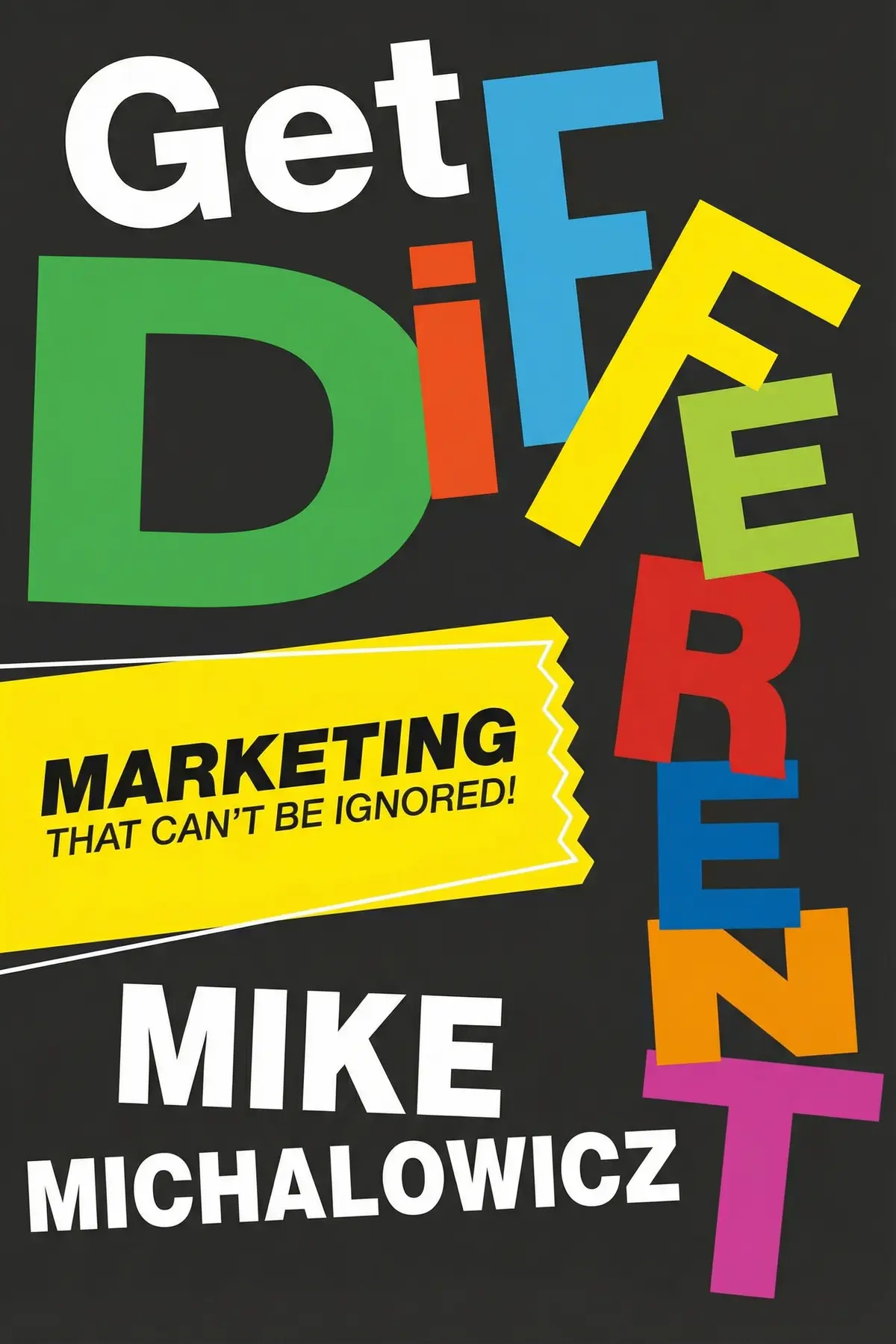
Plenty of good businesses stall because the people who need them never notice them, and Mike Michalowicz says the cause is usually sameness, not a small budget. In Get Different, the entrepreneur behind Profit First argues that the human brain is built to ignore whatever it has seen many times before. Marketing that copies the rest of an industry is invisible almost by design.
His remedy is to treat marketing as a cheap experiment. Pick a hundred prospects, set a clear goal, and decide spending from your real odds. Then try something that breaks the expected pattern, presents a clear opportunity and asks for one simple action. Measure it, and run a new version if it misses.
The cases are small and specific: birthday candles sent through the mail, free ice water announced on a roadside sign, a business book stuffed with sticky notes. Each one shows how a modest budget can win attention, and together they give you a method to plan, cost and test an idea of your own.
1 min 37 sec
Personalized emails once made people stop and smile. Now they get deleted in a second. The reason lies in how our ancestors survived, and it explains why so many marketing tactics stop working.
1 min 41 sec
Marketing to everyone feels safe, yet it rarely lands anyone in particular. A simple ranking exercise, finished with a smiley face, reveals the customers you should be trying to copy.
1 min 44 sec
Wanting to reach the top is rarely enough to start a hard climb. Michalowicz explains what does get people moving, and why he keeps a photo of a man he dislikes on his office wall.
1 min 46 sec
One bookkeeper spent $50,000 chasing leads and got none. Michalowicz offers a three-step calculation that tells you what a prospect is worth, and the number he reaches for his own books is strikingly small.
1 min 56 sec
A man in a Statue of Liberty costume was impossible to miss and impossible to hire. A restaurant owner with a handful of birthday candles shows the difference between being strange and being wanted.
1 min 47 sec
A struggling store in a tiny South Dakota town had almost no passing trade. One summer, a single offer on a roadside sign changed its fortunes for decades, and it cost almost nothing.
1 min 42 sec
An accountant mailed his favorite business book to ten prospects and got nothing back. What he changed the second time cost almost nothing, and the response surprised even him.
1 min 16 sec
Michalowicz’s case comes down to a reframe: marketing rewards nerve and method far more than money. The man waving his arms on the plane and the free ice water on a remote road worked for the same reason. Each broke a pattern people had stopped seeing, and the ice water asked something easy of the right audience.
He adds one more tool for deciding where to be different. Search online for superlatives, the words ending in est, and you will find a list of about a thousand. Read through it, notice which words fit you, and keep the few that match your goals and what your customers need. The aim is to be the best at something specific.
From there, the work is small. Write down a hundred names and the one win you want from them. Check your budget against your real odds before paying anyone who promises leads. Then send something unexpected, with a single clear ask and an end date on the calendar.
Linda Weathers spent $50,000 and heard nothing back. Not counting the free entrées, Kasey Anton spent under $200 on candles, stamps, paper, and ink, and the mailing brought in more than $18,000 of new business in one month.
Many good businesses stall because the people who need them never notice them. Mike Michalowicz argues that the usual cause is sameness. Buyers' brains are built to tune out whatever they have seen many times, so marketing that copies the rest of an industry fades into the background no matter how much it costs. His answer is a framework he calls Get Different, which treats marketing as an experiment. You choose a Target One Hundred from your best and favorite customers, define the win you want, and set a budget from your lifetime customer value and your real odds of closing. Then you try something unusual that presents a clear opportunity and ends with a single, simple directive. Finally, you measure the result and decide whether to drop the idea, improve it or retest it. The cases are small and memorable: a restaurant owner mailing birthday candles, a rural store giving away ice water, an accountant filling business books with sticky notes. Readers get a step-by-step way to plan, cost and test marketing ideas that stand out on almost any budget.
Small business owners whose good product goes unnoticed in a crowded market.
Founders and freelancers with tiny marketing budgets who want a repeatable way to test ideas.
Service providers, such as accountants and consultants, tired of paying for lead programs that never deliver.
Mike Michalowicz is an American entrepreneur and author who founded and sold two multi-million dollar companies before turning 35. After losing his fortune as an angel investor in small businesses, he started over. He created the Profit First and Clockwork methods, and his book Fix This Next was an instant Wall Street Journal bestseller. He once wrote a small business column for The Wall Street Journal, presented the Business Rescue segment on MSNBC's Your Business, and speaks at events and university entrepreneurship programs. His books appear in more than 27 languages.
Mike Michalowicz
Mike Michalowicz
Listeners view this marketing guide as a comprehensive resource that explores every part of the field, offering functional advice that is straightforward to interpret and use. They call it a stimulating listen that provides an instant effect, and one listener draws attention to its actionable real tools.
Finally got around to reading this after seeing it everywhere, and it’s basically the ultimate playbook for anyone tired of being ignored. Mike focuses on the fact that if you don't stand out, you're invisible, and he provides actual, tangible tools to fix that. Truth is, most marketing advice is just a recycled version of what everyone else is doing, but the 'Get Different' philosophy forces you to find your specific superlative. I started implementing the clear directive strategy immediately with my email list and saw a jump in engagement within forty-eight hours. It’s an inspiring read that doesn’t just fluff you up but gives you a concrete mission to execute. Some of the humor is a bit over-the-top, but the core message is too valuable to ignore. If you want to stop being the 'best-kept secret' in your industry, this is your guide.
Show moreMike Michalowicz has done it again by making a potentially boring subject like marketing feel like a high-energy workshop. I chose the audiobook version because his passion is contagious, though I’d recommend staying at normal speed so you don't miss the nuances of the 'win' strategy. He talks about this 'nemesis' photo he keeps on his wall to stay motivated, which sounds crazy until you realize how much more effective you are when you have a clear villain to outmarket. The advice on pointing customers toward action through a simple, singular request is something I realized I was failing at miserably. My only minor gripe is that he occasionally repeats stories from his other books, but the new context makes them feel fresh enough. It’s an easy, fun read that actually makes you want to get to work immediately.
Show moreThis book is essentially a roadmap for anyone who is sick of following the same old 'best practices' that lead to mediocre results. Mike explains that being 'the best' isn't enough; you have to be the best at something so specific that the competition becomes irrelevant. I loved the section on creating a marketing mission that actually motivates you to climb the proverbial mountain every single day. The author's tone is analytical yet incredibly encouraging, making complex concepts feel like common sense once he explains them. One of the highlights for me was the emphasis on measuring progress rather than just throwing money at experiments and hoping for the best. It’s an ultimate guide that covers every aspect of standing out in a crowded, noisy marketplace. If you’re willing to dare to be different, this book will show you exactly how.
Show moreStop blending in and start reading this book if you actually want your business to grow this year. The 'Get Different' framework is a brilliant reminder that our prospects are bombarded with thousands of messages a day, so we have to be the 'red apple in a basket of greens.' I found the chapter on defining your 'win' and your 'marketing mission' to be particularly transformative for my current campaign planning. Mike doesn't just tell you to be weird; he explains how to be different in a way that provides actual value and solves problems for your customers. It’s an inspiring read that makes an immediate impact on how you view your competition—especially with that 'nemesis' exercise. This is easily one of the most practical marketing books I've picked up in the last five years.
Show moreAfter hearing Mike speak on a podcast about how most marketing is just the same crap with a different logo, I knew I had to pick this up. This book is a masterclass in unique positioning and teaches you how to stop competing on price by competing on personality and approach. I loved the breakdown of how to identify your '-est' and why that specific superlative is your ticket to being remembered. The writing style is casual and easy to digest, which is perfect for busy entrepreneurs who don't have time for academic jargon. Not gonna lie, some of the ideas are pretty wacky, but that’s the whole point—it gets your creative juices flowing in directions you never would have considered. It’s a five-star guide that I’ll be keeping on my desk for reference during every new product launch.
Show moreAs a small business owner who lives and breathes Profit First, I had high expectations for this one. The concept of finding your '-est' is probably the most useful takeaway because it forces you to stop trying to be everything to everyone. Look, the Wall Drug story about the free ice water is a classic for a reason, and Mike uses it perfectly to illustrate how a simple directive can change a business's trajectory. I did find the book a little overlong in some of the middle chapters, and some of the case studies felt a bit wacky for my specific B2B niche. However, the framework for measuring progress and investing intelligently in marketing experiments makes it worth the price of admission. It’s a solid read that will definitely get your creative juices flowing even if you don't use every single idea.
Show moreEver wonder why your marketing feels like shouting into a void? This book argues it's because you're playing it too safe and following standard industry practices that ensure you blend right into the background. Mike breaks down the psychology of attention and why our brains are wired to ignore the mundane, which really clicked for me. Personally, I found the mountain analogy for setting marketing goals to be a bit simplistic, but the focus on defining a clear 'win' is vital for any small business. The text is filled with actionable advice that you can start testing today without needing a massive corporate budget. While it’s not as revolutionary as his work on business finance, it provides a much-needed kick in the pants for anyone stuck in a creative rut. Definitely worth a read for the focus on differentiation alone.
Show moreI listened to this on 1.25x speed and, frankly, it was a wild ride. Mike's energy is off the charts, and while some might find it a bit annoying or 'extra,' I thought it kept the material engaging. The core idea of the 'simple directive' really resonated with me, especially the story of Wall Drug and how they used free ice water to build a literal empire. It makes you realize how often we overcomplicate our calls to action and confuse our prospects before they even have a chance to buy. I gave it four stars because some of the 'stupid' anecdotes felt a bit forced, but the underlying framework is solid. It’s a refreshing take on a saturated subject that prioritizes being noticed over being 'polished.' Great for brainstorming and getting out of your comfort zone.
Show moreTo be fair, I preferred Profit First and The Pumpkin Plan much more than this latest installment. There is some good stuff in here regarding the framework for standing out, but I felt the writing was a bit too frantic and scattered at times. Mike is definitely energetic, but some of the anecdotes felt like filler or were just a little too 'out there' to be applicable to my professional services firm. I struggled to pull out as many tangible takeaways as I usually do from his books, though the message to 'get different' is a necessary reminder. Maybe I need to re-read it in print rather than listening to the audio, as the humor can sometimes overshadow the actual marketing mechanics. It’s a decent book with a few golden nuggets, but it didn’t transform my perspective the way his previous work did.
Show moreNot what I expected based on the hype surrounding Mike's other titles. I found many of the anecdotes to be a bit like 'junk' and honestly felt like some of the advice was bordering on spammy tactics that I wouldn't want my brand associated with. For instance, the suggestion to use exclamation marks or weird subject lines felt a bit dated and desperate. I know the goal is to be different, but there’s a fine line between being creative and being annoying, and I think this book leans toward the latter too often. It’s a very quick read, but I struggled to find the 'tangible stuff' that would actually work in a high-end market without looking cheap. If you like Mike's over-the-top personality, you'll enjoy it, but if you're looking for sophisticated marketing strategy, you might want to look elsewhere.
Show moreMichalowicz argues that people are wired to ignore anything they have seen many times, a process called habituation, so marketing that copies the industry goes unnoticed. His Get Different framework treats marketing as an experiment: choose a hundred target prospects, set a clear win and a budget, present an unusual idea that offers a real opportunity, end with one simple directive, then measure the result and adjust.
It is the group of prospects your marketing experiment aims at. Michalowicz cites data scientist Dr. Piroska Bisits Bullen’s advice that experiments need at least one hundred people. To build the list, rank existing customers by revenue over two years, mark the ones you love working with, and target prospects like those in both groups. New businesses can start from vendors, friends, colleagues and partners of their best clients.
Multiply a top customer’s average yearly revenue by the years you expect them to stay to get Customer Lifetime Value, then estimate your Close Rate Odds from past conversions or industry averages. Michalowicz’s own books give a $28 lifetime value and a one in five close rate, so he spends $1 per prospect, or $100 for a hundred prospects. A rough estimate is enough.
Gather a few people to brainstorm ideas that run opposite to your industry’s habits, keep only those that offer prospects a clear opportunity, and attach one simple call to action. Before launching, record start and end dates, prospect numbers, spending and the outcome you want. If it fails, change something and retest, as accountant Gabe Piña did by adding sticky notes to the books he mailed.
AUDIO SUMMARY AVAILABLE
Get the key ideas from Get Different by Mike Michalowicz, plus 5,000+ more nonfiction titles.