
Blink: The Power of Thinking Without Thinking
Malcolm Gladwell
 English
 ไทย
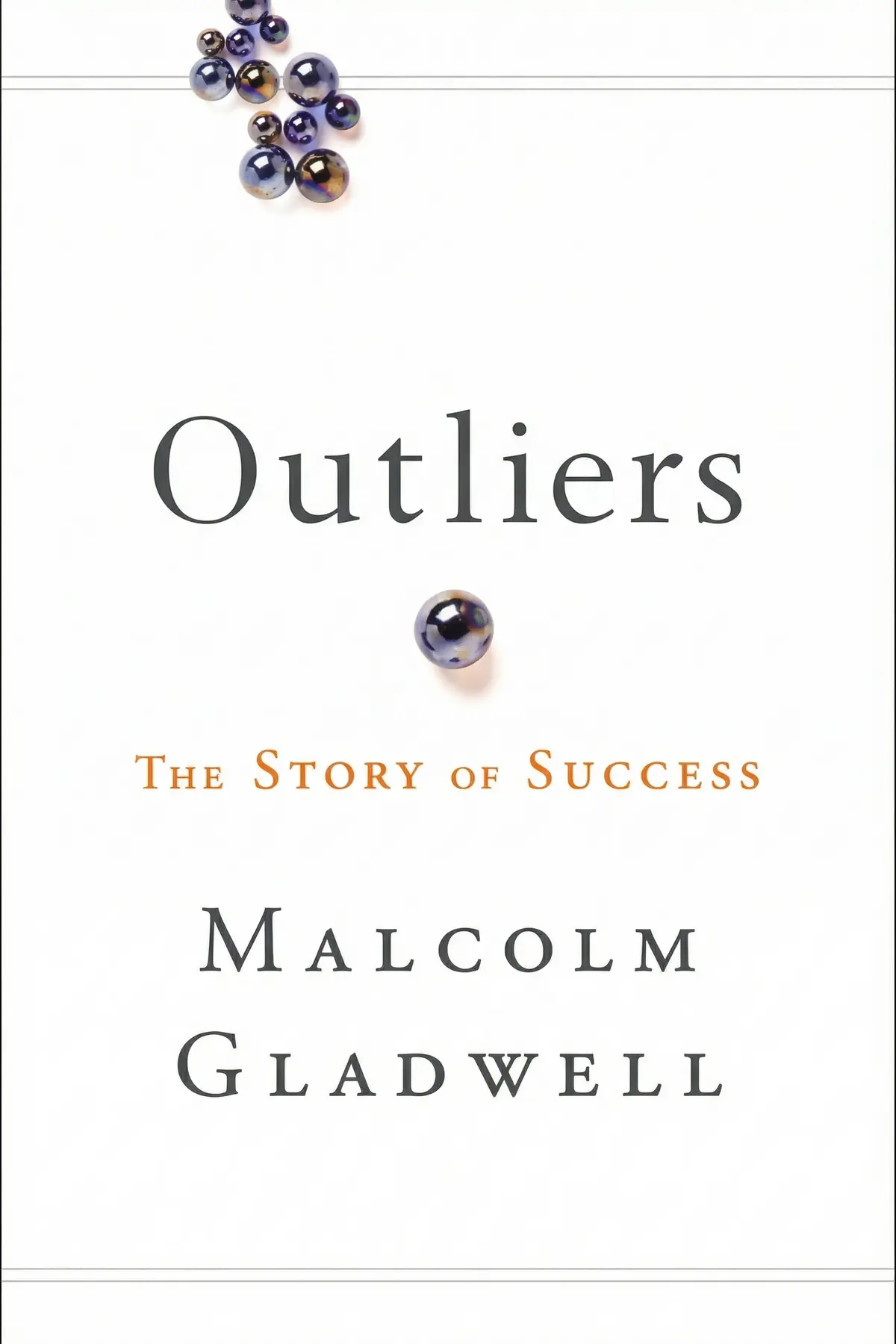
Outliers shows why success depends on more than talent and effort. Birth dates, practice hours, upbringing and cultural habits shape who rises, and seeing them helps you find advantages and build fairer systems.
1 min 00 sec
Most of us explain success with talent and effort, so when someone gets ahead, we assume they had more of both. In Outliers, New Yorker writer Malcolm Gladwell points to a stranger pattern. In Canada, professional hockey players are more often born in the first half of the year than in the second, because of a cutoff date set by youth leagues that none of those players chose.
That is Gladwell’s case in miniature. Extraordinary achievement, he argues, grows from a chain of opportunities, timing and inherited habits that mostly lie outside a person’s control. Once you can see that chain, you can use it for yourself and redesign it for others. The evidence runs from a software boom and a South Bronx middle school to a cockpit near Guam and the rice fields of Asia. By the end, success stories will read differently, and you will know which hidden advantages are still within your reach.
1 min 31 sec
A politician with presidents in his family called himself self-made, and voters were expected to nod along. The label was absurd, so why did he bother, and what does it reveal about how we judge talent?
1 min 34 sec
Extra height should make a better basketball player, and a higher IQ should make a better scientist. Gladwell finds a line beyond which neither helps much, and law school graduates show what takes over.
1 min 42 sec
Bill Gates and the Beatles had talent, but so do many people nobody has heard of. The difference lies in a number, and in the rare circumstances that let anyone reach it at the right moment.
1 min 33 sec
Two nine-year-olds sign up for the same hockey league, and one is quickly marked as a future star. The coaches believe they spotted talent, but the real cause appears on a birth certificate.
1 min 43 sec
Some children grow up knowing how to ask a teacher for an exception, and others never learn it exists. A sociologist traced that difference to the kitchen table, and it follows people into every career.
1 min 45 sec
A familiar stereotype about math has roots that Gladwell traces to number words and centuries of work in flooded fields. The habit that grew there still decides how long a student keeps trying.
1 min 40 sec
A first officer saw the danger ahead and said something, but so gently that the captain never heard a warning. One airline’s crash record shows how respect for rank can turn deadly, and how to fix it.
1 min 37 sec
A boy born on December 27 cannot change his birthday, and children in a poor neighborhood cannot choose richer parents. Gladwell shows that the rules around them can change, with striking results.
1 min 10 sec
Outliers asks you to trade a comforting story for a truer one. The self-made star turns out to stand on things nobody chose: a birth month, a birth year, parents who taught them to speak up, ancestors who worked the paddies before dawn, and thousands of hours someone made room for. Gladwell does not dismiss effort. He shows that effort grows only where conditions allow it.
That view gives you two kinds of work. For yourself, look for the advantages still within reach, such as more practice hours, the habit of asking the right person at the right moment, and a little more patience with a problem that resists you. For others, look at the rules you control. Check ages before you label a child, invite a junior colleague to state a worry plainly, and ask whether a cutoff, a test or a chain of command is sorting people by something other than their potential.
The boy born on December 27 never needed more talent. He needed a league that let him play against children his own age.
We like success stories that reward talent and hard work, and we rarely hear one that credits luck. Malcolm Gladwell argues that this habit hides most of what makes people extraordinary. Behind every outlier he finds advantages the person did not choose: the month or year they were born, the hours someone made room for them to practice, the lessons their parents taught about dealing with authority, and work habits handed down from their ancestors. Gladwell builds the case through vivid examples. They include Canadian hockey leagues that favor children born in January, software billionaires born within a few years of each other, a sociologist's study of rich and poor families, rice farmers whose patience lives on in math classrooms, and an airline whose crashes traced back to respect for rank. The promise is a sharper way of reading success, your own and other people's. Readers learn where talent stops mattering and which hidden advantages can still be gained. They also see how coaches, teachers and managers can change the rules so that fewer talented people are lost.
Professionals who wonder why equally able peers get ahead and want to find the advantages still open to them.
Teachers, coaches and parents who judge children's talent and want to avoid mistaking age or background for ability.
Managers and trainers designing hiring, promotion or team rules that give everyone a fair chance.
Malcolm Gladwell was born in England in 1963 and grew up in rural Ontario. He worked as a reporter at the Washington Post before joining The New Yorker. His books include The Tipping Point and Outliers, and his writing often draws on research from sociology and psychology. He co-founded the podcast company Pushkin Industries, and in 2011 he was appointed to the Order of Canada.
Malcolm Gladwell
Malcolm Gladwell
Listeners describe this work as compelling and stimulating, prompting reflection on their own lives as they examine achievement through intriguing real-world examples. Furthermore, the material is accessible and moves at a fast pace, backed by thorough investigation and captivating insights. Listeners also value the author's approach, with one listener pointing out the understated prose and another emphasizing how well-written the case studies are.
This book completely reframed how I view success and achievement in our society. Gladwell argues that we focus too much on the individual and not enough on the circumstances that allow talent to flourish. The data about Canadian hockey players and their birth months was a total "aha" moment for me. It makes so much sense that the oldest kids in a cohort get the most coaching and attention, creating a self-fulfilling prophecy of excellence. While the 10,000-hour rule is a bit of a generalization, the core message about the necessity of opportunity is undeniable. It’s a quick, punchy read that challenges the American myth of the self-made man. I did find the lack of female examples a bit disappointing, but the overall thesis is still incredibly powerful and humbling.
Show moreAfter hearing so much about the 10,000-hour rule, I finally decided to dive into the source material. It's much more nuanced than the "practice makes perfect" mantra you hear on social media. Gladwell doesn't just say work hard; he says you need the opportunity to work hard for that long without the burden of survival. The story of the Beatles playing eight-hour sets in Hamburg was such a vivid illustration of this point. They weren't just talented; they were forced to practice more than any of their peers. This book is a page-turner that makes you look at your own life and the "lucky breaks" you might have taken for granted. It’s deeply engaging, even if you don't agree with every single conclusion he draws about cultural legacies.
Show morePicked this up on a whim and ended up finishing it in two sittings because the prose is just so fluid. I was particularly fascinated by the "culture of honor" section involving the Scotch-Irish in the American South. It explains so much about regional temperaments and the persistence of certain social behaviors over centuries. Gladwell has this unique ability to take a tiny, seemingly insignificant detail and expand it into a grand theory of everything. While some critics say he overgeneralizes, I think the value lies in the way he encourages us to look beyond the individual. We aren't just the sum of our choices; we are the products of our ancestors, our birth dates, and our environments. This is a must-read for anyone who feels like the "meritocracy" isn't quite what it's cracked up to be.
Show moreThe truth is that we love the myth of the "self-made man" because it makes us feel like we have total control. Gladwell deconstructs this myth with such elegance that you can't help but feel a bit more empathetic toward those who haven't "made it." By highlighting how success is often a matter of being the right age during a tech boom or having the right parents, he shifts the focus from blame to structure. I found the story of Chris Langan, the man with the 195 IQ who didn't succeed, to be the most moving part of the book. It proves that without the right social support, even the most brilliant mind can go to waste. This is an important book that asks us to build a fairer society rather than just praising the lucky few.
Show moreEver wonder why some people seem to skyrocket to the top while others with equal talent stall out? Gladwell explores this by looking at "outliers"—those who exist outside the normal curve of achievement. I found the section on Bill Gates particularly enlightening because it highlights how his proximity to a computer lab in the 1960s was just as vital as his raw intellect. It turns out that genius alone isn't enough; you need the right time, the right place, and a healthy dose of luck. The writing is incredibly fluid and conversational, which makes complex sociological ideas feel accessible to a casual reader. My only real gripe is that the connections sometimes feel a bit too convenient, as if he's smoothing over the messy parts of reality to fit a neat narrative. Still, it’s a fascinating look at the hidden logic behind who wins and why.
Show moreAs someone who works in education, the chapter on the achievement gap and summer vacation really struck a chord. Gladwell’s analysis of the KIPP schools suggests that the problem isn't the kids or the curriculum, but the "summer slide" where poor students lose ground while wealthy ones stay engaged. It’s a sobering look at how our structures often fail the very people they are supposed to help. The prose is clean and rhythmic, making it easy to breeze through the chapters in a single afternoon. I do think he oversimplifies the role of IQ, basically dismissing it once you hit a certain threshold, which feels a bit reductive. However, the focus on "practical intelligence" and knowing how to navigate social systems is a vital contribution to the conversation.
Show moreTo be fair, Gladwell isn't trying to write a peer-reviewed academic paper; he's telling a compelling narrative about our world. The book functions like a series of interconnected dots that reveal a picture we often refuse to see. I loved the breakdown of how "merit" is often just a result of accumulated advantage, like the hockey players who get better coaching simply for being born in January. It’s a heavy blow to the ego of anyone who thinks they made it entirely on their own, but it’s a necessary perspective. Some of the chapters, like the one on the "rice paddy" work ethic, felt a bit like he was forcing a square peg into a round hole. However, the overall readability and the way he summarizes his points make it a very satisfying experience.
Show moreFinally got around to reading this and I was surprised by how much the "culture of honor" section resonated with my own family history. Gladwell explores the idea that our ancestors' livelihoods—like herding versus farming—shape our reactions to conflict even generations later. It’s a bold claim, and while I’m not sure it explains everything, it certainly provides a fresh lens for looking at social dynamics. The book is filled with these kinds of provocative insights that make you want to pause and discuss them with whoever is nearby. It’s remarkably reader-friendly and lacks the dry, academic jargon that usually plagues sociology books. While he definitely cherry-picks his case studies to fit his themes, the underlying message about the power of our environment is hard to ignore.
Show moreWow, I enjoyed the ride, but I can't help but feel there’s a massive blind spot regarding women in this book. Almost every single "outlier" featured is a man—Bill Gates, Joe Flom, the Beatles, Bill Joy—while women are relegated to the sidelines as mothers or minor characters. It’s a glaring omission that makes the book feel a bit dated and narrow in its scope. That said, the chapter on Korean Air and the "culture of deference" was absolutely fascinating and terrifying at the same time. It illustrates how communication styles rooted in cultural history can have life-or-death consequences in the modern world. Gladwell is undeniably talented at making you think about the world in a different way, but his methodology is often too sloppy for my taste. It's good for a cocktail party, but maybe not for a classroom.
Show moreLook, Gladwell is a master storyteller, but the actual science here feels incredibly cherry-picked and flimsy. He starts with an interesting premise—that success is tied to luck and culture—but then he stretches it to the breaking point with shaky anecdotes. The claim that Asians are better at math specifically because of a cultural history of rice farming felt like a massive leap of logic that ignored a hundred other variables. He presents these ideas as if they are settled facts, yet he rarely provides a truly systematic review of the conflicting research. It’s entertaining as a collection of New Yorker-style essays, but as a serious social theorist, he falls flat for me. I wanted to be convinced, but instead, I found myself arguing with his "just-so" stories on every other page. It’s pop-psychology at its most superficial.
Show moreGladwell argues that extraordinary success is not simply earned through talent and hard work. It comes from a series of opportunities and advantages the person usually did not choose, such as their birth month or year, the chance to practice for thousands of hours, an upbringing that teaches them to deal with authority, and cultural habits inherited from their ancestors. The self-made individual, in his view, is a popular myth.
Gladwell reports that studies point to around 10,000 hours of practice as the minimum for world-class skill in any field. He uses Bill Gates’s programming and the Beatles’ many hours on stage as examples. He also stresses that few people get the chance to practice this much, because it requires an early start, financial support, sometimes costly equipment and steady encouragement.
In Canadian youth hockey, children are grouped by calendar year with a January 1 cutoff, so those born early in the year are almost a year older than some teammates. Coaches mistake that age gap for talent and give the older children more encouragement and more chances to improve. This cumulative advantage explains why Canadian professional players are born more often in the first half of the year. Schools with annual cutoffs can create the same effect.
Before 2000, Korean Air crashed more than seventeen times as often as the industry average. Gladwell links this to a cultural habit of deferring to rank, which kept junior crew from correcting captains. On a flight to Guam, a first officer hinted about the weather instead of warning the captain, and the plane hit a hill. After training its crews to communicate, the airline’s safety record matched its competitors’.
Look past raw talent once someone has cleared the basic skills threshold, since social skills and opportunities matter more after that point. Build practical intelligence by deciding whom to ask, what to ask for and when. Give hard problems more time before quitting. If you coach, teach or manage, check for hidden advantages like relative age, and change rules that sort people by anything other than potential.




Richard Wiseman



Robin Ryan



Steven C. Hayes
AUDIO SUMMARY AVAILABLE
Get the key ideas from Outliers by Malcolm Gladwell, plus 5,000+ more nonfiction titles.









