Blink: The Power of Thinking Without Thinking
Malcolm Gladwell
 English
 ไทย
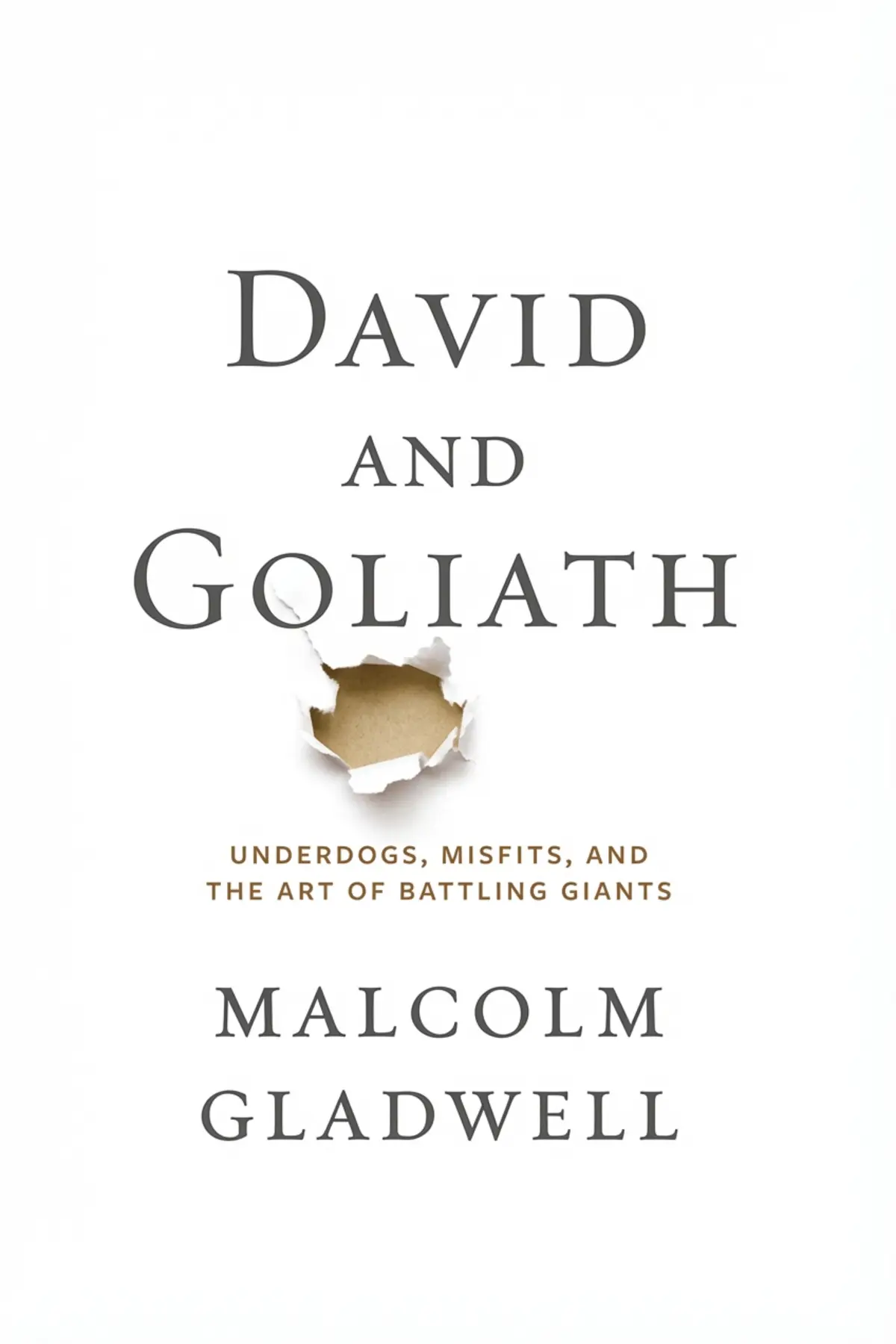
Gladwell shows why advantages like wealth, prestige and size can backfire, how hardships such as dyslexia or early loss can build rare strengths, and how underdogs win by refusing to fight on the stronger side's terms.
56 sec
Feeling outmatched by a bigger rival or a more polished peer often means misreading the contest. In David and Goliath, Malcolm Gladwell argues that even David was never really the underdog. His sling could throw a stone at deadly speed from well beyond a sword’s reach, he had practiced with it against predators that threatened his sheep, and Goliath’s great size probably came from a medical condition that likely blurred his eyesight.
Gladwell’s case is that strengths and weaknesses are often the reverse of what they seem. Advantages turn into burdens past a certain point, handicaps can build rare skills, and the side that refuses the giant’s rules often wins. From a Paris art exhibition to a dyslexic lawyer, a desert campaign and a police unit handing out Thanksgiving turkeys, he offers a sharper way to judge your own position and to play it well.
1 min 36 sec
Getting into the most elite school or team feels like the obvious win. Gladwell points to a hidden cost that makes talented people more likely to quit, and to painters who prospered by walking away from the top.
1 min 35 sec
More wealth and more personal attention sound like pure gains for a child. Gladwell traces the point where each one flips, and what children lose once they cross it.
1 min 38 sec
A short arithmetic puzzle trips up most people, even at an elite university. Making it harder to read changed the scores, and that result helps explain how one dyslexic man became a formidable courtroom lawyer.
1 min 47 sec
A striking share of people famous enough for an encyclopedia entry lost a parent young. Gladwell explains how the worst childhood event can feed ambition, through the life of a doctor who refused to give up.
1 min 45 sec
In a straight contest, the side with more resources almost always wins. Weaker armies have found a way around that rule, and the numbers show how much it changes their odds.
1 min 47 sec
The civil rights marchers of the 1960s are remembered as pure and plain-dealing. Gladwell describes a far craftier campaign, and one photograph that reached all the way to the White House.
1 min 44 sec
Facing a boycott that threatened him with financial ruin, one company founder made a deal that no one else around him considered acceptable. Gladwell uses his gamble to show why being disagreeable can pay.
1 min 57 sec
Tougher penalties seem like the natural answer to disorder. Evidence from prisons, the streets of Belfast and a New York housing project suggests they can feed the very problem they are meant to stop.
1 min 08 sec
Gladwell’s book finally teaches a way of reading a situation. The giant’s size, the elite school’s name, the family fortune and the tiny classroom all look like advantages, and each can turn into a burden past a certain point. Dyslexia, grief and a shortage of trained soldiers look like weaknesses, and each can open a route the favorite never sees. Power obeys the same rule, since the strong side keeps its strength only while people believe it is fair.
That points to a few habits. Before chasing a seat among the very best, ask whether it will grow your confidence or drain it, the choice the Impressionists made when they stopped waiting on the Salon. Notice what a hard limitation has forced you to master, as Boies did with listening, and build around it. Against a bigger rival, change the terms of the contest. And if you hold authority, invest in being seen as fair: the New York officers cut crime where the Belfast raids only fed it.
David never needed to be bigger. He needed to pick the fight he was built to win.
We tend to judge contests by size: the bigger army, the richer family, the more famous school. Malcolm Gladwell argues that this habit misleads us. Even David, the shepherd boy of the Bible story, held the stronger hand once you look at his sling and at Goliath's likely medical condition. Gladwell follows that reversal through very different worlds. Talented students drop out of elite universities, while the Impressionists flourished once they stopped courting the Paris Salon. Wealth and tiny classrooms help children only up to a point. A dyslexic lawyer turns his struggle with reading into exceptional listening, and a doctor whose father died by suicide goes on to develop a childhood leukemia treatment with a 90 percent cure rate. Small forces win by changing the rules, from Lawrence of Arabia in the desert to civil rights organizers working the press. The book ends with a warning for those who hold power. Harsh punishment can feed the disorder it targets, and authority works best when people see it as fair. Readers get a sharper way to judge their own position, and practical ways to play a weak hand well.
Students and young professionals weighing a prestigious school or employer against a place where they can stand out.
Founders and small teams competing against much larger, better funded rivals.
Managers, parents and anyone with authority who wants cooperation rather than resentment.
Malcolm Gladwell was born in England in 1963 and grew up in rural Ontario. He reported for the Washington Post before joining The New Yorker. His earlier books include The Tipping Point and Outliers, and his writing often draws on research from sociology and psychology. He co-founded the podcast company Pushkin Industries and was appointed to the Order of Canada in 2011.
Malcolm Gladwell
Malcolm Gladwell
Malcolm Gladwell

Listeners find this to be an accessible and captivating experience packed with intriguing data and moving narratives regarding actual individuals. Furthermore, the prose reflects Gladwell’s characteristic speechifying, which results in a work that is both brainy and evocative. Listeners also value the motivational aspects of the material, especially its focus on empowering the underdog within everyone and offering unexpected perspectives on common circumstances.
As a parent of a child who struggles with learning disabilities, this book felt like a breath of fresh air. Gladwell’s take on how challenges can actually forge resilience is exactly what I needed to hear right now. The story of the doctor who revolutionized leukemia treatment by being 'disagreeable' was heartbreaking yet inspiring. It reminds us that empathy isn't always soft; sometimes it requires a certain kind of toughness to find a cure. Some critics call this cherry-picking, but I call it finding meaning in the struggle. The writing style is conversational and punchy, making complex social theories feel accessible to anyone. I couldn't put it down.
Show moreWow, I never realized how much of a tactical advantage David actually had in that valley. Gladwell turns the biblical narrative on its head by explaining the physics of the slingshot and Goliath’s likely medical issues. It’s a brilliant way to kick off a book about reframing power dynamics. I loved the section on the Impressionists and how they chose to start their own show rather than begging for Salon approval. The truth is, we often spend too much time trying to fit into systems that weren't built for us. This book gives the underdog permission to stop playing by the giant's rules. It's fast-paced, insightful, and left me feeling incredibly motivated.
Show morePicked this up on a whim at the airport and ended up finishing it before my return flight. I’ve always been a fan of how Gladwell can take a dry statistic and turn it into a high-stakes drama. The 'Big Fish-Little Pond' theory is something I wish I had read before I applied to college. It explains so much about why talented students often drop out of rigorous science programs. The book is filled with these 'aha' moments that make you rethink your own life choices. While the ending felt a little abrupt, the journey through these various case studies was totally worth it. It’s an inspirational read for the 'little guy' in all of us.
Show moreFinally got around to this one and it definitely lives up to the hype for anyone who feels like an outsider. Gladwell has this way of making the underdog feel like the smartest person in the room. The stories about the Civil Rights movement and the Huguenots in France were moving and provided a fresh perspective on courage. Not gonna lie, I was skeptical about how he’d link all these things together, but it mostly works. The book is easy to digest and perfect for a quick intellectual boost. It’s the kind of writing that makes you feel smarter just by reading it. Definitely worth picking up if you like stories about triumphing over adversity.
Show moreGladwell has this incredible gift for making you look at the world sideways. In this book, he deconstructs the classic underdog story, arguing that what we perceive as weaknesses are often our greatest weapons. I particularly enjoyed the 'Big Fish-Little Pond' section regarding university choices. It makes you rethink the obsession with prestigious institutions like the Ivy League. While some of the transitions between chapters felt a bit forced, the prose remains breezy and incredibly readable. You might find yourself questioning his data sources occasionally, but the central message is undeniably empowering. It's a must-read for anyone who has ever felt like they were fighting an uphill battle.
Show moreAfter hearing Gladwell speak at a conference, I wanted to see if his writing matched his oratorical style. It absolutely does. The book reads like a series of compelling TED Talks, moving quickly from the basketball court to the civil rights movement in Alabama. I was particularly struck by the discussion on 'legitimacy' and how heavy-handed authority often backfires. His exploration of the 'three strikes' law was a bit of a rollercoaster, showing both sides in a way that was genuinely confronting. Even if you don't agree with every conclusion, you can't deny that he knows how to spark a conversation. It’s intellectually stimulating without being overly dense or academic.
Show moreEver wonder why the most successful people often come from the most harrowing backgrounds? Gladwell dives into the 'remote miss' phenomenon, showing how surviving a trauma can sometimes remove the fear of future failure. The chapter on Dr. Jay Freireich and his 'distanced' empathy during pediatric cancer trials was particularly haunting. It forces you to ask difficult questions about what it takes to actually innovate in a field where everyone else is playing it safe. Look, the book isn't a perfect scientific treatise, but it is a masterclass in narrative non-fiction. It provides surprising insights into everyday situations that you’ll find yourself quoting to friends for weeks. Truly a thought-provoking experience.
Show moreIs this rigorous science or just a collection of very well-told anecdotes? To be fair, Gladwell doesn’t claim to be writing a textbook, yet his conclusions are presented with such authority that it’s easy to get swept up. I found the chapter on class sizes fascinating but ultimately a bit contradictory. He suggests smaller classes aren't always better, then pivots to saying teachers just don't adapt. It’s classic pop-psychology: high on narrative, slightly lower on consistent logic. However, his exploration of dyslexia as a 'desirable difficulty' was genuinely thought-provoking. It’s an easy, engaging read for a weekend, though you should keep your critical thinking cap on.
Show moreTo be fair, Gladwell is a master of the 'Aha!' moment, even if those moments don't always hold up to scrutiny. In this installment, he tackles the myth of the underdog with his signature blend of anecdotes and social theory. I enjoyed the parts about how we misinterpret the David and Goliath story, but other sections felt a bit like filler. The discussion on class sizes was interesting but seemed to ignore a lot of contradictory evidence from actual educators. Still, the writing is so smooth and the stories are so engaging that it's hard to stay mad at his selective data. It’s a solid 3-star read that offers some cool cocktail party facts.
Show moreThe problem with this book is that it tries too hard to find a pattern where none exists. Frankly, I felt some of the parallels—like comparing the Troubles in Northern Ireland to a neighborhood in New York—were a massive stretch. Gladwell is a fantastic storyteller, but the way he weaves these disparate case studies together feels more like a magic trick than an analysis. He presents his theories as if they are universal laws of humanity, yet they often fall apart if you look too closely at the statistics. It’s a fun read if you enjoy 'speechifying' prose, but as a serious look at power, it lacks depth. It just felt like a repeat of his previous work.
Show moreGladwell argues that strengths and weaknesses are often the reverse of what they appear. Beyond a certain point, advantages such as wealth, prestige and size become burdens, while hardships like dyslexia or losing a parent can build rare skills and drive. Underdogs win by refusing to fight on the stronger side’s terms, and the powerful keep control only when people see them as fair.
Not in Gladwell’s reading. The sling was a potent weapon that could throw stones at devastating speed from well beyond the reach of a sword, and David had practiced with it defending his sheep from predators. Goliath’s enormous size was probably caused by a medical condition that likely blurred his vision. David knocked him down with a stone and finished him with the giant’s own sword.
At an elite school you compare yourself with the brightest people around you, which Gladwell calls relative deprivation, and your confidence suffers. Talented students who move up to elite universities are more likely to drop out than similar students at less prestigious ones. He also argues that classes of about 12 or fewer lose the variety of classmates that makes discussion lively.
Choose settings where your strengths will be noticed instead of chasing the biggest name, as the Impressionists did when they left the Paris Salon behind. Look at what a limitation has forced you to get good at, the way David Boies built his listening skills. Against bigger rivals, play to your own strengths, as Lawrence of Arabia did. If you lead others, work on being seen as fair.
Gladwell argues that harsh punishment past a certain point increases crime. One study found that jailing more than 2 percent of a community in a year raised crime the next year. In 1970s Belfast, extreme measures against Catholics radicalized young men and violence grew. By contrast, a New York police unit that built trust in a housing project in 2003 saw crime fall sharply.


Deborah Gruenfeld


Anthony Pratkanis




Richard Wiseman

AUDIO SUMMARY AVAILABLE
Get the key ideas from David and Goliath by Malcolm Gladwell, plus 5,000+ more nonfiction titles.