

15 min 08 sec
Available in: English
7 Rules of Power: Advice on How to Get Things Done and Advance Your Career
Shows why strong performance alone rarely gets you ahead. It gives seven concrete rules for claiming status, projecting authority, bending small norms, building a name and a network, and acting fast once you hold power.

Table of Content
1. Introduction
1 min 07 sec
Plenty of people do excellent work and still watch someone else win the promotion, the budget and the credit. In 7 Rules of Power, Stanford business professor Jeffrey Pfeffer argues that the difference often lies in how you treat power: as something you claim, or as something you wait to receive.
His opening case is Rukaiyah Adams, a young, single Black woman who entered asset management in the harsh hiring market of 2008, in a field run mostly by white men. She did not hide her difference. Colleagues trusted her with problems they feared raising, executives asked her for the unvarnished picture, and that credibility took her to a chief operating officer role and then to running trading desks that handled billions.
Pfeffer accepts that bias is real, yet he holds that waiting for fairness costs more than acting. The people who get things done stop shrinking, look the part, make their name and network work for them, and use power the moment they hold it. Each rule here comes with a move you can try in your next meeting.
2. Stop shrinking the story you tell about yourself
1 min 58 sec
A top analyst was about to lose her team to an ambitious peer, and better relationship skills would not have saved her. What turned the fight around started with a few words she used about herself.
3. Look and sound in charge from the first minute
1 min 58 sec
Two powerful executives faced tough questions from lawmakers in the same year. One kept his job for eight more years and the other was gone within months, and the facts of their cases were only part of it.
4. Bend small rules to get through closed doors
1 min 52 sec
A business student was admitted to an exclusive festival dinner along with a guest nobody had invited. The way she did it reveals why gatekeepers so often say yes to the person who skips the usual script.
5. Build a reputation that brings opportunities to you
1 min 47 sec
Some professionals spend their careers chasing openings while others seem to attract them without effort. One venture investor built a loop of small public projects that kept feeding itself, and the pattern can be copied.
6. Spend eight hours a week on the right people
1 min 44 sec
A talented Netscape employee realized his excellent work was going nowhere, so he changed how he spent his time. One relaxed dinner later, he was among the first people Google ever hired.
7. Act fast in a new role before opposition forms
1 min 54 sec
New leaders get a brief window before resistance gets organized. A president on a plane, a hospital chief fixing a leaky roof and a clever California politician show what to do with it.
8. Let your results soften how people judge you
1 min 39 sec
A senator who once attacked a candidate in the harshest terms became one of his loudest defenders. Pfeffer explains what changed, and why it should make you less afraid of how your own choices will look.
9. Conclusion
1 min 09 sec
Pfeffer’s rules can sound cynical on first hearing, yet they rest on a hopeful idea: power is less a trait you are born with than a set of behaviors anyone can practice. Christine did not become older or more senior before she won her fight. She changed the words she used about herself and then acted on them. Rukaiyah Adams did not wait for her industry to welcome her. She made being the outsider the reason people trusted her.
That is also where to begin. Write down the labels you give yourself and replace the ones that make you smaller. In your next meeting, know your points well enough to leave the notes behind, and drop the apology you would normally open with. Set aside a few hours this week for people outside your usual circle, and offer them something useful before you ask for anything. When a new role arrives, make a visible move early, while the window is still open.
Pfeffer asks you to choose tactics that fit your values and then let momentum build. Every door you open makes the next one lighter to push.
About this book
What is this book about?
Many capable people assume that doing excellent work will be noticed and rewarded. Then they watch a louder colleague take the promotion, the budget or the credit. Jeffrey Pfeffer, who teaches a course on power at Stanford's business school, argues that ambitious people should stop waiting for fairness. His answer is seven rules, each illustrated with real people. A marketing analyst wins a turf fight by rewriting the labels she uses about herself. Two chief executives testify before Congress, and their posture helps decide who keeps his job. A business student talks her way into a private Sundance dinner and later raises $56,000 across several MBA programs. Google's eleventh employee earns his place partly over dinner, and Lyndon Johnson starts planning the Great Society on Air Force One. Readers get specific moves: drills against imposter syndrome, signals of authority in voice and posture, a two-line personal story, four principles for networking, and a plan for a new leader's first weeks. They also get Pfeffer's blunt observation that success excuses almost everything, and why that should make them less afraid of being judged.
Book Information
Who it's for
Strong performers passed over
Strong performers who keep watching louder colleagues get promoted ahead of them.
Newly in charge
New managers and leaders entering a role with a short window to show what they can do.
Outsiders wanting more influence
Outsiders in their field who want practical ways to turn being different into influence.
About the Author
Jeffrey Pfeffer
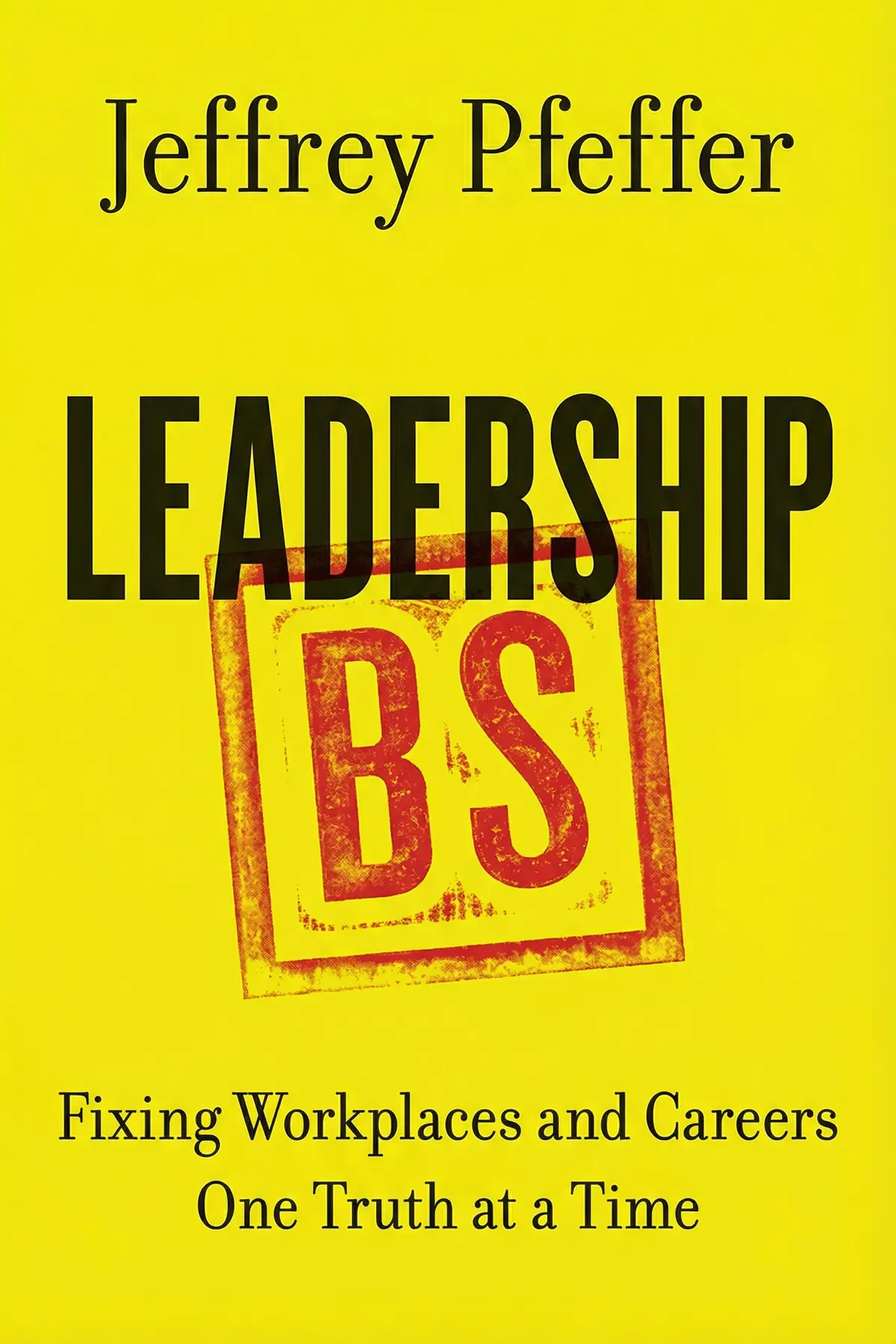
Jeffrey Pfeffer is the Thomas D. Dee II Professor of Organizational Behavior at Stanford's business school, where he has taught since 1979 after posts at the University of Illinois and the University of California, Berkeley. He teaches a second-year MBA elective called Paths to Power. His other books include Leadership BS and Dying for a Paycheck. He has written for Fortune and Harvard Business Review and received the Academy of Management's Richard I. Irwin Award for scholarly contributions to management.

Ratings & Reviews
Ratings at a glance

What people think
Listeners find the book useful and perceptive, with one review noting that it outlines established methods for moving up within a company. Furthermore, the work is praised for being easy to follow, as one listener characterizes it as a must-read for professionals. Listeners also value the inclusion of scientific data throughout the text. On the other hand, the ethical aspects of the book elicit a variety of responses from listeners.
Top reviews
Ubolrat
Forget the sanitized HR platitudes about meritocracy and doing good work in silence. Pfeffer delivers an unvarnished masterclass on how corporate hierarchies actually function. Instead of lecturing us on how the world ought to look, he provides a scientific blueprint explaining why rule-breakers capture the highest offices. His central argument—that power operates like physics, completely indifferent to human morality—is both terrifying and profoundly liberating. The advice on projecting supreme confidence and deliberately constructing a personal brand felt immediately applicable to my own workplace struggles. Frankly, if decent individuals refuse to study these tactical maneuvers, less scrupulous actors will happily seize every opportunity.
Show moreTalia
Picked this up right after watching one of Pfeffer's online lectures, and the written material exceeded my expectations. Most career manuals peddle polite fairy tales that leave well-meaning employees completely blindsided by office politics. This text does the exact opposite. By framing influence as an amoral mechanism, the author demystifies the exact behaviors required to drive meaningful organizational outcomes. You cannot execute noble visions from a position of absolute weakness. Pfeffer's emphasis that good people must deliberately acquire power to do good in the world was the exact mindset shift I needed. A brisk, revelatory, and deeply empowering piece of writing.
Show morePang
Why do so many underqualified self-promoters land executive roles while dedicated workers stay invisible? This book answers that question with uncomfortable precision. Pfeffer unpacks the psychological mechanisms of authority, proving that competence alone rarely guarantees advancement without intentional visibility. Every chapter delivers concrete, actionable steps—from systematically nurturing professional ties to mastering expressive body language. What sets this apart from typical pop-psychology is the sheer volume of peer-reviewed behavioral research supporting every claim. In my experience, implementing even a couple of these principles yields noticeable shifts in how senior leadership perceives your presence. It belongs on every ambitious professional's desk.
Show moreBenjamin
Stop treating modern leadership like an aspirational Sunday sermon. Pfeffer forces you to confront the reality of organizational life as a competitive arena where leverage dictates outcomes. His seven rules are stripped of sentimental posturing, offering an analytical framework backed by decades of behavioral research. I particularly resonated with the principle that past transgressions are routinely overlooked once someone successfully captures the summit. While timid readers will inevitably label the author Machiavellian, the strategies outlined are simply the structural realities of human social systems. If you want results instead of platitudes, start here.
Show moreAnawin
Bracingly honest and completely unapologetic from start to finish. Pfeffer dismantles the comfortable lies we tell ourselves about corporate fairness and replaces them with an evidence-based roadmap to real influence. The idea that power is a renewable resource—growing larger the more frequently you exercise it—fundamentally shifted my daily approach to executive meetings. You quickly understand that remaining passive out of a desire to be universally liked is a losing proposition. The writing is punchy, relentless, and brimming with illustrative case studies. Anyone frustrated by watching political operators leapfrog them on the corporate ladder must read this immediately.
Show moreMichael
Look, nice professionals frequently lose out in competitive hierarchies unless they understand the real rules of the game. This book supplies that missing tactical education. Pfeffer provides rigorous empirical evidence showing how authority is established, projected, and protected over time. He refuses to sugarcoat the uncomfortable truth: sitting quietly at your desk waiting for your labor to be discovered is career suicide. You must actively carve out a distinctive presence, leverage scarce resources, and build strategic alliances. It is an indispensable, eye-opening survival guide for anyone serious about making a measurable impact in their field.
Show moreYaowares
As someone who has spent two decades grinding in middle management, I found this book remarkably clarifying yet slightly uneasy to digest. Pfeffer pulls zero punches, stripping away the feel-good fluff that clutters typical leadership bestsellers. He backs up his assertions with rigorous empirical data rather than cherry-picked anecdotes, showing precisely how building alliances and managing perceptions determine promotions. To be fair, certain recommendations regarding relentless self-promotion left a slightly sour taste in my mouth. My only substantial critique is that these aggressive tactics feel heavily geared toward cutthroat American corporate climates and might backfire in more collectivist, consensus-driven organizational cultures. Nevertheless, the tactical clarity here remains unmatched.
Show moreWitthaya
The chapter on breaking conventions to rewrite competitive dynamics completely transformed how I analyze strategic initiative. Pfeffer writes with crisp, engaging momentum, making complex academic findings feel remarkably accessible. He demonstrates that waiting around for permission is a guaranteed recipe for career stagnation. That said, readers should proceed with reasonable caution. Following these bold rules requires exceptional social calibration; an inexperienced junior employee attempting to act powerful before securing foundational credibility could easily crash and burn. A touch more nuance regarding the risks of overplaying your hand would have earned this five stars, but it is undeniably an extraordinary playbook.
Show moreAraya
Took me just two evening sittings to rip through this cover to cover. The book reads fast because Pfeffer cuts the academic jargon and focuses straight on tactical utility. His advice on treating your network like a strategic asset rather than a casual social club was particularly motivating. Personally, I struggled slightly with the cynical tone surrounding authenticity and the open encouragement to project an illusion of stature until reality catches up. Yet, looking around my own firm, I have to admit his diagnostic accuracy is terrifyingly spot on. An essential read, even if it occasionally makes you squirm.
Show moreAva
A bitter pill that left me feeling thoroughly cynical about the professional world. While Pfeffer's prose is sharp and his academic research is formidable, the actual ethos borders on depressing. The framework strongly mirrors Robert Greene's work, but wrapped in Stanford business credentials. You are effectively advised to fake expertise, bend rules when expedient, and build transactional networks solely to gain personal leverage. Truth is, I cannot fault the accuracy of his observations regarding toxic leadership ascendancy. It clearly works. I simply wish the book spent more time addressing how to reform these broken incentives rather than coaching readers on how to exploit them for personal gain.
Show moreQuestions about this book
What is the main idea of 7 Rules of Power?
Jeffrey Pfeffer argues that good work alone rarely advances a career and that waiting for fairness is a costly mistake. Power goes to people who claim it: they stop undercutting themselves, bend minor rules, appear powerful, build a clear personal brand, network constantly and use their power early. His final rule is that success excuses almost everything, so visible results soften how others judge the path you took.
What are the seven rules of power?
Pfeffer’s rules run as follows: stop getting in your own way, break the rules, look powerful, build a strong personal brand, network without letup, put your power to work, and accept that success excuses almost everything. Each comes with real cases, from a Sundance dinner crashed with a one-line email to a hospital chief at Stanford who moved fast, posting clear metrics everywhere and fixing nagging issues.
How does Pfeffer suggest overcoming imposter syndrome?
He draws on self-perception theory, the idea that people form attitudes by watching their own behavior, so acting confident helps you feel confident. He suggests noticing that many people above you are not more qualified, and pushing yourself to pitch ideas anyway. Practical drills include asking peers to replace diminishing words you use about yourself and removing every unnecessary apology from a day of conversations.
How can I appear more powerful at work?
Pfeffer points to open posture, controlled gestures, a steady and slightly louder voice, longer eye contact and more speaking time. He advises knowing your points rather than reading notes, using short declarative sentences without hedges like sort of, and pausing and repeating key lines. Apologies tie you to blame, so use them sparingly when your competence is being judged.
How much time should I spend networking according to 7 Rules of Power?
Pfeffer recommends eight to ten hours a week. He advises pursuing weak ties outside your usual circle, connecting people who would benefit from knowing each other, choosing central roles that touch many parts of the organization, and helping others with what they need. When you ask for help, be specific. Omid Kordestani’s habit of building relationships helped him become Google’s eleventh employee.


Readers also enjoyed

60 Seconds & You’re Hired!
Robin Ryan




Be A Free Range Human: Escape the 9 to 5, Create a Life You Love,
Marianne Cantwell
Be the Unicorn: 12 Data-Driven Habits That Separate the Best Leaders from the
William Vanderbloemen


AUDIO SUMMARY AVAILABLE
Listen to 7 Rules of Power in 15 minutes
Get the key ideas from 7 Rules of Power by Jeffrey Pfeffer, plus 5,000+ more nonfiction titles.
- 5,000+ titles
- Listen as much as you want
- 7-day free trial
- Cancel anytime









