
14 min
Available in: English
 ไทย
EnglishไทยBlink: The Power of Thinking Without Thinking
Shows when a fast first impression is more accurate than careful analysis, and how stress, hidden associations and artificial test conditions can bend it, with concrete checks for deciding when to trust your gut.
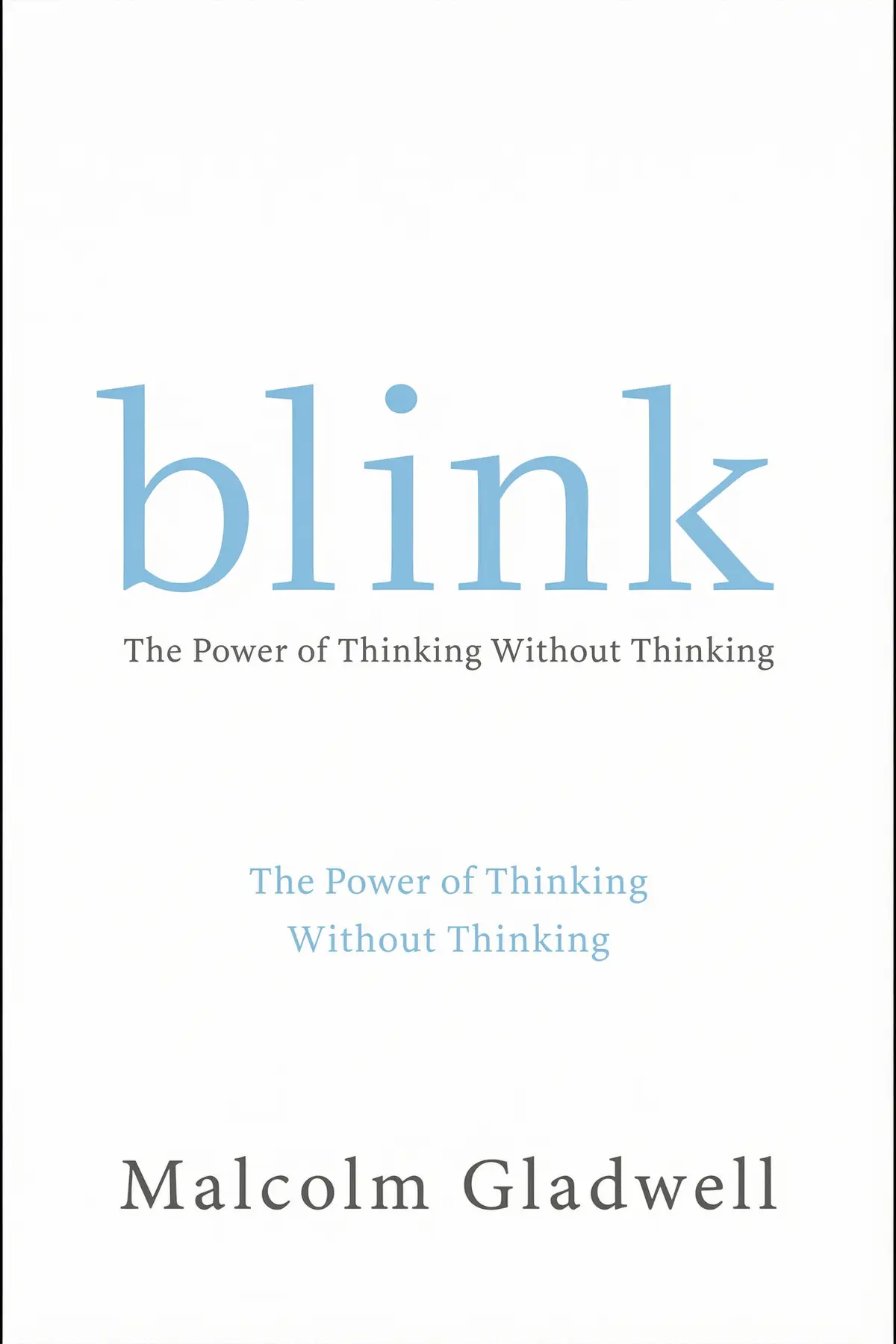
Table of Content
1. Introduction
59 sec
Most decisions you think you reasoned out were made in a flash, and the reasons came afterward. In Blink, New Yorker writer Malcolm Gladwell argues that this fast, unconscious judging is often sharper than careful analysis, because it ignores the noise and fixes on the few facts that matter. It has a darker side too. The same speed lets old associations about height, gender and skin color slip into choices we believe are fair.
Gladwell’s throughline is that good decisions come from knowing which kind of snap judgment you are facing: one built on real patterns, or one bent by stress, a false setting or prejudice. Along the way come art experts who sense a fake before they can explain it, a cola that won every taste test and then failed, a president chosen for his appearance, and orchestras that found hidden talent once they stopped looking. What you gain is a short set of checks for when to trust your first read and when to block it.
2. Know when a fast judgment beats slow analysis
1 min 40 sec
Some experts can tell a painting is fake or a serve will fail before they can say why. Their reasons arrive late, yet their verdicts are right. What lets a feeling outrun careful thought?
3. Watch a few signals and ignore the rest
1 min 40 sec
Recording every detail of a couple’s behavior sounds like the surest way to predict their future. It turns out to be one of the worst, and the reason changes how you should judge almost anything.
4. Spot the gut call behind your neat reasons
1 min 36 sec
People can list every trait they want in a partner, in careful detail. Then they meet someone and the list vanishes. The gap reveals how often our explanations are written after the choice.
5. Spot when looking the part misleads you
1 min 45 sec
A few minutes of imagining yourself as a professor can change how well you do at a quiz. The same hidden mechanism helped a man with no real record win the American presidency.
6. Keep pressure from narrowing what you see
1 min 40 sec
Everyone reads faces all day without effort, across every culture. Yet under enough stress, that skill can shut down, and the tunnel vision that follows can lead police officers to shoot innocent people.
7. Test products the way people really use them
1 min 43 sec
Coca-Cola had the data: every taste test pointed to its new recipe becoming a smash success. The launch still failed so badly the drink was withdrawn. The tests were accurate about the wrong thing.
8. Retrain your instincts and screen out bias
1 min 52 sec
Most people believe they judge others fairly, and simple tests suggest otherwise. One student temporarily set aside his own hidden bias just by watching track and field, and orchestras found a fix that needed nothing more than a screen.
9. Conclusion
1 min 05 sec
This book does not ask you to choose between instinct and analysis. It asks you to know what your instinct has been fed. The art expert’s unease and the researcher’s eye for contempt are fast because they rest on real patterns and ignore everything else. Harding’s election, the wallet mistaken for a gun and the cola that won a sip test and lost the market were fast too, but they rested on stereotypes, panic or a false setting. The speed is identical in both cases. What differs is the material the unconscious works with.
That suggests habits worth practicing. When a strong first impression arrives in an area you know deeply, take it seriously and then look for its reason. When stress is rising, slow the moment down before you act. When you test an idea or a product, test it where it will actually be used. And when you judge people, remove what should not matter, as the orchestras did.
The screen is the image to keep. It did not make the judges think harder. It only let them hear the music.
About this book
What is this book about?
Many people treat a gut feeling as a guess and a spreadsheet as the truth. Malcolm Gladwell argues that this gets the mind backward. Most of our decisions are made in a flash by the unconscious, and our neat reasons often arrive afterward. Those fast judgments are frequently better than slow ones, because the unconscious discards irrelevant detail and keeps the few cues that predict the answer. But Gladwell also shows the cost of speed. Hidden associations link height, gender and skin color with competence, and they helped put Warren Harding in the White House. Stress narrows attention until a wallet looks like a gun. A cola that won every sip test became one of the biggest product failures ever because the tests ignored how people really drink. The reader gets a practical way to sort good snap judgments from bad ones: trust first impressions built on deep experience, slow down when pressure rises, test ideas in their real setting, and block information that should not count, as orchestras did when they began auditioning musicians behind a screen.
Book Information
Who it's for
Managers and recruiters
Managers and recruiters who judge people quickly and want to keep bias out of hiring and promotion.
Planning tests with customers
Product and marketing teams deciding how to test new ideas with customers.
Professionals weighing their gut
Professionals who either distrust their gut or follow it blindly and want a clear rule for when it deserves trust.
About the Author
Malcolm Gladwell
Malcolm Gladwell was born in England in 1963 and grew up in rural Ontario. He worked as a reporter at the Washington Post before joining The New Yorker. His writing often draws on research from sociology and psychology. He co-founded the podcast company Pushkin Industries and was appointed to the Order of Canada in 2011. His books include The Tipping Point, Outliers and Blink.
Outliers: The Story of Success
Malcolm Gladwell
The Tipping Point: How Little Things Can Make a Big Difference
Malcolm Gladwell
Ratings & Reviews
Ratings at a glance

What people think
Listeners describe this title as a fast-paced and captivating experience, featuring thoroughly investigated insights that uncover the capabilities of human cognition. Furthermore, the prose is both approachable and inspiring, benefiting from a narrative structure that develops in a coherent fashion. The work also offers a variety of real-world applications, and one listener points out the heavy reliance on citations from scientific research and trials.
Top reviews
Yui
Ever wonder why you just 'know' something before you can explain it? Gladwell explores this beautifully by looking at the hidden potential of our fast-thinking brains. I was completely hooked by the story of the art experts who knew a kouros statue was fake just by looking at it, even though the lab tests said otherwise. The writing flows effortlessly, making complex psychological studies feel like a fast-paced mystery novel. While some of the conclusions might seem a bit oversimplified, the central idea of 'thin-slicing' changed how I view my own snap judgments. It’s a motivating read that encourages us to trust our instincts while remaining aware of our blind spots. I finished it in two sittings and immediately started recommending it to my friends.
Show moreEleni
Wow, I didn't expect a book about psychology to be this gripping. The story about the firefighter who ordered his team out of a building seconds before the floor collapsed was absolutely bone-chilling. It perfectly illustrates how our subconscious processes years of experience into a single, life-saving moment. Gladwell has this unique ability to take disparate stories and weave them into a larger narrative about the human condition. I found the section on 'mind-reading' and facial expressions particularly fascinating—it makes you look at every person you meet a little differently. Frankly, this is the kind of book that makes you feel smarter just by reading it. It's accessible, motivating, and filled with 'aha!' moments that stay with you long after the final chapter. A must-read for anyone who wants to understand the engine under their own hood.
Show morePete
The chapter on Paul Ekman and the science of facial expressions blew my mind. I had no idea that our faces could betray our true emotions in such a tiny fraction of a second. Gladwell does an incredible job of showcasing the potential of the human mind to process massive amounts of data instantly. The book is incredibly well-researched, with extensive references to studies that back up his storytelling. I found the writing style to be very reader-friendly and perfect for a layman who doesn't want to get bogged down in dense academic jargon. It’s a motivating look at how we can improve our own judgment by understanding the 'blink' moments that define our lives. I read the whole thing in under a day because I just couldn't put it down. Highly recommended.
Show morePrae
Picked this up on a whim and ended up fascinated by the chapter on unconscious bias. The discussion about the Implicit Association Test was a real eye-opener for me regarding how we perceive race and gender without even realizing it. Gladwell takes these heavy academic concepts and makes them incredibly accessible for the average reader. I loved the variety of examples, from tennis coaches predicting double faults to car salesmen and their tactics. It makes you realize how much processing is happening under the surface every single day. My only gripe is that it feels a bit repetitive towards the end, as if he’s stretching the same point to fill the page count. Still, the practical takeaways about 'listening' to your intuition are worth the price of admission. It's a quick, thought-provoking journey into the mechanics of the mind.
Show moreTitiluck
Finally got around to reading this after hearing about the 'Pepsi Challenge' example for years. Gladwell explains why sip tests don't actually predict long-term preference, which was a lightbulb moment for me as a marketing student. The way he builds his arguments logically through these diverse case studies is really impressive and keeps you turning pages. You get to jump from high-stakes emergency rooms to the world of professional musicians in a single chapter. To be fair, he does lean heavily on the 'wow' factor of his stories rather than deep data, but that’s what makes it a bestseller. It isn’t a textbook, and it doesn’t pretend to be one. It’s a compelling look at how our brains shortcut their way to conclusions. Definitely a great conversation starter for anyone interested in human behavior.
Show morePloy
After reading The Tipping Point, I had high expectations for this one and it mostly delivered. Gladwell shifts the focus from social movements to the internal clock of the human brain, and the results are mostly enlightening. I particularly appreciated the parts about how we can actually train our intuition to be more accurate through deliberate practice. The contrast between the veteran police officer who didn't shoot and the tragedy of Amadou Diallo was a sobering reminder of how high the stakes can be. Look, the book isn't perfect, and Gladwell definitely has a tendency to cherry-pick his examples to fit his narrative. However, the core message about the power of the adaptive unconscious is a vital one. It’s a quick, informative read that provides plenty of 'dinner party' facts. Gladwell remains the king of making science feel like a story.
Show moreKofi
Direct and insightful, this book offers a great look at how we navigate complex choices without even thinking. Gladwell coins the term 'thin-slicing' to describe our ability to find patterns based on tiny slivers of experience, and it’s a concept that has stuck with me. He balances the awe-inspiring stories of success with the 'Warren Harding error,' reminding us that our guts can be horribly wrong if we aren't careful. Personally, I found the examples involving marriage counselors being able to predict divorce with 90% accuracy to be the most compelling. The book is structured logically, moving from the benefits of snap judgments to the dangers and finally to how we can control them. It’s a solid 4-star read because while it lacks some scientific rigor, it makes up for it in sheer readability and intrigue.
Show moreLuke
As someone with a background in social sciences, I found myself frequently frustrated by the lack of nuance here. Gladwell is undoubtedly a gifted storyteller, but he often polishes the data until the actual science is lost. He presents 'thin-slicing' as this miraculous tool, but then spends half the book showing how it leads to massive errors like the election of Warren Harding. Truth is, the book doesn't offer a clear framework for deciding when to trust your gut versus when to rely on data. If you want a fun, light read for a flight, this is perfect for you. However, if you're looking for rigorous psychological analysis, you’re better off reading something like Scott Plous or the Heath brothers. It’s engaging, sure, but it feels more like an anecdote collection than a cohesive theory.
Show moreTun
Not what I expected after all the hype. Don't get me wrong, Gladwell is a talented writer who knows how to keep an audience engaged, but the 'revelations' here felt a bit thin. Most of what he calls 'thin-slicing' is just what we used to call 'expert intuition' or 'common sense' based on years of practice. I didn't feel like I was uncovering valuable new facts so much as hearing old ones restated in a very polished way. The anecdotes about classical musicians and blind auditions were interesting, but did I need 250 pages to understand that bias exists? Probably not. It’s a decent introductory book for someone who has never thought about their thought processes before. For anyone else, it might feel like a collection of magazine articles stitched together.
Show moreWacharapol
This book feels like it's constantly arguing with itself. On one hand, we are told that split-second decisions are often superior to hours of careful analysis. Then, without much transition, we're warned that our snap judgments are riddled with prejudice and can lead to tragic police shootings. Gladwell doesn't provide a bridge between these two extremes, leaving the reader confused about what the actual takeaway should be. Is intuition a superpower or a curse? He never really says. While the individual anecdotes are entertaining, the book never gels into a coherent whole. I found the writing style to be a bit too 'pop-psychology' for my taste, prioritizing style over substance. It’s a fast read, but by the time I finished, I felt like I hadn't actually learned a usable skill.
Show moreQuestions about this book
What is the main idea of Malcolm Gladwell's book on snap judgments?
Gladwell argues that the unconscious makes fast judgments that are often better than slow analysis, because it filters out irrelevant information and focuses on a few key cues. Tennis experts who sense a fault and art experts who spot a forgery at a glance are his examples. The same speed, though, lets stereotypes, stress and misleading contexts distort decisions, so the skill lies in knowing which kind of snap judgment you face.
When should you trust your gut according to Blink?
Gladwell suggests trusting snap judgments when they rest on real patterns the unconscious has learned, as with experts who have studied serves or paintings for years. Be wary when stress is high, when the setting is artificial, as in the New Coke sip tests, or when appearance might be standing in for evidence, as in Warren Harding’s election to the presidency.
Why did New Coke fail if it won the taste tests?
According to Gladwell, the tests were run under unrealistic conditions. Testers judged each cola from one sip with all brand signs, including the can’s color, hidden. Real customers drink a whole can at home, often on the couch, and know which brand they are holding. He also notes that innovative products often score poorly at first, because people need time to grow used to anything unfamiliar.
How does Gladwell suggest reducing unconscious bias?
Gladwell offers two approaches. One is changing the associations themselves through new people and experiences, as when a student weakened his hidden racial bias by cheering for a mostly Black American track and field team. The other is blocking irrelevant information, as orchestras did by auditioning musicians behind a screen, which led to many more talented women being hired.
What does stress do to decisions in Blink?
Gladwell says heavy stress and time pressure make people stop reading facial expressions and other indirect signals, narrowing attention to the most urgent threat. He calls this a temporary kind of autism. Police officers in this tunnel vision have shot innocent people after mistaking a black wallet for a gun. His advice is to slow down and reduce the pressure in your surroundings.

Readers also enjoyed

Acting with Power: Why We Are More Powerful Than We Believe
Deborah Gruenfeld


Age of Propaganda: The Everyday Use and Abuse of Persuasion
Anthony Pratkanis




59 Seconds: Change Your Life in Under a Minute
Richard Wiseman



AUDIO SUMMARY AVAILABLE
Listen to Blink in 15 minutes
Get the key ideas from Blink by Malcolm Gladwell, plus 5,000+ more nonfiction titles.
- 5,000+ titles
- Listen as much as you want
- 7-day free trial
- Cancel anytime









