


Acting with Power: Why We Are More Powerful Than We Believe
Deborah Gruenfeld
 English
Shows why fighting anxious thoughts and painful feelings tends to make them stronger, and how to step back from them, accept them and act on your values anyway, one small step at a time.

1 min 01 sec
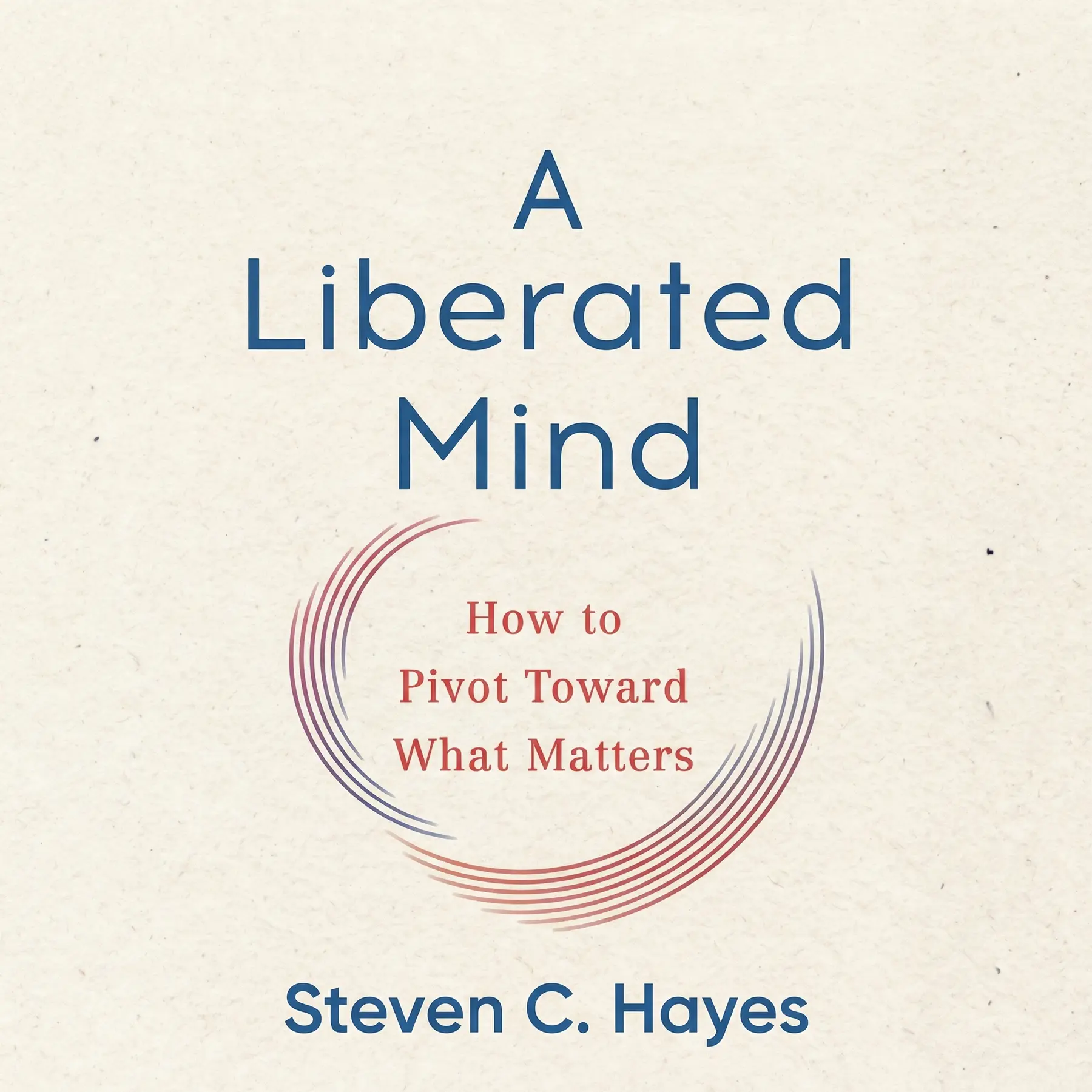
If you spend your days arguing with your own worries, trying to think them away, you probably know how that ends: the worry gets louder. In A Liberated Mind, clinical psychologist Steven C. Hayes starts from research showing that battling your mind tends to backfire, strengthening the very thoughts and feelings you want gone.
His alternative is a set of mental shifts that add up to what he calls psychological flexibility. The claim running through all of it is simple to say and harder to practice. You do not have to win the fight with your thoughts and feelings before you can live well, because you can carry them with you while you move toward what matters.
Hayes shows how to step back from a thought, how to hold a painful feeling without being run by it, how to find values that work like a compass, and how to act on them on days when confidence never shows up. Each shift is small enough to try before the week is out.
1 min 49 sec
Telling a worry to stop seems like common sense, yet it often makes the worry grow. Hayes explains what the mind is really trying to do, and why winning the argument may be the wrong goal.
1 min 52 sec
One woman changed her relationship with a frightening thought by adding a handful of words in front of it. The thought itself stayed exactly the same, so what lost its power over her?
1 min 59 sec
Harsh feedback can feel like an attack on who you are. A simple image about weather and a moment in a cinema point to a part of you that criticism never reaches.
2 min 08 sec
We are taught to avoid pain at all costs. A woman grieving a lost friendship found her sadness carried information she needed, and a heavy weight held at arm’s length explains why avoidance wears us out.
2 min 04 sec
Hitting targets can still leave you feeling stuck. An imagined 90th birthday party, and a career rethink that ignored job titles entirely, reveal a kind of direction that no goal can supply.
1 min 58 sec
Waiting to feel confident before acting can mean waiting forever. A would-be community organizer and a frustrated artist show what it looks like to move forward while doubt is still talking.
1 min 11 sec
The thread through A Liberated Mind is a change of direction. Most of us turn away from discomfort by instinct, arguing with worry, outrunning grief, waiting for doubt to clear. Hayes asks for the opposite turn: toward the hard thought, so you can see it as a thought; toward the painful feeling, so you can hear what it says about what you care about; and then toward the life those cares point to. Flexibility, in his account, is the ability to keep moving with an unsettled mind.
That makes the practice small enough to begin today. When a worry loops, put I’m having the thought that in front of it and see what loosens. When a feeling hurts, find it in your body and give it room instead of pushing it off. And before tomorrow ends, take one modest step toward a value you would want remembered at your 90th birthday, bringing whatever doubts insist on coming.
Maya’s worry only grew louder the harder she told it to stop. Her story shows the loop itself, not a way out of it. The wider sky and the small next step come later, through other people’s stories.
Telling yourself to stop worrying rarely works. Pushing away a painful feeling usually makes it louder, and arguing with self-doubt tends to produce more evidence for it. Clinical psychologist Steven C. Hayes builds his book on that observation and offers a different response to it. Hayes does not try to win the fight with the mind. He teaches a set of mental shifts that together build psychological flexibility. You learn to treat thoughts as passing events you can watch, to find a stable observing self beneath shifting emotions, and to turn toward pain with curiosity, because it often points at what you care about. From there, he separates values from goals: values are directions you can follow for life, and you find them by asking who you want to be at your best. The book closes on action. Through short cases of people facing presentations, grief, social anxiety, discrimination and stalled careers, Hayes shows how to take small committed steps while carrying doubt and discomfort along. Readers get simple, repeatable practices, from naming a thought to choosing one values-based action for tomorrow.
Professionals whose anxiety grows the harder they try to think it away.
People stuck in careers or routines who want a clearer sense of what matters to them.
Anyone carrying grief, self-doubt or social anxiety who wants practical ways to act anyway.
Steven C. Hayes, born in 1948, is a clinical psychologist and Nevada Foundation Professor in the psychology department at the University of Nevada, Reno, where he has taught since 1986. He co-developed Acceptance and Commitment Therapy, a psychotherapy built on mindfulness, acceptance and values, and is known for relational frame theory, a theory of how human language and thought work. He also coined the term clinical behavior analysis. His interest in the field grew from his own panic disorder as a young professional, which he began to move past in 1981 by turning toward his suffering. He spent 11 years writing A Liberated Mind.
Listeners find this work to be thoroughly evidence-based yet written for the average person, creating a truly engaging experience. They value the seamless integration of psychological concepts and real-world applications, with one listener describing how it completely reshaped their work as a psychotherapist. Listeners appreciate the book’s kindhearted perspective and its power to foster greater bravery in daily life, while one noted it specifically helped their professional rapport with supervisees.
This book changed everything for me. Truth is, I’ve spent years fighting my "Dictator Within," trying to argue away every negative thought with logic, but Hayes shows why that struggle is exactly what keeps us stuck. The six pivots—especially defusion and values—provide a roadmap that feels both scientifically grounded and deeply compassionate. While the writing can get a bit dense when he dives into the clinical research, the payoff for sticking with it is immense. I found myself highlighting entire sections on psychological flexibility because they finally explained why my previous attempts at "positive thinking" failed so miserably. It’s not about feeling good; it’s about feeling well and moving toward what matters. If you’re willing to do the work, this is a life-changer.
Show moreEver wonder why your brain is so obsessed with solving problems that aren’t actually solvable? Steven Hayes explains that our analytical minds are great for the outside world but a disaster when applied to our internal feelings. Personally, I found the "Dictator Within" metaphor to be the most helpful part of the book because it perfectly captures that bossy, judgmental voice we all have. The writing style is definitely more academic than your average bookstore find, but the compassion in his words shines through the data. It’s clear he cares deeply about helping people move from a state of "flight" to a state of "presence." This book didn't just give me tools; it gave me permission to be messy and human while still pursuing my values.
Show moreFinally got around to reading this and I’m kicking myself for waiting so long. In my experience, most books on mindfulness miss the "action" part of the equation, but Hayes nails it with the six pivots. He shows that acceptance isn't just about sitting still; it's about making room for the hard stuff so you can get back to doing what you love. The section on "Values" was particularly eye-opening for me, as it helped me distinguish between goals (which you can check off) and values (which are a direction you travel). Yes, it’s a long book, and yes, Steve is clearly very proud of his work, but when the work is this effective, I think he’s earned the right to brag a little. Truly a masterclass in psychological health.
Show moreWow. Honestly, I didn't expect a book written by a clinical psychologist to be this moving. Steven Hayes shares his own personal journey with panic attacks in a way that is so vulnerable it immediately builds a bridge to the reader. It’s one thing to read about "Acceptance" as a concept, but hearing how it saved the author’s own life makes it feel real. The book is definitely a "slow burn" because there is so much information to digest on every single page. You can’t just skim this one; you have to live with it for a while. It’s a powerful reminder that our pain isn't an enemy to be defeated, but a teacher that shows us what we actually care about.
Show moreAfter hearing Hayes on a few podcasts, I expected a lot of high-level theory, but I was surprised by how many practical exercises are packed into these chapters. Strictly speaking, it’s probably the most comprehensive guide to ACT available for a general audience. I loved the "unplug the drain" metaphor for stress—it completely changed how I handle my workweek. The truth is, we spend so much energy trying to shut off the "taps" of stress that we forget we have the power to just let it flow through us. Some of the chapters felt a little long-winded, and the self-promotion of the ACT model was a bit heavy-handed at times, but the core message is too important to ignore. Five stars for the content, even if the editing could have been tighter.
Show moreSteven Hayes has managed to write something that feels both like a warm embrace and a rigorous scientific paper. Truthfully, the balance he strikes between empathy and evidence is what makes "A Liberated Mind" stand out in a crowded field. He doesn't offer easy answers or "hacks," but instead provides a sophisticated framework for building a life that actually matters. I appreciated his receptiveness to how these principles overlap with spiritual traditions, making the book feel much more holistic than a standard CBT workbook. It’s a demanding read that asks you to look directly at your pain, but the sense of freedom it offers on the other side is worth every minute of effort. This is essential reading for the modern age.
Show morePicked this up after finishing The Happiness Trap by Russ Harris, and it was the perfect "next step" for deepening my understanding of ACT. Gotta say, Hayes definitely loves his research data, and at times the academic tone can be a little dry compared to Harris’s more accessible style. However, hearing the concepts from the founder himself adds a layer of authority that I really appreciated. The way he discusses turning toward pain with curiosity instead of running from it is a perspective shift I desperately needed. It’s a thick read, and you might want to keep a notebook handy for the exercises, but the insights into human suffering are profound. This isn't just a self-help book; it’s a manual for being human in a world that’s increasingly hard to navigate.
Show moreAs a psychotherapist, I’ve seen my fair share of clinical manuals, but this book bridges the gap between theory and practice beautifully. Look, it’s a big commitment—Hayes doesn't shy away from the technical aspects of Relational Frame Theory—but the way he applies it to relationships and performance is genius. I’ve already started using the perspective-taking exercises with my supervisees, and the results have been remarkable. Some might find his writing a bit "sandpaper-y" because of the sheer volume of research citations, yet that’s exactly what makes the advice so trustworthy. It’s not just "woo-woo" mindfulness; it’s a data-driven approach to psychological flexibility. This belongs on the shelf of every clinician and anyone else who wants to understand the mechanics of the human soul.
Show moreThe chapter on Defusion alone makes the entire purchase worth it, even if some of the later sections feel a bit like a sales pitch for ACT's superiority. Frankly, Hayes can be a bit repetitive with the "this is better than CBT" narrative, which started to grate on me after the third or fourth time he mentioned it. But look past the self-promotion and you’ll find some of the most practical advice for anxiety I’ve ever encountered. He breaks down how our minds use "coherence" to keep us trapped in old stories, and how to step back and just notice those stories without letting them drive the car. It’s dense, yes, but the science is rock-solid and the practical exercises are actually transformative if you actually do them. A solid middle-of-the-road read for those who can handle a bit of academic ego.
Show moreI'll be blunt: this book was a struggle to get through. Not gonna lie, the author’s writing style feels like he’s being paid by the word, and the endless descriptions of academic studies made my eyes glaze over more than once. I really wanted to love this because I’ve heard so much about ACT, but the "sandpaper" quality of the prose kept me from really connecting with the message. It felt like a textbook masquerading as a trade book. If you’re a hard-core science nerd, you’ll probably love the deep dives into clinical data. But for the average reader just looking for some relief from anxiety, it might feel a bit like trying to learn to swim by reading a 400-page manual on fluid dynamics. It’s just too dense.
Show moreSteven C. Hayes argues that fighting unwanted thoughts and feelings usually makes them stronger. Instead, he teaches mental shifts that build psychological flexibility: watching thoughts as passing events, noticing them from a stable observing self, accepting painful emotions as messengers, clarifying values, and taking small committed actions. The aim is to move toward what matters while carrying discomfort along, instead of waiting for it to disappear.
In Hayes’s account, it is the capacity to meet difficult thoughts and feelings without being run by them, while staying pointed at your values. It grows through practice: each time you notice yourself caught in an old pattern, make room for a hard feeling or take a step toward something that matters, the skill becomes a little stronger. Perfection is never the goal.
Goals can be completed and checked off. Values, as Hayes describes them, are ongoing directions, like a North Star you steer by but never reach. They are freely chosen, they give energy instead of restricting you, and they need no justification to others. To find yours, he suggests imagining your 90th birthday and asking what qualities you would want people to remember.
Start with one practice. When a worry loops, rephrase it as I’m having the thought that, and watch it pass like a cloud. When a feeling hurts, locate it in your body and give it space. Then choose one small action for tomorrow that fits a value, such as five minutes of real listening, and do it even if doubt shows up.
It suits people whose efforts to control anxiety, self-doubt or grief keep backfiring, and those who feel stuck despite setting goals. The book’s examples cover work presentations, harsh feedback, family arguments, social anxiety and career choices, so it speaks to professionals and to anyone wanting a steadier way to act on what they care about.
Deborah Gruenfeld




Anthony Pratkanis





Alcoholics Anonymous World Services
AUDIO SUMMARY AVAILABLE
Get the key ideas from A Liberated Mind by Steven C. Hayes, plus 5,000+ more nonfiction titles.









