
Noise: A Flaw in Human Judgment
Daniel Kahneman
 English
 ไทย
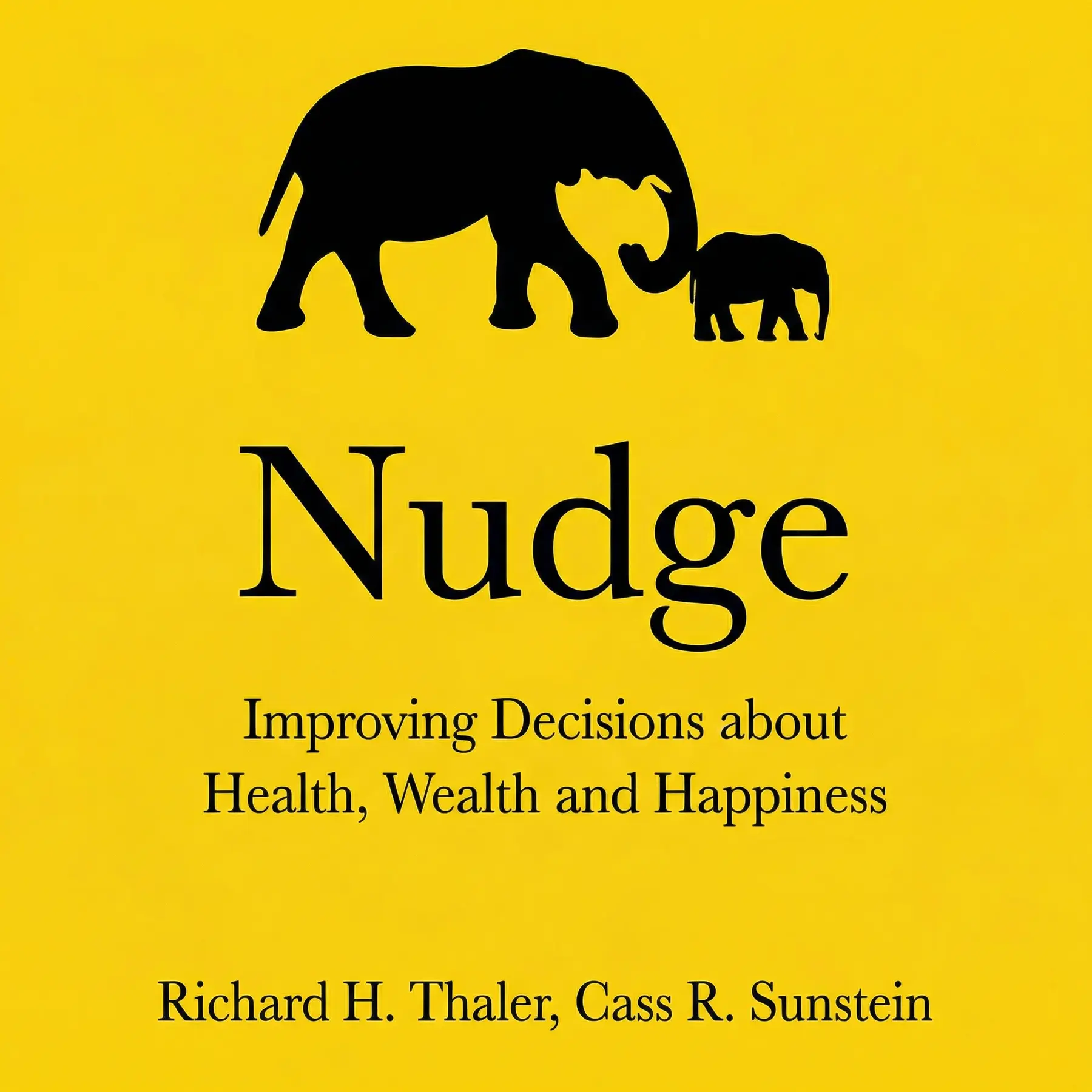
Explains why people who know what is good for them still overeat, overspend and undersave. It shows how small changes to the way choices are set up, especially smart defaults, steer people toward better decisions.

58 sec
Most people already know they should eat well, save money and stop smoking, and many of them still do the opposite. In Nudge, economist Richard H. Thaler and legal scholar Cass R. Sunstein trace that gap to how we decide: mostly on autopilot, so the way a choice is arranged often settles it for us. Their remedy is the nudge, a small change in the setting of a choice that makes the wiser option easier while taking no option away.
That one idea runs through the whole book. It explains why moviegoers keep eating popcorn they dislike, why a free magazine trial ends up on your bill and why the authors want employees enrolled in pension schemes by default. It also gives you something to work with. By the end, you will be able to spot the setups that steer you, rebuild your own defaults and see how a company or a government could help people choose well without forcing anyone.
1 min 47 sec
A laughing baby and a multiplication problem reveal two very different ways your mind makes choices. One of them runs most of your day, and it can talk you out of protecting your own health.
1 min 34 sec
Picking an ice cream flavor is easy, yet picking a loan can leave even careful people lost. Some companies have learned to profit from that confusion, and from the impulses we act on without thinking.
1 min 25 sec
A cafeteria can change what people eat without banning a single item or printing a single warning. The trick works on everyone, which is exactly why it matters who decides how it is used.
1 min 46 sec
Many people intend to save for retirement, yet most US citizens end up putting away very little. The authors argue the fix lies in what happens to the people who never decide at all.
1 min 30 sec
Some decisions almost never go badly, while others trip up nearly everyone. Two warning signs tell you which is which, and an insurance company shows how a single recommendation can protect confused customers.
1 min 25 sec
Many of us reach the end of another year having broken our New Year’s resolutions, yet some people manage to keep theirs. Their method involves friends, deadlines and, for the boldest, the threat of funding a sports rival.
1 min 43 sec
A reporting rule can cut pollution without a single legal limit, and one dollar a day can change young lives. The authors make the case that governments should copy what good nudges do for individuals.
1 min 00 sec
What Thaler and Sunstein finally offer is a change of target. Instead of asking people to become more disciplined, they ask whoever arranges a choice to take responsibility for where autopilot leads. The cafeteria counter, the pension form, the insurance menu and the car dashboard are never neutral. Someone decides what is easy, visible and automatic, and that person shapes more decisions than any warning ever could.
That puts some of the power back with you. Look at the defaults in your own life, from the subscription that renews itself to the savings that never start, and switch off the ones working against you. Put the healthy option where you will see it first and the temptation a little out of reach. For a goal that keeps slipping, attach a cost you can feel today, the way Stickk users risk money on a rival team. And if you design choices for other people, ask what happens when they do nothing, then make that the outcome they would thank you for.
Nobody has to be forced. The right option only has to be the easiest one to take.
Most people know they should eat well, save for retirement and avoid smoking, and many still do the opposite. Richard H. Thaler and Cass R. Sunstein argue that the gap comes from how human decisions are actually made. Most choices run on a fast, instinctive Automatic System. That system is easily thrown by confusing information, by temptation and by companies that profit from impulse. The authors' answer is the nudge: a small change in the setting of a choice that makes the wiser option easier without banning anything. Their examples include fruit placed in plain view in a cafeteria, an email reminder about a missing attachment, automatic enrollment in a company pension plan, a recommended default insurance policy and commitment contracts that put money on a personal goal. Readers learn why their own good intentions fail, how to redesign the defaults in their lives, and how businesses and governments could use the same tools for public good, from carbon reporting rules to a seat belt that keeps beeping.
Professionals who know they should save, eat better or quit a habit and keep putting it off.
Managers, HR leads and product designers who build the forms, plans and menus other people choose from.
Curious readers who want to understand why people act against their own interests, and what small design changes can do.
Richard H. Thaler is an economist at the University of Chicago Booth School of Business and one of the scholars who, alongside Daniel Kahneman and Amos Tversky, helped define behavioral economics. He received the Nobel Memorial Prize in Economic Sciences in 2017 and served as president of the American Economic Association in 2015. Cass R. Sunstein is a legal scholar at Harvard Law School, where he founded the Program on Behavioral Economics and Public Policy. From 2009 to 2012 he led the White House Office of Information and Regulatory Affairs, and in 2014 studies found him to be the most cited American legal scholar.
Daniel Kahneman
Richard H. Thaler
Listeners find this work both captivating and stimulating, featuring high-quality prose and useful real-world instances. They value the perspectives offered on choice architecture and human behavior, specifically the concept of libertarian paternalism. The text receives praise for being easy to digest; one listener mentions the possibility of reading it in separate parts, while another listener points out how every chapter centers on a unique concept.
This book is a masterclass in understanding how we make decisions. The concept of "choice architecture" is brilliantly illustrated through simple examples like a school cafeteria layout where fruit placement nudges kids toward better health. Thaler and Sunstein explain complex behavioral economics in a way that feels surprisingly accessible and practical. I found myself thinking about the "nudges" in my own life long after finishing the last chapter. While some sections are denser than others, the payoff is immense for anyone interested in psychology. It really highlights how small design changes can lead to huge societal shifts. Truly a fundamental read for understanding modern society.
Show moreThe chapter on "Save More Tomorrow" changed how I look at my own finances. Thaler and Sunstein show how we can outsmart our own procrastination by committing to future contributions to our retirement funds. It’s a brilliant example of a nudge that works because it understands human laziness and loss aversion. I appreciated the clear, distinct sections that make it easy to pick up and put down. Each chapter tackles a different real-world scenario, from marriage to environmental policy. It is a thought-provoking read that offers genuine solutions for our flawed decision-making processes. It makes you realize how often we are being steered by invisible hands.
Show moreEver wonder why you signed up for a subscription you never use or why you can't seem to save money? This book holds the answers. Thaler and Sunstein have crafted a mind-changing guide to how the world is structured to influence our every move. I found the section on "choice architecture" to be revolutionary for my own work in communications. The authors managed to take heavy topics like the 2008 financial crisis and make them relatable through a behavioral lens. It’s practical, insightful, and honestly, a bit scary when you realize how easily we are influenced by simple defaults. Essential reading for anyone who wants to regain control over their choices.
Show moreWow, I didn't expect a book about economics to be this readable. The authors present a fascinating case for "libertarian paternalism," which basically means setting up defaults that help people without removing their freedom. One of the most compelling parts was the discussion on organ donation and how simply changing a form’s default can save lives. My only gripe is that the middle sections drag a little bit when they dive into the weeds of US healthcare and retirement plans. If you aren’t American, those specific chapters might feel a bit irrelevant or dry. Still, the core ideas regarding human behavior are absolute gold.
Show morePicked this up for a book club and was surprised by how much debate it sparked. Even though several members didn't finish the whole thing because of the dense economic data, the discussion was incredibly lively. We spent an hour talking about whether the government should be in the "marriage business" at all, which was an unexpected turn! The writing is clear, but let's be real: some of the financial planning examples are tedious. However, the insight into how defaults shape our lives is too important to ignore. It’s a solid 4-star read for anyone in management, design, or policy work who wants to understand their audience better.
Show moreFinally got around to reading this updated classic and I can see why it’s making such a policy impact in the UK and USA. The authors provide a funny and remarkably clear exposition of why we constantly sabotage our long-term goals. Unlike many books that just point out our flaws, this one actually suggests remedies. I particularly enjoyed the analysis of loss aversion and how it applies to everything from energy bills to school choices. It’s analytical without being overly academic, though it does require some focus during the policy-heavy segments. A very rewarding read for the patient reader who wants to improve their choice architecture.
Show moreAfter hearing so many endorsements from big names like Obama and Cameron, I had high expectations for this "new international edition." To be fair, it’s a bit of a letdown because it remains stubbornly US-centric despite the branding. Most of the case studies focus on very detailed American insurance policies and financial structures that don't translate well to a global audience. The first third of the book is excellent and introduces the "Econs vs. Humans" concept clearly, but then it gets bogged down in policy minutiae. It’s worth a skim for the social psychology, but be prepared to skip the denser, more localized chapters if you live outside the States.
Show moreLook, I’ve been reading a lot of behavioral psychology lately, and Nudge falls somewhere in the middle of the pack for me. The logic is sound, and the research is clearly top-tier, but the execution feels a bit dated compared to newer titles. It’s essentially about how "Humans" aren't "Econs," and how "choice architects" can help bridge that gap. While the organ donation and 401k examples are classics, they’ve been discussed so much in other media that they didn't feel fresh. It’s a good foundational text, but it probably won’t blow your mind if you're already familiar with the field. I'd recommend it as a reference rather than a page-turner.
Show moreNot what I expected for a runaway bestseller, but it has its moments. The truth is that the core concepts are fascinating, especially the idea that there is no such thing as a "neutral" design. Whether you’re setting up a website or a lunchroom, you’re already nudging people somewhere. However, the authors' "libertarian paternalist" label feels like a bit of a contradiction that they never quite resolve to my satisfaction. I ended up skimming the later chapters on privatizing marriage and healthcare because they felt very specific to US law. It’s a "good-to-know" book, but maybe not a "must-read-every-word" book for everyone.
Show moreIs it just me, or is this book incredibly overrated? The central idea—that we can be "nudged" into better choices—is interesting but could have been summarized in a long essay. Instead, we get over 200 pages of repetitive anecdotes and a tone that feels a bit too "jokey" for the serious political power dynamics at play. It feels like a manual for making us more compliant "Rational Economic Men" rather than truly autonomous individuals. I found Predictably Irrational much more engaging and less patronizing. To be fair, the data on pension defaults is solid, but the rest felt like a stretch. It's too much fluff for one good idea.
Show moreThaler and Sunstein argue that people often make unwise choices because they decide mostly on instinct, get overwhelmed by information or give in to temptation. Small changes in how a choice is presented, called nudges, can steer people toward better decisions without banning anything. Placing fruit in plain view in a cafeteria or enrolling employees in a pension plan automatically are typical examples.
A default is what happens when a person does nothing. Because most people prefer to leave things as they are, the authors argue that defaults should produce good outcomes. Their main example is automatic enrollment in a company pension plan, where employees save unless they actively opt out. Gmail’s reminder when an email mentions an attachment but has none is a smaller everyday version.
The authors say nudges help most in two situations. One is when the pleasure comes now and the cost comes later, as with an extra slice of cake or a cocktail after work. The other is when a decision is rare, so there is no experience to draw on, such as choosing a health insurer. A recommended default policy can protect customers who feel lost.
Set up your surroundings and commitments so the better choice is easier or failure costs something now. The book describes people who keep resolutions through bets with friends, public weigh-ins and progress-tracking tools. More than 100,000 people have signed commitment contracts on Stickk.com, where they can stake money on a goal that, if they fall short, goes to a recipient they pick, perhaps a rival of their favorite football team.
It suits anyone who knows what is good for them yet struggles to act on it, especially with saving, eating and other health habits. It is also useful for managers, designers and policy makers who set up the choices other people face, from pension forms to insurance menus, and who want to help people decide well without forcing them.


Anthony Pratkanis



Yanis Varoufakis




Richard Wiseman

Andrew Ross Sorkin
AUDIO SUMMARY AVAILABLE
Get the key ideas from Nudge by Richard H. Thaler, plus 5,000+ more nonfiction titles.









