

Nudge: Improving Decisions about Health, Wealth and Happiness
Richard H. Thaler
 English
Shows why winners of crowded auctions tend to overpay, why strangers share more than theory predicts, why ownership inflates value, and why even financial markets break their own basic laws.
1 min 03 sec
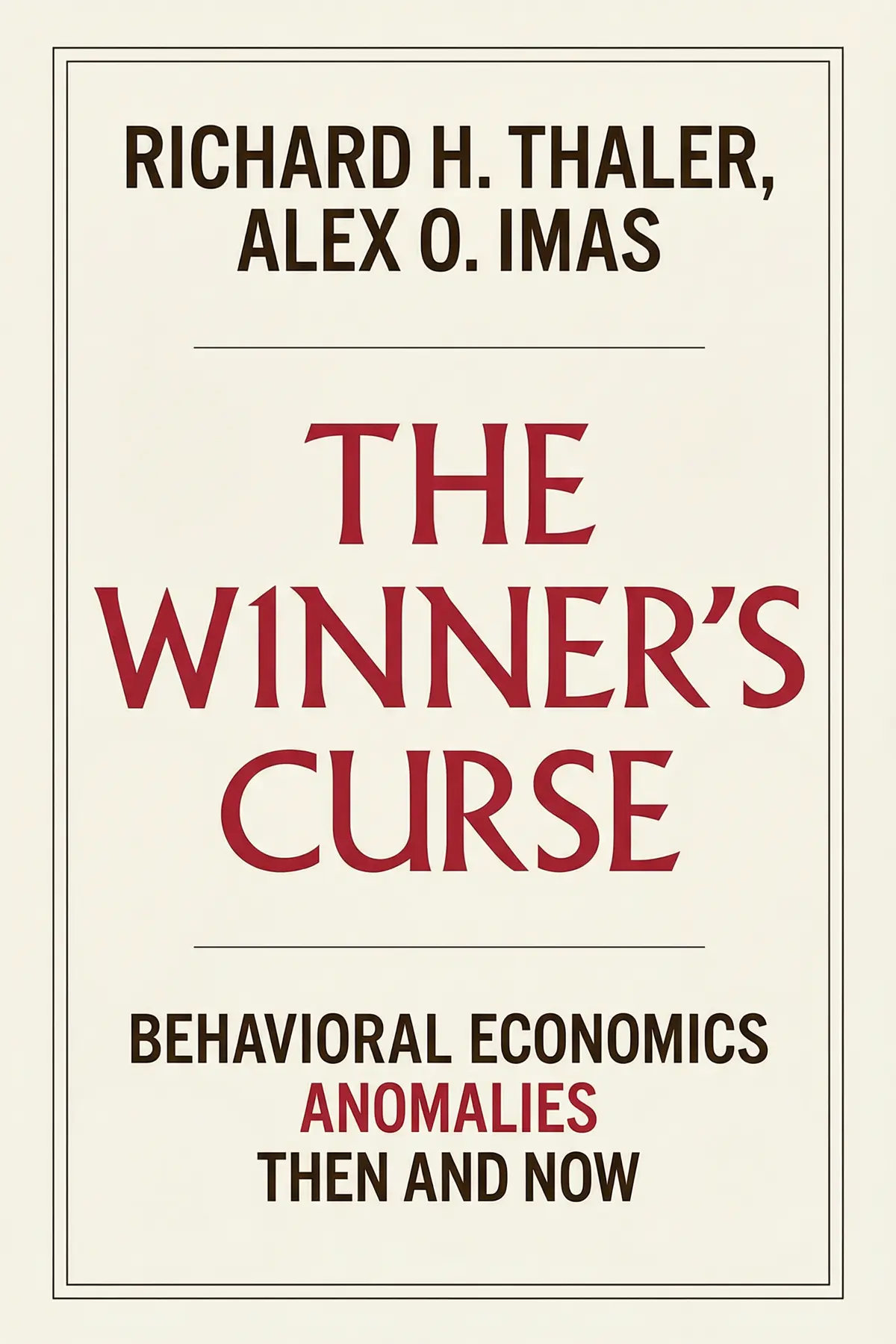
If you have ever won a bidding war and felt a flicker of doubt afterward, that doubt was probably right. In The Winner’s Curse, Nobel laureate Richard H. Thaler and his University of Chicago colleague Alex O. Imas explain why: in a crowded auction, the winner is usually the person who guessed the value highest, and so the person most likely to be wrong. That puzzle is one of the anomalies Thaler first catalogued in a series of articles more than 30 years ago, working alongside Daniel Kahneman and Amos Tversky. Here the two authors return to those findings with fresh eyes.
Their throughline is easy to state and hard to escape. Economic theory pictures people as cold, selfish calculators, and that picture keeps failing when it meets real behavior, even inside financial markets. Each failure, once you can name it, turns into a check you can run on yourself: before you bid, before you hold on to something, before you choose.
1 min 57 sec
An oil company kept winning the drilling rights it wanted and kept being disappointed by what it found. The cause was not bad engineering, and the fix runs against every competitive instinct you have.
2 min 10 sec
A game designed to reward pure selfishness keeps producing the same stubborn result with anonymous players. One simple change to the rules makes their behavior shift even further from what economists expected.
1 min 49 sec
A trained economist refused to sell his wine at a price he also refused to pay for it. His contradiction reveals a pull that shapes how you value almost everything you already have.
1 min 44 sec
Elite golfers try harder on one kind of putt than another, though both count exactly the same on the scorecard. The reason also explains why canceling a subscription feels like more work than it is.
2 min 01 sec
People choose one bet and then put a higher price on the other. A badly arranged stove explains the contradiction, and a music playlist shows how the same slip follows us into daily life.
2 min 10 sec
Two kinds of shares in one company were bound by a fixed ratio that anyone could calculate. For decades the market let them wander far from it, and nothing stopped traders from correcting it.
1 min 07 sec
What the anomalies add up to is a different person at the center of economics. Thaler and Imas replace the cold, selfish calculator with someone more interesting: a bidder who trusts their own estimate too much, a stranger who adds to a common pot for no reward, an owner who cannot part with a $200 bottle they would never buy, and a market that lets two fixed slices of one company drift apart for years. None of these errors is random. Each one repeats, and that is exactly what makes it worth knowing.
That predictability is your opening. Before your next competitive bid, count the other bidders and let a crowded room make you more careful. When you hesitate to sell or cancel something, ask whether you would buy it today at its current price. And when you say you prefer one option, check that you would also pay more for it.
Traditional theory simply assumed that everyone in the crowd would reason rationally. The jar of coins at the party says otherwise: the average guest is cautious, and the winner still overpays.
Economics long rested on a simple picture of human beings: rational, selfish and consistent, always weighing costs and benefits correctly. More than 30 years ago, Richard H. Thaler began collecting the cases where that picture failed, in a series of articles called Anomalies. In The Winner's Curse, he and economist Alex O. Imas return to those findings and look at them again. The cases are vivid. An oil company kept winning drilling auctions and kept finding less oil than its engineers expected. Strangers in a money game gave away close to half their stake for no reward. An economist refused to sell wine he would never have paid the same price to buy. Two share classes of one company drifted far from the fixed ratio arithmetic said they must keep. Each anomaly comes with a reason and a test you can apply. Readers learn when to bid less as competition grows, how to plan for both free-riders and cooperators, how to see past their attachment to what they own, and why a market price is never guaranteed to be right.
Professionals who bid for contracts, hire talent or buy companies and want to stop overpaying.
Investors who suspect market prices are less rational than textbooks claim.
Managers and curious readers who want to understand why people cooperate, cling to what they own and contradict their own preferences.
Richard H. Thaler is the Charles R. Walgreen Distinguished Service Professor at the University of Chicago Booth School of Business. He worked with Daniel Kahneman, Amos Tversky and others to help define behavioral economics, won the 2017 Nobel Memorial Prize in Economic Sciences, and wrote Nudge and Misbehaving. Alex O. Imas holds the Roger L. and Rachel M. Goetz professorship in Behavioral Science, Economics and Applied AI at Chicago Booth, where he has taught Negotiations and Behavioral Economics. His research covers finance, decisions under uncertainty and applied AI, and he received a 2023 Alfred P. Sloan Research Fellowship.
Richard H. Thaler
Listeners find the book to be an excellent primer on behavioral economics, with one listener noting it includes 12 chapters explaining anomalous events in the field. Listeners describe the work as highly approachable and very captivating.
Ever wonder why people reject free money in the Ultimatum Game just because they feel the offer is unfair? This book explores that exact kind of irrationality with surgical precision. Thaler demonstrates that fairness often outweighs small financial gains, which completely flips traditional game theory on its head. I found the chapter on intertemporal choice—how we value things differently over time—to be absolutely fascinating and relevant to my own spending habits. It is refreshing to see a Nobel Laureate admit that humans are messy and vaguely right rather than precisely wrong. This isn't just an economics text; it's a psychological deep dive into the human condition. Every social marketer and policy maker should have this on their shelf.
Show moreThis book is a masterclass in identifying where traditional economic models fail to account for human psychology. Thaler’s exploration of the Winner’s Curse is particularly brilliant, explaining why being the highest bidder often means you’ve actually lost out. I found the chapters on cooperation and reciprocal altruism to be a refreshing counterpoint to the idea that everyone is a free rider. The analysis is sharp, and the anecdotal examples really help ground the more complex theories in reality. While it's true that the literature is quite old, the fundamental human behaviors haven't changed. It’s a super engaging read for anyone interested in the intersection of money and the mind.
Show moreAfter hearing Thaler speak in London recently, I had to dive back into the source material that started it all. This collection of his Anomalies papers is accessible yet deeply rigorous, showing exactly how the standard paradigm falls short. The chapter on fair wage models was particularly eye-opening, connecting micro-experiments on fairness to macro-economic trends in wages. Not gonna lie, some of the math-heavy sections went over my head, but the general insights are pure gold. It’s fascinating to see names like Kahneman and Yellen popping up in the citations long before they became household names. A truly foundational text for anyone who wants to understand why we do the weird things we do with our money.
Show morePicked this up because I wanted a foundational look at how people actually make decisions versus how math says they should. It’s organized into 12 distinct chapters, each tackling a specific anomaly where human behavior defies the "rational" economic model. Truth is, Thaler makes some of these dense academic concepts feel surprisingly accessible to a non-expert. I particularly enjoyed the breakdown of the endowment effect and how our irrational attachment to things we own warps market logic. While it’s certainly more technical than his later work, the writing manages to remain engaging throughout. It’s a great introduction for anyone looking to go beyond the surface level of behavioral economics. Some of the data feels a bit legacy now, but the core principles haven’t aged a day.
Show moreAs someone who worshipped Nudge and Misbehaving, I found this to be the more serious, academic older sibling that explains the raw mechanics behind the theories. It’s a series of deep dives into the Winner’s Curse and why we tend to overbid in auctions when competition heats up. The truth is that Thaler was decades ahead of his time in identifying the "homo economicus" as a fable. I appreciated the specific details on labor markets and why larger firms pay more even after controlling for sector factors. It’s not exactly a page-turner, and there were moments where the technical jargon slowed me down. Still, the intellectual payoff for finishing a chapter is worth the effort.
Show moreFinally got around to this classic and I was surprised by how much of it remains applicable to today’s messy markets. It’s a great introduction to the concepts of status quo bias and the various ways our brains fail at simple logic. Each chapter starts with a scenario that poses a question, making you realize your own cognitive biases before the data even hits the page. It’s way more engagingly written than your standard academic treatise, even if it does get a bit list-heavy at times. I loved the section on how group identity can completely turn experiment results around. It’s a must-read for anyone who thinks they are a purely rational actor.
Show moreTo be fair, the research presented here is the bedrock of the entire field, but there's no denying it shows its age. Published originally in the early 90s, many of the market inefficiencies like Monday returns or January effects have probably been arbitraged away by modern algorithms. The book is essentially a series of chapters on anomalies co-written with other experts, which leads to a somewhat inconsistent tone. While the insights into loss aversion are great, I would have much preferred a current-day perspective on how these findings hold up in the 2020s. It’s a solid reference book for the history of the discipline, but it lacks the energy of Thaler’s newer publications. A bit too much legwork is required to bridge the gap to the present.
Show moreLook, it’s an important book, but don’t go into it expecting a breezy airport read. It’s a series of essays on anomalies like the endowment effect and fairness that requires a good deal of concentration. Personally, I found the chapters on stock market reactions to be the driest of the bunch, though they offer some food for thought regarding random walks. The writing style is definitely more academician mode than Thaler’s later, more polished work. It provides a good summary of the field’s origins, but I’m glad to hear an updated 2025 edition is coming. It needs a fresh coat of paint to stay relevant in the age of AI and algorithmic trading.
Show moreFrankly, after reading the more modern behavioral econ books like Thinking Fast and Slow, this felt like a slog through dense journal entries. I wanted to love it because Thaler is a legend, but the writing is way too advanced for a casual weekend read. Most chapters start with a neat anecdote but quickly devolve into a dry literature review that repeats the same points to oblivion. It feels more like a collection of technical papers for the Journal of Economic Perspectives rather than a cohesive book. To make things worse, the narration in the audiobook version was incredibly distracting—this Morey character sounds like he's speaking with a mouthful of marbles. If you aren't an economist, you might find yourself zoning out halfway through.
Show moreNot what I expected at all, and honestly quite a disappointment compared to the hype. I thought this would be a popular science book, but it reads like a dry laundry list of economic papers from the 1980s. There’s almost no meat to the analysis beyond summarizing what other researchers already found decades ago. For a non-economist, the jargon is overwhelming, and the author doesn't do enough to explain the real-world implications in a way that sticks. It’s utterly forgettable and highly uninteresting unless you are actually studying for a PhD in the subject. I’ll stick to digital resources like The Decision Lab for my behavioral insights from now on.
Show moreThe winner’s curse is the tendency of the winning bidder to overpay. In a jar-of-coins auction, the average bid falls below the jar’s value, yet the winner usually bids above it. Thaler and Imas connect this to Atlantic Richfield, which kept winning drilling auctions and finding less oil than expected. The more bidders there are, the likelier someone overestimates, so crowded auctions call for more caution, not bolder bids.
The authors argue that economic theory’s picture of people as rational, selfish and consistent keeps failing against real behavior. They revisit anomalies Thaler first described more than 30 years ago: overpaying in auctions, cooperating in public goods games, valuing what we own more highly, reversing our preferences, and financial markets breaking the law of one price, as in the Royal Dutch/Shell twin shares.
The endowment effect means we value things more simply because we own them. Thaler’s advisor would neither sell his wine at $200 nor buy more at that price. The authors trace it to loss aversion and status quo bias, and suggest the price people demand to sell runs about twice what they would pay. To check yourself, ask whether you would buy the item today at its market price.
It suits people who make high-stakes choices: those bidding for houses, businesses or contracts, investors who wonder how far to trust market prices, and managers designing shared projects where free-riding is a worry. It also suits readers curious about behavioral economics who want concrete cases, from golfers on the PGA tour to farmers near Cornell University selling produce on an honor system.


Anthony Pratkanis



Yanis Varoufakis




Richard Wiseman

Andrew Ross Sorkin
AUDIO SUMMARY AVAILABLE
Get the key ideas from The Winner’s Curse by Richard H. Thaler, plus 5,000+ more nonfiction titles.









