
15 min 38 sec
Available in: English
 ไทย
EnglishไทยNoise: A Flaw in Human Judgment
Shows why experts judging the same case often reach very different answers, why that random scatter goes unnoticed, and how audits, averaging and simple decision routines can shrink it in courts, companies and your own choices.
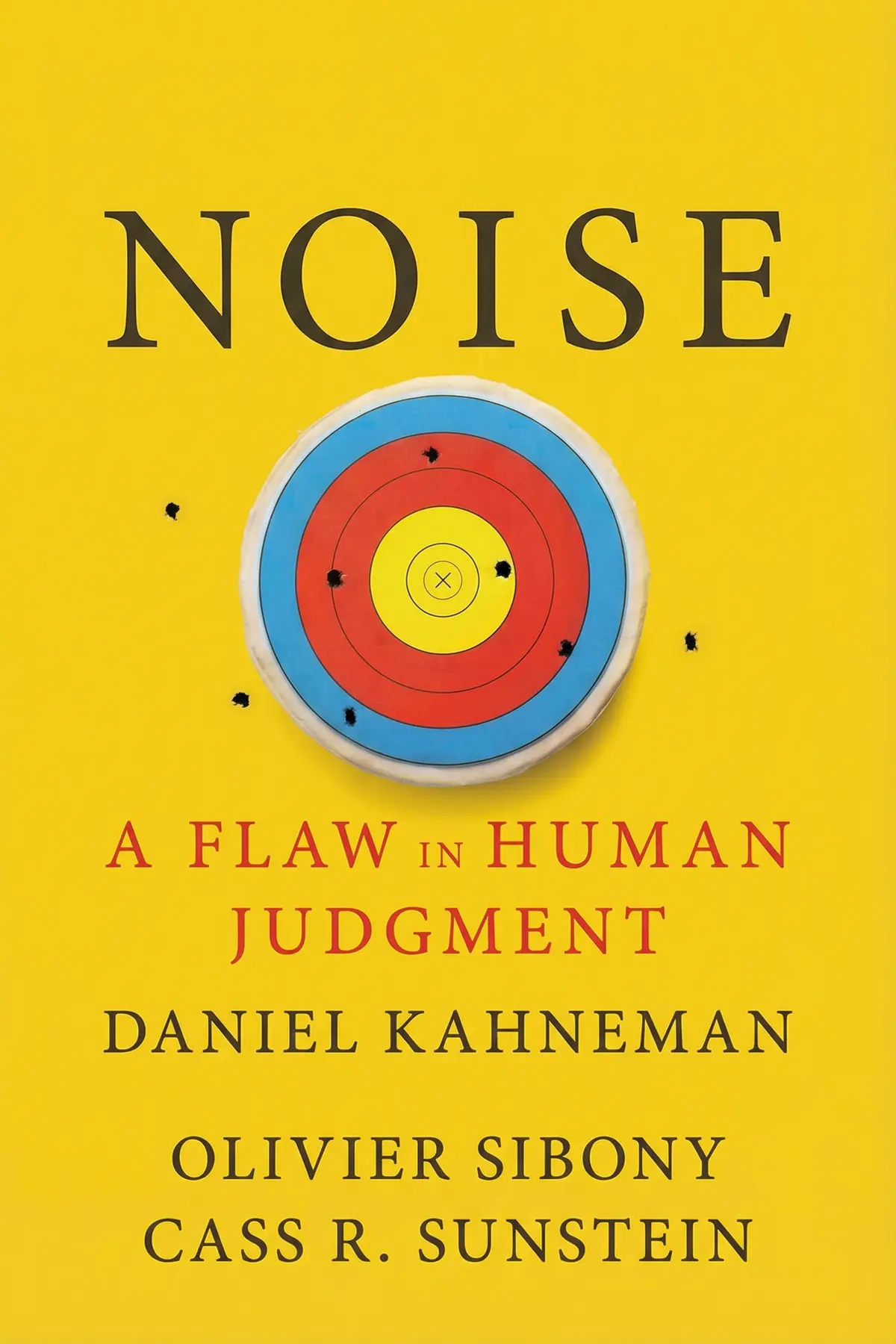
Table of Content
1. Introduction
1 min 03 sec
If your work involves judging people or cases, such as hiring, pricing, grading or diagnosing, you probably assume your calls are consistent. They rarely are, and the scatter is costly. In Noise, psychologist Daniel Kahneman, strategy professor Olivier Sibony and legal scholar Cass R. Sunstein show that the same expert can reach different verdicts on the same facts depending on something as random as the weather. They call this unwanted variability noise, and they argue it is a different problem from bias: present wherever people judge, hard to see, and expensive.
A quick test makes it concrete. Start a stopwatch without looking and stop it at what feels like ten seconds, a few times over. Some tries run short, some long, with no pattern at all. That is noise. Once you can see it, the authors argue, you can measure it and turn it down, and the tools for doing so are plain enough to use this week.
2. Spot the irrelevant forces that sway every decision
1 min 34 sec
Two equally brilliant students meet the same admissions officer a day apart, and only one gets in. The difference between them may have nothing to do with either student, and that should worry anyone who judges for a living.
3. Tell random error apart from bias
1 min 27 sec
Two people miss the same target in completely different ways. Learning to read the pattern of the misses changes which problem you think you have, and which fix will actually help.
4. Simple formulas beat expert predictions, and you can use them
1 min 44 sec
Judges with decades of experience decide who waits in jail before trial. A computer program and a two-factor formula both did better, and the reason lies in a feeling every expert trusts.
5. See the errors your storytelling mind hides
1 min 26 sec
A flaw that touches courts, hospitals and hiring should be headline news, yet almost nobody talks about it. The reason has less to do with the evidence than with how human minds like to explain things.
6. Average independent guesses to cancel out noise
1 min 44 sec
Nearly 800 villagers guessed the weight of an ox and every one of them was wrong. A curious scientist then found something remarkable in their answers, along with the conditions that make it work or fail.
7. Run a noise audit to measure the damage
1 min 47 sec
One forger got 30 days and another got 15 years for nearly the same crime. A federal judge set out to prove such gaps were the rule, and his method works in any office that makes repeated calls.
8. Decision habits that stop noise before it starts
1 min 41 sec
A surgeon never sees the infections she prevents by washing her hands. The authors argue good judgment needs the same kind of routine, and the first habit asks you to ignore the details you find most interesting.
9. Make noise reduction last by winning judges over
2 min 01 sec
A reform cut sentencing gaps from years to months, then collapsed, and the old disparities came roaring back. The missing ingredient was not better math, and it applies to any rule you bring to a team.
10. Conclusion
1 min 11 sec
Seen from a distance, the book offers a second way to think about error. Bias draws attention because it has a culprit. Noise has none, so it costs people their liberty, their college places and their asylum claims, and costs companies hundreds of millions, mostly unnoticed. The authors’ bet is that this unglamorous flaw gives way to unglamorous work: measuring, averaging, scrubbing up before each call and agreeing on the target.
The first moves are small. Before your next big judgment, find out how similar cases usually turn out, and keep your gut feeling waiting until you have. When a decision matters, gather several independent views on the same question and average them, or ask yourself again on another day. If your team makes repeated calls, give everyone the same few cases and see how far apart the numbers fall.
As for the airports, the authors put the share in the United States at 32 percent. See how near your average came. One guess is a stopwatch stopped by feel; many honest guesses begin to keep time.
About this book
What is this book about?
Two judges in the same Miami court grant asylum at rates of 5 percent and 88 percent. An admissions officer weighs grades differently depending on the weather. Daniel Kahneman, Olivier Sibony and Cass R. Sunstein argue that cases like these share one flaw. They call it noise: random, unwanted variability in judgment, which is a different problem from bias and turns up wherever people decide. Noise rarely gets attention, the authors explain, because it has no cause and no villain, so our story-loving minds miss it or mistake it for bias. It shows up only in statistics, when many decisions are set side by side. The authors trace it through bail hearings, criminal sentencing, insurance pricing and hiring, and show why simple formulas often beat trained experts at prediction. The second half is practical. Readers learn how Francis Galton found the wisdom of crowds at a county fair, how to run a noise audit in their own organization, and which decision hygiene habits prevent noise before it starts. A cautionary tale from American sentencing reform shows why any fix only lasts when the people doing the judging agree on what they are aiming at.
Book Information
Who it's for
Managers overseeing routine judgments
Managers whose teams price, hire, rate or approve the same kinds of cases every week.
Experts wanting consistent calls
Lawyers, doctors, underwriters and analysts who make expert calls and want them to be consistent.
Questioning gut decisions
Anyone who trusts their gut on big decisions and suspects it is less steady than it feels.
About the Author
Daniel Kahneman
Daniel Kahneman (1934 to 2024) was a psychologist who shared the 2002 Nobel Memorial Prize in Economic Sciences for work on judgment, decision-making and behavioral economics, and wrote Thinking, Fast and Slow. Olivier Sibony is a professor of strategy at HEC Paris who studies how biases affect strategic decisions, after 25 years at McKinsey, where he was a Senior Partner. Cass R. Sunstein is a Harvard Law School professor and behavioral economics scholar who co-wrote Nudge and led the White House Office of Information and Regulatory Affairs from 2009 to 2012.

Nudge: Improving Decisions about Health, Wealth and Happiness
Richard H. Thaler
Thinking, Fast and Slow
Daniel Kahneman
Ratings & Reviews
Ratings at a glance
What people think
Listeners find the content educational and thought-provoking, specifically commending the thorough exploration of noise in psychological assessment and choices. Feedback regarding the quality of writing is varied, with some listeners praising the prose while others characterize the editing as subpar. Evaluations of the text’s density and clarity are also inconsistent; some business professionals feel the insights justify the commitment, yet others conclude the book is not worth the time.
Top reviews
Nam
Ever wonder why two doctors can look at the same X-ray and see two different things? This book dives deep into that discrepancy, labeling it 'noise' and explaining why it’s just as dangerous as the biases we usually talk about. I found the sections on 'occasion noise'—like how a judge’s mood changes after a local football game—absolutely terrifying but necessary to understand. While some reviewers find the statistical talk a bit wordy, I appreciated the rigor they brought to a field that often feels too soft. The distinction between bias and noise is a mental model I’ll be using for years. It’s a dense, academic journey, but the reward is a much sharper lens for viewing the world’s inconsistencies. Definitely worth the effort for those who appreciate behavioral economics.
Show moreHiroshi
Picked this up because I’m a fan of behavioral economics, and I wasn't disappointed by the data-driven approach. The 'Clouds Make Nerds Look Good' section was a personal favorite—it’s hilarious but also deeply troubling to realize how much sunshine affects university admissions. The writing is much more technical than 'Freakonomics,' which I actually preferred because it felt more authoritative. Truth be told, it’s a bit of a commitment to get through the Gaussian mean squared error bits, but they provide the backbone for the entire argument. If you want to understand why systems fail even when everyone has good intentions, this is the manual you need. It’s a masterclass in identifying the invisible errors in our collective thinking. A must-read for anyone in a decision-making role.
Show moreTern
Finally got around to this and I have to say, it’s a vital piece of work for anyone who makes high-stakes decisions. The authors provide a meticulous breakdown of why our 'gut feelings' are usually just sources of error. I loved the emphasis on how noise and bias are different animals—you can have an unbiased system that is still incredibly noisy and therefore unfair. The practical guides for conducting a 'noise audit' are something I plan to bring to my own organization next quarter. It’s certainly a dense read, and some parts feel a bit like a textbook, but the depth of insight into judicial and medical errors is unparalleled. If you want to improve your judgment, you have to learn to silence the noise. Five stars for the depth of research.
Show moreWoravit
The chapter on decision hygiene really changed how I view our team meetings at work. While the writing can feel a bit dry compared to Kahneman’s earlier work, the core argument about unwanted variability is undeniable. We often focus so much on bias that we ignore how much randomness creeps into our daily choices. Frankly, the authors could have trimmed about a hundred pages without losing the meat of the message. However, the insights into how weather or even a sports team's loss can swing a judicial sentence are eye-opening. It makes you realize that our systems are far less consistent than we like to pretend. It's a heavy read, but the practical audits suggested are worth the effort for any serious manager looking to refine their organizational judgment.
Show moreFilm
After hearing so much buzz about this, I was worried it wouldn't live up to the hype. While it’s not as revolutionary as 'Nudge,' it provides an excellent overview of how human judgment is fundamentally flawed in ways we rarely measure. The authors do a great job of explaining why we shouldn't trust 'intuitive' experts who can't replicate their own decisions even when given the same data twice. I was particularly struck by the 'gambler's fallacy' examples involving asylum judges. It’s a sobering look at how much randomness dictates our lives. My only gripe is that the tone can get a bit pedantic, almost like a sophomore psych lecture that's gone on too long. Still, the practical tips for structuring interviews to reduce noise are pure gold for anyone in HR.
Show moreTanyaporn
Truth be told, the biggest takeaway for me was the idea of 'decision hygiene.' Just like washing your hands, you do it to prevent problems you might never even see, and that’s a powerful metaphor for management. This isn't a book you breeze through on a flight; it requires actual focus to digest the statistical concepts and the various types of system noise. I appreciated the deep dive into insurance premiums and how 'system noise' creates massive financial leaks for companies. While the authors are a bit overconfident in their solution of using rules and formulas, they make a compelling case that humans are far too inconsistent. It’s a bit poorly edited in spots, but the core insights into medical and judicial judgment are well worth the effort.
Show moreElena
This book is essentially a brilliant 100-page idea stretched out to over 400 pages. Kahneman and his co-authors are clearly brilliant, and the concept that variability in judgment is a major systemic problem is vital. However, the sheer amount of repetition makes it difficult to stay engaged through the middle sections. I liked the comparison between a 'noise audit' and 'decision hygiene,' but did we really need dozens of examples that all make the same basic point? It’s informative and insightful if you have the patience to dig, but the editing is noticeably loose. If you’re a business reader, you might find yourself skimming after the first few chapters once the main thesis settles in. It's good, but it simply doesn't reach the heights of the authors' previous individual works.
Show moreTantipat
Look, if you can get past the academic jargon and the repetitive structure, there is a very important message here. The problem is that the delivery is so incredibly wordy that the message often gets lost in the, well, noise. I enjoyed the parts about how physicians prescribe more antibiotics at the end of the day—that’s a terrifyingly practical example of what the authors are talking about. But do we really need 400 pages to say that humans are inconsistent? It feels like the prestige of the authors prevented the editor from doing their job properly. It's a decent addition to the behavioral economics shelf, but it lacks the 'wow' factor I expected from Kahneman. It’s fine, just prepare for a slow burn through the statistics.
Show moreMonthon
Not what I expected from such a powerhouse trio of thinkers. I went into this expecting a sharp follow-up to 'Thinking Fast and Slow,' but instead, I found a repetitive slog that felt more like a bloated consulting pitch. The authors spend an eternity defining 'noise' as randomness—a concept most of us already understand—and then just hit you over the head with it repeatedly. To be fair, some of the research summaries on medical diagnostic errors are fascinating, yet the writing lacks the punch of their previous books. It frankly feels like they had enough material for a long-form article but were forced to hit a page count for the publisher. Save your time and read Tetlock instead if you want real depth on forecasting and expert political judgment.
Show moreGame
As someone who loved 'Thinking Fast and Slow,' I found 'Noise' to be a massive disappointment. It feels like the authors are trying to invent a new category for consulting fees rather than offering groundbreaking psychological research. The idea that randomness exists in human judgment isn't exactly a revelation. Most of the book feels like a bad game of telephone where they summarize other people's research without adding much new flavor. Honestly, I found the suggestion to replace human judgment with algorithms a bit tone-deaf to the sociological problems those algorithms often create. The prose is dry, the examples are recycled from better books, and the overall experience was just... noisy. I’d recommend checking out 'Invisible Women' for better insights into data-driven failures.
Show moreQuestions about this book
What is the main idea of Noise by Kahneman, Sibony and Sunstein?
The authors argue that human judgment suffers from noise, meaning random, unwanted variability, as well as from bias. The same expert can judge identical cases differently on different days, and experts in the same system can disagree wildly, as with Miami asylum judges whose grant rates ran from 5 to 88 percent. Noise hides because it tells no story, but it can be measured and reduced.
What is the difference between noise and bias?
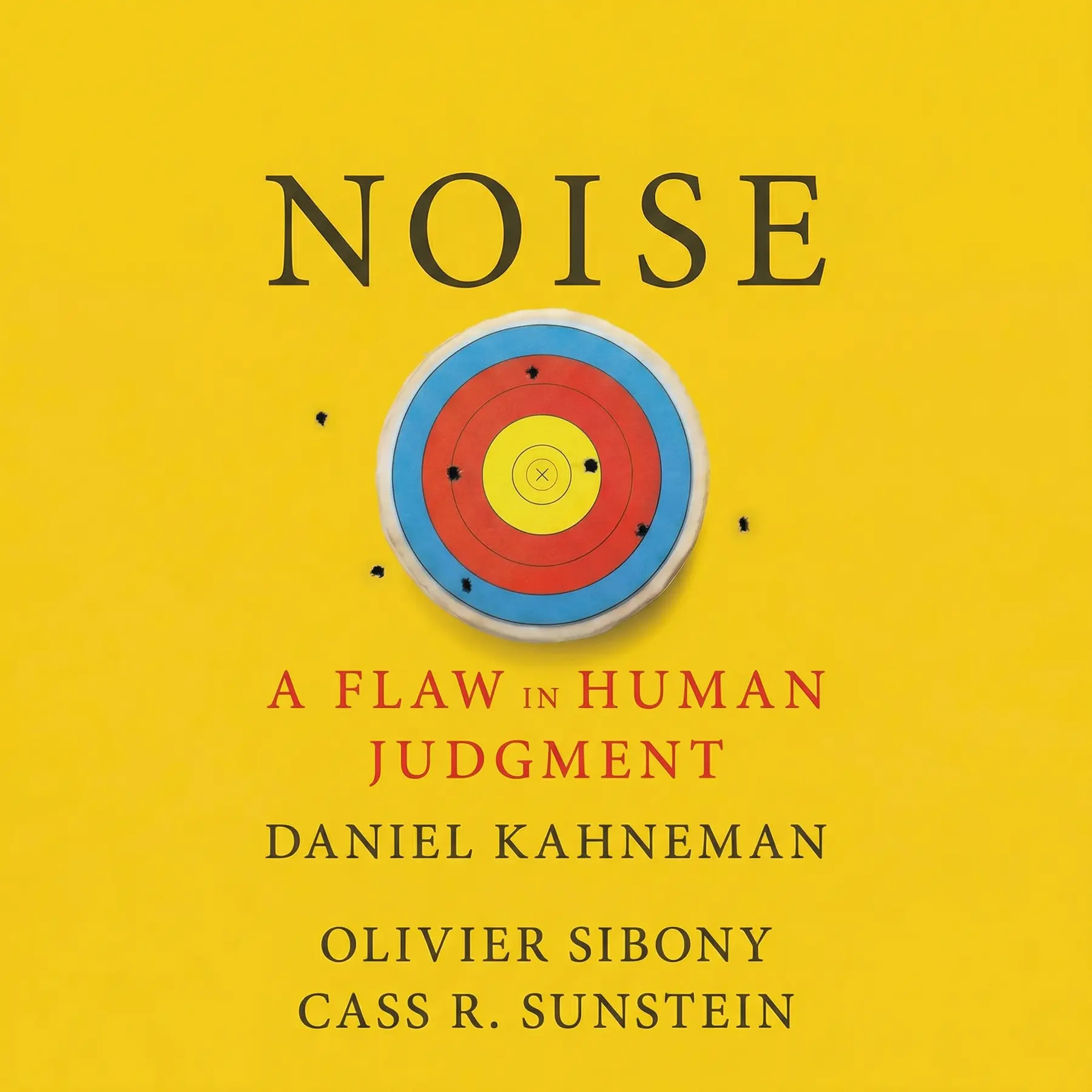
The authors use a shooting gallery image. Bias is a consistent miss, shots grouped tightly but away from the bullseye, like a rifle with a bent barrel. Noise is scatter, shots spread with no pattern. Bias has a cause we can name, which makes it easy to notice. Noise only shows up when many decisions are compared statistically, so it often goes unseen.
What is a noise audit and how do you run one?
A noise audit measures how much experts in one organization disagree on similar cases. The authors describe three steps: decide how much disagreement is acceptable, give your experts the same realistic cases and ask each for a number such as dollars or years, then chart their answers against the target. Kahneman’s audit at an insurer found underwriters’ premiums differed by 55 percent on average.
How can I reduce noise in my own decisions?
The authors recommend decision hygiene. Take the outside view by checking how similar cases usually turn out before studying the details. Hold back early intuition until that picture is in place. Split hard problems into separate questions judged independently. On your own, ask yourself the same question several times over a few days and average the answers, a small crowd inside one head.
Why did sentencing reform in the United States fail to keep noise down?
The 1984 Sentencing Reform Act cut variation in sentences from years to months, but judges resented losing their discretion. After the Supreme Court struck it down in 2005, Crystal Yang’s study of 4,000 cases found that harsh sentences strayed from the average twice as far. The authors conclude that reformers never got judges to agree that accuracy was the goal.
Readers also enjoyed


Acting with Power: Why We Are More Powerful Than We Believe
Deborah Gruenfeld


Age of Propaganda: The Everyday Use and Abuse of Persuasion
Anthony Pratkanis




59 Seconds: Change Your Life in Under a Minute
Richard Wiseman


AUDIO SUMMARY AVAILABLE
Listen to Noise in 15 minutes
Get the key ideas from Noise by Daniel Kahneman, plus 5,000+ more nonfiction titles.
- 5,000+ titles
- Listen as much as you want
- 7-day free trial
- Cancel anytime









