

A Force for Good: The Dalai Lama's Vision for Our World
Daniel Goleman
 English
Shows why the pressure to love your job is a recent invention. Explains how passion gets used to keep pay low and hours long, and why winning back time takes collective action.
57 sec
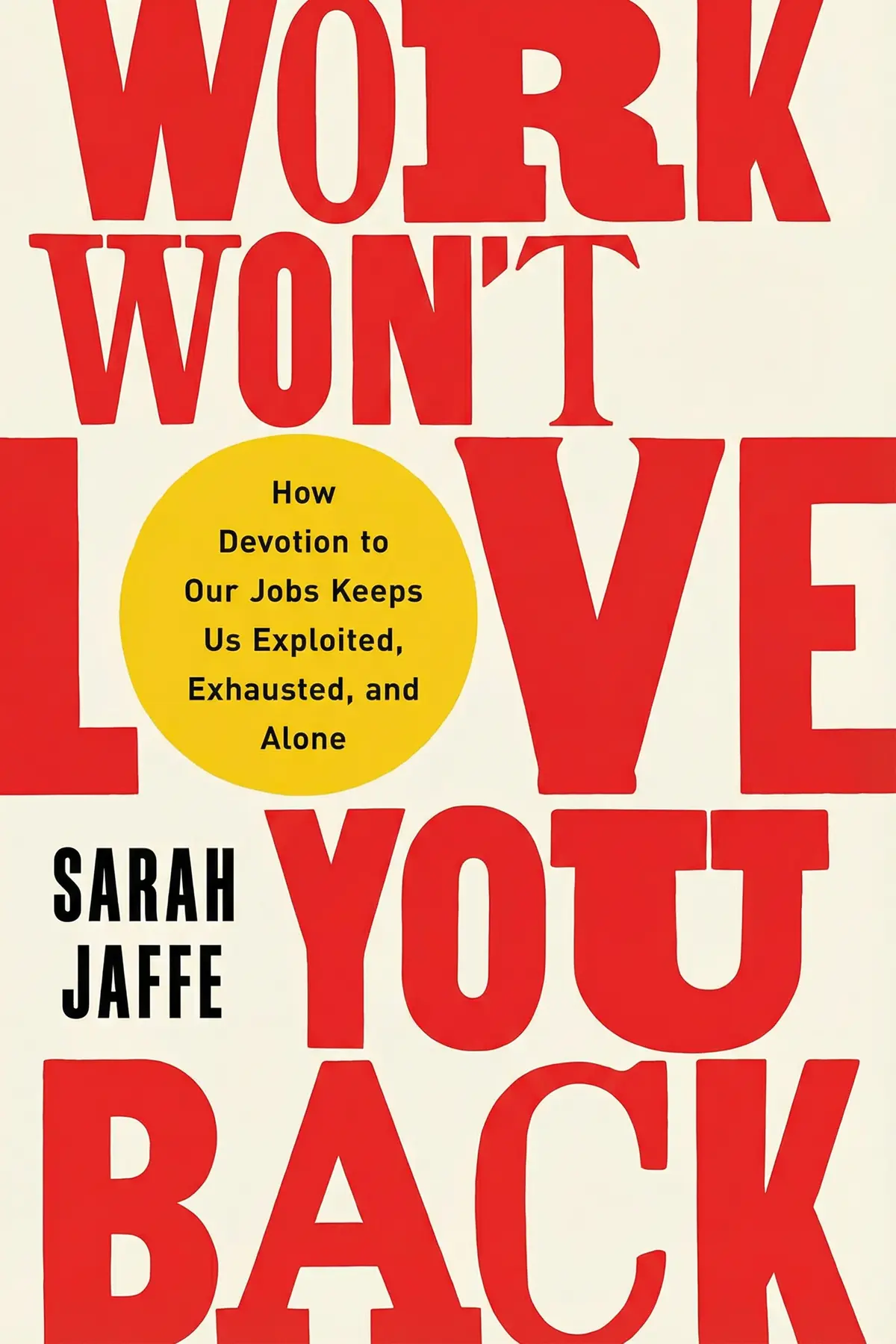
If your job asks for passion on top of your hours, and you feel guilty when the passion runs out, Sarah Jaffe has a different reading of that guilt. In Work Won’t Love You Back, the labor journalist argues that the expectation to love our work is a recent invention, not a timeless truth, and that it grew out of a major defeat for organized workers.
Two generations ago, a good job in the United States meant enough pay, enough free time and a stable future. Today it is supposed to feel meaningful, and that change has a cost. Jaffe’s case is that devotion to work is used to justify longer hours, thinner pay and lonelier lives, and that the way out runs through other people.
Follow her argument and you will be able to tell a job you enjoy apart from a job that is spending your love against you, and you will know what has actually won workers back their time and money.
1 min 43 sec
Calling a job good because it feels meaningful seems like common sense. A truce struck at a car company shows that workers once measured a good job very differently, and got more out of it.
2 min 12 sec
Precarious careers can feel like a personal failure. Jaffe traces them instead to a decade of deliberate choices by businesses and politicians, and to a change that pulled millions of new workers into low-paid jobs.
1 min 53 sec
A teacher and a painter seem to face very different pressures at work. Jaffe finds the same ethic behind both, split into two versions, each resting on an old belief about men and women.
1 min 59 sec
Well-paid software developers and part-time retail staff seem to live in different worlds. Both, Jaffe argues, are caught by the same logic, and it has a ready answer for anyone who stops feeling the love.
1 min 41 sec
Being told you belong to a workplace family can feel warm, even flattering. Jaffe points to one thing an employer can do that no relative can, and to the real relationships that pay the price.
1 min 59 sec
A quick coffee with a friend, squeezed between obligations, looks like the cure for an overloaded life. Jaffe explains why it is closer to a symptom, and what workers in many fields have started doing instead.
1 min 17 sec
Jaffe has no quarrel with people who enjoy their jobs. Liking your work is good, and giving yourself to a cause you believe in deserves respect. Her target is the way love has been turned into a management tool: a set of ideas and tactics that presses people to accept longer hours, heavier demands, lower pay and worse conditions, and to call it passion. That, she argues, is exploitation dressed as affection, and its real price is paid outside the office, in the people and pastimes we no longer have the energy to love.
Her history gives you firmer footing. The idea that a job should fulfill you is younger than the free weekend, and it spread as unions lost ground. So keep two accounts when you think about your work: how you feel about it, and what it gives you in money and time. When someone calls your workplace a family, check the contract instead. Protect long, unhurried time with the people you care about, the kind a quick coffee cannot replace. And talk with your colleagues, because every gain Jaffe describes, from the eight-hour day onward, was won together.
Your job can be something you enjoy. It still will not love you back, and the people who can are waiting outside it.
Employers no longer want only your labor. They want passion, gratitude and a willingness to sacrifice for the team, the cause or the craft. Labor journalist Sarah Jaffe argues that this demand to love our work is far newer than it seems, and far less innocent. Jaffe traces it to the collapse of the Fordist compromise, the mid-century deal that gave many American workers the eight-hour day, free weekends and a wage that could support a family. When businesses and governments broke unions from the 1970s onward, the promise of time and money faded, and the idea that work should be its own reward took its place. She shows how that ethic splits into a care version and a creative version, each leaning on gender stereotypes, and how it ends up justifying stagnant wages, crunch weeks and the myth of the workplace family. Readers get a clear history of how our ideas about good jobs changed, a way to tell real enjoyment apart from exploitation, and Jaffe's case that friendship, shorter hours and collective organizing are what actually make life better.
Professionals who feel guilty when their passion for the job runs out.
Care, nonprofit, creative and tech workers asked to give endless hours for a mission or a craft.
Anyone burned out and wondering why working harder has not brought security or time with loved ones.
Sarah Jaffe is an American journalist who reports on labor and work. Her writing has appeared in The New York Times, The Washington Post, The Atlantic, The Guardian and The New Republic. She is also the author of Necessary Trouble and From the Ashes, writes a column for The Progressive and New Labor Forum, and co-hosts Dissent magazine's Belabored podcast. Earlier she was a staff writer at In These Times and labor editor at AlterNet.
Listeners find this book to be a powerful and thoroughly investigated examination of today's work culture, even if some feel the structure is sometimes disjointed and leans more toward history than actionable tips. Many value the perceptive analysis of different sectors, pointing out how the idea of a "labor of love" can result in widespread exploitation and exhaustion. Furthermore, they appreciate how the author weaves together individual narratives with a fervent critique of neoliberalism. They also note the writing provides significant validation for those facing career burnout, with one listener emphasizing that it effectively "dismantles the myth" that work should be a primary source of fulfillment.
Sarah Jaffe has written a manifesto that everyone needs to read. She completely dismantles the toxic idea that we should be grateful to work ourselves to the bone just because we "love" what we do. The historical deep-dives into different sectors, from teaching to the arts, show how this "labor of love" narrative is just a clever tool for exploitation. To be fair, it’s a dense read and leans heavily into Marxist theory, which might turn some people off. However, her arguments about how neoliberalism has commodified our very identities are incredibly sharp. It’s not a self-help book, but it offers a kind of collective clarity that is much more valuable than typical career advice. We need more than just "self-care" to fix this mess. This is about power, history, and reclaiming our time from a system that views human passion as just another resource to be extracted.
Show moreWow, this was a punch to the gut in the best way possible. As a former "star student" who entered the creative arts thinking passion would pay the bills, I felt deeply seen by these pages. Jaffe’s critique of how we’ve been groomed to accept low pay for "meaningful" work is scathing and necessary. She uses personal stories from interns and retail workers to ground the heavy theory. It’s a depressing read at times, sure. But there’s something validating about realizing your exhaustion isn't a personal failing; it’s a systemic feature. The chapter on the "family" vibe in corporate offices was particularly spot-on. They use your emotions to keep you working late without extra pay. Don’t fall for the trap. Your job is an exchange of labor for money, nothing more, and this book proves why that boundary is sacred.
Show moreFinally got around to reading this, and it’s a necessary critique of modern work culture that feels more relevant every day. Jaffe successfully dismantles the myth that a job should be our primary source of fulfillment or identity. The section on the tech industry was especially eye-opening for me, showing how the promise of "changing the world" is used to justify 80-hour weeks and total social isolation. My only minor gripe is that it relies heavily on secondary sources rather than original journalistic investigation in some parts. Still, the synthesis of ideas is impressive. It makes you realize that the "lifestyle" your job offers is often just a gilded cage. A very well-documented, persuasive, and ultimately hopeful call for a world where we love people, not our productivity metrics. Truly a must-read for the burnt-out generation.
Show moreAfter hearing so many people talk about "quiet quitting" and the "Great Resignation," I wanted to understand the roots of our collective burnout. Sarah Jaffe provides those answers in spades. This book is a brilliant, multifaceted look at how the "labor of love" has become a trap for the modern worker. From the world of professional sports to the halls of academia, the stories are heartbreaking but necessary. She makes a compelling case for why we need to decouple our self-worth from our output. I finished this feeling angry, but also strangely empowered to set better boundaries. It’s a long journey through history and political theory, but the conclusion ties it all together beautifully. We deserve a life that belongs to us, not our employers. Stop loving a job that will never love you back.
Show moreEver wonder why you feel like a failure for being exhausted after a forty-hour week? Jaffe explains it perfectly by tracing how the "vocation" myth traps us. I especially appreciated the section on nonprofits. It’s wild how these organizations are often funded by the very exploitation they claim to fight against. The truth is, your job doesn't have a soul and it won't care if you burn out. While the book can feel a bit repetitive when she moves from one industry to the next, the core message remains powerful. It's a call for solidarity over individual striving. It’s time we stop seeing our coworkers as competition and start seeing them as allies in a broken system. Some chapters were definitely stronger than others, but the overall impact is undeniable for anyone feeling the weight of modern employment.
Show morePicked this up during a particularly bad week at my retail job and it was exactly the validation I needed. For years, I’ve been told that "service with a smile" is just part of the job, but Jaffe shows how that emotional labor is just another way we're exploited for profit. The book is pro-worker and pro-union through and through. It doesn't sugarcoat how grim things are. I loved the way she connected the struggles of academic researchers with those of domestic workers. We’re all being squeezed by the same neoliberal machine. It’s a passionate, intense, and often angry book. If you’re tired of being told to just "lean in" or "find your passion," read this instead. It’s about fighting back, not fitting in. A bit long in the middle, but the conclusion is worth it.
Show moreThe chapter on tech alone is worth the price of admission. Jaffe explores how work has colonized our personal lives and our very identities through the lens of "passion." We’ve become so used to "networking" and "personal branding" that we’ve forgotten how to just exist as human beings. This book is a loud, clear rejection of that entire mindset. It’s refreshing to read someone who isn't afraid to name capitalism as the root problem rather than just blaming bad bosses. The prose is sharp, though the sentence lengths vary wildly which keeps you engaged. It’s not a light read by any means, and the focus on history over practical advice might annoy some. But if you’re feeling lonely and burned out, this book will explain exactly why. It’s not you, it’s the system.
Show moreThe research here is undeniable, but the structure felt fragmented and a bit formulaic. Each chapter follows a similar pattern: a personal anecdote from a specific industry, a massive history lesson starting from the dawn of time, and then a brief wrap-up that doesn't always connect the dots. After a few chapters, it starts to feel a bit like beating a dead horse. I also found it frustrating that racism and gender were often treated as additions to the main narrative—the “for women it was X, for women of color it was Y” structure felt a bit dated. That being said, Jaffe is a brilliant writer when she’s focused on the present. Her analysis of how "love" has been weaponized by employers is the book's strongest point. It’s an important contribution to labor literature, even if it’s a bit of a slog.
Show moreLook, I agree with the core message, but the delivery is a bit too academic for what the cover promises. I was hoping for something more along the lines of a journalistic exposé or a guide to navigating the modern workplace. Instead, it feels like a deep-dive into labor history that sometimes loses the thread of its own argument among the fragments of different industries. The author is clearly passionate, but she spends so much time on the deep history of each sector that the modern-day impact gets buried. I did appreciate the final chapter, though. It offers a glimmer of hope that isn't just "join a union" but a broader vision of human connection. It’s a solid 3-star read for me. Good ideas, but the execution was a bit dry and drawn-out for my taste.
Show moreNot what I expected based on the title and cover. I was looking for practical advice on how to find a better work-life balance, but this is more of a historical and sociological analysis. The author goes into these long-winded histories of labor movements that felt better suited for a graduate textbook. Frankly, the mentions of Ancient Greece felt out of place and unnecessary for a book ostensibly about modern neoliberalism. It’s well-researched, but the organization is all over the place. One minute we're talking about bougie interns, and the next we're diving into decades-old union struggles in Japan. If you want a dry history of the Western Left, this is for you. If you want to know how to actually improve your life at work, you'll probably leave feeling more frustrated than when you started.
Show moreSarah Jaffe argues that the expectation to love your job, which she calls the labor-of-love ethic, is a recent norm. It grew after businesses and governments dismantled the Fordist compromise from the 1970s. Instead of time, pay and security, workers were offered meaning, and that devotion is now used to justify longer hours, stagnant wages and lives with little room left for friends and family.
It was a mid-twentieth-century truce between employers and workers in the United States, named after the Ford Motor Company. Unions secured a shorter working day, down from twelve hours to eight, along with weekends free of work and pay that was sufficient for a single earner to support a family. Jaffe stresses that it mostly benefited white men, while women and people of color were largely excluded.
An employer hires you because your labor earns them money, and it can end the relationship by firing you, which relatives cannot do. Employment is a legal contract between two sides with unequal power. Jaffe argues the family language discourages workers from unionizing or striking, while long hours damage the real families and friendships people have outside work.
No. Jaffe says there is nothing wrong with genuinely liking your work or devoting yourself to a cause you care about. Her objection is to love being used as a lever to make people accept more hours, greater demands, lower pay and worse conditions. She calls that exploitation rather than love, and points to the burnout and loneliness it leaves behind.
Judge a job first by its hours, pay and security, the measures workers used under the Fordist compromise, and separate those from how much you enjoy it. Treat talk of a workplace family with caution and look at the actual contract. Guard unhurried time with friends and family. Jaffe’s larger point is that better terms have come from workers organizing together, so talk with colleagues about pay and hours.
Daniel Goleman


Virginia Woolf

Tracy Rosenthal

Jessica Valenti



Johny Pitts


bell hooks
AUDIO SUMMARY AVAILABLE
Get the key ideas from Work Won’t Love You Back by Sarah Jaffe, plus 5,000+ more nonfiction titles.









