

15 min 35 sec
Available in: English
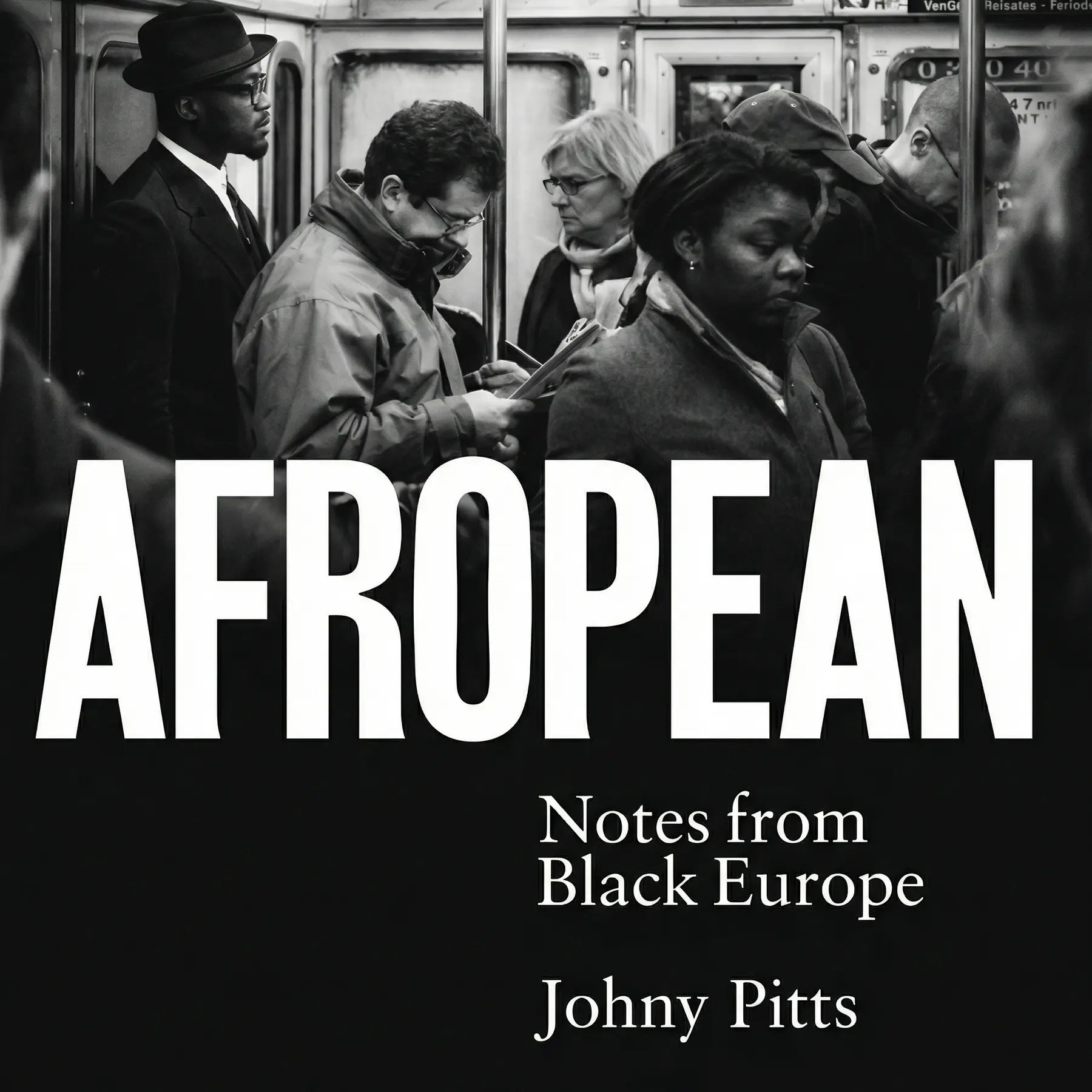
Afropean: Notes From Black Europe
By Johny Pitts
Johny Pitts travels from Paris to Lisbon to uncover Black Europe. He shows how colonial history ties Africa to Europe, and how Afropeans have built lively communities that many national stories still leave out.

Table of Content
1. Introduction
54 sec
Many people, in Europe and far beyond it, still hear the word European and picture a white face, even though Black families have lived on the continent for generations. In Afropean, the Sheffield-born writer and photographer Johny Pitts sets out to show how much that picture misses. His father was a Black American and his mother white and British, and growing up he felt he had to be either British or Black, never both. So he packed a bag and crossed the continent, from Paris and Brussels to Moscow and Lisbon, looking for people who live that double identity every day.
One argument ties his stops together. Black Europe is hidden, yet very real. Colonial history bound Africa and Europe together long ago, and many countries still avoid facing that past. Even so, Black Europeans have built communities that let them be fully both.
2. A neighborhood that shows how belonging breaks
1 min 51 sec
A rough northern English district once gave a mixed-race boy a proud identity, full of weddings, reggae and hip-hop. Then something outside the neighborhood changed, and the sense of home went with it.
3. Read Paris as a crossroads of three continents
1 min 54 sec
A famous French novelist, a unit of American soldiers and a perfume maker on television all point to the same buried truth about the French capital, one that its tourist image rarely mentions.
4. Spot the colonial past hiding in plain sight
1 min 51 sec
Europe’s supposedly dullest capital sells a famous children’s comic in its tourist center and keeps a strange museum on its outskirts. Both tell a story Belgium has barely begun to face.
5. Remembered history becomes a tool for today
1 min 57 sec
Students guard the legacy of a couple, one of whom met Lenin and was later exiled from America, and they do it from a building set right amid the red-light quarter of Amsterdam. Why keep such stories? Because they still mobilize people.
6. Tell real solidarity from comfortable tolerance
2 min 03 sec
An anti-racist march with almost no Black faces, and a country famous for kindness whose factories feed foreign wars. Two liberal places show how easily good intentions drift away from the people they claim to serve.
7. What Moscow teaches about a fragile welcome
1 min 58 sec
A Black American star once wrote that he finally felt human in Moscow. Decades later, African students there barely leave their campus. What happened in between is a lesson about how inclusion can be lost.
8. Belonging grows where neighbors build it together
1 min 56 sec
Luxury villas on the French coast were paid for with colonial blood. Nearby, a harbor city, and later a Lisbon settlement that even the police avoid, offered something the villas never could.
9. Conclusion
1 min 11 sec
Pitts ended his trip in Gibraltar, where on a clear day Africa is visible from Europa Point. The day he arrived, cloud hid everything a few yards out. He did not mind. He had already seen Africa up close, in Parisian shops, a Brussels district of salons and jazz clubs, an Amsterdam archive, a Berlin community center and nightclub, and a Lisbon dance floor.
That foggy view is the book in one image. Black Europe has been inside the house for centuries, tied to it by colonial wealth and violence that many countries still prefer not to discuss. Where that history is denied, as in Belgium’s dusty museum or on Moscow’s lonely campus, people get pushed to the edges. Where it is remembered and shared, as in Cova de Moura or the Huiswouds’ archive, people build homes that last.
What the book leaves you with is a habit of looking. When a city or an institution tells its own story, ask whose names are missing and whose labor paid for the grand buildings. If you feel caught between two identities, you may not have to pick one. Across the continent, Afropeans already live as both.
About this book
What is this book about?
Many people still treat European as another word for white, even though Black families have lived on the continent for generations. Johny Pitts, a writer and photographer from a working-class district of Sheffield, grew up feeling he had to choose between being British and being Black. Afropean is his attempt to find out whether he could be both. He backpacks through Paris, Brussels, Amsterdam, Berlin, Stockholm, Moscow, Marseille and Lisbon. In each city he looks at two things: the colonial history that tied the place to Africa, and the Black communities living there today. He finds a Belgian museum that has barely faced the Congo, an Amsterdam archive that keeps forgotten revolutionaries alive, and a Russian campus where an old welcome has turned cold. In Marseille and in a Lisbon settlement he finds working-class neighborhoods where people of many origins have built something close to home. Readers get a new map of familiar European cities and the history behind their monuments. They also come away more alert to the people national stories leave out, and see that a double identity can be a place to live rather than a problem to solve.
Book Information
Who it's for
Caught between two identities
Readers who feel caught between two identities and want to see how others live with both.
Travelers and Europe watchers
Travelers and Europe-watchers curious about the colonial history behind famous cities.
Managers and educators
Managers and educators who want a sharper eye for whose stories institutions leave out.
About the Author
Johny Pitts
Johny Pitts is a writer, photographer and broadcaster from Firth Park in Sheffield, and he has also worked as a journalist. He founded Afropean, an online journal covering art, literature and events from the Afro-European diaspora, which has grown into a network for Black Europeans across the continent. Before writing the book, he worked with the author Caryl Phillips on a BBC photo essay about London's immigrant communities.
Ratings & Reviews
Ratings at a glance
What people think
Listeners value this perceptive examination of Black identity throughout Europe, characterizing it as a stimulating mixture of personal memoir, travel writing, and historical analysis. The author's interactions with diverse communities and literary icons are considered highly absorbing, with one listener observing that the work acts as a "reimagined travel guide" uncovering intricate, obscured histories. Furthermore, many point to the stirring black-and-white photos documenting the genuine everyday experiences of the African diaspora. Although views differ regarding the narrative's relaxed, journalistic format, the majority believe it represents a powerful and essential addition to the dialogue on identity. Beyond that, listeners perceive the prose as an approachable and "intelligent" achievement that effectively disputes conventional views of European legacy.
Top reviews
Aria
Finally got around to reading this award-winning travelogue and it completely shifted my perspective on what it means to be European. Johny Pitts takes us from his childhood home in Sheffield across the continent on a shoestring budget, uncovering stories that history books usually ignore. I was particularly struck by the section on Lisbon; the way he describes the city as a masterpiece with 'troubling details' in the brushstrokes is pure poetry. The black-and-white photography scattered throughout adds such a haunting, authentic layer to the narrative. It’s not just a book about travel; it’s an urgent exploration of belonging and identity. Frankly, it’s the kind of reimagined travel guide we’ve needed for decades. Every chapter feels like a conversation with a friend who happens to be incredibly well-read.
Show moreChatri
The photography alone is worth the price of admission here. Pitts captures the daily lives of Black Europeans with such dignity and grace, from protesters in Paris to the statue of Pushkin in Moscow. It is a beautiful, melancholic journey that feels deeply personal yet globally significant. I was moved by his search for home and how he navigates spaces that often feel hostile to his presence. The encounters with writers like Linton Kwesi Johnson felt like organic, lucky moments in a very human story. Not gonna lie, I teared up a few times reading about the struggle for belonging. This isn't just a book; it's a mood and a movement. It challenges the facade of a white Europe in the most sophisticated way possible.
Show moreEvelyn
This book is a necessary slap in the face to the 'white-only' version of European heritage we are usually sold. Pitts writes with an accessible intelligence that makes complex history feel immediate and vital. I loved his descriptions of the Parisian suburbs; they felt so vivid and far removed from the typical tourist traps. His ability to link his own Sheffield roots to the wider African diaspora is masterfully done. The black-and-white images are hauntingly beautiful and anchor the stories in reality. Personally, I didn't mind the journalistic structure at all—it made the book feel like a living, breathing document. It’s a brilliant exploration of identity that finally gives a voice to millions of people living in the shadows of the continent.
Show moreYui
What a stunning achievement. Pitts manages to capture the nuance of being Afropean with such sensitivity and sharp observation. I was completely absorbed in his journey from the very first page, following him through the cold streets of Stockholm and the radical pockets of Berlin. The way he discusses the impact of colonial power without becoming overly academic is a rare talent. The photography provides a wonderful visual counterpoint to his prose, showing an African presence that has survived for centuries. This book is about the fundamental human need to belong, and it resonated with me on a very deep level. It’s an intelligent, forceful piece of work that I’ll be recommending to everyone I know. Truly essential reading for our times.
Show moreWei
Honestly, this is one of the most eye-opening books I’ve read in years. Johny Pitts doesn't just travel through Europe; he deconstructs it. By focusing on the African diaspora, he reveals a hidden history that is both heartbreaking and resilient. I loved the personal touches, like his nervousness in the Parisian suburbs or his unexpected meeting with Caryl Phillips. The book successfully bridges the gap between a gritty travelogue and a serious historical inquiry. It feels authentic because it doesn't try to be a definitive encyclopedia; it’s a subjective, deeply felt exploration of a complex identity. The black-and-white photos of daily life are the perfect finishing touch. If you care about the future of Europe and the people who inhabit it, read this book.
Show moreChamlong
As someone who spent years studying European history without ever seeing a Black face in the syllabus, this was a revelation. Pitts expertly mingles the literary and the political, bringing in heavyweights like Frantz Fanon and James Baldwin to ground his observations. I loved the gritty, impressionistic feel of his writing as he navigates the Parisian suburbs and the streets of Berlin. To be fair, the structure is a bit loose—it often feels more like a series of interconnected journalistic articles than one cohesive study. However, that fluidity allows for some really raw and honest encounters with the African diaspora. It’s an intelligent, accessible piece of work that asks hard questions about why 'European' is still treated as a synonym for 'white.' Definitely worth a read.
Show moreTeng
Ever wonder what it actually means to be both Black and European in a world that often treats those terms as opposites? Johny Pitts sets out to answer this by backpacking through various communities on a budget, and the result is quite powerful. His observations on the Cold War’s legacy and colonial power structures are woven seamlessly into his travel diary. I particularly enjoyed the Berlin chapter, though I agree with other reviewers that the scope is somewhat limited. Truth is, you can’t cover everything in one trip, and Pitts is honest about his partial perspective. The book serves as a fantastic conversation starter rather than a final word on the subject. It’s a forceful, necessary contribution to modern literature that everyone should pick up.
Show moreNoi
Picked this up after seeing it on several 'best of' lists and I wasn't disappointed by the content. Pitts has a gift for finding the extraordinary in the ordinary, documenting the lives of people he meets in hostels and on street corners. The book feels like a reimagined travel guide for the marginalized, focusing on the brushstrokes of cities like Lisbon and Brussels. His encounters with the ghosts of Fanon and Baldwin provide a rich intellectual backdrop to his winter travels. While some might find the journalistic style a bit loose, I thought it suited the 'backpacking on a shoestring' vibe perfectly. It’s a thought-provoking blend of memoir and history that successfully challenges traditional perceptions of European culture. A very solid four stars.
Show moreRungrat
Not what I expected given the massive hype surrounding its Jhalak Prize win. While the concept of 'Afropean' identity is fascinating, the book felt a bit too much like a collection of travel notes rather than a finished product. I found the literary references a little heavy-handed at times, and the narrative flow was quite uneven. For example, the exclusion of Eastern Europe—aside from a brief look at Moscow—felt like a missed opportunity to provide a truly comprehensive view of the continent. Look, the writing is undeniably good and the photography is stunning, but I wanted more depth and a tighter structure. It’s an interesting backpacker’s journey, but it lacks the analytical punch I was hoping for in a definitive study.
Show moreYulia
I'll be frank: while the premise is brilliant, the execution felt a bit hit-or-miss for me. There are moments of absolute brilliance where the history and the personal narrative align perfectly, but then there are long stretches that feel like aimless wandering. I felt the lack of a broader perspective on Southern Europe, specifically Italy and Greece, left a big hole in the argument about the refugee crisis and migration. The writing style is impressionistic, which works for a travelogue, but I found myself wishing for a more rigorous framework. It’s a good book, and certainly an important one, but it didn't quite reach the five-star status I was expecting. It’s a series of interesting insights that don't always add up to a full-fledged book.
Show moreQuestions about this book
What is Afropean by Johny Pitts about?
It is a travel book about Black Europe. Born in Sheffield to a British mother who is white and an American father who is Black, Pitts backpacks through cities including Paris, Brussels, Amsterdam, Berlin, Stockholm, Moscow, Marseille and Lisbon. In each one he traces how colonial history linked the place to Africa, and he meets the Black communities who live there today and are shaping a new identity that is both African and European.
What does the word Afropean mean?
It describes people who are both Black and European, rather than one or the other. According to Pitts, the Belgian-Congolese singer Marie Daulne first used the term for a music project with David Byrne of Talking Heads that mixed African and European influences. Byrne later called her music a subtle manifesto for a new Black European identity. Pitts uses the word for communities across the continent.
What is the main argument of Afropean?
Pitts argues that Black Europe is real but kept out of sight. Colonialism tied Africa and Europe together over centuries, yet many countries, from Belgium to the Netherlands, have barely faced that past, and Black residents are often pushed to city edges and low-paid work. Even so, he finds strong communities, such as an activist archive in Amsterdam and a community center in Lisbon, where Afropeans have built real homes.
Which cities does Johny Pitts visit in Afropean?
He starts from his home district of Firth Park in Sheffield, then visits Paris, Brussels, Amsterdam, Berlin, Stockholm and Moscow. Then he returns to France through Provence and Marseille, travels on to Lisbon, and ends in Gibraltar. He finds Marseille’s working-class mix and the Cova de Moura settlement in Lisbon closest to his idea of Afropean community, while Moscow is the most hostile stop.
How can I apply the ideas in Afropean?
The book teaches a way of looking. When a museum, a city or an employer tells its story, ask whose history is missing and whose labor paid for the grand buildings. Judge openness by who is actually housed, included and remembered, as Pitts does in Berlin and Stockholm. And if you live between two identities, his travels suggest you can belong to both.
Readers also enjoyed



All About Love: New Visions
bell hooks


A Biography of Loneliness: The History of an Emotion
Fay Bound Alberti

A Force for Good: The Dalai Lama's Vision for Our World
Daniel Goleman


A Room of One’s Own
Virginia Woolf

Abolish Rent: How Tenants Can End the Housing Crisis
Tracy Rosenthal
AUDIO SUMMARY AVAILABLE
Listen to Afropean in 15 minutes
Get the key ideas from Afropean by Johny Pitts, plus 5,000+ more nonfiction titles.
- 5,000+ titles
- Listen as much as you want
- 7-day free trial
- Cancel anytime









