

12 min 34 sec
Available in: English
 ไทย
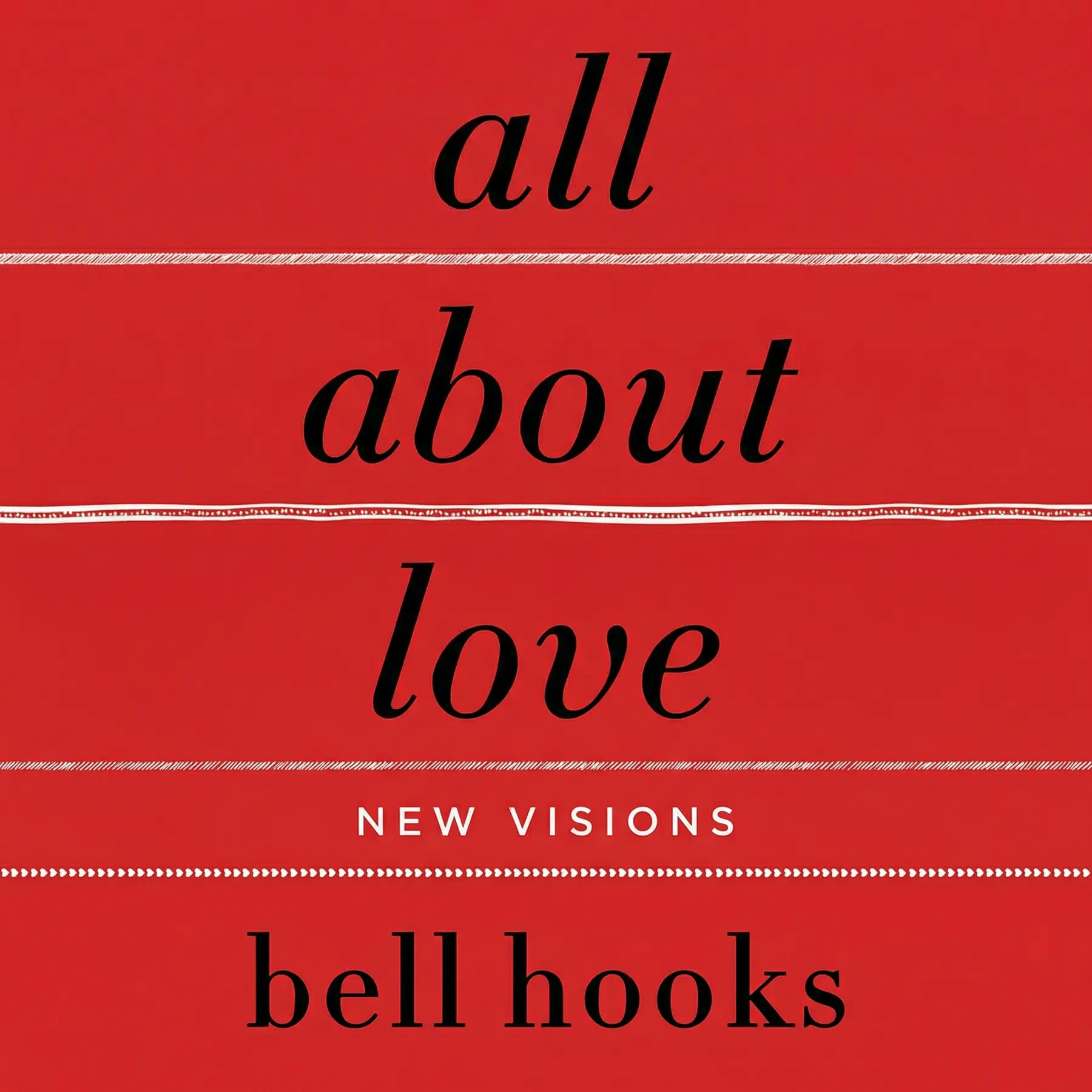
EnglishไทยAll About Love: New Visions
By bell hooks
Shows why treating love as a feeling leaves people open to lies, neglect and quick breakups. It explains how to practice love as daily action toward yourself, your family, your friends and your partner.

Table of Content
1. Introduction
1 min 02 sec
Many of us grew up on fairy tales and family romances promising that love would change our lives, then found adult love scarce, confusing or painful. In All About Love, the writer and teacher bell hooks argues that the trouble starts with a bad definition. Most of us have simply never been taught what love actually is.
Her answer, shared with a long line of psychologists and theorists, is a working definition: love is the deliberate effort to nurture spiritual growth, in ourselves and in others. Once love is understood as something we do, the obstacles come into view. Feeling-first thinking, cultural lies, greed, isolated families and movie romance all teach us to wait for love. Self-love, community and generous giving teach us to practice it.
What follows is a test for telling love from mere affection, and a handful of small daily acts that make room for it, from a friendship you already have to a greeting for a stranger.
2. Spot real love by what people do
1 min 41 sec
Plenty of people who are mistreated by a partner insist the love between them is real. The reason they believe it starts in childhood, and it changes how you should judge every close relationship you have.
3. Honesty and simplicity make room for love
1 min 52 sec
We teach children that lying is wrong, then build adult romance on small deceptions. Add a habit of wanting everything immediately, and it becomes clear why so many relationships never get the time they need.
4. Stay when the movie version of romance ends
1 min 33 sec
Romantic comedies promise that love strikes without warning and flows without effort. Believing both ideas feels harmless, yet it can turn the first honest difficulty in a relationship into a reason to leave.
5. Build love for others on love for yourself
1 min 58 sec
Everyone has heard that you must love yourself first. hooks agrees, then adds two harder demands: finding where your self-doubt came from, and letting your beliefs about people change what you actually do.
6. Learn to love from family and friends
1 min 44 sec
A shamed and humiliated child can still grow up believing families can hold love. The difference often lies outside the household walls, in people we tend to leave off the list when we count our family.
7. Give generously to free love from gender scripts
1 min 27 sec
Ask people what they want from a partner and the answers come quickly. Ask what they will offer and the silence is longer. Two of the author’s own relationships show what that imbalance costs.
8. Conclusion
1 min 17 sec
What hooks offers is a change of grammar. Love stops being something that happens to us and becomes something we do, again and again, for ourselves and for others. That shift makes the old excuses harder to accept: the parent who hurts in love’s name, the partner who lies, the romance dropped at its first hard stretch. It also makes love less rare, because kindness, compassion, respect and care are open to anyone, on any ordinary day.
The stakes reach past private life. Each of these acts, hooks argues, helps create a world where every person is valued and looked after.
The book supports starting small. Judge your closest relationships by what each person does for the other’s growth. Notice where a convenient lie or a wish for something right now is replacing trust and patience. And build community wherever you happen to be: greet strangers, thank the people around you, and treat these small gestures as the first bridges between you and others.
A grandfather’s steady kindness was enough to show one shamed child that a family could hold love. Most of us can be that person for someone.
About this book
What is this book about?
Most people grow up on stories promising that love will make life better. Then adult relationships turn out confusing, disappointing or painful, and many give up on love while still quietly hoping for it. bell hooks argues that the real difficulty is that hardly anyone was ever taught what love is. Her starting point is a definition: love is the deliberate work of nurturing spiritual growth, our own and other people's. Measured that way, much of what passes for love fails the test. hooks shows how childhood discipline, patriarchal dishonesty, consumer greed, the isolated nuclear family and romantic myths from films and novels all train us to accept less, or to walk away when love asks for effort. The book then turns to repair. Readers learn how to trace and answer their own low self-esteem, why extended family and long friendships are training grounds for love, and why a relationship grows only when both people give as well as receive.
Book Information
Who it's for
Choosing partners who hurt
People who keep choosing partners who hurt them and want a clearer test for what love looks like.
Adults with hard childhoods
Adults working through a difficult childhood who want to learn self-love and lean on friends and wider family.
Couples questioning gender roles
Couples tired of fixed gender roles who want a relationship where both partners give.
About the Author
bell hooks
bell hooks was a writer and teacher, born in 1952 in Hopkinsville, Kentucky, who died in 2021. She took her pen name from her great-grandmother and wrote it in lowercase to keep attention on her ideas. She taught at the University of Southern California, Stanford, Yale and The City College of New York, joined Berea College in 2004 and founded the bell hooks Institute there in 2014. Her many books cover love, gender, art, history, sexuality and mass media.
Ratings & Reviews
Ratings at a glance
What people think
Listeners find this book to be a vital read that provides lessons in every chapter, opening their hearts and guiding them toward a proper understanding of self-love. The writing is easy to engage with and has the feel of a supportive conversation, with listeners valuing the way it alters their views on relationships. While listeners consider the text life-changing and useful, some find it to be repetitive and uninteresting.
Top reviews
Pornpimon
This book felt like a deep breath I didn't know I needed to take. bell hooks challenges our cultural obsession with romanticized, passive love and forces us to look at it as an active choice. I was particularly moved by her insistence that love and abuse simply cannot coexist, a truth that feels both obvious and revolutionary. To be fair, her writing is incredibly accessible, making complex sociological ideas feel like a warm, nurturing conversation between friends. While I found some of the religious references a bit unexpected, they didn't detract from the core message of self-recovery. It truly changed how I view my relationships and the effort I put into my community. Every chapter offers a new lesson on how to cultivate a more compassionate life.
Show morePawinee
Wow. I think this should be required reading for every human being who wants to build better connections. bell hooks writes with such a profound sense of clarity that it feels like she’s speaking directly to your soul. The distinction she makes between 'cathexis' and real love is something I will be thinking about for the rest of my life. It’s not a light read by any means, as it forces you to confront the ways you’ve been complicit in lovelessness. The chapters on honesty and community were the most impactful for my personal growth. Even the more 'preachy' parts felt like they came from a place of genuine concern for humanity’s future. It’s a beautiful, challenging, and ultimately healing meditation on what it means to be truly human.
Show moreNoppadol
After hearing so much about this foundational text, I was blown away by how relevant it still feels today. hooks offers a radical re-imagining of what it means to live in a community centered around care rather than consumption. While some of the language is certainly a product of the late 90s, particularly regarding gender, the underlying philosophy is timeless. I found the section on 'communion' to be especially moving, as it challenges the idea that love is only found in the nuclear family. To be honest, it’s rare to find a book that is both an intellectual powerhouse and a deeply emotional guide to self-recovery. It’s a must-read for anyone who feels disillusioned by the shallow nature of modern dating. This book doesn't just give you answers; it gives you a whole new vocabulary for intimacy.
Show moreSuwit
Finally got around to reading this and it has completely shifted my perspective on what it means to be a loving person. hooks takes the concept of love out of the realm of abstract feelings and places it firmly in the world of action and ethics. Her definition—extending oneself for the purpose of spiritual growth—is a game-changer for anyone struggling with low self-esteem. Not gonna lie, some parts are painful to read because they hold up a mirror to our own failings. But the tone is so nurturing and hopeful that you want to do the work she suggests. It’s a life-changing guide for anyone who feels lost in our current culture of cynicism and isolation. Truly a masterpiece of emotional intelligence.
Show moreSarawut
The way this book treats love as a serious subject for study is absolutely refreshing. We often dismiss love as something that just 'happens' to us, but hooks argues that it is a skill we must learn and practice daily. I appreciated how she didn't shy away from the political aspects of love, showing how patriarchy actively prevents men from being able to express vulnerability. It’s a heavy-hearted read at times, especially when she discusses childhood trauma, but it leads to a place of incredible healing. This isn't just a book; it's a blueprint for a better society. I will be recommending this to everyone I know who is tired of the shallow, disposable relationships our culture promotes.
Show moreWichai
Picked this up after seeing it recommended everywhere, and I definitely see why it’s considered a classic. The way hooks breaks down the 'will to nurture' really helped me understand my own patterns of self-neglect. Her prose is clear and direct, though I’ll admit it gets a bit repetitive towards the middle of the book. In my experience, some of the sections on angels and spirituality felt a little out of place for a social critique. However, the core argument about love being a verb remains one of the most transformative things I’ve read this year. It’s a great starting point for anyone looking to deconstruct the toxic myths we’re fed about romance and family. I’m walking away with a much healthier definition of what it means to care.
Show moreLeah
The chapter on greed alone makes this book worth the price of admission. hooks does an incredible job of linking our internal emptiness to the 'psychotic lust' of consumer culture. It’s a stinging critique of how capitalism tricks us into replacing intimacy with material goods. While I didn't agree with every single point—especially her take on addiction, which felt a bit oversimplified—the overall sentiment is powerful. The writing style is engaging and feels like a dialogue, though it can be a bit 'wordy' at times. Truth is, even when I disagreed with her, I felt like I was learning something new about myself. It’s a book that asks more of you than just reading; it asks you to change.
Show moreCooper
Ever wonder why our society is so obsessed with love yet seems so remarkably bad at practicing it? That's the question bell hooks tries to answer here with varying degrees of success. I loved the early sections about how we are taught to accept neglect as a form of love in childhood. It’s eye-opening stuff that makes you re-evaluate your entire upbringing. On the flip side, the middle of the book drags significantly and feels quite dated in its approach to gender roles. Personally, the heteronormative lens was distracting, and the chapter on spirituality was a total skip for me because of the weird 'angels' talk. It’s an okay read with some stellar quotes, but it definitely didn't change my life the way it seems to have for others.
Show moreJonathan
Not what I expected from a feminist icon, to be perfectly blunt. While the opening chapters on childhood and the definitions of love were promising, the book quickly devolved into a moralizing sermon. I was particularly disgusted by the author’s commentary on Monica Lewinsky and Nicole Brown Simpson, which felt surprisingly misogynistic and victim-blaming. For a book that preaches empathy, it shows very little to women who don’t fit a specific moral mold. Additionally, the constant shift toward Christian spirituality felt alienating as a secular reader. Look, there are some decent insights about capitalism ruining community, but they are buried under a mountain of preachy, repetitive prose. It felt more like a dated self-help manual than a rigorous political or social essay.
Show moreKek
As someone who usually admires bell hooks, I found this particular work to be a major disappointment. It felt less like a scholarly analysis and more like a collection of vague, repetitive platitudes. The lack of research to back up her sweeping generalizations about how 'all men' or 'all women' behave was frustrating to say the least. Furthermore, the way she handled the Monica Lewinsky situation felt like a betrayal of the intersectional feminism she usually champions. It was boring, moralizing, and at times, just plain confusing. I kept waiting for a breakthrough that never came. Frankly, if you're looking for her more rigorous political work, I would suggest skipping this one and heading straight for her earlier essays instead.
Show moreQuestions about this book
What is the main idea of All About Love by bell hooks?
bell hooks argues that most people misunderstand love because they treat it only as a feeling. For her, love means actively nurturing spiritual growth, both in ourselves and in other people. Judged that way, behavior such as abuse, lying or neglect cannot be called love, however strongly someone claims to feel it. The book then shows how self-love, community and generous giving help people practice love every day.
Why does bell hooks say love is a verb?
Because a feeling asks nothing of us and can excuse harm. hooks points out that many mistreated people insist their partners love them, and that many children are hit or shouted at by parents who say they love them. Those children learn to accept mistreatment from loved ones. Treating love as action moves the focus to what people actually do for each other’s growth.
What does All About Love say about romantic relationships?
hooks challenges two myths from films and novels: that we cannot choose whom we love, and that true love should be easy. Believing the first stops us from thinking about what we need and can offer. Believing the second makes couples quit when real difficulties appear, such as childhood insecurities or trouble communicating. Love grows, she argues, when two people see each other clearly and keep working at it.
How can I apply the ideas in All About Love?
Start by tracing where any low self-esteem came from and answering it with self-care. Judge relationships by actions, and notice where lies or a hunger for instant satisfaction replace trust. Lean on friendships and wider family as places to learn care. And build community wherever you are, by greeting strangers and showing appreciation to the people around you.
Who should read All About Love?
It suits anyone confused or disappointed by love: people stuck in hurtful relationships, adults who grew up in difficult homes, and couples frustrated by rigid gender roles. Readers interested in how patriarchy, consumer culture and media myths shape private life will also find it useful, since hooks connects personal relationships to the values of the wider society.
Featured in
Readers also enjoyed


A Biography of Loneliness: The History of an Emotion
Fay Bound Alberti

A Force for Good: The Dalai Lama's Vision for Our World
Daniel Goleman


A Room of One’s Own
Virginia Woolf

Abolish Rent: How Tenants Can End the Housing Crisis
Tracy Rosenthal

Abortion: Our Bodies, Their Lies, and the Truths We Use to
Jessica Valenti


Afropean: Notes From Black Europe
Johny Pitts
AUDIO SUMMARY AVAILABLE
Listen to All About Love in 15 minutes
Get the key ideas from All About Love by bell hooks, plus 5,000+ more nonfiction titles.
- 5,000+ titles
- Listen as much as you want
- 7-day free trial
- Cancel anytime









