

Abortion: Our Bodies, Their Lies, and the Truths We Use to
Jessica Valenti
 English
 ไทย
Mary Beard shows why women who speak with authority are still interrupted, mocked or dismissed, tracing the habit to ancient Greece and Rome, and argues that the cure is a new idea of power.

59 sec
Women who speak up at work or in politics and get talked over are not facing a modern glitch. In Women and Power: A Manifesto, the Cambridge classicist Mary Beard traces the habit to one of the earliest works of Western literature, where Homer’s young Telemachus sends his mother Penelope out of the room, telling her that “speech will be the business of men.” When voters in 2016 said Hillary Clinton did not look like a president, Beard heard the same old script.
Her argument is that Greece and Rome defined power, public speech and manhood in terms of one another, and the West still runs on those definitions. Women who speak are cast as freaks, as rare exceptions or as voices for women’s issues alone. Beard’s remedy is to change what we mean by power. Follow her from Clytemnestra to Twitter, and the old rules become easy to name when they show up in a meeting, and harder to obey without noticing.
1 min 56 sec
Ancient Athens filled its stage with women who seized control, and its audiences watched every one of them fail. Even the goddess who guarded the city turns out to be a strange role model once you look closely.
1 min 45 sec
A Roman orator claimed a city would cope better with the plague than with one particular change to its men. His fear still shapes whose voice sounds believable in a meeting today.
2 min 04 sec
Ancient Rome allowed a handful of women to speak in public, and a famous queen’s battlefield speech survives in schoolbooks. The terms under which they were heard reveal a limit that has barely moved.
1 min 54 sec
A senator was stopped from reading a letter aloud, and then her colleagues read the very same words without interruption. The gap between those two moments has a long history inside the rooms where laws are made.
1 min 49 sec
A cartoon from decades ago still makes women in offices wince with recognition, and an online threat echoes an ancient poem. A classicist explains what they share, and what anyone running a room can do.
1 min 42 sec
One search for a cartoon professor returned a single woman in a hundred images, and she came from a video game. The fix that powerful women often adopt carries a hidden cost.
1 min 52 sec
A chamber packed with women might not be a sign of progress at all. Beard turns that uncomfortable thought into a different way to measure who really holds power in a country, a company or a team.
1 min 10 sec
Beard’s manifesto ends somewhere unexpected for a book built on ancient texts: with a request for silence from the people who usually speak. The line from Telemachus to the Senate floor runs unbroken because Greece and Rome defined power, manhood and public speech together, and nobody rewrote the definitions. Adding women to old structures helps, as the climb to 30 percent of British MPs shows, but it leaves those structures deciding who sounds credible.
What the book asks of its readers is recognition first. Learn to spot the script when it plays: the powerful woman painted as a monster, the woman invited to speak only about women, the expert mocked by a stranger online, the idea that waits for a man to repeat it. Then take Beard’s own plain advice and listen. In a meeting or at a bar, notice when you talk over a woman or explain her own subject to her, and let her finish.
Telemachus became a man by silencing his mother. Everyone else can grow up by learning the reverse.
Women hold more public offices than ever, yet they are still heckled in parliaments, abused online and told they do not look the part. Mary Beard, a Cambridge classicist, argues that this is far older than modern politics. In Greek drama and Roman oratory, power, public speech and manhood were defined together, so a woman who spoke or ruled was treated as unnatural. Beard follows that inheritance from Homer's Odyssey and Aeschylus's Clytemnestra to Elizabeth I, Henry James, the US Senate, the British House of Commons and Twitter. She shows how women's voices were allowed only on narrow topics or as victims, and why successful women often adopt the pantsuit or a lower voice. Readers get a clear way to recognize an ancient script when it plays out at work or in the news, and a proposal to stop treating power as a possession held by a few. Beard suggests measuring it instead by what people get done, a view that leaves room for women, and for followers as well as leaders.
Women who get talked over in meetings and want to understand why it keeps happening.
Managers and team leads who run discussions and want credit and speaking time to land fairly.
Readers curious how ancient Greece and Rome still shape politics and public speech.
Mary Beard was born in 1955 in Much Wenlock, Shropshire. She studied at Newnham College, Cambridge, stayed in Cambridge for her PhD, became a fellow of Newnham and has held a professorship of classics at the University of Cambridge. Since 1992 she has been classics editor of the Times Literary Supplement, and she writes the blog A Don's Life. Her bestselling books include SPQR: A History of Ancient Rome, and she appears often on television and radio.
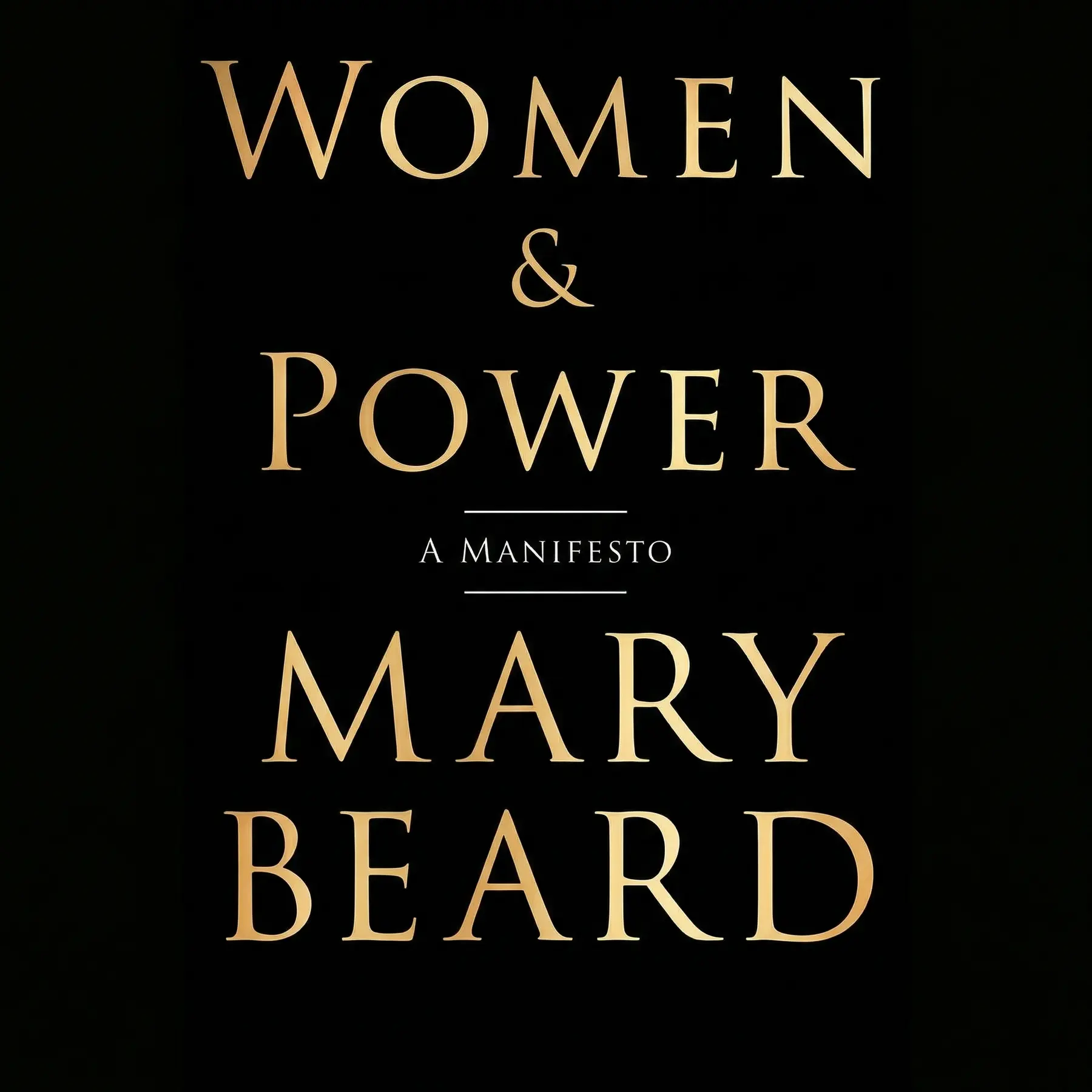
Listeners find this work to be a rapid and compelling listen that is both intellectually stimulating and deeply researched, with one listener highlighting how it transports the audience through ancient history. The narrative style is witty, and listeners value the vital conversation regarding feminism and the feminist outlook provided. They highly respect the author’s efforts, with one listener characterizing her as a profoundly significant modern writer. There are varied opinions on the book's size, as several listeners point out its brevity.
Mary Beard delivers a scorching, intellectual takedown of the ways western culture systematically silences women. By tracing the lineage of the 'female voice' from Penelope in The Odyssey to the modern-day treatment of politicians like Elizabeth Warren, she exposes how deep-seated these prejudices truly are. My biggest takeaway was her argument that we shouldn't just be trying to wedge women into existing male-coded power structures. Instead, we need to redefine power itself—not as a possession or a symbol of prestige, but as an attribute or a verb: 'to power.' It is a short, punchy manifesto that demands we look at why the authoritative voice is still coded as male. Frankly, I wish it were three times longer because her insights into the classical world are unmatched. Even so, it’s a brilliant, necessary spark for a much larger conversation.
Show moreWow, this packs a punch for such a slim volume. Beard’s exploration of the 'Voice of Authority' really resonated with me, especially her points about how women are often forced to lower their pitch or mimic masculine traits to be taken seriously. Look at the way we talk about female leaders needing to be 'likable' while men just need to be 'strong.' She uses her expertise in the classics to show that these aren't modern accidents; they are ancient scripts we are still following. The imagery she includes—like the horrific ways Medusa is used in modern political memes—is genuinely chilling. It’s a wake-up call that forces you to rethink every interaction you have in a professional setting. This isn't just for women; every man who cares about logic and reason should have this on his shelf.
Show moreThis should be mandatory reading for anyone who thinks we’ve already achieved gender equality. Beard’s voice is so clear and authoritative; she manages to be both academic and incredibly accessible at the same time. The way she describes power as something we 'do' rather than something we 'own' is a total paradigm shift. I was particularly struck by the section on how women have to 'pose' as men to be heard—wearing trouser suits, lowering their voices, adopting a certain stoicism. It makes you realize that the glass ceiling isn't just about glass; it's about the very architecture of the building. Despite its brevity, this book stayed with me for weeks. It’s a rallying cry to stop trying to fit in and start tearing the old structures down. Absolutely essential.
Show moreEver wonder why certain voices are dismissed as 'whining' the moment they challenge the status quo? Beard looks back at the ancient world to show us that this isn't a new phenomenon; it's practically baked into our cultural DNA. I was fascinated by the example of Telemachus telling his mother, Penelope, to shut up because speech is the business of men. It’s a direct line from Greek mythology to the way women are treated on Twitter today. The book is incredibly brief—essentially two expanded lectures—so you can finish it in an afternoon. While I appreciated the clever writing and the historical context, I did feel it ended just as the discussion was getting really juicy. It’s more of a starting point than a comprehensive guide, but what's there is pure gold.
Show moreFinally got around to this after seeing it recommended everywhere, and it’s a refreshing take on a heavy subject. Beard has this wonderful, conversational way of debunking historical myths, like the famous Tilbury speech by Elizabeth I. Learning that those words were likely attributed to her decades later by a man really changes how you view the 'heart and stomach of a king' trope. She also points out how Sojourner Truth’s famous words were 'translated' into a dialect she didn't even speak to make her more palatable to a specific audience. These small details build a powerful case for how women’s words are constantly being re-authored by men. I did find the transition between the two lectures a bit jarring, and it definitely feels like 'Padding: The Book' at times with all the illustrations, but the core message is vital.
Show moreAs a student of classics, I found Beard’s analysis of the Greco-Roman roots of misogyny absolutely riveting. She doesn't just list grievances; she shows the structural foundation of why women are excluded from public discourse. The 'Miss Triggs' cartoon reference was a highlight for me, perfectly capturing that feeling of a woman making a point only for a man to repeat it and get the credit. It’s a sharp, clever look at why we perceive power as a masculine possession. I took off one star because I wanted more on the 'how'—how do we actually dismantle these structures in a modern corporate or political environment? Beard draws back the curtain on the emperor's nakedness, but she leaves us standing there in the cold without a map. Still, her intellectual courage is inspiring.
Show moreWhile the scholarship is obviously top-tier, this felt more like a teaser for a book rather than a complete volume. Mary Beard is a legend, and her ability to connect Medusa to Hillary Clinton is genuinely illuminating, yet I left feeling slightly unsatisfied. The text consists of two lectures, and it shows in the pacing and the lack of deep, actionable solutions for the problems she identifies. Truth is, if you’ve read much feminist theory before, some of these concepts might feel a bit introductory. I also found it a bit disappointing that she didn't touch on intersectionality or how white feminism has historically marginalized women of color. It's a great 'gateway' book for those new to gender studies, but seasoned readers might find it a bit slight for the price tag.
Show moreTo be fair, I expected a bit more 'meat' on the bones of this argument. The connection between ancient myths and modern-day abuse of women online is a brilliant angle, but it feels like Beard is just getting warmed up when the book ends. I loved her point about how we need to decouple power from public prestige and think about it more collaboratively. That is a massive, world-changing idea, but it’s only given a few pages of exploration here. Personally, I would have loved to see her engage with other contemporary thinkers like bell hooks or Rebecca Solnit to flesh out the sociological side of things. It’s a good introduction to the topic, but it feels more like a long-form essay than a definitive book on gender and power.
Show moreMy wife recommended this to me, and as a man, it was a bit of a localized ego-check. It’s uncomfortable to realize how much our definition of 'leadership' is tied to traditionally masculine traits like dominance and competition. Beard makes a compelling case for shifting toward 'feminine' ideals of connection and nurturance, though she avoids using those exact labels to keep things nuanced. The truth is, I found the historical bits about the ancient world much more engaging than the modern political commentary. At times, the tone felt a bit like a lecture—which, given the origin of the text, makes sense. It’s a quick, thought-provoking read that definitely sparked some good dinner table conversations, even if it didn't provide any easy answers.
Show moreI'll be the dissenter here and say I was pretty underwhelmed. I love Mary Beard's documentaries, but this felt like a missed opportunity to write something truly transformative. It is incredibly short—you can read the whole thing in under an hour—and it barely scratches the surface of the history it promises to explore. To be fair, her points about the silencing of women are valid, but they aren't exactly groundbreaking if you've spent any time in feminist circles. It reads exactly like what it is: a transcript of two speeches. I was expecting a manifesto with a clear path forward, but instead, I got a few interesting historical anecdotes and a vague suggestion to 'think differently' about power. It’s fine for a quick bus ride read, but don’t expect a deep dive.
Show moreBeard argues that Western assumptions about who may speak with authority come from ancient Greece and Rome, where public speech, power and manhood were defined together. As a result, women who speak in public are still silenced, mocked or treated as exceptions. Her remedy is to understand those roots and redefine power as effectiveness, the capacity to make things happen, which leaves room for women and for followers as well as leaders.
She starts with Telemachus in Homer’s Odyssey sending his mother Penelope back to her weaving. She discusses Clytemnestra in Aeschylus’s Agamemnon, Athena as an odd model of female power, and Aristophanes’ comedy The Assemblywomen, which mocks the idea of women running a city. From Ovid she takes Io turned into a cow, Echo who can only repeat others, and Philomela, whose tongue is cut out.
Beard points out that the pantsuit is the preferred outfit of both Hillary Clinton and Angela Merkel. It is practical, she allows, but it also helps them resemble the accepted image of a powerful man. Because our default picture of authority is male, successful women often reshape themselves to fit it, much as Margaret Thatcher’s advisers suggested voice classes to lower her pitch.
Start by listening. In meetings or social settings, notice whether you talk over women or explain things to them, and step back. If you run a room, credit ideas to the person who first raised them. Check panels and reading lists for women speaking only on women’s issues, and judge power by who gets things done, not by titles.
Jessica Valenti


Johny Pitts


bell hooks

Fay Bound Alberti

Daniel Goleman

AUDIO SUMMARY AVAILABLE
Get the key ideas from Women and Power by Mary Beard, plus 5,000+ more nonfiction titles.









