

15 min 06 sec
Available in: English
 ไทย
EnglishไทยWho Rules the World?
By Noam Chomsky
Chomsky argues that a web of powerful states, banks and corporations shapes global events and the language used to judge them, and shows how to read news about war, money and rights with sharper questions.
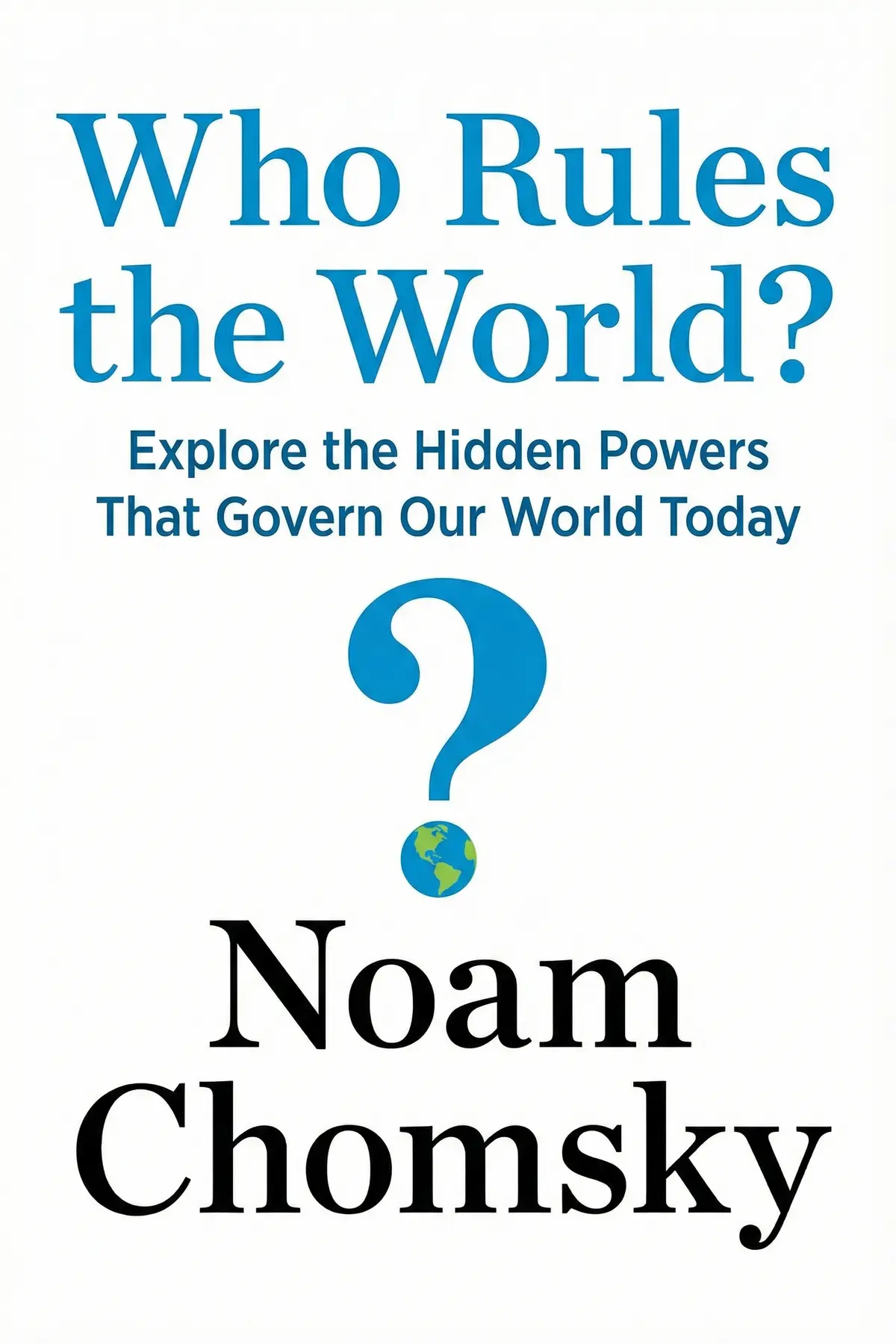
Table of Content
1. Introduction
1 min 04 sec
If world news feels like a stream of heroes and villains you are asked to take on trust, Noam Chomsky offers a sharper way to read it. In Who Rules the World?, the MIT linguist and longtime critic of US foreign policy argues that the same act gets called terrorism or self-defense depending on who commits it, and that this habit of language hides who really holds power.
His answer to the title’s question runs like this. The United States dominated the globe after World War II, and its power has since reached the G7 nations, the World Trade Organization, the International Monetary Fund and other institutions, as well as giant banks and corporations. That looser system, Chomsky argues, serves a narrow elite and treats the common good as an afterthought.
The ideas ahead follow that claim from a coup in Chile to a Citigroup memo to a Soviet officer who refused to fire. What you gain is a set of questions to put to any headline about war, money or rights.
2. Spot the double standard in official stories
2 min 18 sec
One date in September is remembered around the globe. Another, from 1973, saw a US-backed coup topple Chile’s elected government. Putting the two side by side reveals a pattern in how great powers explain themselves.
3. Learn who speaks when headlines say the world
1 min 57 sec
Newspapers often report that the world welcomed a strike or backed a war. Polls taken in other countries sometimes tell a very different story, and the gap says a great deal about whose opinion counts.
4. Spot the double standard behind the word terrorism
2 min 05 sec
A hijacking at sea caused global outrage. A deadlier car bomb in the same region that year drew no such label. Chomsky asks what separates the two, and his answer has little to do with the victims.
5. Follow the money to see who sets policy
2 min 17 sec
After the 2008 crash, most Americans wanted jobs and a fairer tax system, and Washington chose a different agenda. An internal bank memo dividing humanity into two groups helps explain why.
6. Reclaim old rights that power keeps chipping away
2 min 10 sec
A charter signed in 1215 still shapes modern constitutions, and it promised more than most people remember. Chomsky follows two of its protections to see how much of them survives today, and for whom.
7. Understand the clock ticking toward midnight
2 min 03 sec
Scientists keep a clock that measures how close humanity stands to catastrophe, and in 2015 it read three minutes to midnight. One Soviet officer’s decision in 1983 shows how thin the margin can be.
8. Conclusion
1 min 12 sec
Chomsky’s book works like a pair of glasses more than a history lesson. Once you have heard the 1973 coup told beside the 2001 attacks, or the Beirut car bomb beside the Achille Lauro, it becomes hard to read a headline about the world, terrorism or the economy without asking who chose the words. His argument is that the people who choose them, governments, banks and the very rich, rarely choose them for everyone else, and sometimes act against what most people plainly want, as the 72 percent who favored taxing the super-rich found out.
The book supports a few concrete habits. Swap the world in any news report for the actual group behind it, and look for what people elsewhere think. Weigh violence by its victims and by what its planners knew, whoever they were. Follow campaign money when a policy seems to ignore public opinion. And treat old rights, from shared land to fair trial, as protections that hold only while people defend them.
Chomsky ends by handing the job to an engaged public. Stanislav Petrov showed in 1983 that one person who doubts the official signal can change what happens next.
About this book
What is this book about?
Every day the news tells us who the villains are, what the world thinks and which policies are sensible. Noam Chomsky asks who is doing the telling. In Who Rules the World? he argues that the United States came out of World War II as the leading global power, that its influence has slowly declined since then, and that its power is now shared with the other G7 countries and the institutions they control, such as the IMF (the International Monetary Fund) and the WTO (the World Trade Organization). Chomsky builds his case from paired stories: a coup in Chile set beside the 2001 attacks, a hijacking set beside a car bomb in Beirut that no one called terrorism, public opinion after the 2008 crash set beside what Washington actually did. He then turns to old rights, from the Magna Carta to the commons, and to the two threats he sees pushing humanity toward catastrophe, climate change and nuclear weapons. Readers get a provocative argument about where power sits today and a set of questions they can put to any headline about war, money or rights.
Book Information
Who it's for
Doubting the official story
Readers who follow world news and suspect the official story leaves something out.
Students wanting critical analysis
Students of politics, history or media who want a sharp critique of US foreign policy and elite power.
Concerned citizens
Citizens worried about inequality, climate change or nuclear risk who want to know who is making the decisions.
About the Author
Noam Chomsky
Noam Chomsky was born in Philadelphia in 1928 and began teaching at MIT in 1955, after developing transformational grammar at the Harvard Society of Fellows. His 1957 book Syntactic Structures became a landmark in linguistics. Since the 1960s, beginning with his opposition to the Vietnam War, he has been a prominent critic of US foreign policy, and with Edward S. Herman he set out the propaganda model of media criticism in Manufacturing Consent. He is an emeritus professor at MIT and holds a professorship in linguistics at the University of Arizona.
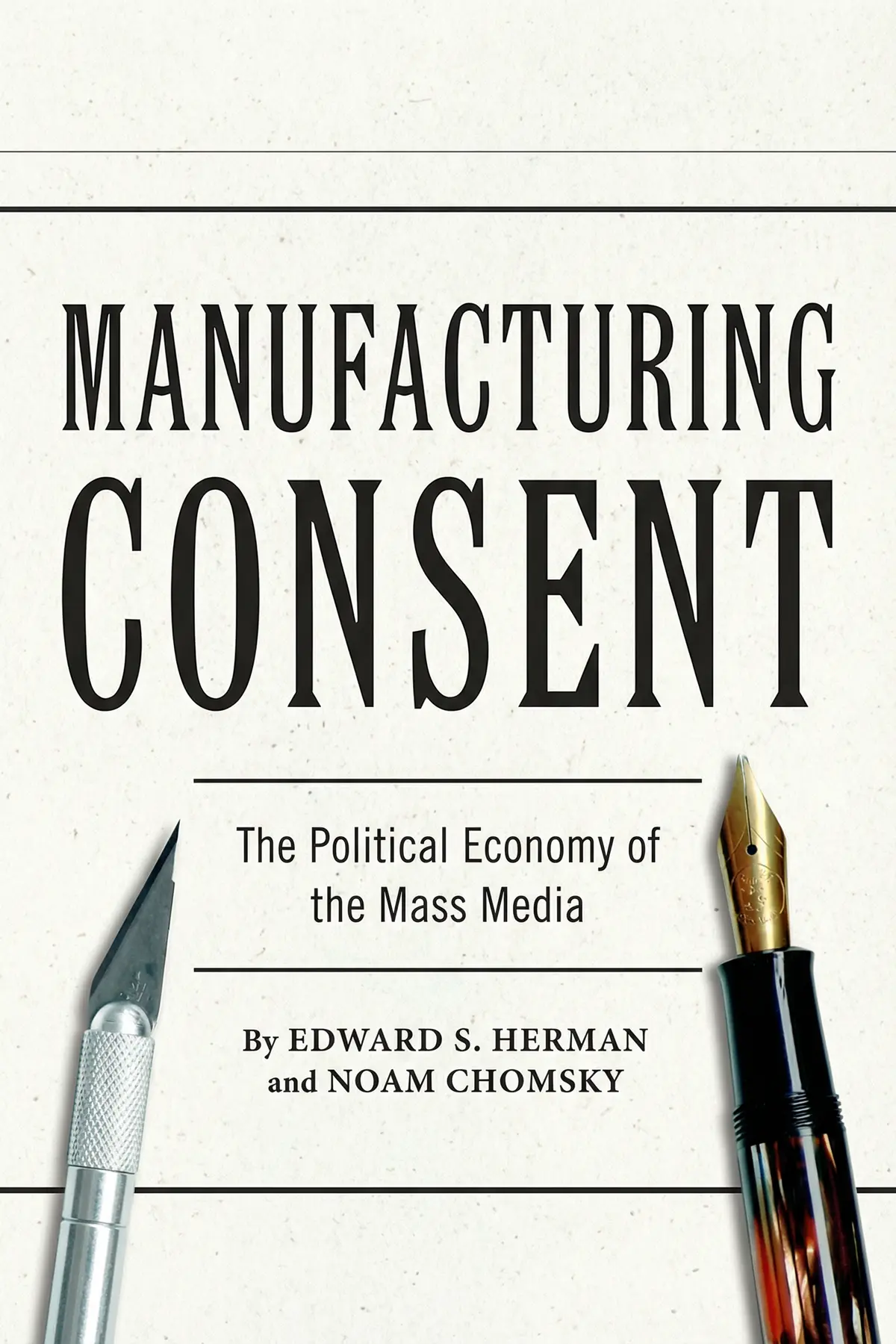
Manufacturing Consent: The Political Economy of the Mass Media
Edward S. Herman
Understanding Power: The Indispensible Chomsky
Noam Chomsky
What Kind of Creatures Are We?
Noam Chomsky
Ratings & Reviews
Ratings at a glance
What people think
Listeners consider this title to be a brief and essential read for Americans, providing profound perspectives that help explain the current global landscape. It is recognized for being thoroughly researched and skillfully composed, with one listener remarking that every chapter is a treasure of information. They value the book's integrity and scholarly substance, finding it truly fascinating. On the other hand, the pacing of the narrative gets mixed reviews.
Top reviews
Sin
This collection of essays serves as a brutal wake-up call for anyone comfortable with the status quo. Chomsky systematically dismantles the illusion of American exceptionalism, replacing it with a grim catalog of "Masters of Mankind" pursuing their own interests at the expense of everyone else. I found the chapter on the 'vile maxim' particularly haunting because it explains so much of the current corporate stranglehold on our democracy. Every chapter is a treasure of information, meticulously researched and presented with a biting, sarcastic wit that I didn't expect from such a serious academic. It is not an easy read by any means, especially when he details the hypocrisy of Western intervention in places like Tunis or Iran. However, it is essential. If you want to understand why the world feels like it's tilting off its axis, you need to read this book. It is a dense but rewarding masterpiece of political analysis.
Show moreNattapong
The chapter detailing 'One Day in the Life of a Reader of The New York Times' is worth the price of admission alone. It is a systematic annihilation of mainstream media hypocrisy that changed the way I look at the morning news. Chomsky exposes the double standards of "the world"—an elite club where independent nationalism is treated like a virus and radical fundamentalism is supported whenever it suits imperial goals. His logic is playful, impish, and absolutely devastating. I was particularly struck by the contrast he draws between the reaction to the invasion of Ukraine versus the ongoing, supported siege in Yemen. It’s uncomfortable. It’s infuriating. But it’s also undeniably truthful. For someone used to the sanitized version of history we get in the West, this book is a necessary shock to the system. It’s well-written, dense with facts, and completely uncompromising. This is a vital contribution to global political literacy.
Show moreBella
Essential is the only word that truly fits here. Chomsky provides a comprehensive source list that allows you to verify every claim, which is necessary because some of the facts he uncovers are truly shocking. The way he describes the "Masters of Mankind" using the national interest as a shield for corporate greed is both logical and depressing. I found the section on the Arab Spring and the restoration of military dictatorships particularly insightful. It’s a treasure of information for anyone who suspects that there’s more to the story than what we see on the nightly news. The writing is sharp and the research is clearly exhaustive. Every American should be required to read this to understand the reality of our role on the international stage. It’s a fascinating, disturbing, and ultimately necessary piece of work. This book doesn't just provide information; it provides a new lens through which to view the entire world.
Show moreGun
If you’re looking for a crash course in why the global power structure looks the way it does, start here. Chomsky is arguably the most important intellectual alive for a reason, and this book proves it. He tackles massive issues like the nuclear threat and the hypocrisy of Western democracy with a level of detail that is both impressive and terrifying. Personally, I think the most important takeaway is how the media creates a false reality that justifies imperialist goals. The examples he gives, from the bombing of Tunis to the logistics support in Yemen, are devastating. This book will make you rethink everything you thought you knew about international relations. It's a well-written, intellectual treasure that challenges you to look at the world without the typical bias. It’s definitely a difficult read because of the subject matter, but it’s one that is incredibly rewarding. Highly recommended for any serious reader of nonfiction.
Show moreIsabella
Have you ever wondered why the mainstream media seems to focus on certain atrocities while completely ignoring others? Chomsky’s breakdown of how "the world" is defined by the political class in Washington and London is eye-opening. To be fair, the pacing can feel a bit disjointed at times since these are essentially separate essays, but the core arguments remain razor-sharp. The historical context regarding the 1953 coup in Iran was a massive revelation for me, showing a direct line to the instability we see today. Truth is, we aren't taught this in school. While his tone is undeniably cynical, it feels earned through decades of observation. I would have given it five stars, but some sections felt slightly repetitive if you've already read his previous work like Manufacturing Consent. Still, it is a highly recommended read for anyone looking to pierce through the veil of modern propaganda.
Show moreSomsri
Picked this up after hearing Chomsky described as a vital intellectual, and it certainly lives up to the reputation for depth. He has a way of connecting the dots between corporate interests and foreign policy that makes you feel like you’re finally seeing the full picture. Look, the book isn't perfect; some chapters are definitely more engaging than others, and the formatting as a collection of essays means you’ll hit some dry patches. However, the insights into how the US maintains hegemony by supporting dictators while claiming to love democracy are chilling. The 2016 election postscript is especially terrifying in hindsight. It’s a concise introduction for those who haven’t tackled his more technical philosophy yet. While I struggled with the dense prose in a few spots, I felt significantly better informed by the end. It's a heavy lift, but one that every citizen should probably attempt at least once.
Show moreGor
I'll admit, Chomsky's 'vile maxim' concept really stuck with me after finishing this. "All for ourselves and nothing for other people"—it explains so much about the lack of action on climate change and the persistent nuclear threat. This book is a deep dive into the hypocrisy of global power dynamics, specifically focusing on how the US and Israel operate with a different set of rules than the rest of the world. To be fair, it can be a very difficult read emotionally. You will likely feel a mix of frustration, anger, and sadness as you realize the scale of injustice being described. The author doesn't just offer opinions; he provides a mountain of evidence and references for further study. My only real complaint is that the tone can be quite dry, making it hard to stay engaged for long periods. Regardless, the intellectual content is top-tier and it’s a must-read for anyone interested in geopolitics.
Show moreTern
To be fair, there are moments where the prose feels slightly repetitive, but the core arguments remain ironclad. Chomsky’s ability to peel back the layers of propaganda is unmatched. I was especially interested in his discussion on how the US prefers radical Islam over secular nationalism when the latter threatens corporate control. It’s a perspective you almost never hear in mainstream circles. The book is well-researched and manages to be quite concise despite the weight of the topics it covers. It’s fascinating to see how the same patterns of intervention repeat themselves from 1953 Iran to modern-day Egypt. Not gonna lie, it's a bit of a downer, but ignoring these truths doesn't make them go away. The pacing is a bit hit-or-miss due to the essay format, but the individual chapters are often brilliant on their own. Definitely worth your time if you want a more nuanced view of world history.
Show moreKet
As someone who generally respects Chomsky's perspective, I found this particular volume to be a bit of a mixed bag. On one hand, his analysis of the "vile maxim" and the corporate architecture of government policy is brilliant and necessary. On the other hand, the book suffers from significant pacing issues. Because it’s a collection of previously published pieces, there is a lot of overlap. You’ll find yourself reading the same statistics about nuclear threats and climate change multiple times across different chapters. Frankly, it could have used a much tighter edit to make it a more cohesive narrative. It's a good reference for specific facts, but reading it cover-to-cover felt like a chore at times. If you’re new to his work, this serves as a decent entry point, but long-time fans might find it a bit redundant. It's a solid three-star effort that offers flashes of brilliance buried under a somewhat repetitive structure.
Show moreAey
Yikes. I really tried to give this a fair shake, but I ended up abandoning the book after just a few chapters. It’s hard to take an author seriously when he blithely equates the morality of a US president with that of a despotic North Korean leader or a literal terrorist. The seething contempt for the United States is so thick it obscures any actual intellectual discourse. Rather than building a coherent argument to convince skeptics, Chomsky seems content to preach to his own echo-chamber acolytes who already agree with every word. Where is the nuance? Where is the balance? It feels more like a long-winded, vitriolic sermon than a serious piece of political science. Honestly, if you're looking for an objective look at world affairs, keep looking. This is little more than hyperbole wrapped in a thin veneer of academic prestige. I found it utterly unconvincing and deeply biased.
Show moreQuestions about this book
What is the main argument of Who Rules the World? by Noam Chomsky?
Chomsky argues that the United States dominated the world after World War II, and that its power has since spread to the G7 nations, to the World Trade Organization, the International Monetary Fund and similar institutions, and to multinational corporations and banks. This looser system, he says, serves elite interests, controls the language used to describe events, and often acts against public opinion and the global good.
What does Chomsky mean by the two September 11s?
He sets the 1973 coup in Chile, backed by the United States, which toppled Salvador Allende and brought General Augusto Pinochet to power, beside the al Qaeda attacks of 2001. Comparing the two, Chomsky argues, exposes a double standard: Washington has supported democracy in some places and crushed it in others, depending on strategic convenience.
How does Chomsky define who gets called a terrorist?
He argues the label depends on who acts. Attacks by groups like Hizbollah are called terrorism, while deadlier actions by states, such as a Beirut car bomb he attributes to the CIA or the Iron Fist campaign in Lebanon, are not. He describes three grades of guilt, and says states usually place their own violence in the milder two.
How can I apply the ideas in Who Rules the World?
Read the news with a few questions. When a report says the world agrees, ask which group is actually meant and check opinion elsewhere. Judge violence by its toll and by what its planners knew. When a policy ignores public opinion, as after 2008 when 72 percent of Americans wanted to tax the super-rich, look at who funds the decision makers.
Readers also enjoyed


Abolish Rent: How Tenants Can End the Housing Crisis
Tracy Rosenthal

Abortion: Our Bodies, Their Lies, and the Truths We Use to
Jessica Valenti

Adults in The Room: My Battle With Europe’s Deep Establishment
Yanis Varoufakis

21 Lessons for the 21st Century
Yuval Noah Harari
A Different Kind of Power: A Memoir
Jacinda Ardern
Age of Anger: A History of the Present
Pankaj Mishra
A Higher Loyalty: Truth, Lies and Leadership
James Comey

Age of Propaganda: The Everyday Use and Abuse of Persuasion
Anthony Pratkanis
AUDIO SUMMARY AVAILABLE
Listen to Who Rules the World? in 15 minutes
Get the key ideas from Who Rules the World? by Noam Chomsky, plus 5,000+ more nonfiction titles.
- 5,000+ titles
- Listen as much as you want
- 7-day free trial
- Cancel anytime









