

13 min 51 sec
Available in: English
Profit Over People: Neoliberalism and Global Order
By Noam Chomsky
Chomsky shows how powerful states, above all the United States, write free-market rules for weaker nations and break them when it pays. He traces the pattern from Latin American coups to the WTO and NAFTA.
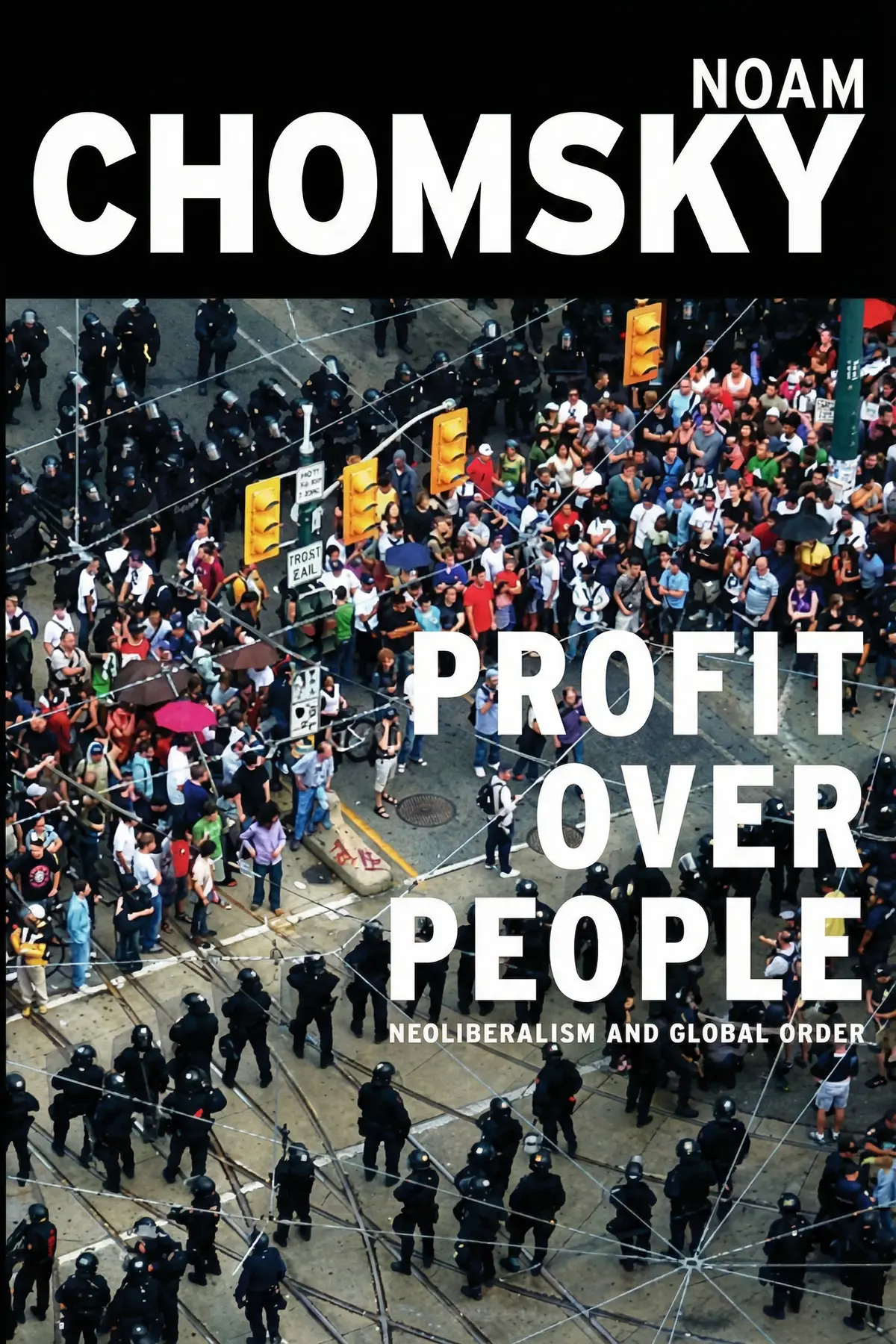
Table of Content
1. Introduction
1 min 03 sec
Most news about trade deals and global institutions comes with the same promise: open the markets, move the government aside, and prosperity will follow. In Profit Over People, the linguist and longtime critic of US foreign policy Noam Chomsky argues that this creed, called neoliberalism, has worked very differently in practice. In his account, powerful states write and enforce the free-market rules, above all the United States. They apply those rules to others and exempt themselves whenever it pays.
His evidence ranges widely. A Guatemalan land reform was crushed in 1954. Indian ironworks were ruined by British imports. Washington refused to accept a World Court ruling, and NAFTA undid Mexican corn farmers. Follow the cases through and headlines about trade, sanctions and global rules start to read differently. The book leaves you with a simple habit for judging any economic policy: ask who wrote the rules, who must obey them and who is allowed to break them.
2. Recognize the free-market creed behind global policy
1 min 56 sec
One set of instructions is handed to struggling countries again and again, and it sounds like pure freedom. Chomsky asks what happens when the promise is checked against the places where it was applied.
3. Understand why Latin American reform governments became targets
1 min 48 sec
Governments that answered their own voters’ demands for better lives were treated as a threat. Chomsky explains what exactly they threatened, and why elected leaders were removed in their name.
4. Spot the protectionist who preaches free trade
1 min 47 sec
India once had a leading iron industry, and then it didn’t. The force that destroyed it was not war or famine but an idea about open markets, applied in only one direction.
5. Follow global power from the UN to the WTO
2 min 01 sec
A trade agreement about phone networks sounds like the dullest document in the world. Chomsky argues it became a lever for rewriting other countries’ laws, and for deciding who controls their communications.
6. Judge a power by how it handles losing
2 min 01 sec
For the first time, an international court ruled against the United States, in a case brought by a small Central American country. What Washington did next says more about its respect for law than any speech.
7. Count the losers before you cheer a trade deal
1 min 58 sec
A trade pact promised growth for three countries. In one of them, small farmers lost their living to cheaper imports, and on the day it began, a rebellion answered it.
8. Conclusion
1 min 17 sec
In the end, Chomsky’s book is an argument about who gets to define freedom. In the history he traces, free markets are a rule the powerful hand to everyone else. Guatemala and Chile lost leaders they had chosen. India lost its iron industry, other countries opened their telecom sectors under US pressure and saw foreign firms gain control, and many small Mexican farmers lost their living to subsidized US corn. When the rules turned against Washington, as they did at the International Court of Justice, the rules were pushed aside.
What the book offers in return is a way of reading the news. Treat any call to let the market decide as a claim you can check against history, starting with how the country making the call grew rich. Pay attention to powerful players at the moment they lose, because that is when their respect for rules shows. And when a trade deal is celebrated, count who pays for it as carefully as you count who gains.
The Zapatistas picked NAFTA’s first day to make their stand. Their uprising won a negotiation, partial autonomy and an audience around the world. It showed that people on the losing side of a rulebook can still answer back.
About this book
What is this book about?
Struggling countries keep hearing the same advice: open your markets, privatize, keep inflation down and let the government step aside. Neoliberalism promises that prosperity follows. Noam Chomsky argues that the record looks very different, and that the rules behind this advice were designed by and for the powerful. He follows the doctrine through some sharp cases. The United States backed coups in Guatemala and Chile. Britain used open markets to ruin India's iron industry while protecting its own. Washington shifted its influence away from the United Nations and toward the World Trade Organization, and it used a telecom agreement to reach into the laws of other nations. It rejected a World Court ruling on Nicaragua, kept a decades-long embargo on Cuba, and pushed NAFTA, which sent subsidized corn into Mexico and left rural poverty rising. Readers get a clear critical lens for economic policy. When a trade deal or an institution is praised, ask who wrote its rules, who has to obey them and who is allowed to ignore them. The book also tells the story of the Zapatistas, who rose up the day NAFTA began.
Book Information
Who it's for
Following trade and sanctions
Readers who follow trade, sanctions and global institutions and want a sharp critical lens on them.
Students wanting policy cases
Students of economics, politics or development looking for clear cases of policy against outcome.
Professionals asking who benefits
Professionals who hear free-market promises and want to test who actually benefits.
About the Author
Noam Chomsky
Noam Chomsky was born in Philadelphia in 1928 and earned his doctorate in 1955, after developing transformational grammar at the Harvard Society of Fellows. He began teaching at MIT that year, and his 1957 book Syntactic Structures became a landmark in linguistics. Since his opposition to the Vietnam War in the 1960s, he has been a prominent critic of US foreign policy. With Edward S. Herman he set out the propaganda model of the media in Manufacturing Consent. He is an emeritus professor at MIT and a professor of linguistics at the University of Arizona.
Manufacturing Consent: The Political Economy of the Mass Media
Edward S. Herman
Understanding Power: The Indispensible Chomsky
Noam Chomsky
What Kind of Creatures Are We?
Noam Chomsky
Who Rules the World?
Noam Chomsky
Ratings & Reviews
Ratings at a glance

What people think
Listeners find this volume to be a classic must-read that offers deep insights and sharpens awareness, viewing it as one of Chomsky’s premier works. The writing is skillfully composed, and listeners call it eye-opening, including one who points out how it encourages people to broaden their outlook. However, reactions to the book's simplicity are varied, as some find it accessible while others consider it intricate. Furthermore, several listeners have reported the presence of typographical errors throughout the text.
Top reviews
Maksim
Chomsky’s 'Profit Over People' is an absolute classic that should be mandatory reading for anyone trying to understand the global landscape. It offers a piercing look at how neoliberalism prioritizes corporate gains over human well-being, widening the gap between the elite and everyone else. While some find his style complex, I thought it was incredibly eye-opening and helped me expand my thinking on international trade. The way he discusses the erosion of democracy is frankly terrifying but essential for any informed citizen today. I did notice a few typos in this edition, which is a bit distracting for such a prestigious work, but the content remains top-tier. If you want to understand the modern world, start here.
Show moreTang
Ever wonder why the world feels like it's built for corporations instead of actual human beings? This book provides the answers in a way that is both intellectually stimulating and emotionally resonant. Chomsky is at his best here, dismantling the myth that neoliberalism is about freedom or democracy. It’s actually about control and the transfer of wealth to a tiny elite. The insights provided are a masterclass in political literacy, forcing you to question everything you hear on the nightly news. Personally, I found the section on the WTO and telecommunications to be a real lightbulb moment for understanding globalization. It’s one of those rare books that completely reconfigures your brain and how you process current events.
Show moreArt
Picking this up feels like taking the red pill; it completely changes how you view US involvement in countries like Haiti and Colombia. Chomsky doesn't pull any punches when he describes how 'aid' is often just a tool for expanding corporate reach at the expense of local communities. The way he connects the dots between Reagan-era policies and the trade wars of the late 90s is brilliant. Some might say his analysis of the WTO is dated, but the underlying mechanisms of power he describes haven't changed one bit. It’s an eye-opening experience that makes you realize how much of our history is sanitized for public consumption. This is essential reading for the 21st century.
Show moreOksana
Finally got around to this collection of essays, and it certainly lived up to its reputation of being an eye-opening deep dive. Chomsky manages to pull back the curtain on the 'free market' rhetoric used by the US to justify some pretty questionable interventions. I was particularly struck by the analysis of how these policies impact developing nations, specifically the examples regarding Haiti. The writing is sharp, though it occasionally feels like a series of disjointed articles rather than a fluid narrative. My only real gripe is that some of the references to 90s-era trade deals feel a little bit dated in the current geopolitical climate. Still, the core principles of his critique are as relevant today as they were twenty years ago.
Show moreTuck
As someone who is relatively new to political theory, I found Chomsky’s breakdown of how neoliberalism functions surprisingly accessible. Many people warned me that his writing was dense, but I actually found it to be quite straightforward and punchy. He has a knack for taking complex economic jargon and translating what these policymakers are REALLY saying behind closed doors. The focus on the 'democratic deficit' is especially poignant given the state of politics today. I did notice several typos throughout the text which was a bit annoying for a professional publication. Regardless, the knowledge gained far outweighs the minor editing flaws found in this specific printing. It’s a great starting point for anyone wanting to see past the media spin.
Show moreKai
Not what I expected given the heavy title, but the writing style is actually quite straightforward and persuasive. I’ve always been skeptical of the 'invisible hand' of the market, and Chomsky provides the data to show why that skepticism is justified. He distinguishes between the rhetoric of capitalism and the reality of state-sponsored corporate welfare. It’s a bit of a grim read at times, especially when he discusses the exploitation of third-world resources. However, the ending offers a bit of hope by showing how grassroots movements successfully fought back against the MAI. It reminds us that people still have power if they choose to use it. Definitely a solid addition to any political library.
Show moreSupatra
This book is a masterclass in exposing the contradictions between the rhetoric of 'free markets' and the reality of state-protected corporations. Chomsky is incredibly effective at showing how the rules are rigged to ensure that profits always come before people. While I found the introduction by McChesney to be a bit dry, the rest of the book is high-energy and deeply informative. It’s a classic work that helps people expand their thinking beyond the narrow corridors of mainstream political thought. Some of the formatting in this edition is a little wonky, and the index is basically useless, but the core message is too important to ignore. It’s a must-read for anyone who suspects the system isn't working for them.
Show moreJackson
The chapter on the Multilateral Agreement on Investment (MAI) was definitely the standout for me, but the rest felt a bit recycled. I’ve read a lot of Chomsky, and if you’ve seen his lectures, you’ll recognize most of these arguments immediately. It’s essentially a compilation of pieces, which makes it feel a bit repetitive at times. To be fair, he makes excellent points about the hypocrisy of 'liberalization' when it only benefits the powerful. However, I was hoping for a more comprehensive critique of economic theory itself rather than just a laundry list of the effects. It’s a good introduction for a beginner, but seasoned readers might find it lacking in fresh insights.
Show moreDimitri
In my experience, Chomsky is usually a bit more rigorous, but this volume feels like a bit of a 'greatest hits' collection. Don't get me wrong, the insight into business-government collusion is still better than 90% of what's on the shelf. But I found myself wanting more contemporary examples and a bit less jumping around between unrelated historical anecdotes. The analysis of globalization is starting to show its age, particularly the predictions about telecommunications markets that didn't quite pan out as expected. It’s still a decent read for the historical context, but it shouldn't be the only book you read on the subject. It’s simple enough for a casual reader but might frustrate those looking for a deep academic dive.
Show moreSureerat
Look, I appreciate the message, but this book is essentially just a compilation of older articles rather than a cohesive new work. I feel like I paid for a brand name rather than new research, which is a bit disappointing. The introduction by McChesney also feels strangely disconnected from the rest of Chomsky’s prose, almost like they were written for different audiences. While the critique of corporate domination is valid, the book spends way too much time on James Madison and historical quotes that don't always feel applicable to modern tech monopolies. Truth is, there are better books out there, like Korten’s work, that cover these topics with much more depth and structure. It's not awful, but it's certainly not his best.
Show moreQuestions about this book
What is the main idea of Profit Over People by Noam Chomsky?
Chomsky argues that neoliberalism, the doctrine that governments should step aside and let markets decide, is applied selectively by powerful states, above all the United States. They press free-market rules onto weaker countries and ignore rules that go against them. As a result, in his view, policies sold as bringing prosperity mostly serve profit and power. He traces the pattern through Latin America, British India, the WTO and NAFTA.
What is the Washington consensus in Profit Over People?
It is the set of market principles that the US government and international financial institutions promoted for developing nations: open trade, prices set by the market, inflation control and privatization, all under the message that government should step aside. The aim it announced was faster growth, though no group ever formally adopted it. Chomsky argues that imposing it on vulnerable societies did serious harm.
What does Chomsky say about NAFTA and Mexico?
He argues that NAFTA, which began in 1994, failed Mexico. Subsidized US corn undercut small Mexican farmers, many lost their livelihoods, and the country grew more dependent on food imports. Between 1990 and 2000, the number of rural Mexicans in extreme poverty rose by almost a third. The Zapatistas rose up in Chiapas on the day the agreement took effect and forced the government to negotiate.
How can I apply the ideas in Profit Over People?
Use the book as a set of questions for any economic policy. Ask who designed the rules and who had to accept them. Check what the country recommending free markets did on its own way to wealth, as Britain did before ruining India’s iron industry. Watch how powerful actors respond when a ruling goes against them. And count who loses from a trade deal as well as who gains.
Who should read Profit Over People?
It suits readers who want to look critically at globalization, trade agreements and institutions like the WTO. Students of politics, economics and development get compact cases, from the 1954 coup in Guatemala to Nicaragua’s case at the International Court of Justice. Anyone who distrusts the promise that open markets always help the poor will find a clearly argued counterpoint.
Readers also enjoyed


A River in Darkness: One Man’s Escape from North Korea
Masaji Ishikawa

A Splendid Exchange: How Trade Shaped the World
William J. Bernstein

A Theory of Justice
John Rawls






A Warning
Miles Taylor
AUDIO SUMMARY AVAILABLE
Listen to Profit Over People in 15 minutes
Get the key ideas from Profit Over People by Noam Chomsky, plus 5,000+ more nonfiction titles.
- 5,000+ titles
- Listen as much as you want
- 7-day free trial
- Cancel anytime









