
Manufacturing Consent: The Political Economy of the Mass Media
Edward S. Herman
 English
Noam Chomsky tests America's claim to defend democracy and law against its record, from UN privileges and Cuba to Iraq and ignored public opinion, and gives readers simple questions to apply to any government.

1 min 00 sec
If you follow world news, you hear one country call itself the guardian of freedom and law, and you may struggle to match that with what it does. In Failed States, linguist and longtime foreign policy critic Noam Chomsky argues the mismatch runs deep. The United States, he says, praises democracy in its speeches while its real decisions, abroad and at home, follow economic and strategic interest. By the standard Washington applies to others, it counts as a failed state itself.
Chomsky builds the case from specific episodes: a UN aid program through which a dictator collected $1.8 billion in kickbacks, a sanctions office that chased Cuban transactions far harder than terrorist money, a bombed clinic in Fallujah. Each one carries a test you can reuse on any government’s claims, beginning with the simplest: whether it would accept its own rules if a rival used them.
1 min 50 sec
The United Nations looks like a parliament where every country gets a voice. A multibillion-dollar aid scandal and a quiet dispute over one word suggest that some members play by a very different rulebook.
1 min 52 sec
A doctrine that lets a country strike first sounds reasonable when your own side uses it. Chomsky hands the same doctrine to Cuba and to the Taliban, and the results are uncomfortable.
1 min 49 sec
Two threats could end human civilization, and one superpower has the means to reduce both. Chomsky explains why it keeps declining, and his explanation has little to do with doubt about the danger.
2 min 06 sec
An office that investigates money transfers suspected of funding terrorism had 120 employees in April 2004. Counting what they actually worked on reveals which enemy Washington feared more, and the answer is not the one in its speeches.
1 min 42 sec
An American cabinet secretary stood at a pipeline ceremony and praised a government’s progress toward a just, democratic society. A New York Times article that ran just before told a story the speech left out.
1 min 57 sec
Washington called for Palestinian elections only after one particular leader had died. Chomsky asks why the timing mattered, and finds the same logic behind decades of rejected two-state plans.
1 min 50 sec
The Iraq war was sold as a clean break that would bring democracy. One offensive in one city, with sealed exits and a bombed health center, tests that promise against what actually happened.
1 min 50 sec
The term failed state was built to describe distant, broken countries. Chomsky reads the Bush administration’s own expanded definition closely and finds a country that fits it much closer to home.
1 min 09 sec
Chomsky’s book works like a mirror held up to a superpower. Each case, from the torture definition to the Cuban fines to the Fallujah clinic, takes a standard Washington set for others and asks whether Washington meets it. His answer, again and again, is that democracy and law supply the vocabulary while economic and strategic interest makes the decisions. A country whose policies ignore its own citizens, he concludes, has a democracy deficit by its own definition.
You do not have to accept every judgment to use the method. Turn any claimed right around and picture a rival using it. Follow staff, fines and budgets, the way the Cuba figures did, with $8 million in Cuba-related fines set against $9,000 from terrorism cases. Notice when support for an election or a peace plan begins, and what changed just before. And measure your own government by whether its actions match what its people say they want.
The phrase failed state was coined to describe other countries. Chomsky’s lasting move is to read the definition carefully and point it home.
American leaders often describe their country as the world's guardian of freedom, a police officer for liberty wherever it is threatened. Noam Chomsky argues that the record tells a different story. As he sees it, American foreign policy often leaves the world more brutal and less just, while the language of democracy mostly masks a drive for economic and strategic gain. Chomsky builds his case from specific episodes. A permanent Security Council seat that shields Washington from sanctions. A torture definition far narrower than the Geneva Convention's. A sanctions office that collected $8 million in Cuba-related fines and $9,000 from terrorism cases. Praise for Azerbaijan's democracy while its police beat protesters. Blocked two-state plans for Israel and Palestine, and a Fallujah offensive that bombed a health center. He ends at home. When polls show Americans want something and the government does the opposite, he argues, the country has a democracy deficit, which under the Bush administration's own expanded definition makes it a failed state. Readers get a sharp argument and a set of reusable tests for judging what any government says against what it does.
Readers who follow world news and want sharper tests for official foreign policy claims.
Students of politics, international relations or law looking for a forceful critique of US power.
Anyone who wonders why government action so often drifts away from public opinion.
Noam Chomsky was born in Philadelphia in 1928 and earned his doctorate in 1955 after developing transformational grammar. He began teaching at MIT that year, and his 1957 book Syntactic Structures became a landmark in linguistics. Since opposing the Vietnam War in the 1960s, he has been a prominent critic of US foreign policy, and with Edward S. Herman he set out the propaganda model of media criticism in Manufacturing Consent. He is an emeritus professor at MIT and also a professor of linguistics at the University of Arizona.
Edward S. Herman
Noam Chomsky
Noam Chomsky
Noam Chomsky
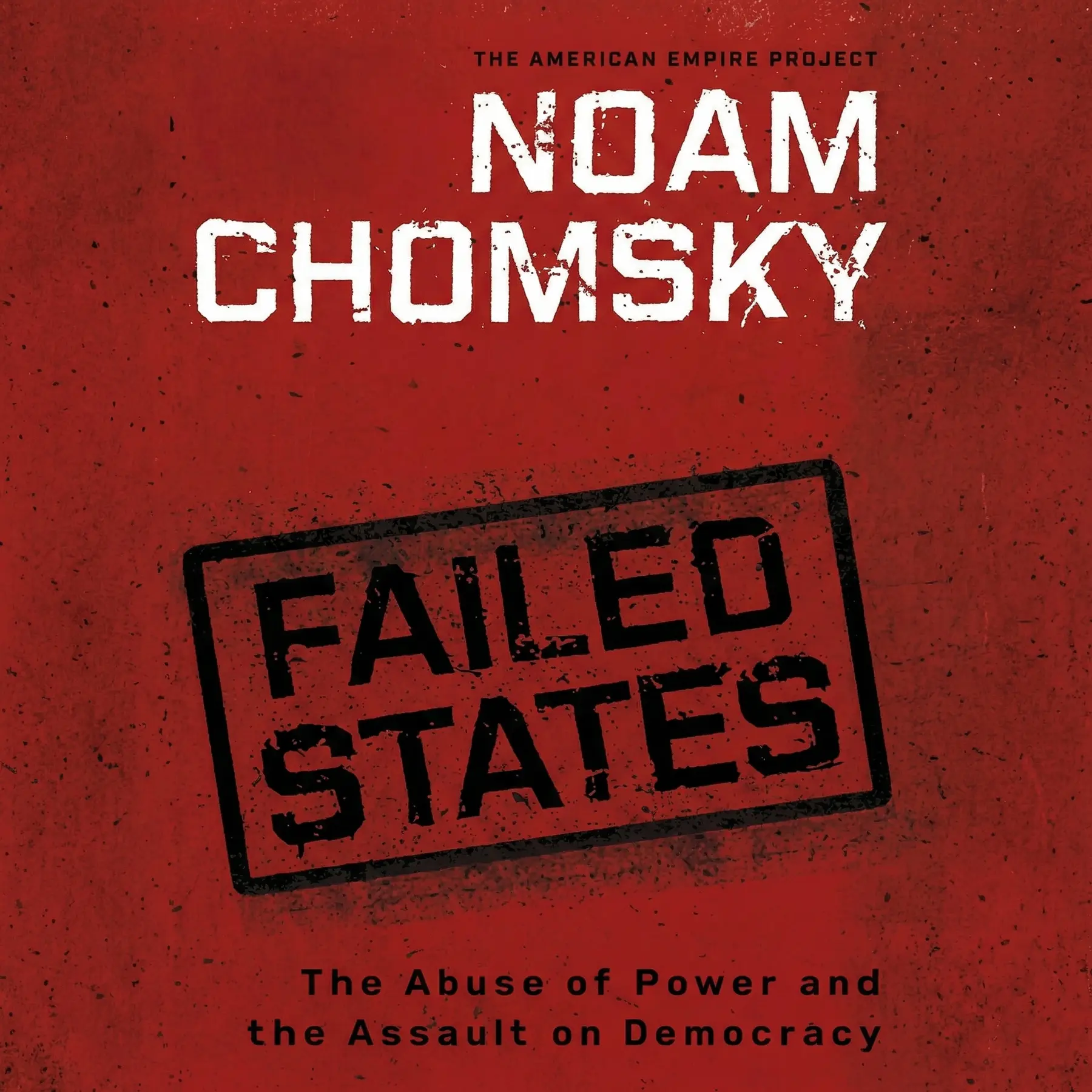
Listeners find the work both educational and revelatory, with one individual pointing out how it meticulously establishes a factual basis. Furthermore, the writing is considered deeply intellectual, prompting listeners to reconsider government policies. On the other hand, the ease of consumption gets varied responses, as some struggle with the content initially. Perspectives on the book's precision and narrative direction are also divided; one listener characterizes it as a devastating polemic against the U.S., while another feels it is lacking focus.
Finally got around to this classic critique, and it remains disturbingly relevant even decades after the Bush era. Chomsky’s central argument is devastatingly simple: the United States routinely flouts the very democratic principles it claims to champion globally. His thesis isn't just a loud polemic; it is methodically constructed with an abundance of evidence that makes you question the 'official' history we are fed daily. The synthesis of global power relations and the unpacking of how aggression is framed as 'freedom' provides a sound foundation for understanding modern imperialism. I found his analysis of the two existential threats—nuclear proliferation and environmental catastrophe—to be particularly chilling. Even if you find his prose a bit dry or forensic, the moral balance sheet he presents is impossible to ignore. This is an essential audit of power that demands a response from any thinking citizen.
Show moreAfter hearing so much about the 'Failed States' thesis, I was surprised by how forensically Chomsky dismantles the narrative surrounding the Iraq War and WMDs. He highlights a glaring contradiction: while the administration claimed there were no weapons, equipment for developing them—provided by the West in the 80s—was being looted and moved across the Jordanian border in truckloads. It’s this kind of detail that makes his work so dangerous to the status quo. He isn't just shouting at the wind; he is citing the IAEA and high-precision equipment logs. The chapter 'Illegal but Legitimate' regarding Kosovo is particularly eye-opening, showing how much of our history is written backwards to justify intervention. This book isn't just about foreign policy; it’s a terrifying look at how sovereignty is used as a shield for the powerful while being denied to the weak.
Show moreThe chapter on the assault on democracy within the United States itself was a total revelation. We often talk about 'bringing democracy' elsewhere, but Chomsky points out the massive disjunct between what the American public wants—like universal health care or reliance on the UN—and what the political elite actually delivers. He argues that corporatism has perverted the democratic process to the point where the electorate’s views are almost entirely ignored by both major parties. This internal decay is what really justifies the 'failed state' label in his eyes. The book is a devastating polemic, but it’s backed by public opinion surveys and legislative records that are hard to refute. It makes you realize that the threat to our way of life isn't just external; it's baked into the way our institutions currently function. It’s gut-wrenching, brilliant, and absolutely necessary for understanding the 21st century.
Show moreTruth is, the sheer volume of obscure journals and technical literature cited here is staggering, even for a Chomsky book. He is relentless in his pursuit of truth, refusing to let the reader look away from the debacles of the Bush II years. This isn't just a book about the past; it’s a warning about the future of a superpower that believes it can write its own rules. The focus on how we have been lied to regarding WMDs and 'altruistic' interventions is handled with a surgical precision that is rare in modern political writing. Personally, I found the analysis of the 'War on Terror' to be the most enlightening section, as it connects U.S. support for global terror to its own stated goals of smashing competition. It is an informative, thought-provoking, and ultimately essential read for anyone trying to make sense of a world that often seems to have lost its way.
Show moreReading Chomsky is a workout for your conscience that often leaves me feeling washed out and despondent. He presents the failures of our system so vividly that it becomes impossible to hide behind the comfortable lies of mainstream news programs. The most frightening aspect of this work is that he doesn't rely on conspiracy theories; he shows how the system is self-correcting and maintains its own trajectory of exploitation. This book feels even more urgent than Naomi Klein’s work because it suggests a level of domestic decay that we are trained to overlook. Truth is, we have become the very Winston Smiths that Orwell warned us about, accepting legal end-runs as standard procedure. My only minor gripe is the readability, as the sheer volume of data can feel overwhelming at first. However, the insight into how public opinion is curtailed is worth the effort.
Show moreAs someone who lives outside the American bubble, Chomsky’s dissection of US foreign policy feels like a necessary antidote to the polished narratives of the state department. He pulls no punches in describing how the U.S. government views international law: as something that is fine, provided it comes out the right way. The book makes a compelling case that the 'War on Terror' has actually increased the risk of global instability. I especially appreciated the sections on how the U.S. rejects the jurisdiction of the International Criminal Court. While I don't always agree with his structural determinism, his ability to track the systemic incentives for power is unparalleled. It’s a dense read and can be quite depressing, but it provides a perspective that is rarely allowed in polite political conversation. Highly recommended for those who want to see under the hood of the empire.
Show moreTo be fair, I don’t always align with Chomsky’s specific brand of political philosophy, but his audit of American hypocrisy in 'Failed States' is airtight. He methodically traces how the U.S. claims the right to attack any country it deems a potential threat while exempting its own nuclear facilities from international inspection. The irony is blinding. He isn't interested in romantic revolution; he’s performing a cool, forensic unpacking of how democracies start to mimic the authoritarian regimes they supposedly oppose. The writing is dry and can be difficult to get through at first, but the rewards are worth the effort. It forces you to confront the enormity of the issues we face, from nuclear proliferation to the erosion of civil liberties at home. Even if you only agree with half of it, the half you agree with will keep you up at night.
Show moreLook, the research here is undeniable, but the prose style is a massive slog for the average reader. Chomsky is a master of the forensic detail, yet he often gets lost in a meandering array of figures that can make the book feel lacking in focus. I appreciate the effort to define the U.S. through the lens of a failed state—specifically its inability to protect citizens and its habit of bypassing international law—but the delivery is often too dry. To be fair, if you aren't paying close attention, you’ll miss the subtle irony he uses to dismantle government propaganda. It’s a thought-provoking read, but it requires a level of patience that many might not have. It’s informative, sure, but I wouldn't call it an easy or particularly engaging experience for someone new to political theory.
Show moreEver wonder if a book can be too right for its own good? Chomsky is clearly brilliant, but his tone can be so dismissive and sarcastically heavy that it risks alienating anyone who isn't already a devotee. He spends a lot of time on rhetorical chicanery, trying to trap the reader in a web of facts that sometimes feel like they are being used to bludgeon the 'imperialists' rather than to invite a genuine dialogue. The premise that America is a failed state is a fascinating intellectual exercise, but in practice, he stretches the definition to its breaking point. Not gonna lie, the middle chapters felt repetitive, essentially echoing his previous work like 'Hegemony or Survival.' It’s an eye-opening book if you can get past the author's apparent lack of intellectual honesty regarding his own biases. Use it as a starting point, but keep your skepticism high.
Show moreThis book fills me with a blank uneasiness that I find hard to shake. Noam Chomsky is clearly a gifted thinker, but his worldview has become so rigidly consistent that it borders on the surreal. At this point in his career, he feels like the Jimmy Buffett of the far left; he keeps packing in the crowds without ever really changing his set list. You get the same numbing array of facts, the same quotes from obscure journals, and the same scathing denunciations of American perfidy. While the research into the Bush years is deep, the central conceit—that the U.S. is the new Somalia—feels like an exercise in rhetorical magic rather than a functioning political analysis. Frankly, his self-serving definition of a 'failed state' ignores the most basic requirement: that a state must actually stop functioning. It’s a dense, predictable slog that will only satisfy those already converted to the cause.
Show moreChomsky argues that the United States presents itself as the defender of democracy and international law, while its actual policies serve economic and strategic interests. He supports this with cases ranging from UN privileges and the Oil-for-Food kickbacks to Cuba, Azerbaijan, Israel and Palestine, and Iraq. Because US policy often ignores what Americans want, he concludes the country has a democracy deficit and fits the Bush administration’s own expanded definition of a failed state.
Originally the term described a government that had given up basic duties, like keeping its citizens safe or delivering public services. Under Bush it was widened to include states with a democracy deficit, lacking institutions that turn the public’s wishes into policy. Chomsky points to issues where majorities of Americans held clear views, such as the Kyoto Protocol and a leading role for the UN, while the government did the opposite.
Chomsky describes decades of hostility after Fidel Castro took power in 1959, including an embargo and sabotage of plantations, factories, docks and ships. His sharpest evidence is the Office of Foreign Assets Control: in April 2004 only four of 120 staff tracked bin Laden and Saddam Hussein’s finances, while almost two dozen worked on Cuba. Cuba-related investigations produced $8 million in fines, terrorism cases $9,000.
The book offers reusable tests. Turn any claimed right around and imagine a rival using it, as Chomsky does with anticipatory self-defense. Judge priorities by staff and budgets instead of speeches. Notice when a government starts backing an election or peace plan and what changed just before. And compare what a government does with what clear public majorities say they want.
It suits readers who follow international news and want a critical framework for judging official claims, and students of politics, international relations or law who want to see a forceful critique of US foreign policy built from specific cases. Readers interested in why government action can drift from public opinion will find Chomsky’s closing argument about the democracy deficit especially relevant.


Barack Obama

Masaji Ishikawa

John Rawls



Miles Taylor


AUDIO SUMMARY AVAILABLE
Get the key ideas from Failed States by Noam Chomsky, plus 5,000+ more nonfiction titles.









