

11 min 21 sec
Available in: English
 ไทย
EnglishไทยUnfu*k Yourself: Get Out of Your Head and into Your Life
Shows how the running commentary in your head keeps you stuck. It offers five blunt assertions, plus a push to act despite doubt, for excuses, old beliefs, crises, fear of the unknown and shaky confidence.
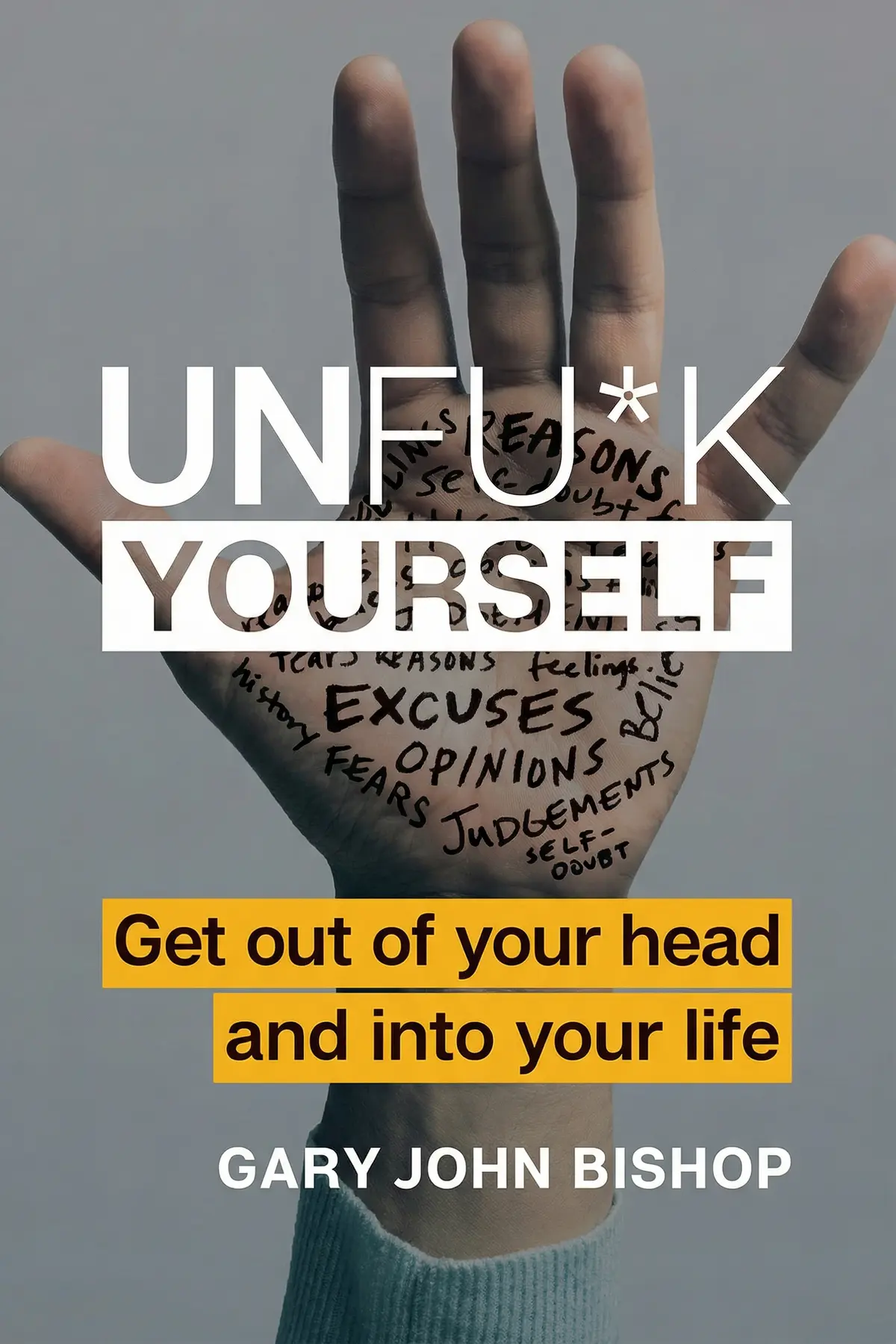
Table of Content
1. Introduction
1 min 00 sec
If you feel stuck, the person keeping you there is probably the one you talk to most, and that person is you. In Unfu*k Yourself, Glasgow-raised coach Gary John Bishop estimates that we have around 50,000 thoughts a day, many of them running as a private conversation with ourselves. That inner voice sizes you up in the mirror, talks you out of approaching a stranger, and second-guesses the email you are about to send.
Bishop’s argument is blunt. Change how that voice speaks, and you change what you are willing to do, and so what your life becomes. He offers short assertions to say to yourself, each aimed at a different trap: excuses, old beliefs, crises and fear of the unknown. The last one goes further, because some days the voice will not budge and you have to move anyway. What you get is a sentence for each moment you usually stall in, and a reason to stop waiting until you feel ready.
2. Turn every excuse into a choice you can change
1 min 51 sec
A dead-end job and a partner who never washes up seem like things that simply happened to you. One small word in the way you explain them suggests otherwise, and it is a word you probably use every day.
3. Stop winning at the game you hate
2 min 02 sec
A man who wants love more than anything finds it, then watches it fall apart again. Bishop says he did not fail at all. He succeeded, and the thing he succeeded at explains a lot about your own repeating patterns.
4. Face a crisis with your own track record
1 min 59 sec
Positive thinking will not stop a breakup, a hospital stay or an empty bank account. Bishop accepts that, then offers a mental exercise on a railroad track that changes how big the latest disaster looks.
5. Quit craving certainty and open your life to growth
1 min 46 sec
Checking the forecast or the latest poll feels like a harmless habit. Bishop treats it as a sign of a craving that quietly blocks new friends, bold ideas and the experiences you say you want most.
6. Act first and let confidence catch up
1 min 43 sec
After teaching you to change your thoughts, Bishop admits that on the worst days none of it works. His fallback is simple, and an invitation to speak at a big conference shows why it holds up.
7. Conclusion
1 min 00 sec
Unfu*k Yourself rests on a plain claim: the person most often standing between you and the life you want is you, speaking in your own voice. Bishop does not promise that the voice will turn kind for good. He offers a few short sentences to interrupt it, and permission to act when it refuses to cooperate.
What makes the approach usable is how small each step is. Catch the word but the next time you explain why you cannot change something, and treat it as a sign you have not yet decided. Look at the pattern you keep repeating, the way Jack kept ending up alone, and ask what belief it is proving. When a crisis hits, walk the railroad track in your mind and count what you have already come through. And when the doubts are loud, do the thing anyway, because having done it is what changes the voice later.
The conference talk is the image to keep. The fear never fully left. The speaker stood up, spoke, and walked off the stage with proof for next time.
About this book
What is this book about?
Most people who feel stuck blame the situation: the job market, a partner, bad luck, a lack of time. Gary John Bishop points somewhere less comfortable. You spend more time talking with yourself than with anyone else, and that private conversation decides what you are willing to try. Bishop's approach is direct and has no frills. He gives a short assertion for each trap that keeps people where they are. One is for the excuses that start with but. One is for the old beliefs we keep proving true, like a man named Jack who keeps confirming he is unlovable. One is for crises that threaten to swamp everything else, and one is for the craving for certainty that blocks anything new. Then he turns on his own method and argues that actions matter more than thoughts. Readers get a simple vocabulary for the moments they usually stall in, a railroad track visualization for putting hard times in perspective, and a clear permission to stop waiting until they feel confident before they act.
Book Information
Who it's for
Waiting for perfect timing
People who keep explaining why now is not the right time to change jobs or relationships.
Stuck in repeating patterns
Anyone stuck in a repeating pattern, from procrastination to failed romances.
Professionals doubting themselves
Professionals whose self-doubt makes them turn down talks, pitches and new opportunities.
About the Author
Gary John Bishop
Gary John Bishop grew up in Glasgow, Scotland, and worked as a senior program director at a large personal and professional development company. His coaching and writing follow an approach he calls urban philosophy, which is direct and has no frills. He is a best-selling author, and Unfu*k Yourself brought him wide recognition. His other books include Do the Work and Love Unfu*ked.

Ratings & Reviews
Ratings at a glance
What people think
Listeners find the content simple to digest and easy to track, offering actionable tips that spark a new outlook on their personal journeys. They also emphasize its power to motivate, labeling the work as both life-altering and inspiring, while one listener shared that it guided them through a particularly hard phase. The caliber of the writing is another highlight, with one listener even calling the text pure poetry. On the other hand, the book’s speed draws varied opinions, as some enjoy the no-bullsh*t delivery while others find it stupid.
Top reviews
Naomi
Finally got around to this after seeing the title everywhere, and I have to say, it’s pure poetry in its bluntness. While other authors want to coddle your inner child, Bishop is here to tell you that your thoughts are mostly white noise and only your actions define your reality. This book was life-changing for me during a particularly dark month where I felt completely paralyzed by my own anxiety. The prose is lean and mean, cutting out the fluff that usually bogs down the self-help genre, which makes it incredibly easy to follow. Not gonna lie, I needed to hear that I am responsible for my own situation regardless of how unfair life feels. It is an inspirational manifesto for the cynical soul who is tired of the 'power of positive thinking' movement and just wants results.
Show moreSelin
Look, if you are tired of the 'law of attraction' hippie nonsense, Gary John Bishop is exactly the wake-up call you have been waiting for. This isn't about making a vision board and waiting for the universe to provide; it's about the relentless pursuit of your goals through grit and action. I loved the distinction he makes between your thoughts and your actions because it allows you to feel like crap while still getting your work done. In my experience, waiting for the 'right mood' is the fastest way to fail, and this book hammers that point home with glorious Scottish intensity. The pacing is fast, the chapters are short, and the message is loud enough to drown out your own excuses. It’s the kind of book you keep on your nightstand for those days when you feel like being lazy and need a mental slap.
Show moreLucas
Ever wonder why you keep making the same excuses while your life stands still for years on end? This book identifies those internal barriers with surgical precision and then proceeds to blow them up with a heavy dose of reality. Personally, I found the chapter on embracing uncertainty to be the most profound because we often spend our lives waiting for a 'sure thing' that never actually arrives. Bishop’s style is punchy and direct, which makes the 200 pages fly by in a single sitting. It helped me through a tough time by reminding me that my feelings are secondary to my actions. You don’t have to feel like a winner to act like one, and that realization is incredibly freeing for anyone prone to overthinking. It's a spectacular guide to getting out of your own way and finally living with some actual intention.
Show moreUdom
In my experience, the best advice is usually the stuff you already know but refuse to hear because it hurts your ego. Gary John Bishop isn't interested in protecting your feelings; he wants to dismantle the cage of self-doubt you’ve built for yourself. The assertions in this book, particularly 'I am not my thoughts, I am what I do,' provide a powerful framework for anyone struggling with a loud inner critic. It's an easy, motivational read that feels like a long, honest talk with a friend who won't let you get away with your usual crap. Some might find the tone 'stupid' or overly simplistic, but for me, that simplicity is where the power lies. I felt energized and ready to tackle my to-do list the second I finished the last page. If you need a life-changing perspective shift, this is it.
Show moreMingkwan
This book is basically a conversational slap from the universe designed to wake you up from a self-imposed slumber. Gary John Bishop brings what people are calling 'urban philosophy' to the masses, stripping away the flowery language of traditional stoicism and replacing it with raw, blunt assertions. Frankly, the chapter on being 'wired to win' changed how I view my own failures because it suggests we are always winning at something, even if it's just winning at being miserable. The advice is simple, perhaps even basic to some, but the delivery is what makes it stick in your brain during a morning commute. I found the repetitive nature of the seven assertions helpful for internalizing the message, though I can see why it might grate on others. It’s not a deep psychological treatise, but it’s an effective kick in the pants for anyone stuck in a rut.
Show moreNiphon
What I appreciated most was the focus on being 'wired to win' in your own current mess of a life. Bishop argues that if you’re broke, you’re currently 'winning' at being broke because you’ve subconsciously prioritized comfort over the discomfort of change. That perspective shift is uncomfortable but necessary for anyone who feels stuck in a loop of negative self-talk and stagnation. The writing quality is surprisingly high for a book with a curse word in the title, and the logic flows logically from one assertion to the next. I’ll admit that some parts felt a bit repetitive, and he definitely has some blind spots regarding people in truly dire circumstances. Still, for the average person sitting on their couch complaining about their life, this provides a very practical roadmap for change. It’s a no-bullsh*t approach that values movement over meditation.
Show moreWoramet
Picked this up because the cover looked like every other trendy self-help book, but the guts of it actually surprised me with their utility. While it’s true that he borrows heavily from ancient philosophers, he translates those ideas into a modern 'urban' context that feels much more accessible than a dusty textbook. The advice is easy to read and follow, provided you can handle a little bit of aggressive coaching. I did think the section on 'I am relentless' was a bit repetitive, but the overall impact was positive and made me rethink my morning habits. It’s not a perfect book, and it definitely caters to a certain demographic that has the luxury of 'choosing' their lifestyle. However, as a tool for personal accountability, it is one of the more effective ones I’ve encountered recently. It's short, sharp, and mostly hits the mark.
Show moreGabriel
The audiobook experience is definitely unique thanks to that aggressive Scottish accent, though I wonder if the message would hold up without the performance. Truth is, most of the advice here is recycled stoicism and basic cognitive behavioral therapy rebranded with a lot of profanity to make it seem edgy. I didn't find anything particularly 'new' in these pages, but sometimes you just need a different voice to tell you what you already know. The seven assertions are solid reminders, especially the bit about expecting nothing and accepting everything, which helps with daily frustrations. However, the author’s lack of mental health training shows when he discusses trauma, as he tends to oversimplify complex emotional states into 'just stop it' territory. It’s a decent, quick read if you want a motivational boost, but don't expect it to solve deep-seated psychological issues or replace actual therapy.
Show moreRoydao
As someone who deals with systemic issues daily, this book felt incredibly tone-deaf and saturated in unacknowledged privilege. Bishop’s central thesis is that you are the only one responsible for your shitty job or your lack of money, which completely ignores how the American system is stacked against certain populations. Look, I understand the value of reframing internal narratives, but telling someone in a disenfranchised position to just 'unf*ck themselves' feels like blaming the oppressed for their own oppression. The author mentions the Untouchable caste in India only to say 'someone has it worse,' which is a lazy rhetorical device that offers zero substance for real-world problems. To be fair, the section on embracing uncertainty had some decent points, but the overarching message left a very bad taste in my mouth. It's fine for people who just need a little nudge, but it’s useless for those facing actual structural barriers.
Show moreElias
Complete waste of a library hold and a total shill for the author's other programs. This is just another motivational speaker with zero credentials trying to make a quick buck by screaming at you to 'work harder.' The messages are some of the most garbage personal improvement tropes out there: you deserve nothing, you're a f*ck up, and everything is your fault. Not only is it unoriginal, but it’s also potentially harmful to people suffering from actual depression or legitimate abuse who are told their 'mindset' is the only problem. He ignores reality in favor of a 'bootstrap' mentality that has been debunked a thousand times over. Save your time and read a real philosophy book or a guide by a licensed therapist instead of this recycled, privileged nonsense. It's forgettable, shallow, and frankly quite annoying.
Show moreQuestions about this book
What is the main idea of Unfu*k Yourself?
Gary John Bishop argues that the voice in your own head, which he estimates runs through about 50,000 thoughts a day, is what keeps you stuck. He offers short assertions to reshape that self-talk, such as I am willing and I got this. He also insists that actions matter more than thoughts, so when the doubt will not go away, you act anyway.
What are the assertions in Unfu*k Yourself?
Bishop gives a sentence for each trap. I am willing targets excuses that start with but. I am wired to win targets old beliefs you keep proving true. I got this is for crises. I embrace the uncertainty is for the fear of the unknown. The last pairs I am not my thoughts with I am what I do.
How do I stop proving negative beliefs about myself?
Bishop suggests first finding the belief by looking at where you repeat the same pattern, like Jack, who keeps ending relationships and so proves he is unlovable. Then prove the opposite with a concrete plan. A procrastinator might install an internet blocker or reward each 90 minutes of focused work, while picturing the projects they will finish.
What should I do when positive self-talk does not work?
Act anyway, Bishop says. Using the example of a dreaded conference talk, he argues that acting confident can create confidence, that a task in progress leaves less room for worry, and that the feared event is usually milder than expected. Your brain remembers that it went fine, which makes the next attempt easier.
Readers also enjoyed


A High-Performing Mind: Strengthen Your Mind and Live Your Best Life
Andrew D. Thompson


Abundance: The Inner Path to Wealth
Deepak Chopra


59 Seconds: Change Your Life in Under a Minute
Richard Wiseman




AUDIO SUMMARY AVAILABLE
Listen to Unfu*k Yourself in 15 minutes
Get the key ideas from Unfu*k Yourself by Gary John Bishop, plus 5,000+ more nonfiction titles.
- 5,000+ titles
- Listen as much as you want
- 7-day free trial
- Cancel anytime









