

59 Seconds: Change Your Life in Under a Minute
Richard Wiseman
 English
Shows how to break the complaining habit you barely notice, using a bracelet, a 21-day streak and four stages of change, so attention moves toward what is going right and clear requests replace criticism.

59 sec
Most people complain far more often than they think, because griping about traffic, the weather or a slow coffee line runs on autopilot. In A Complaint Free World, author and speaker Will Bowen offers a blunt remedy: go 21 days in a row without a single complaint, and track every slip on your wrist.
His argument is that complaining is a habit you cannot see from the inside, and that it shapes your mood, your health and the people around you. Make it visible, stay with it through four stages of change, and gratitude eventually takes its place without effort.
Bowen is not asking anyone to pretend life is perfect. He asks you to turn your attention toward what is going right, and to restate real concerns in a form that can lead somewhere. Ahead are the reasons the habit is so sticky, the bracelet method he designed, a way to handle friends who still grumble, and the words that turn criticism into requests people can act on.
1 min 40 sec
A shared gripe about the commute can feel like real closeness with a colleague. Bowen agrees the bond is genuine, then shows what each round of it does to the way your mind sorts the day.
1 min 34 sec
Doctors spend a startling share of their working hours on illnesses that begin somewhere other than the body. One man with chronic pain found an unexpected way to make his days hurt less.
1 min 37 sec
Halfway through breaking a habit, many people feel worse than when they started and assume they are failing. Bowen’s map explains that dip, and what lies on the other side of it.
1 min 43 sec
A cheap band, two wrists and a count that resets every time you slip. The method sounds almost too simple, until people discover how many times they move it on the very first day.
1 min 41 sec
Once your own complaints fade, other people’s suddenly sound much louder. A lunch between two friends in California shows how to decline an invitation to grumble without making the conversation go cold.
1 min 37 sec
Pointing out what someone did wrong feels like honest feedback, yet it rarely gets the result you hoped for. Bowen suggests a small change in wording that works on children and colleagues alike.
1 min 30 sec
At one of his own workshops, Bowen was invited to vent along with everyone else and could not think of a thing to say. A bridge designer’s story shows what it takes to get there.
1 min 13 sec
Bowen’s book comes down to a plain discovery: most complaining happens below awareness, and good intentions cannot fix a habit you do not notice. The bracelet works because it drags the habit into view, one wrist swap at a time, until noticing becomes choosing and choosing becomes the default. The benefits spread outward. Moods lift, people at home and at work start to notice, and some want to try it themselves; Jeanne Reilly found her practice rubbed off on the people near her, her husband included.
Testing the idea costs nothing. Put any bracelet or rubber band on one wrist today and move it each time a complaint slips out, without scolding yourself for the count. When a friend invites you into a shared gripe, try Joan McClure’s move: say what you are practicing and change the subject. And when someone frustrates you, tell them plainly what you would like to happen next time.
Real problems will not vanish. What changes is where your attention goes: toward what you want instead of what you do not want. Keep that up for 21 straight days, and you may end up like Bowen at his own workshop, searching for a complaint and finding none.
Most people complain far more than they realize. A slow coffee line, the weather, a late train: the gripe comes out before any decision is made. Will Bowen argues that this reflex costs more than it seems. It trains the mind to look for problems, adds stress the body has to carry, and sets the mood for everyone at home and at work. His remedy is simple and demanding. Wear a bracelet on one wrist, switch it to the other each time you complain, and keep going until you reach 21 days in a row without a switch. Bowen maps the change onto four stages of competence, from complaining without noticing to a state where gratitude takes no effort at all. Along the way, the book deals with the hard parts: friends who expect you to join their grumbling, the strange discomfort of suddenly hearing everyone's negativity, and the habit of criticizing people instead of telling them what you want. Stories from people who took the challenge, including a bridge designer once known as an angry complainer, show what the change looks like in practice and how long it can take.
Professionals who notice that venting with colleagues leaves them more drained, not less.
Team leads and parents who want to replace criticism with requests that get results.
Anyone feeling stressed or stuck in negativity who wants a simple daily practice to test.
Author and professional speaker Will Bowen started the Complaint Free movement and set up a non-profit, A Complaint Free World, whose bracelets have reached people in 106 countries. His books, among them A Complaint Free World, Complaint Free Relationships and Happy This Year!, are international bestsellers. He gives talks to businesses and associations, with clients such as Volvo, Kimberly Clark and The Million Dollar Roundtable, and holds the Certified Speaking Professional designation.
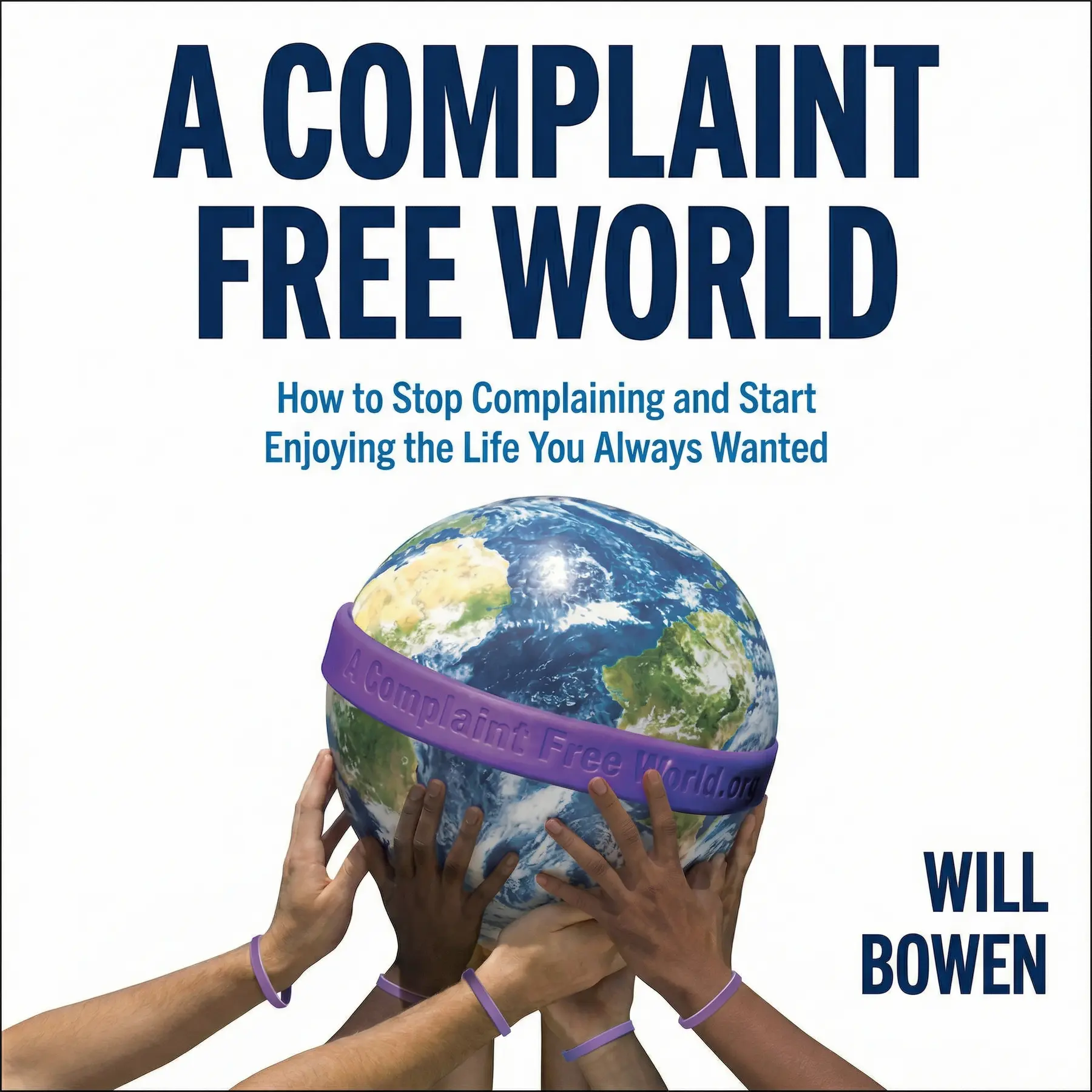
Listeners find this book simple to digest and follow, centered on an excellent premise that aids in their personal growth. Furthermore, they value its impact as a self-improvement guide, as one listener points out that it offers a formula-like method for achieving a better life. Listeners also speak highly of the level of challenge it presents; one says it is enjoyable to apply, while another highlights how it keeps them grounded in the present moment.
This book provides a surprisingly structured formula for what often feels like an abstract, unreachable goal. By focusing on the direct link between our spoken words and our internal thoughts, Bowen offers a practical roadmap to emotional intelligence that goes beyond mere fluff. I found the 21-day challenge specifically compelling because it forces you to remain anchored in the present moment, rather than drifting into past grievances or future anxieties. To be fair, the inclusion of the purple bracelet might seem like a gimmick to some, but it serves as a necessary physical anchor for a mental habit. If you are looking for a clear, step-by-step method to stop the cycle of negativity, this is an excellent resource that delivers exactly what it promises.
Show moreEver wonder why you feel so drained after a standard day at the office? It turns out that the 'water cooler' talk we participate in is often just a cycle of complaints that keeps us stuck in a miserable loop. Bowen’s formula for better living is deceptively simple: change your words to change your life. I was particularly fascinated by the section explaining that we often complain just to inspire envy or to excuse our own poor performance. Once you see those patterns in yourself, it is impossible to ignore them. This book isn't just about being 'nice'; it's about reclaiming the energy you waste on things you cannot change. It is a powerful tool for anyone ready to take full responsibility for their happiness.
Show moreWow, I didn't realize how much toxic energy I was putting out until I started switching that purple bracelet from wrist to wrist. This book is a life-changer for anyone who feels stuck in a rut of negativity and cynicism. Bowen makes it clear that our words are the mirrors of our thoughts, and by cleaning up our speech, we inevitably clean up our minds. Personally, I found the challenge level to be quite high, but that’s what makes it so rewarding to finally hit those 21 days. It keeps you focused on the present and prevents you from spiraling into gossip. I’ve already recommended this to my entire family. It is a simple, effective, and truly uplifting guide to better living.
Show morePicked this up during a difficult season of life and it acted as a perfect anchor to keep me grounded in the present. I loved the inclusion of the Maya Angelou quote at the beginning; it set such a powerful tone for the rest of the chapters. The book is very easy to read and the advice is so practical that you can start using it before you even finish the first chapter. In my experience, the biggest benefit isn't just less complaining, but the massive increase in energy and gratitude I feel every day. Even if you don't agree with every single spiritual point the author makes, the core practice of being mindful of your words is invaluable. It has truly helped me become a better version of myself.
Show moreFinally got around to reading Bowen’s work after seeing those purple bracelets everywhere in my yoga circle. The writing is incredibly easy to read and understand, making it accessible for anyone regardless of their experience with self-help literature. I really appreciated the way the author breaks down how complaining actually hampers our productivity and drains our energy levels. My only real gripe is that it leans a bit too heavily on the Law of Attraction concepts found in 'The Secret,' which isn't always my cup of tea. However, the core message about mindfulness and the power of our tongue is undeniable. It is a fun challenge to put into practice with friends or family members.
Show moreAfter hearing several mentions of the '21-day challenge,' I decided to give this a shot to improve my overall mindset. The book is very encouraging and the tone is mostly upbeat, though it does occasionally feel like a motivational speech you'd hear at a corporate retreat. Gotta say, the physical act of moving a bracelet from one wrist to the other is a very effective way to build awareness of your speech patterns. I noticed a significant shift in my mood within just the first week of being mindful. While some of the stories about people staying positive during extreme tragedies felt a bit graphic and unnecessary, the general premise is solid. It makes the world feel like a much kinder place when you stop looking for things to criticize.
Show moreThe chapter on why people actually complain was worth the price of the book alone. Most of us don't even realize we are playing the 'yes, but' game just to avoid taking action on our problems. Bowen provides a great formulaic approach to identifying these behaviors in others and, more importantly, in ourselves. It’s not always easy to read because it forces you to confront your own toxicity, but that’s exactly why it works as a self-help guide. I did find the repetitive testimonials a bit tedious after a while, as they started to sound exactly the same. Nevertheless, the central challenge is effective and has definitely helped me become a more grateful person. It’s a decent read for anyone looking to declutter their mental space.
Show moreAs someone who appreciates a good vent session, I found this book a bit difficult to swallow at times. The author, a minister in the Unity Church, definitely lets his religious background influence the tone, which might require a bit of a warning label for secular readers. Frankly, the book feels like it could have been a long-form article if you removed all the repetitive testimonials and the filler chapters at the end. While I agree that constant negativity is a problem, I worry that following this too strictly might turn a person into a doormat who never stands up for themselves. Still, the analysis of why we complain—to seek attention or avoid responsibility—offered some genuine food for thought that I will keep in mind during my work week.
Show moreNot what I expected from a book that claims to offer a world-changing perspective on human interaction. To be perfectly honest, the tone reminded me far too much of a television barker or a late-night infomercial salesman trying to push a miracle cure. There is almost zero research or scientific backing for any of the claims made, with the author instead relying on anecdotal evidence and spiritual pontification. The idea that the universe is neutral and will provide whatever you think about is pure 'Secret' style pseudoscience that I find hard to get behind. Also, the story about him having a 'deal with God' for good weather felt incredibly out of touch. While the goal of less complaining is noble, the execution here is thin on substance and heavy on marketing.
Show moreLook, the concept of not complaining is noble, but the execution in this book feels more like a gimmick than a legitimate guide. I struggled with the author's voice, which felt more like a motivational speaker trying to sell me something than a researcher offering real insights. There is a lot of filler here, including graphic stories that felt misplaced in a book that is supposed to be 'uplifting' and light. If you’ve read any Law of Attraction books, you have already heard half of what is in these pages. Truth is, you could probably get the same results just by buying a pack of rubber bands and promising yourself to be nicer. It lacks the depth I usually look for in a transformative non-fiction book.
Show moreWill Bowen argues that complaining is an unconscious habit that trains the mind to look for problems, adds stress and spreads to the people around you. His remedy is to make the habit visible with a bracelet you switch between wrists after every complaint, aiming for 21 consecutive days without a switch. Over time, he says, gratitude replaces griping and becomes automatic.
You wear a bracelet on one wrist. Each time you complain, you move it to the other wrist and your count of complaint-free days starts again. The target is 21 days in a row. Bowen says any bracelet or even a rubber band works. Some people finish in weeks, others take months, and the point of each slip is to show you how often the habit appears.
Bowen uses the stages of competence. In unconscious incompetence you complain without noticing. In conscious incompetence you notice complaints just after making them. In conscious competence you catch them beforehand and swap in gratitude. In unconscious competence a positive outlook runs as easily as breathing. He warns that the second stage can feel worse, because you suddenly see how negative things have been.
No. Bowen is clear that the practice is not about pretending everything is perfect. It means focusing on what is going right and restating concerns constructively. One key move is to say what you would like from other people rather than criticizing what they did wrong, since criticism tends to land as an attack. Real problems remain, but they lose much of their hold on you.
Bowen suggests valuing silence and declining to join in. Joan McClure, a woman from California, did this at lunch when a friend expected her to agree with a complaint: she explained the practice she was trying and then changed the subject. At later stages, Bowen says, the urge to correct or judge complainers fades too, and you simply let them be.
Richard Wiseman




William B. Irvine


Andrew D. Thompson


Deepak Chopra

AUDIO SUMMARY AVAILABLE
Get the key ideas from A Complaint Free World by Will Bowen, plus 5,000+ more nonfiction titles.









