

13 min 01 sec
Available in: English
Stop Doing That Sh*t: End Self-Sabotage and Demand Your Life Back
Shows why good stretches in life so often end in self-made crashes, and how to find, accept and work past the three hidden beliefs about yourself, other people and life that drive them.
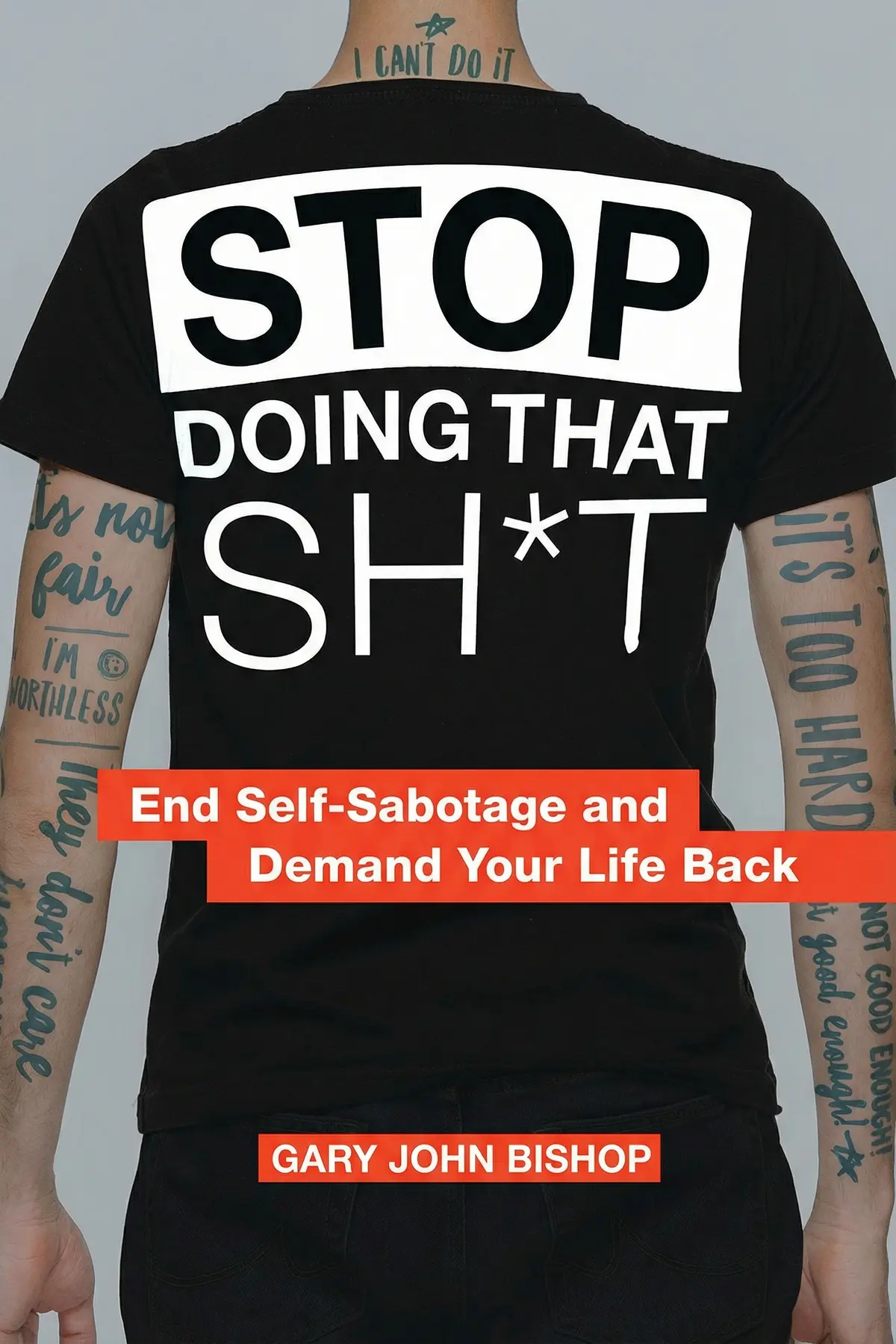
Table of Content
1. Introduction
58 sec
If you keep building something good and then watching it fall apart, Gary John Bishop has an uncomfortable explanation: the collapse may be your own work, driven by beliefs you cannot see. In Stop Doing That Sh*t, the Glasgow-born coach argues that self-sabotage is rarely bad luck. It grows out of worry that shows up exactly when life is going well, and that worry slowly changes what you do.
His case is blunt. Three hidden statements, one about yourself, one about other people and one about life, steer your choices until you find them, accept them and plan around the future you actually want. Bishop draws on his own struggles with self-sabotage and on the many clients he has coached through theirs.
By the end, you will know how to hunt for your own three sentences, why acceptance has to come before ambition, and what to do the next time a good stretch starts to make you nervous.
2. Spot the crash you set up yourself
1 min 48 sec
A car that breaks down just as your pet needs costly treatment, followed by a lost job, looks like pure bad luck. Bishop asks you to look again at the weeks before it all fell apart.
3. Stop letting your history excuse today's choices
1 min 50 sec
Some people swear the past explains nothing. Others insist it explains everything. Bishop thinks both camps are wrong, and the space between them is where your freedom to change actually lives.
4. Find the one sentence you believe about yourself
1 min 48 sec
You can repeat confident words every morning and still act against your own goals by evening. The reason, Bishop says, is a short sentence about yourself that you have probably never said out loud.
5. Catch the lens you use on people and life
1 min 52 sec
Even your warmest friendships may be filtered through a suspicion you never chose. Bishop shows how two more hidden beliefs shape every interaction and every setback, and why searching for trouble tends to find it.
6. Accept your saboteurs before you try to fix them
1 min 43 sec
Most people who discover a painful belief about themselves rush to argue with it or cover it up. Bishop insists on a slower, harder step, and he says skipping it lets the old pattern keep running.
7. Dream big, then plan backward from it
1 min 40 sec
After all the digging, the final steps sound almost too simple to matter. Bishop agrees they are simple, and explains why they only work for people who have done the uncomfortable part first.
8. Conclusion
1 min 22 sec
Bishop begins with a strange picture: someone wrestling a sofa up the driveway and into the house alone, simply because it never occurred to them to ask for help. Self-sabotage looks like that from the outside. It is a lot of effort spent against an obstacle you cannot quite see. What his book does is make the obstacle visible. The crashes that follow good times are built from small fearful choices, those choices come from three sentences about yourself, other people and life, and the mind keeps those sentences alive because being proven right feels safe.
The practical response is modest and demanding at once. When the next setback hits, complete the phrase “Naturally this would happen to me, since I’m a…” in your own words, and then repeat the exercise for other people and for life in general. Write the three answers down and let them stand without argument until they lose some of their charge. Then picture what you actually want and work backward to the first action. When a good stretch starts to make you nervous, treat that nervousness as a signal to pause and look again.
Nobody else can do this digging for you. For Bishop, that is the good news: the hands your life rests in are your own.
About this book
What is this book about?
Many people know the pattern well. Life starts going well, worry creeps in, and soon everything falls apart again: the car, the money, the job. Then they rebuild, promise to try harder, and watch it happen once more. Gary John Bishop argues that this is rarely bad luck. Anxious thoughts shape small decisions, and those decisions bring on the very collapse that was feared. Bishop, a coach from Glasgow, says the loop is driven by three hidden statements everyone carries: one about themselves, one about other people and one about life. They grow out of a past nobody chooses, and they persist because the mind would rather be proven right than face uncertainty. They also explain why so much self-help advice slides off people who are stuck. His way out is direct. Uncover your three saboteurs through honest reflection on your worst moments. Accept them fully instead of fighting them. Then picture the life you want and work backward to the actions that lead there, checking in regularly, because new saboteurs can appear. Readers get a clear way to spot their own pattern and a method for breaking it.
Book Information
Who it's for
Repeatedly losing good stretches
People who keep building good stretches in life and then watching them fall apart.
Stuck despite knowing why
Readers who know where their patterns come from but repeat them anyway.
Tried plenty of self-help
Anyone who has tried plenty of self-help advice and wants to know why none of it sticks.
About the Author
Gary John Bishop
Gary John Bishop grew up in Glasgow, Scotland, and once worked as a senior program director at a large personal and professional development company. His coaching and writing follow what he calls urban philosophy, a direct, no-frills approach to changing your life. He is a best-selling author whose book Unfu*k Yourself brought him wide recognition, and his other titles include Do the Work and Love Unfu*ked.
Love Unfu*ked: Getting Your Relationship Sh!t Together
Gary John Bishop
Unfu*k Yourself: Get Out of Your Head and into Your Life
Gary John Bishop
Ratings & Reviews
Ratings at a glance
What people think
Listeners find this title both transformative and simple to digest, viewing it as an unconventional self-help guide that blends sharp humor with genuine perspective. They value the book's authentic and engaging nature, with one listener highlighting it as a perfect starting point for self-exploration. The author tends to evoke a range of different responses from listeners.
Top reviews
Watcharee
If you're going to dive into this, do yourself a favor and get the audiobook because hearing Gary John Bishop’s Scottish accent adds a layer of grit you just don't get from the page. This isn't your typical light and fluffy self-help fluff; it’s a blunt, sweary, and incredibly direct wake-up call that forces you to stare your own uncomfortable truths right in the face. To be fair, his approach is polarizing, but his passion for changing people's mentality shines through every single chapter. I found myself marking up my hardcopy like crazy because the takeaways on self-sabotage were just that relevant to my current situation. While it might feel like a 'smarten up buttercup' rant at times, that is exactly the kind of kick in the head I needed to stop dragging my past around. It is authentic, entertaining, and life-changing if you are actually willing to do the work instead of just reading about it.
Show morePhu
Finally got around to reading this and I definitely felt like I got a proverbial kick in the head in the best way possible. In my experience, most self-help books try to coddle the reader, but Bishop tells you to stop dragging the past around and just get on with it. The chapter on staring your own truths in the face was particularly eye-opening for me. I’ve read a lot of these types of books, yet the way he frames our internal 'machinery' felt fresh and actionable. This isn't just about positive thinking; it's about recognizing the garbage behaviors we've normalized and deciding to end them. It’s a short, cut-to-the-chase kind of book that doesn't waste time with flowery language or useless anecdotes. If you’re ready to change your life and don’t mind a little Scottish ranting along the way, this is absolutely the book for you.
Show moreEmma
Stop looking for easy answers and just read this if you’re actually ready to change your mentality because Gary John Bishop doesn't offer any shortcuts. This is an incredible follow-up that dives deeper into the 'why' behind our actions, providing a delightful and straightforward way to look at your life differently. I’m addicted to this series now because it’s not light or fluffy; it’s a direct confrontation with the parts of yourself you’d rather ignore. The audiobook is a masterpiece of narration, and the humor kept me engaged even when the truths he was hitting were starting to hurt. It hit the mark for me perfectly, offering a new perspective on happiness and personal fulfillment that I hadn't considered before. This isn't just a book you read; it’s a book you experience and then apply immediately to your own life. Absolutely brilliant and highly recommended for anyone who is sick of their own excuses.
Show moreRafael
Gary John Bishop has a way of cutting through the nonsense that most gurus try to sell you with a straightforward and bluntly honest perspective. Look, this book isn't offering some mind-blowing secret that has never been written before, but the delivery is what makes it stand out from the pack. It’s an easy read that focuses heavily on why we aren't happy and how we perpetuate our own cycles of failure. I appreciated the humor he injected into the heavier topics, making the bitter pill of self-reflection much easier to swallow. While some parts felt a little stretched out, the core message about taking personal responsibility for your dream life is powerful. It’s a great introduction to self-discovery for anyone who is tired of the sugar-coated approach found in mainstream titles. Definitely worth a read if you need a punchy reminder to get out of your own way.
Show moreWyatt
As someone who has read a lot of self-discovery books, I found this to be a refreshing, blunt take on why we sabotage ourselves so consistently. Truth is, we often know what we need to do, but we just don't do it, and Bishop calls us out on that specific bullshit. The writing style is aggressive and to the point, which might turn some people off, but I found it quite authentic and entertaining. It isn't a long read, but the impact stays with you as you start to notice your own patterns in real-time. I did feel that a few sections were a bit redundant, repeating the same concepts in different words to fill out the page count. However, the core message about refusing to be a victim of your own history is something I think everyone needs to hear. It’s a solid addition to the series that keeps the momentum going.
Show moreNing
Is it helpful? Yes, but it's also incredibly repetitive and feels like a long-winded version of his previous work. Gotta say, I enjoyed the first book because it was honest and simple, but this one felt like it was trying too hard to be 'deep' and ended up being a bit too complicated for its own good. Self-development doesn't mean you have to transform into Jeff Bezos overnight, and sometimes the author's tone suggests that anything less than total life overhaul is a failure. There are some great takeaways buried in here, particularly about how we hold ourselves back, but you have to wade through a lot of swearing and 'tough love' posturing to find them. It’s not a bad book by any means, but it didn't hit the mark for me the way I hoped it would after all the hype. It’s decent for a one-time read, but I probably won’t be revisiting it.
Show moreSangduan
The swearing is a bit much at times, even for someone who isn't easily offended, as it starts to feel like a gimmick after a while. Not gonna lie, I was hoping for more practical steps once the author finished deconstructing our psychological barriers and self-defeating habits. The book is definitely easy to read and has some moments of genuine humor, but it feels like it lacks the 'what now' factor that would make it truly transformative. I think everyone could take away at least one or two nuggets of wisdom, but don't expect a complete life-changing revelation on every page. It’s a nice, sweary reminder to get over yourself, though I found the second half to be much weaker than the first. For fans of his style, it’s a must-read, but for those seeking a structured guide, it might feel a bit hollow. It sits somewhere between a motivational speech and a therapy session.
Show moreChanpen
The first half of the book really hooked me, but then it felt like it went a bit too far ahead into complicated theories that didn't feel as grounded as his first book. To be frank, the advice is good, but it’s nothing absolutely mind-blowing if you’ve already spent any significant time in the self-help genre. I appreciated the lack of sugar coating and the directness of the advice, though I wish there were more concrete examples of how to apply these 'truths' to daily life. It’s a quick read, which is a plus, and Gary’s passion is evident on every page. However, it often feels like he’s just shouting the same three things over and over again in different ways. It’s a decent 'smarten up' book for a weekend, but it didn't leave the lasting impression on me that I was expecting. A bit of a mixed bag overall.
Show moreDen
Maybe I expected too much after his first book, but this one felt like a lot of circular logic that never quite landed on a solid solution. Frankly, the 227 pages could have been condensed to about 27 without losing any of the actual substance or advice. I kept waiting for a clear 'how-to' after he finished shouting about our issues, but the point never arrived, leaving me feeling like I wasted both time and money. It lacks the Jen Sincero-esque humor and storytelling that makes other self-help books engaging. Instead of feeling inspired, I just felt lectured by someone who thinks swearing every three words makes a point more profound than it actually is. If you want a book that provides a roadmap for change, look elsewhere because this is mostly just repetitive filler that goes nowhere fast.
Show moreScarlett
Not what I expected based on the reviews that claimed this was a life-changing masterpiece of modern self-help. Personally, I felt like he didn't really say anything new or profound, and the 'tough love' act started to wear thin about halfway through the book. The Scottish accent and the swearing might make for a fun audiobook experience, but the actual content is quite thin and lacks any real depth or scientific backing. It felt like a collection of blog posts stitched together rather than a cohesive guide to stopping your self-destructive behaviors. There are no easy answers here, which I respect, but there aren't many difficult answers either—just a lot of telling the reader they are the problem. I’m disappointed because I really wanted to like this, but it felt more like a waste of money than a helpful resource. It’s definitely not for everyone, especially those who want substance over style.
Show moreQuestions about this book
What is the main idea of Stop Doing That Sh*t?
Gary John Bishop argues that self-sabotage comes from three hidden statements everyone carries: one about themselves, one about other people and one about life. These beliefs form from a past nobody chooses, and they push us toward choices that confirm them. The cycle of building and wrecking breaks only when you uncover those statements, fully accept them, then picture the life you want and work backward to the actions that get you there.
What are the three saboteurs in Gary John Bishop's book?
Each saboteur is a short statement. The first starts with I, such as I don’t matter or I’m incapable. The second starts with people are, for example people are deceitful. The third starts with life is, such as life is unfair or life is hard. The form is shared by everyone, but the actual words are personal, so your set will differ from your friends’ or your family’s.
How do I find my own saboteurs?
Bishop suggests deep journaling or working with a therapist or other licensed professional. Look at your worst moments: where your thoughts go when you fail or when things turn against you. Notice the sense that of course this happened to me, because I’m a… and fill in the word. For people and for life, ask what you feel when you fear something will go wrong, and what you think right after it does.
Why does Bishop say acceptance matters so much?
He explains that people need to feel secure and want to know what to expect, so the mind looks for evidence that its negative beliefs are right. If you only identify your saboteurs and then try to fight or ignore them, they keep working in the background. Accepting that your past produced them, and sitting with that for a while, is what begins to weaken their hold.
How can I apply Stop Doing That Sh*t in daily life?
When a setback seems purely external, trace the fearful choices you made beforehand. Write down your three saboteur statements and let them stand without arguing. Then imagine what you really want and work backward to concrete actions. Bishop also advises regular check-ins, because new saboteurs can appear: whenever you catch yourself acting from fear instead of looking forward to the future you want, pause and look for the belief behind it.
Readers also enjoyed

59 Seconds: Change Your Life in Under a Minute
Richard Wiseman





A Guide to the Good Life: The Ancient Art of Stoic Joy
William B. Irvine


A High-Performing Mind: Strengthen Your Mind and Live Your Best Life
Andrew D. Thompson


Abundance: The Inner Path to Wealth
Deepak Chopra
AUDIO SUMMARY AVAILABLE
Listen to Stop Doing That Sh*t in 15 minutes
Get the key ideas from Stop Doing That Sh*t by Gary John Bishop, plus 5,000+ more nonfiction titles.
- 5,000+ titles
- Listen as much as you want
- 7-day free trial
- Cancel anytime









