

59 Seconds: Change Your Life in Under a Minute
Richard Wiseman
 English
Shows how the ape-like parts of your brain and their chemicals shape your mood, focus and trust. It also shows how small changes in attitude, attention, relationships, food, exercise and rest keep your reasoning brain in charge.
1 min 00 sec
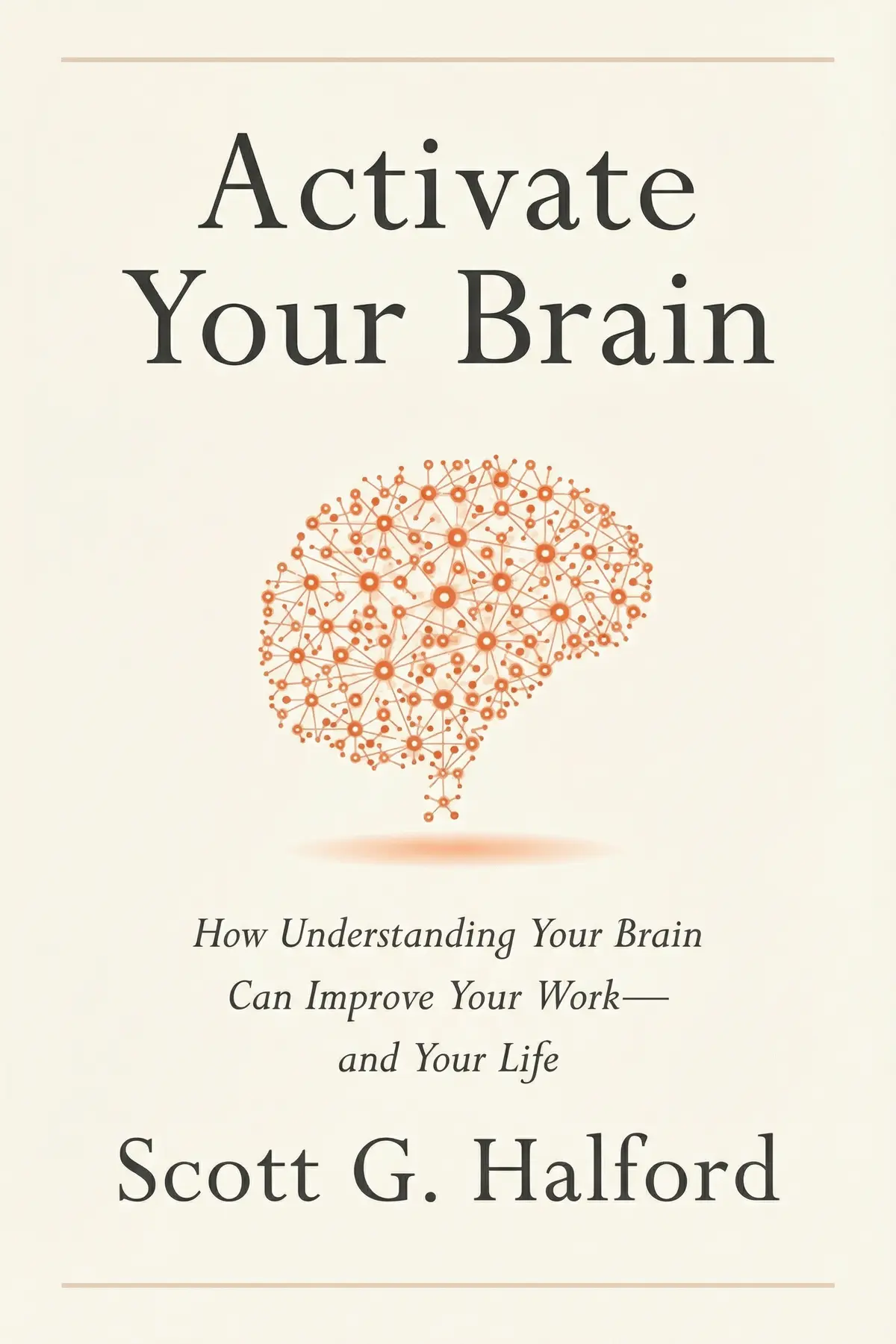
Most of us suspect our minds could do more, if brain fog, stress and a steady stream of interruptions would only let up. In Activate Your Brain, Emmy-winning writer and speaker Scott G. Halford starts from a humbling fact: two of your brain’s three main parts work much like a chimpanzee’s. Only the top layer, the prefrontal cortex, is distinctly human, and its job is to keep the older parts in order.
Halford’s case is that once you know how those parts and their chemicals behave, small changes in attitude, habits and daily care can tilt your brain away from stress and toward reward. His advice is modest and concrete, from answering a colleague’s good news well to eating more berries. Along the way you’ll learn why a 4.5-second interruption matters, why back slaps help basketball teams, and how a jog helps your brain repair itself.
1 min 30 sec
Two of your brain’s three main parts would feel at home in a chimpanzee. Knowing which part grabs the wheel when a boss is rude to you is the first step to taking it back.
1 min 39 sec
The same office, the same diet, the same chore can either drain you or drive you. Halford traces the difference to a choice your brain makes, and it is one you can make on purpose.
1 min 33 sec
Waiting for perfect conditions feels safe, yet it slowly erodes confidence. Halford offers two ways to feel in control again, and one of them asks you to picture things going badly wrong.
1 min 35 sec
A distraction of just 4.5 seconds can triple the errors in your work, and a lofty long-term target can motivate you less than small wins you can reach right away. Both problems have surprisingly small fixes.
1 min 48 sec
Your brain treats every new acquaintance as a small threat. Halford explains what turns that wariness into trust, and why the way you answer a colleague’s good news counts more than you think.
1 min 36 sec
Working alone can feel faster and safer. Halford points to studies suggesting the opposite, and to one simple request that makes colleagues like and trust you more at the same time.
1 min 39 sec
A short walk home and a handful of berries sound too simple to matter. Halford explains what exercise, water and the right foods actually do inside your head, and how little you need to start.
1 min 28 sec
Long hours and short nights look like dedication, yet Halford argues they work against you. The part of your mind that solves the hardest problems does its best work when you stop trying.
1 min 10 sec
Halford’s brain is a busy classroom with a capable but easily tired teacher. The children, our ancient reactions, will always move first. Everything else in the book is a way of helping the teacher do its job, whether that means a breath before you react, a frame that pulls you toward a goal, or enough sleep and water to show up at all. None of it asks you to become a different person. It asks you to work with the chemistry you already have, so that more of your day runs on dopamine and oxytocin and less of it on cortisol.
Attention is a sensible place to begin, because its cost is so easy to see. Turn off pop-ups and choose fixed times for email, since a few seconds of distraction can triple your mistakes. When a colleague shares a win, answer the effort behind it with real warmth. And when a problem refuses to give way, leave it, walk around the block, and let the background mind take its turn.
The ape in your head is here to stay. Your work is to keep the teacher in the room.
Many people feel their minds could do far more if brain fog, stress and constant interruptions would only ease off. Scott G. Halford starts from a humbling fact: two of the brain's three main regions work much like a chimpanzee's. Only the prefrontal cortex is distinctly human, and it has to keep the impulsive, emotional parts below it in order. From there, Halford explains how brain chemicals such as cortisol, dopamine and oxytocin drive our moods, and how we can steer them. He covers choosing to approach goals instead of avoiding threats, building a sense of control, protecting focus from tiny interruptions, setting goals small enough to reward you quickly, and earning trust through high-fives, generous replies and real collaboration. The book closes with the basics of brain care: exercise, water, natural food, learning, sleep and guilt-free rest. Its promise is modest and practical. It won't make you a genius, but its small daily changes help the brain you already have work better at your job and at home.
Office workers who lose hours to email, pop-ups and constant task switching.
Managers and team leads who want trust and real collaboration on their teams.
Anyone worn down by stress who wants simple, science-based habits for a healthier brain.
Scott G. Halford is an Emmy Award-winning writer and producer who speaks on brain-based behavioral science and influence. He was inducted into the National Speakers Hall of Fame in 2014 and holds the Certified Speaking Professional designation, the National Speakers Association's highest. He founded Complete Intelligence, LLC, and has been a guest lecturer in the Executive MBA program at the University of Denver's Daniels School of Business. His other books include Be a Shortcut and Senseless Acts of Beauty.

Listeners find the material accessible and full of knowledge, with one individual pointing out that complicated details are shared concisely. Additionally, the text covers fundamental concepts regarding brain activation for daily use; one listener specifically notes it changed their outlook on everyday responsibilities. There is also praise for its engaging quality and usefulness across both career and home settings.
This book is a masterclass in making complex neuroscience actually useful for the average person. Scott G. Halford avoids the trap of being too academic, instead focusing on how our 'grey matter' dictates our daily successes and failures. I especially appreciated the sections on how to prevent mental decline through simple choices like better sleep and nutrition. It’s not just a collection of dry facts; it’s a practical guide to reclaiming your focus in a world designed to distract you. Personally, the way he explains the chemistry of the brain made me rethink my entire morning routine. If your brain feels like it's running on fumes by 3 PM, you need to read this. It’s succinct, highly informative, and surprisingly entertaining for a book about biology.
Show moreWow, I didn't think a book about the brain could actually be this relevant to my daily grind. I’m the kind of person who spends my evenings mindlessly browsing the internet because my brain feels totally exhausted after work. Halford explains exactly why that happens and how to fix it. The advice on 'brain-friendly' choices has honestly changed how I approach my afternoon slumps. Instead of reaching for more caffeine, I’m using the mental exercises he suggests. It’s rare to find a book that balances hard science with such easy-to-do steps. The way it’s written makes you feel like you’re actually in control of your biology. Highly recommended for anyone looking for a boost in energy and motivation.
Show moreAfter hearing a colleague rave about the productivity tips in here, I decided to give it a shot, and I’m so glad I did. The book is incredibly informative without being overwhelming. It covers everything from how to motivate a team during stressful times to the specific types of food that help fight off dementia. I found the focus on building trust through neurobiology particularly fascinating. It’s one thing to be told to be a good manager; it’s another to understand how trust affects the hormones in your employees' brains. It’s a practical, well-researched guide that has genuinely helped me improve my perspective on my career. This should be required reading for anyone in a high-pressure office environment.
Show morePicked this up because I wanted to understand the 'why' behind my procrastination and focus issues at work. To be fair, a lot of the advice—like breaking big tasks into smaller steps—isn't revolutionary, but the way Halford backs it up with brain science makes it stick better. He does a great job of explaining how the mammalian and reptilian brains fight for control over our decisions. It is a solid resource for managers trying to get the best out of their teams without causing burnout. The writing is clear, though it can get a bit heavy on jargon in the first few chapters before it settles into the real-world applications. It definitely helped me improve my perspective on daily tasks that used to feel overwhelming.
Show moreAs someone who constantly feels stressed, I found the foundation of this book incredibly grounding. Halford explains how the brain operates differently when it feels safe versus threatened, which explains so much about my workplace anxiety. The focus on 'brain-friendly' choices is a great way to frame habit building. I loved the practical tips on meditation and how specific foods can actually protect your brain cells from dementia. While some of the management advice felt like stuff I’ve read in relationship books before, applying it to a business environment was a fresh enough take. My only gripe is that it occasionally feels a bit too 'rah-rah' American self-help, but the underlying science is strong enough to keep it credible.
Show moreEver wonder why you make terrible decisions when you are tired? This book dives deep into that exact problem. It’s a very practical look at how we can use our biology to our advantage rather than fighting against it. Truth is, I’ve always known that exercise and sleep are important, but seeing the actual neurological impact of those choices was the kick in the pants I needed. The author does a great job of encouraging the reader without being overly cheesy. It’s especially relevant for anyone in a leadership role who wants to foster better collaboration and trust within their team. Some parts are a bit slow, but the overall takeaway is worth the time. It is a very informative read for your daily life.
Show moreFinally got around to reading this after seeing it recommended for office productivity, and it’s actually quite useful. The first part focuses heavily on willpower and confidence, which was exactly what I needed to hear. I like how Halford transitions from the 'nitty-gritty' science in the beginning to the very practical exercises in the second half. The section on how chemistry affects our brain was a highlight for me. It’s a detailed jumping-off point for anyone interested in why we act the way we do. Some of the 'real-life' examples felt a bit manufactured, but the actionable steps for meditation and focus are easy to implement. It’s a good travel companion that actually leaves you with something to think about.
Show moreNot what I expected when I saw the cover, as I was hoping for a lighter, more breezy self-help guide filled with quick motivational tricks. Instead, the book feels quite dense and plodding at times. I’m really not a fan of the common self-help trope where the author introduces a friend named 'Marie' to illustrate every single point. It feels a bit patronizing. However, the science isn't just 'mumbo-jumbo'—there is real substance here if you are willing to slog through the anecdotes. The bullet points at the ends of the chapters were my saving grace, allowing me to skim the fluff and get to the meat of the advice. It's a decent refresher course on common sense, but it didn't exactly blow my mind.
Show moreLook, the advice here is solid, but if you have read more than two self-help books in the last decade, you have heard most of this before. The 'brain activation' hook is mostly a way to frame standard advice on diet, exercise, and mindfulness. To be fair, the author is a good writer and he presents the information in a way that is very easy to understand for a layperson. I appreciated the emphasis on how small choices compound over time to create new behaviors. It’s a nice refresher, and the price is right for what you get. I’d recommend it to someone who is new to the genre, but seasoned self-improvement junkies might find it a bit basic.
Show moreGotta say, this felt like a lot of repackaged common sense hidden under a thin veneer of neuroscience jargon. Most of the advice is things we’ve all heard a million times: eat your veggies, get some sleep, and don't be a jerk to your coworkers. Just seems like the same old, same old pablum that gets churned out in the business self-help world every year. The author uses terms like 'reptilian brain' to make basic psychological concepts sound more scientific than they actually are. It’s a very light read if you skip the anecdotes, but I didn't find much here that I couldn't have found in a five-minute blog post. If you're looking for deep, cutting-edge science, keep looking. This is for beginners only.
Show moreScott G. Halford argues that two of the brain’s three main parts work much like an ape’s, while the prefrontal cortex acts like a teacher calming a noisy kindergarten. By understanding how brain chemicals such as cortisol, dopamine and oxytocin shape mood, focus and trust, you can make small changes in attitude, attention, relationships, diet, exercise and rest that help the reasoning brain stay in charge.
According to Halford, the brain can focus on just one activity at a time, so multitasking is really rapid switching that raises errors and wastes time. He reports that a 4.5-second interruption triples the errors in a task, and that one focused hour equals four distracted ones. His fix is to disable pop-up notifications and check email at fixed times, such as 9 am, 2 pm and 6 pm.
Halford links trust to oxytocin and names reliability, generosity, laughter and shared memories as its builders. He recommends thanking people, high-fiving and hugging when appropriate, citing a study of basketball teams that played better with more back slaps. He also recommends active-constructive responding: meeting a colleague’s good news with genuine interest and warm recognition of their effort, never a warning about the work ahead.
Halford recommends physical and mental exercise, which release a chemical that helps the brain grow and repair cells. He advises drinking enough water, since about 75 percent of the brain is water, and choosing natural foods such as berries, apples, cocoa, nuts and seeds. Learning a new language through practice, sleeping enough and taking guilt-free awake rest also protect the brain from stress.
It suits busy professionals who feel scattered, stressed or held back by distractions, and who want short, practical advice grounded in brain science. Managers will find tools for trust and collaboration, while anyone worried about long-term brain health gets simple habits around exercise, food, water, learning and sleep. Halford makes no promise of genius, only of getting more from the brain you have.
Richard Wiseman





William B. Irvine


Andrew D. Thompson


Deepak Chopra
AUDIO SUMMARY AVAILABLE
Get the key ideas from Activate Your Brain by Scott G. Halford, plus 5,000+ more nonfiction titles.









