

14 min 26 sec
Available in: English
The Seventh Sense: Power, Fortune, and Survival in the Age of Networks
Explains why power now flows through networks of people, devices and markets, why slow institutions keep losing to them, and how to read the risks and gates hidden inside every connection you rely on.
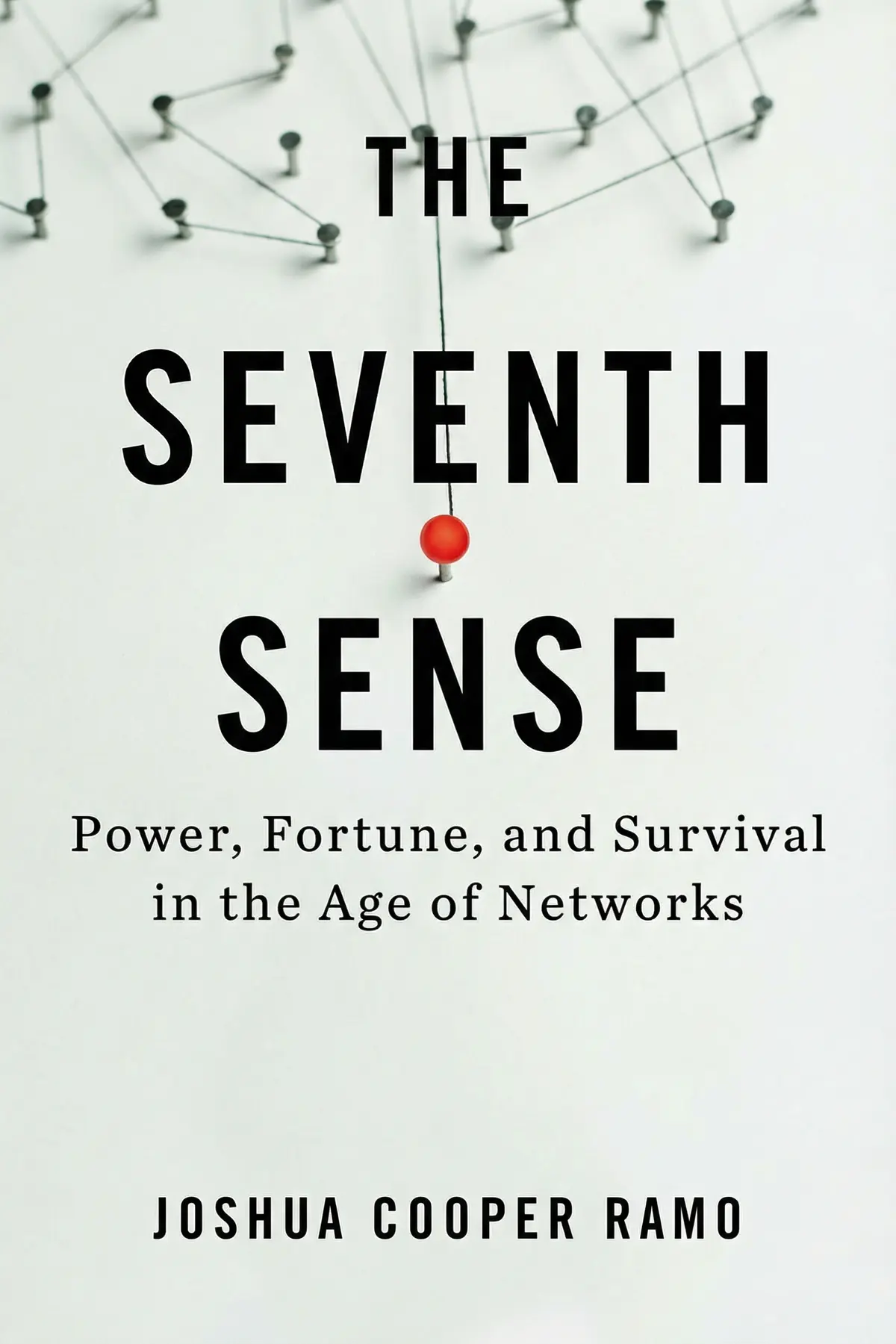
Table of Content
1. Introduction
1 min 03 sec
Most of us use networks all day without seeing the power they hold over our work, our money and our safety. In The Seventh Sense, former Time editor and Kissinger Associates adviser Joshua Cooper Ramo argues that this blindness has become a real danger. Power used to sit at the top of fixed hierarchies of kings, presidents and experts. Now it flows through webs linking people, phones, computers and markets.
Ramo calls the instinct for reading those webs a Seventh Sense. His case is that every connection brings opportunity and exposure together, and that people and institutions who fail to keep updating get outpaced by those who move faster.
The ideas ahead run from an iPod that rewired an industry to a bomb design that crossed countries in ten days, a chatbot strangers trusted with their secrets and a password that decides who gets online. Each one trains a part of the sense Ramo says this age demands.
2. Spot the network behind every big change
1 min 53 sec
A small music player launched in 2001 ended up closing shops and creating whole new companies. Ramo uses it to show why judging any new tool on its own leaves you blind to what is really shifting.
3. Fast networks beat slow institutions, and you can see it
1 min 41 sec
In 2003, a weapon designed in one country killed someone in another country just ten days later. The army knew it was coming, and still could not respond in time.
4. Know where authority moves when everyone connects
1 min 36 sec
A cardiologist with years of experience can now hold less power than the medical sites people find through a search engine. Ramo explains the two kinds of network power that made this possible, and who else is exposed.
5. Tell a complex system from a merely complicated one
1 min 41 sec
A central banker admitted that one mistake in how officials saw the market helped bring on a global financial crisis. The error is easy to repeat in any office, with any system you manage.
6. Expect the crash that comes with every invention
2 min 02 sec
A hacker beat the defenses of major web browsers in less than a minute, and a simple program from MIT frightened its own creator. Both point to the weakest link in any connected system.
7. Understand the gates that let you in or out
1 min 42 sec
Why does almost everyone end up on the same phone system and the same social network? The answer explains who holds power online, and what happens to the people left on the wrong side.
8. Guarded gates can make digital money safer for everyone
1 min 42 sec
Cash is likely to disappear, and the currency many expect to replace it already serves drug dealers and tax evaders. Ramo describes a different kind of gate that could protect ordinary users instead.
9. Conclusion
1 min 06 sec
Ramo’s book changes where you look for power. It no longer sits only in palaces, ministries or a doctor’s office. It lives in the links between millions of devices and people, in who passes through a gate and who stays outside, and in how fast a network learns compared with the institutions trying to manage it. The Seventh Sense is the habit of seeing those links before they surprise you.
That habit has a defensive side, and Ramo’s own advice is modest and specific. When any of your apps pushes out its next update, set aside a quarter of an hour at minimum to read the privacy policy, so the fine print cannot surprise you and you can choose whether your data is passed to third-party apps. Treat a friendly program the way Weizenbaum came to see ELIZA: useful, but only software, and no place for secrets. And whenever you depend on a network, find out who holds its gate.
The plane and the plane crash arrive together. Seeing both at once is the sense this age asks of you.
About this book
What is this book about?
Most of us spend our days inside networks: phones, search engines, social platforms, payment systems. We rarely stop to ask who holds power in them, how fast they change or what they expose us to. Joshua Cooper Ramo argues that this blindness has become dangerous. Authority once sat at the top of fixed hierarchies. Today it moves through webs of connection, and people and institutions that cannot read those webs get outpaced or exploited. Ramo calls the instinct for reading them a Seventh Sense. He builds it from vivid cases: an iPod that rewired the music industry, a bomb design that crossed from Baghdad to Afghanistan in ten days, a hacker who beat major web browsers in under a minute, and a simple chatbot that people trusted with their secrets. He separates complicated systems from complex ones, explains why big networks become hard to leave, and shows how gatekeepers can shut people out or protect them. Readers get a clear way to think about technology, power and risk, plus practical questions to ask of any network they depend on, from a workplace Wi-Fi to tomorrow's digital money.
Book Information
Who it's for
Constantly connected professionals
Professionals who use connected tools all day and want to understand the power and risks behind them.
Business leaders facing platforms
Founders and managers whose industries are being reshaped by platforms and network effects.
Specialists questioned online
Experts whose authority is being challenged by search engines and online communities.
About the Author
Joshua Cooper Ramo
Joshua Cooper Ramo started as a journalist and became the youngest senior editor and foreign editor in Time magazine's history, writing more than 20 cover stories. He later held a senior role at Kissinger Associates and led the investment and advisory firm Sornay. A Mandarin speaker, he lived in Beijing for a decade and won an Emmy and a Peabody for his NBC analysis of the 2008 Olympics. He also founded Peace Machines, a Zurich-based effort using technology against causes of conflict.
Ratings & Reviews
Ratings at a glance
What people think
Listeners find this work captivating and skillfully crafted, offering superb perspectives on technological disruptions and the significance of interconnected systems. They value the stimulating material, use of historical stories, and how it relates to current affairs, with one listener observing that it acts as a powerful guide using history to shed light on what's ahead. While the prose itself earns high marks, there are varying views regarding how easy it is to follow.
Top reviews
Gioia
After hearing Ramo discuss his ideas on a podcast, I knew I had to grab this. The concept of the "Seventh Sense" isn't just another tech buzzword; it’s a fundamental shift in how we perceive the modern world. Instead of seeing static objects or isolated nations, Ramo forces you to view everything through the lens of a massive, pulsating network. The historical anecdotes, from the Gutenberg press to the Peloponnesian War, provide a necessary bridge between old-world power and new-world connectivity. While some might find the prose a bit dense, the payoff is immense for anyone trying to understand why traditional structures are failing. It's about recognizing that power now lies with the gatekeepers of these systems. To be fair, not every page is a revelation, but the core thesis is life-changing. Truly a thought-provoking read that will make you look at your smartphone—and your government—differently.
Show moreSoontorn
Wow, this book totally reframed my understanding of the digital age. I’ve always felt a bit overwhelmed by how fast things are changing, but Ramo’s concept of the "seventh sense" gave me a way to process it all. Once you start seeing the world as a series of interconnected networks rather than just a collection of separate things, everything clicks. The way he discusses Airbnb turning houses into network nodes or how translation software will eventually erase language barriers is mind-blowing. It’s not just a book about tech; it’s a book about the future of humanity and how we organize ourselves. I found his writing style to be quite beautiful, almost like a grand strategy manual written by a philosopher. If you want to understand the forces shaping our future, you absolutely have to read this. Simply brilliant.
Show moreAroon
Ramo’s background at Kissinger Associates shines through in his strategic approach to global instability. He argues convincingly that our current leaders are fundamentally illiterate when it comes to the topology of modern power. The chapter on how ISIS uses network dynamics while we try to fight them with 20th-century bombs was chilling and insightful. It’s a call to arms. Policymakers must stop looking at geography and start looking at connection. I appreciated the deep dive into how AI and ARPANET have fundamentally altered the DNA of our social interactions. My only gripe is that the author tends to wander off into barely-related tangents that occasionally break the momentum of his argument. Still, the core thesis is too important to ignore in our current era of constant disruption. It’s a solid look at the future.
Show moreJulian
The analogy between the Athenian destruction of Melos and modern network aggression is worth the price of admission alone. It perfectly illustrates how being a "node" in a network controlled by someone else is a position of extreme vulnerability. Ramo’s exploration of how protocols can be more influential than the actual platforms they support changed how I think about the tech industry. We often focus on the gadgets. The real power lies in the invisible architecture that links them. Personally, I think the writing can be a bit flowery at times, bordering on the poetic when a more direct style would have sufficed. But the intellectual ambition of the project is admirable. It provides a much-needed framework for understanding why the world feels so chaotic and unpredictable lately. It is a dense but rewarding experience for the patient reader.
Show moreManika
As someone who works in the tech sector, I found the analysis of platform gatekeepers particularly relevant. Ramo explains why the modern marketplace has become a winner-take-all environment where data is the ultimate currency. The way he links Eastern philosophy with Western technological progress provides a unique perspective you won't find in your typical Silicon Valley business book. He correctly identifies that the internet hasn't just changed how we communicate; it has fundamentally altered the nature of power itself. I would recommend this to any business leader or entrepreneur trying to wrap their head around the current landscape. Some of the sections on artificial intelligence feel a bit like a "greatest hits" of common fears, but his overall synthesis of these trends is very sharp. A very solid read that rewards careful study. It's timely and quite relevant.
Show moreDuangjai
Finally got around to reading this after seeing it on several "must-read" lists. Ramo is a gifted writer who manages to weave together history and futurism in a way that feels urgent. The book acts as a fantastic interpreter of the past to help illuminate where we are headed next. While the tone is occasionally a bit too self-important, the actual content is incredibly valuable for understanding the modern world's chaotic nature. He makes a compelling case. Interconnection doesn't necessarily lead to peace, but often creates new avenues for conflict. It’s a dense read that requires focus, but the insights into how networks compress space and time are well worth the effort. It’s definitely one of those books that sticks with you long after you’ve put it down. Not perfect, but certainly essential for the curious mind.
Show moreYaowares
Picked this up because the premise seemed fascinating, but the execution was a bit of a mixed bag for me. On one hand, the idea that we need a new instinct to survive an era of "winner-take-all" platforms is spot on. Ramo does a great job explaining why companies like Amazon and Google dominate by shortening connections between people. However, the book is way longer than it needs to be. I found myself skimming through large sections of historical fluff just to get back to the actual analysis of contemporary technology. Look, there are some genuine "aha" moments here, particularly regarding how networks compress time and space. But you really have to dig through a lot of wordy prose to find them. It’s a decent read if you have the patience, but it could have been a much tighter essay.
Show morePrim
Not what I expected based on the glowing blurbs on the back cover. The central idea—that we need to develop an intuition for how networks function—is genuinely interesting and timely. Unfortunately, the book feels like it was written by someone who enjoys hearing themselves talk a little too much. It’s very dense. It often takes the long way around to prove a point that could have been made in a single paragraph. I liked the stuff about the history of the telegram and how it mirrors our current internet struggles. Yet, the overall pacing was just too slow for my taste. Gotta say, it’s a solid 3-star read for the ideas alone, but the delivery left me wanting something a bit more punchy and less academic. It felt like work to finish.
Show morePot
Truth is, I have a love-hate relationship with this book. Joshua Cooper Ramo has some brilliant insights into how networks have reversed the law of diminishing returns in economics, which explains the rise of tech giants perfectly. But man, the first few chapters are a total slog. He takes forever to define what the "seventh sense" actually is, leaving the reader wandering in a fog of abstract metaphors and pretentious name-dropping. If you decide to pick this up, I’d actually recommend skipping the intro and jumping straight into the discussion on the power of protocols and network topology. There is a great three-page summary near the end that basically captures everything important. It’s a frustrating experience because the "good" parts are genuinely five-star material, but they are surrounded by so much unnecessary fluff. Read it with a highlighter.
Show moreBenjamin
This book suffers from a terminal case of "I’m the smartest guy in the room" syndrome. Joshua Cooper Ramo clearly has some high-level connections, but his writing style is so incredibly ponderous and bloated that the actual message gets buried. He spends hundreds of pages trying to define the "seventh sense" without ever really getting to the point. Frankly, the first three chapters were such a disjointed mess that I almost gave up. Most of the "insights" about networks and technology are things that anyone who has been paying attention to the internet for the last decade already knows. It feels like he took a simple, mainstream observation and wrapped it in pseudo-intellectual jargon to make it sound revolutionary. If you’re looking for a concise analysis of technology, look elsewhere. This is 75% filler and 25% ego.
Show moreQuestions about this book
What is the Seventh Sense according to Joshua Cooper Ramo?
It is an instinct for understanding the networks that now link people, mobile devices, computers and financial markets. Ramo builds on Nietzsche’s claim that the industrial age required a sixth sense. Today, he argues, we must see that everything is interconnected, that new networks keep replacing old ones, and that every connection brings both opportunity and exposure to attack or exclusion.
What is the difference between complicated and complex systems in The Seventh Sense?
A complicated system, like a jet engine or a calculator, has many parts but performs a limited set of tasks that never change. A complex system, like the World Wide Web or a financial market, keeps changing and resists control. Ramo cites Jean-Claude Trichet, who admitted that failing to treat the market as complex helped cause the 2008 crisis.
What are gatelands and gatekeepers?
A gateland is a closed network, and gatekeepers are the people or protocols that decide who can enter, such as the password on a work Wi-Fi. Ramo shows that large gatelands become hard to leave because of network effects, and that being shut out, from a university network or a cancer genetics database, can leave people at a serious disadvantage.
Who should read The Seventh Sense?
It suits professionals, founders and managers who rely on digital networks and want to understand how power and risk move through them. Experts whose authority is challenged by online information, and anyone curious about hacking, terrorism networks, network effects or the future of digital money, will find concrete cases and a clear way of thinking about them.
How can I apply the ideas in The Seventh Sense?
Ramo’s direct advice is to spend at least 15 minutes reading an app’s privacy policy whenever it updates, so you control what data is shared with third parties. More broadly, ask which older network a new tool might replace, treat friendly software with caution, and check who guards the gate of any network you depend on.
Readers also enjoyed


AI 2041: Ten Visions for Our Future
Kai-Fu Lee

Abolish Rent: How Tenants Can End the Housing Crisis
Tracy Rosenthal


Abortion: Our Bodies, Their Lies, and the Truths We Use to
Jessica Valenti


Adults in The Room: My Battle With Europe’s Deep Establishment
Yanis Varoufakis

AUDIO SUMMARY AVAILABLE
Listen to The Seventh Sense in 15 minutes
Get the key ideas from The Seventh Sense by Joshua Cooper Ramo, plus 5,000+ more nonfiction titles.
- 5,000+ titles
- Listen as much as you want
- 7-day free trial
- Cancel anytime









