
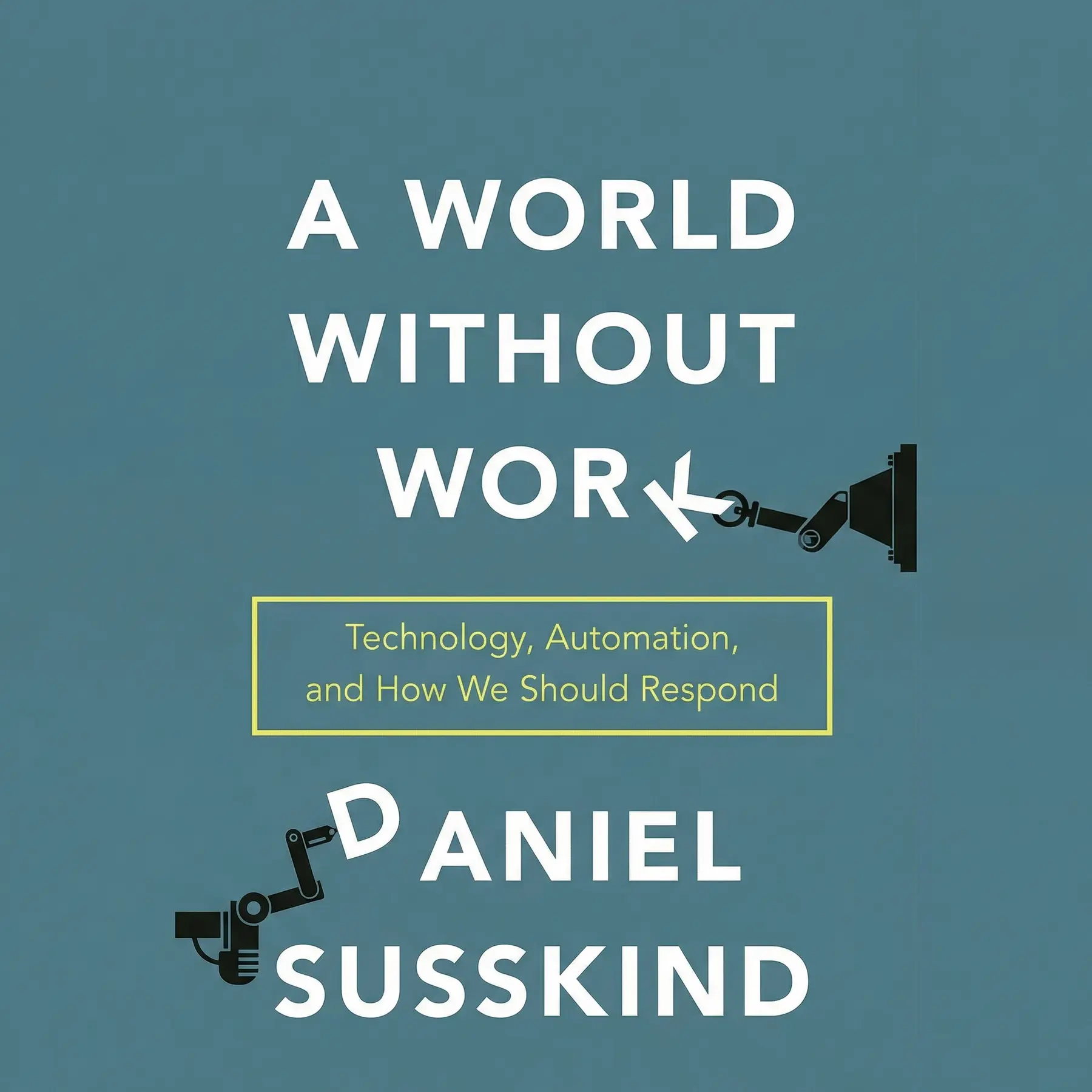
Growth: A History and a Reckoning
Daniel Susskind
 English
Shows which kinds of work automation helps, which it threatens and why artificial intelligence changes the old rules. It also explains why a shrinking need for human labor would make sharing wealth a job for the state.

1 min 02 sec
If you worry that a machine might one day do your job, you may be asking too narrow a question. In A World Without Work, Daniel Susskind, a researcher at King’s College London, shows that technology has always taken some tasks from people while making them better at others, and that second effect is why work has survived so many waves of invention.
His warning is that the balance is now tipping. Artificial intelligence learned to solve problems in ways no human would, which puts even creative and judgment-heavy work within reach. Over the coming decades, Susskind expects output to keep growing while the work left for people shrinks, and the gains to flow to those who own the machines. Sharing the wealth then becomes a task for the state.
Follow his reasoning and you can judge which parts of your own work are exposed, read the robot headlines with a cooler eye and take a clear position on who should get a slice of a growing economy.
1 min 47 sec
Weavers once smashed the machines they feared would end their trade. Decades of evidence, from cloth mills to cash machines, suggest that replacement is only half of what new technology does to work.
1 min 46 sec
Computers once made the educated richer, and mechanical looms once did the opposite. A simple distinction from three MIT economists explains who wins and who loses, and why that answer keeps shifting.
1 min 44 sec
For decades, the smartest minds in artificial intelligence tried to teach computers to reason like chess grandmasters, and they hit a wall. What finally worked changes how you should judge any job’s exposure.
1 min 56 sec
In Japan drones now do 90 percent of crop-spraying, and a robot guides patients around some Belgian hospitals. Yet a machine being able to do a job is not the same as a machine getting it, and the gap varies by country.
1 min 51 sec
Automation creates new jobs, the optimists say, and they are partly right. But some obstacles to filling those jobs fade with time, while one kind grows stronger as the machines improve.
1 min 48 sec
The world now produces enough for everyone to live comfortably, yet the gap between top and bottom keeps widening. A simple split between two kinds of capital explains why, and who automation is likely to leave behind.
1 min 45 sec
Today’s welfare systems assume nearly everyone has a job. Susskind sketches what replaces them when that assumption fails, and why he thinks a basic income paid to everyone could split communities apart.
1 min 17 sec
Susskind asks his readers to hold two thoughts at once. Ever since the Luddites smashed the first looms, machines have made workers more productive and the pie bigger, which is why the darkest fears about technology kept failing to come true. Yet the same machines, now finding answers no human would, are moving into the non-routine work that once looked out of reach. The danger he sees ahead is less a shortage of wealth than a shortage of ways to share it, once wages stop doing that job.
His single piece of practical advice is modest and worth taking. Look at the dull, high-volume parts of your work and hand them to software that can scan documents, organize data or find patterns you would miss, the way skilled engineers already do. Look for the mundane, high-volume tasks in your week, like scanning documents or organizing data, and let software take them on. And when someone promises that technology always creates new jobs, remember the bank teller and the taxi driver: one machine made room for more tellers, the other is designed to need no driver at all.
Whether machines can do the work is already settled. What remains open is who will own them, and how everyone else will get a share.
Talk about robots and jobs tends to swing between panic and reassurance. Daniel Susskind takes a calmer and more unsettling line. He agrees with the optimists that machines have usually made workers more productive and the economy larger, as the spread of ATMs alongside more bank tellers shows. He then explains why that pattern may not hold. The turning point, in his account, came when artificial intelligence stopped trying to copy human thinking and began finding its own solutions in huge amounts of data. That shift lets machines take on creative, judgment-heavy and even emotional tasks that economists once considered safe. Adoption will be uneven across countries, and new jobs will not always suit the people who lost old ones. Over decades, Susskind expects output to keep rising while the work left for humans shrinks. Because most people live on their skills and own little else, he argues the gains will flow to owners of capital, as rising inequality already suggests. His answer is a Big State that taxes the winners of automation and supports others through a Conditional Basic Income. Readers get a clear way to judge which tasks are exposed and how to think about who should share the rewards.
Professionals who wonder which parts of their job software could take over.
Career switchers and students choosing skills that will hold their value as AI spreads.
Managers and policy-minded readers who want a clear case for how automation's gains should be shared.
Daniel Susskind holds a research professorship at King's College London and has a research role linked to the Institute for Ethics in AI at Oxford University. He has worked in UK government, including the Prime Minister's Strategy Unit, the Policy Unit at 10 Downing Street and the Cabinet Office, and was a Kennedy Scholar at Harvard. A World Without Work was runner-up for the Financial Times business book prize in 2020. He also co-wrote the best seller The Future of the Professions.
Daniel Susskind
Listeners view this work as a stimulating and research-backed examination of how automation and artificial intelligence are set to transform employment. While there are mixed feelings regarding whether the author's suggested policy fixes are practical, listeners value the deep historical background and systematic way he clarifies intricate economic changes. Furthermore, they find the illustrative examples useful, and one listener highlights that the sections on "task encroachment" and the evolution of bank tellers are especially beneficial. Many also point out that the writing is high-quality and offers a pertinent model for grasping the fundamental shifts happening in today's workforce.
The concept of 'task encroachment' alone makes this required reading for anyone concerned about their career longevity. Susskind brilliantly explains why this time actually is different, moving past the tired Luddite arguments to show how AI is solving problems in ways that don't just mimic human intelligence. I was fascinated by the breakdown of the "manure crisis" and how it parallels our current technological crossroads. The writing is meticulous and methodical, yet it maintains a sense of urgency that kept me turning pages late into the night. Look, we can't just rely on "learning new skills" if the machines are moving faster than our ability to adapt. This book provides the intellectual tools to discuss that uncomfortable reality. It’s a powerful, well-documented piece of work that doesn't shy away from the dark undertones of a post-work society.
Show moreFinally, an economist who writes with both clarity and a sense of urgency regarding the structural changes in our economy. This book is a masterpiece of synthesis, pulling together history, technology, and policy into a cohesive narrative. I was especially struck by the way he reframed the Luddite movement; they weren't just anti-progress, they were pro-fairness. Susskind’s argument that we are heading toward a world with less economically valuable work for humans is both terrifying and deeply convincing. The way he handles the "frictional vs structural" unemployment debate is some of the best writing I've seen on the subject. Not gonna lie, the future he describes is daunting, but he provides a necessary roadmap for the conversations we need to be having now. If you want to understand the future of work beyond the headlines, start here. It is absolutely essential.
Show moreSusskind offers a remarkably sober look at a future we usually only see in dystopian sci-fi. Instead of the typical alarmist rhetoric, he provides a well-documented analysis of how "task encroachment" slowly erodes even the most specialized human roles. I found the section on bank tellers particularly illuminating; it perfectly illustrates how technology doesn't just replace us but fundamentally shifts what value we bring to the table. Truth is, many of his points about the hollowing out of the middle class feel undeniably relevant in today's gig economy. My only real gripe is that the book gets a bit repetitive in the middle chapters. He tends to hammer home the same economic theories about the "bigger pie" effect more than necessary. Still, it is a well-crafted framework for anyone trying to understand the structural changes occurring in the labor market right now.
Show moreThis isn't your typical manifesto about robots coming for your cubicle. Susskind has crafted a very thoughtful and highly plausible analysis of the shift from routine to non-routine task automation. I particularly liked how he challenged the assumption that we can simply educate our way out of this crisis. The reality is that the hollowing out of the middle class is a structural issue, not just a lack of skills. Some might find his prose a bit reiterative, but I think the repetition helps solidify the complex economic concepts he introduces. Frankly, I walked away with a much better understanding of why traditional economic models are failing to predict the current labor market shifts. It’s a relevant framework that avoids the trap of technological determinism while still acknowledging that major change is inevitable. Definitely worth the time for the historical context alone.
Show moreAs someone who has worked in tech for years, I found Susskind’s distinction between substitution and complementarity to be spot on. He avoids the easy answers and instead digs into the messy reality of how software is "eating the world." The discussion on AlphaGo was a great way to illustrate that machines are no longer just riding the coattails of human intelligence. However, I do think he overestimates how quickly these changes will be implemented across all industries. In my experience, large firms are often remarkably slow to adopt even basic AI tools because of internal bureaucracy. Despite that, the book is a thought-provoking look at the long-term horizon. It’s well-written and adds a lot of depth to the general discussion about UBI and the role of the state. A very solid 4-star read for the intellectually curious.
Show moreWow, the section on the 'hollowing out' of middle-income jobs really hit home for me. It’s one thing to see it in the news, but Susskind provides the data and the economic theory to explain why it's happening so rapidly. I appreciated the methodical approach he took to explaining how machines have moved from following rules to creating their own. It’s a bit of a dark read at times, especially when he discusses the potential for permanent displacement of the workforce. However, his writing is characteristically British—refined, slightly dry, and very precise. I do wish he had spent more time on the man-machine interface side of things, as that seems like a more likely middle ground than total displacement. Nevertheless, it is a well-crafted and relevant book for anyone trying to navigate the modern labor market. A very insightful read.
Show moreAfter hearing Susskind on several podcasts, I was eager to see if the book lived up to the hype. It mostly does, offering a very thorough and careful analysis of the "task encroachment" phenomenon. He does a great job of explaining why the old advice of "just get a degree" is becoming less effective in an age of advanced AI. To be fair, the second half where he proposes solutions like the "Big State" and redistribution felt a bit rushed compared to the excellent economic history in the first half. I also found some of his points about "ancient wisdom" a bit of a weird detour from the main argument. Regardless, the book is a good, well-documented resource that provides a lot of food for thought. It’s a relevant framework for understanding why our current education and employment systems feel so broken. Worth reading for the context.
Show morePicked this up because I keep hearing about AI taking our jobs and I wanted a balanced perspective. It started strong with a great historical context, especially the parts about how we’ve survived previous industrial revolutions. But as I kept reading, the tone shifted into something that felt more like a dry textbook than a call to action. I appreciate the examples, like the bank teller evolution, but I felt like I could have gotten the same information from a long-form essay. To be fair, Susskind is a clear thinker, and his points about the "changing pie" effect are well-argued. I just found the second half a bit characterless and lacking in humor or charm. It’s a decent overview if you’re new to the topic, but it doesn't offer many practical steps for the average worker.
Show moreEver wonder if we are just overthinking the impact of technology based on past cycles that didn't actually end the world? Susskind tries to answer that, but I’m not entirely sure he succeeds in proving this time is truly unique. He brings up great historical examples like the ATM, but then makes a huge leap to a "nightmare scenario" that feels more like an interesting hypothetical than a certainty. The truth is, there’s some smoke here but very little fire in terms of immediate evidence. The book is well-documented, but the pace is quite slow and it can be a bit of a slog to get through the academic jargon. I did find the discussion on the meaning of work quite poignant, as it touches on a very human fear of obsolescence. Overall, it’s a bit too repetitive for my taste, though the core thesis is certainly worth considering.
Show moreWhile the initial chapters provide a solid grounding in economic history, the second half of this book drifts into a bizarrely optimistic political fantasy. The author seems to believe that a benevolent "Big State" will simply step in to provide meaning and resources once the machines take over, which is frankly laughable given our current political climate. He apparently is not much of a student of history if he thinks wealth redistribution on that scale will happen without massive social upheaval. To be fair, his explanation of how modern AI differs from old-school programming is clear and accessible. However, the disconnect between his technical observations and his proposed solutions is just too wide to bridge. It’s an interesting hypothetical, but the conclusions feel detached from how power actually functions in the real world. Not as insightful as I had hoped.
Show moreDaniel Susskind argues that machines have long complemented workers and grown the economy, but artificial intelligence now solves problems in its own way and is reaching non-routine tasks once thought safe. Over decades, he expects less work for humans even as output rises. Because most people live on their skills, the gains will flow to owners of capital, so the state must take on the job of sharing wealth.
Recent trends point to a squeeze in the middle: more cleaners and lawyers, fewer secretaries and salespeople. Following three MIT economists, Susskind explains that routine tasks are easiest to turn into algorithms. He warns, though, that because modern AI learns from data rather than copying human reasoning, creative, judgment-based and even emotional work is no longer safe.
The Big State is Susskind’s replacement for the welfare state, designed for a world with too little work. It taxes those who gain from automation, such as highly paid tech workers, capital owners and companies profiting from automating, then passes money to those harmed. Instead of a Universal Basic Income for everyone, he proposes a Conditional Basic Income paid to people meeting certain criteria within a community.
Use technology to boost your own productivity on mundane, high-volume tasks, for example software that scans documents, organizes data or finds patterns you would miss. Sort your work into routine and non-routine tasks to see what is most exposed. And when you hear that automation always creates new jobs, ask who can actually fill them and whether they will still need a person.
It suits professionals and students wondering how AI will affect their work, managers deciding where to automate, and readers interested in inequality and policy. The book combines history, from the Luddites to ATMs, with recent AI progress and a concrete proposal for how governments should respond when work no longer gives everyone a share of the economy.

Kai-Fu Lee






Andrew Ross Sorkin

Ha-Joon Chang
Niall Kishtainy
AUDIO SUMMARY AVAILABLE
Get the key ideas from A World Without Work by Daniel Susskind, plus 5,000+ more nonfiction titles.









