

14 min
Available in: English
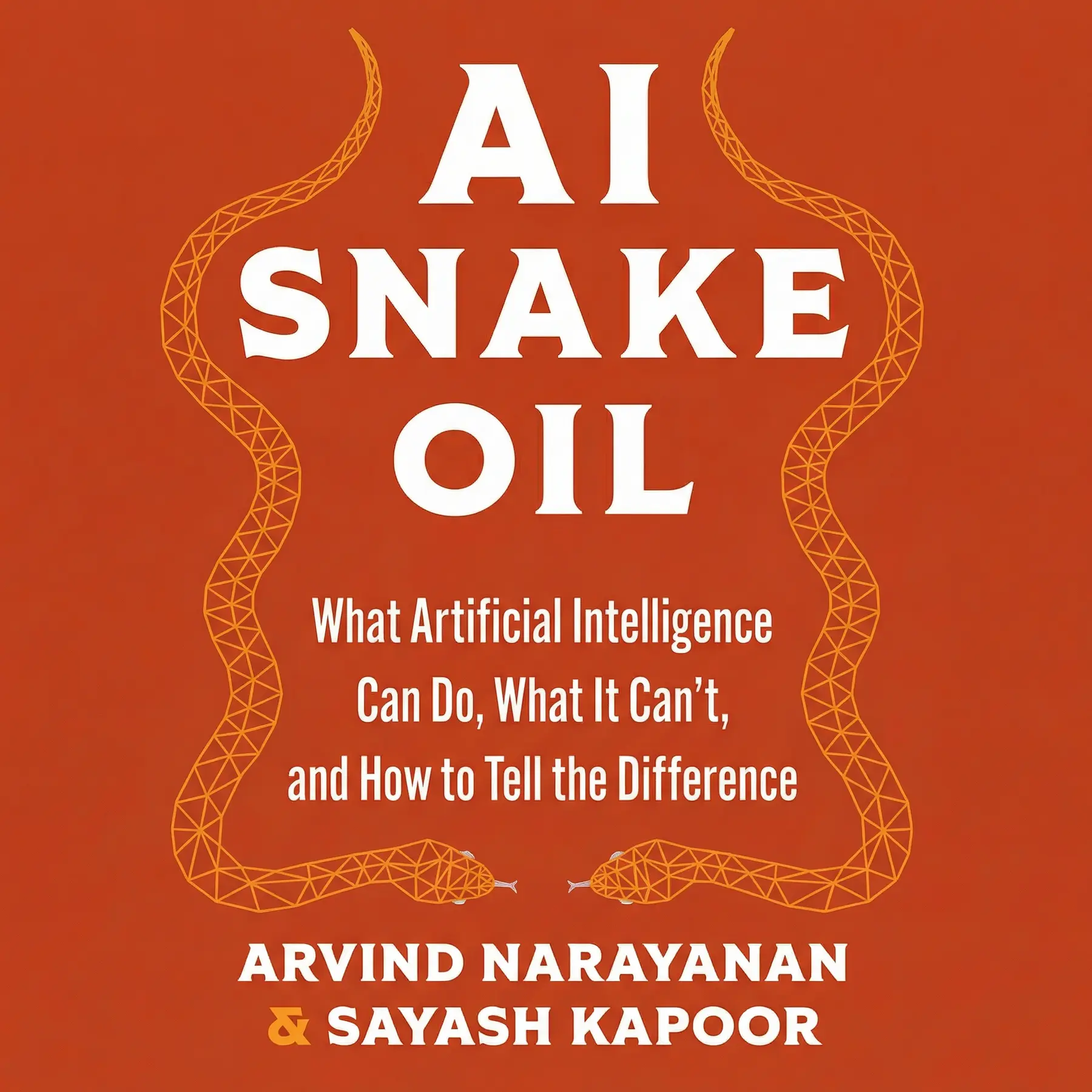
AI Snake Oil: What Artificial Intelligence Can Do, What It Can’t, and How to Tell the Difference
Shows how to tell AI that works from AI that is oversold. Generative tools and image recognition have made real progress. Systems that claim to predict people's futures or judge what posts mean often fall short.

Table of Content
1. Introduction
1 min 05 sec
If every new AI product sounds like magic, you have no way to tell which ones deserve your trust, your budget or your data. In AI Snake Oil, Princeton computer scientists Arvind Narayanan and Sayash Kapoor argue that the label AI covers very different technologies, and that some of them work while others barely work at all. Tools that create text and images, or recognize what is in a photo, have made real progress. Tools that claim to predict a person’s future, or to judge the meaning of a post, are another story.
That distinction is the spine of the book. Once you know which kind of AI you are looking at, you can use it where it adds value, spot the inflated claims and push for rules that protect people. Ahead are a few sharp questions to put to any AI pitch, a clearer picture of who pays the hidden costs, and the authors’ reasons for thinking the future of AI is still open.
2. Use chatbots for drafts, not for facts
1 min 46 sec
An app for blind users shows generative AI at its most helpful, even though human volunteers still do the job better. The catch lies in how chatbots build their answers, and it changes what you should trust them with.
3. See the people who pay for generated images
1 min 51 sec
Behind every polished AI picture are artists who were never asked and workers who were barely paid. And the same skill that sorts photos so well has a darker use that few users stop to consider.
4. Spot when accurate predictions still lead to bad decisions
1 min 59 sec
A forecast can be right and the choice built on it can still go wrong. Medicine learned long ago how to close that gap, and most prediction software skips the very step that makes the difference.
5. Accept that some futures cannot be forecast
1 min 58 sec
Résumé-screening software was meant to find the best candidates, yet it often teaches applicants to hide who they are. The deeper reason institutions keep buying such tools says more about us than about the machines.
6. Expect moderation software to miss the context
1 min 56 sec
A machine that never tires should be the perfect referee for millions of daily posts. Instead it removes the wrong things and misses others, for reasons that better code alone is unlikely to fix.
7. Steer AI with better rules and incentives
2 min 03 sec
Many people assume AI needs a brand new rulebook and that it will wipe out whole professions. The authors disagree on both counts, and their alternative puts more power in public hands than most expect.
8. Conclusion
1 min 22 sec
The book’s title points at a familiar kind of product: technology that claims to work magic and often does not work at all. What Narayanan and Kapoor offer against it is a habit of asking which kind of AI is in front of you. Image recognition and text generation have made real progress, sometimes so much that they raise fears about privacy and creative ownership. Predictions about individual lives and judgments about meaning remain weak, however confident the sales pitch. The authors do not ask anyone to reject the technology. They ask for a clear, evidence-based view, and they argue that knowing the limits is what lets developers, policymakers and ordinary users put their effort where AI truly helps.
That view turns into small acts. Check the facts a chatbot gives you before you pass them on. When a tool promises to forecast a person’s future, ask how it was tested and on whom, and make sure a named human still owns the decision. And when the debate turns to AI and jobs or AI and speech, look past the software to the incentives and the rules behind it.
The future the authors want, with AI working alongside human intelligence, is still being decided, and every question we ask shapes it.
About this book
What is this book about?
Every week brings a new AI product that promises to transform work, hiring, health or the internet. Some of these tools do what they claim. Others barely work at all. Without a way to tell them apart, managers, buyers and citizens end up trusting the wrong things. Princeton computer scientists Arvind Narayanan and Sayash Kapoor argue that the word AI hides very different technologies. Generative AI, which produces text and images, and image classification have made real progress, though they bring problems with copyright, low-paid data labeling and surveillance. Predictive AI, which claims to forecast who will succeed at a job or commit a crime, is where they find the most exaggerated claims. It learns from biased past data, it is easy to game and it often fails when used on new groups. Content moderation AI, meanwhile, struggles with context, culture and constant change. Readers get a practical set of questions to ask about any AI pitch. They also get a clear view of who carries the hidden costs, and the authors' case that openness, better-funded regulators and fair labor policy can still steer AI toward the public good.
Book Information
Who it's for
Deciding on AI tools
Managers and buyers asked to approve AI tools for hiring, customer service or risk scoring.
Professionals using chatbots daily
Professionals who use chatbots daily and want to know when to trust them.
Cutting through AI hype
Policy watchers, moderators and citizens trying to separate real AI progress from hype.
About the Author
Arvind Narayanan
Arvind Narayanan is a computer science professor at Princeton University and directs its Center for Information Technology Policy. He studies machine learning, data de-anonymization and the social effects of AI, and he has received the Presidential Early Career Award for Scientists and Engineers. Sayash Kapoor is a Princeton computer scientist who researches reproducibility, openness and accountability in AI. He has published in Science and PNAS and won a best paper prize at FAccT. TIME named both authors to its first list of the 100 most influential people in AI.
Ratings & Reviews
Ratings at a glance
What people think
Listeners find this work highly educational and thoroughly investigated, offering a fair perspective on how AI affects society. Its accessible writing style is a highlight, with one listener mentioning that it is especially appropriate for a non-expert audience. The material earns praise for its in-depth information, practical utility, and overall worth for the price.
Top reviews
Chanpen
After hearing so much hype about AGI, this book felt like a much-needed splash of cold water. Narayanan and Kapoor do a stellar job breaking down why we keep falling for the same marketing tricks. They distinguish between predictive AI, which often fails to outperform simple statistics, and generative AI, which actually shows promise but carries its own risks. I found the section on how algorithms are used in the justice system to be particularly sobering. The authors don't just complain; they provide a well-researched framework for identifying when a company is selling you a solution that doesn't actually work. It’s accessible, yet deep enough to feel like you've actually learned something substantial. If you're tired of the breathless tech-bro narratives, this is your antidote.
Show moreMason
Wow, the chapter on existential risk should be mandatory reading for every lawmaker in Washington right now. The authors masterfully dismantle the 'AI doomer' narrative by focusing on tangible, present-day harms rather than sci-fi nightmares. It’s refreshing to see a focus on how humans misuse these tools instead of worrying about an autonomous Skynet. My only gripe is that they were a bit too sanguine about the environmental costs, which felt like a massive omission for a book so focused on ethics. Regardless, the way they separate 'snake oil' from genuine utility is brilliant. It changed the way I look at every 'AI-powered' startup pitch I see on LinkedIn. Highly recommended for anyone who wants to stop being fooled by the marketing machine.
Show morePakpoom
Finally got around to reading this, and it’s the most sensible take on the 'snake oil' side of the industry I’ve encountered. Many authors today seem to think AI is either magic or a demon, but Narayanan and Kapoor treat it like what it is: software. They expose how many 'AI' systems are actually just humans behind a curtain or broken statistical models that can’t predict the future any better than a coin toss. It’s a very informative read that doesn’t shy away from the gritty details of how these systems are trained and deployed. I loved the focus on reproducibility and the call for better laws against deceptive marketing. If you want to understand the reality behind the buzzwords, this is the book to buy. It’s easily the best tech book I’ve read this year.
Show moreCha
Ever wonder why AI seems to fail at the most basic human tasks while dominating the headlines? This book provides the answer by exposing the gap between what companies promise and what the tech actually delivers. The authors highlight how 'predictive AI' is frequently used to justify bias in hiring and bail decisions under the guise of objectivity. I was particularly struck by the chapter on social media moderation, which correctly identifies that human judgment is still the bottleneck. The writing is punchy and moves fast, though sometimes it feels a bit breathless in its attempt to cover every societal ill at once. Despite that, the insights into how we categorize different types of machine learning are incredibly valuable. It’s a necessary reality check for anyone living in the digital age.
Show moreMaksim
Narayanan and Kapoor have managed to turn a dense, jargon-heavy subject into something incredibly readable for the average person. I picked this up because I was confused by the conflicting news reports about AI taking our jobs and ending the world. This book provides a balanced, well-researched perspective that cuts through the noise. It’s worth the price of admission just for the explanation of why 'predictive' models for things like child welfare often cause more harm than good. The tone is informative without being condescending, which is a rare find in tech literature today. It’s a great value for anyone who wants to be a more informed citizen. You don't need a computer science degree to follow along, but you’ll feel like you have one by the end.
Show morePrinya
As someone who works in healthcare, the section on predictive AI in hospitals was particularly illuminating and slightly terrifying. We are often pushed to adopt these 'efficient' new tools without actually understanding if they work better than a seasoned nurse's intuition. This book gave me the vocabulary to push back against the hype and demand better evidence for the models we use. The authors' distinction between generative and predictive systems is a masterclass in making complex ideas accessible. I did find the content moderation chapter a bit out of place, as it felt more like a critique of Facebook than a deep dive into AI architecture. Still, the overall message is powerful and incredibly timely. It’s a balanced look at a technology that is too often either worshipped or feared.
Show moreDarawan
To be fair, the distinction between predictive and generative AI is a masterclass in clarity, even if the content moderation section felt a bit bolted on. The authors are at their best when they are deconstructing the failures of machine learning in high-stakes environments like hiring and policing. They show how 'bias' isn't just a bug, but often a fundamental feature of models trained on historical data. I wish they had engaged more with the literature on how these systems can actually outperform flawed human judges, rather than just pointing out the AI's mistakes. It feels a bit one-sided in that regard. However, the writing is sharp and the research is clearly top-notch. It’s a great starting point for a conversation, even if it doesn't provide all the answers.
Show moreTak
This book is clearly aimed at a non-technical audience, which is fine, but it left me wanting more depth. For those of us already working in data science, the explanations of 'leakage' or basic statistical models feel a bit like an undergrad lecture. I appreciated the skepticism toward AI hype, yet I was frustrated by the lack of discussion regarding recent breakthroughs in scaling laws. It feels a bit odd to read a 2024 release that leans so heavily on older studies involving GPT-2. Still, it serves as a decent primer for my non-tech friends who are worried about the 'robot apocalypse.' It’s a solid 3-star read—informative for some, but perhaps too surface-level for others who want a materialist narrative of the industry.
Show moreUbolrat
Frankly, I appreciated the skepticism toward tech-solutionism, but the authors seem to have a weird hang-up regarding capitalism that colors every conclusion. They make some excellent points about how predictive AI is often just a fancy way to automate discrimination. However, when they start critiquing the wages of data annotators in Kenya, it feels like they’re straying from the technology into pure political demagoguery. Why compare a low-wage worker’s salary to a top engineer’s? It’s a bit one-sided and ignores that these jobs might be the best available option for those workers. The technical sections are solid, especially the discussion on data leakage, but the policy recommendations feel deeply misguided at times. It’s a mixed bag that offers great warnings but flawed solutions.
Show moreTong
The truth is, I found this remarkably dated for a book published in 2024. How can you write a definitive guide to 'AI Snake Oil' without a deep dive into agents or the current hyperscaling race? Relying on examples from GPT-2 feels like bringing a knife to a gunfight in the current tech landscape. While I agree that much of the predictive AI on the market is garbage, the authors' dismissal of recent generative advances feels overly cynical. They seem more interested in critiquing capitalism than explaining the actual algorithmic breakthroughs that make this era different. It’s a shame because the core premise is vital, but the execution misses the mark by ignoring the very capabilities that are changing the world right now. Not recommended for technical readers.
Show moreQuestions about this book
What is the main idea of AI Snake Oil?
Arvind Narayanan and Sayash Kapoor argue that AI is not one technology but several. Generative AI and image classification have made real progress, while predictive AI, which claims to forecast outcomes like job success or crime, is often overhyped and harmful. Content moderation AI struggles with context and culture. Knowing which kind you face lets you use AI where it adds value and avoid misguided uses.
Why do the authors distrust predictive AI?
They give several reasons. Predictive models learn from past data, so they repeat old biases and often fail when applied to a different population. They rarely test how their own decisions change outcomes, unlike randomized controlled trials in medicine. They can be gamed, as when job seekers tailor résumés to screening software. And companies often blame missing human oversight when the systems fail.
Are chatbots reliable according to AI Snake Oil?
Not for facts. The authors explain that chatbots produce text by predicting likely sequences of words rather than by understanding context. That makes their answers sound convincing even when they are wrong, so the authors consider them largely unreliable for tasks that demand factual accuracy. They can still be useful, much as Be My Eyes helps visually impaired users by describing images at any hour.
Will AI take away jobs, according to Narayanan and Kapoor?
They expect AI to follow earlier waves of automation, which rarely wiped out entire job categories. Instead, automation tends to reshape tasks, create new roles and change what employers need. Demand for some roles will fall. They mention a robot tax on companies that profit from automation as one way to encourage keeping human workers, while noting that labor inequality predates AI.
How can I apply the ideas in AI Snake Oil?
Check chatbot answers before relying on them. When offered a predictive tool, ask whether it was tested by acting on its predictions and whether it was trained on people like those it will judge. Keep a human accountable for important decisions. When buying AI, ask where the training data came from and who labeled it, and support well-funded regulators and open development.
Featured in
Readers also enjoyed








AUDIO SUMMARY AVAILABLE
Listen to AI Snake Oil in 15 minutes
Get the key ideas from AI Snake Oil by Arvind Narayanan, plus 5,000+ more nonfiction titles.
- 5,000+ titles
- Listen as much as you want
- 7-day free trial
- Cancel anytime









