

13 min 32 sec
Available in: English
The Chaos Machine: The Inside Story of How Social Media Rewired Our Minds and Our World
By Max Fisher
Max Fisher shows how Facebook, Twitter and YouTube were designed to exploit our need for approval, our small-group brains and our appetite for outrage, and how that design spilled into harm far beyond the screen.
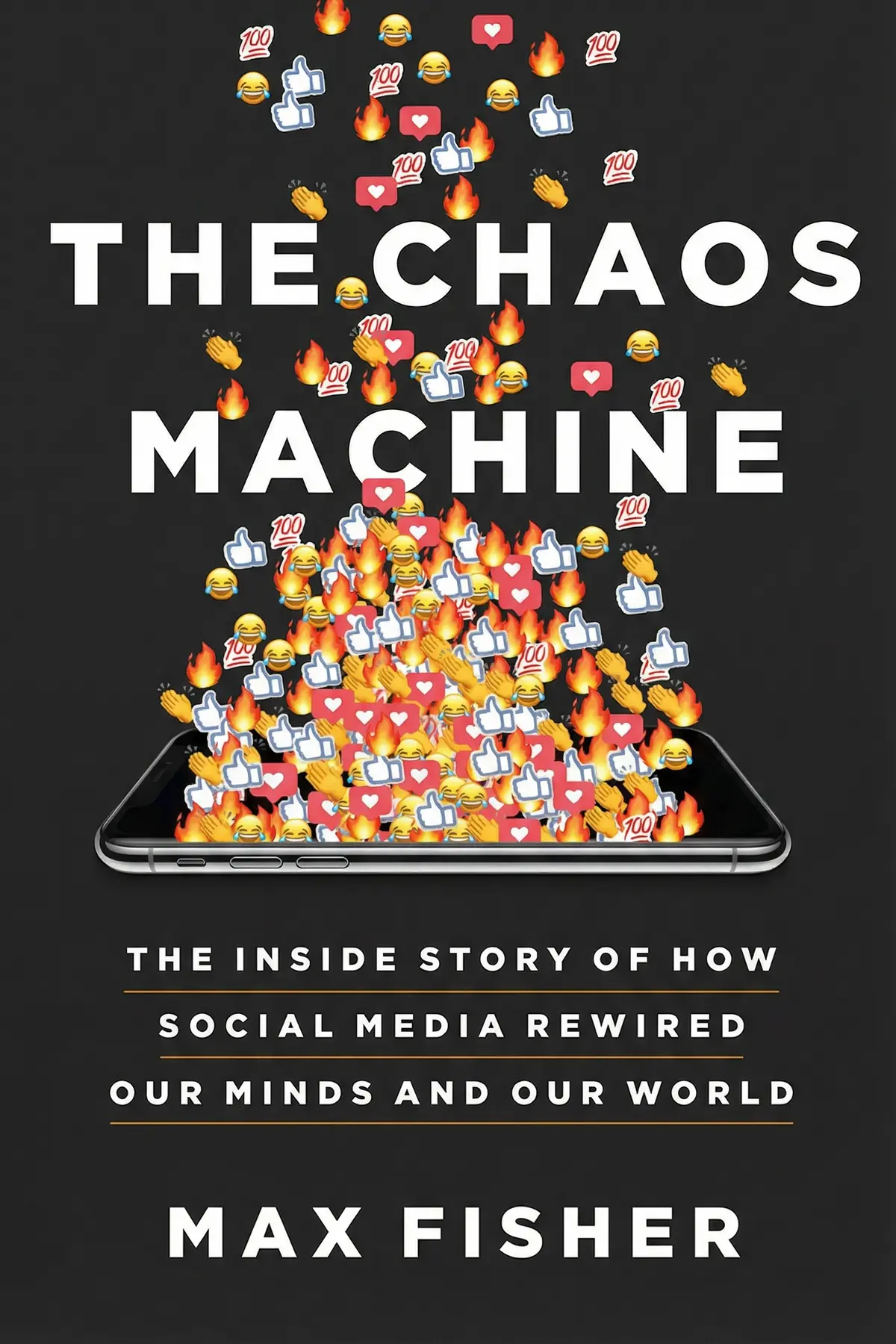
Table of Content
1. Introduction
1 min 01 sec
If your first move each morning is to check who liked your post, that pull was built for you on purpose. In The Chaos Machine, New York Times journalist Max Fisher argues that Facebook, Twitter and similar platforms were engineered to exploit weak spots in human psychology. He says their effects now reach far beyond our screens, from pandemic misinformation to a mob inside the Capitol.
One idea runs through his case. Instincts that once held small human groups together are being turned, for profit, into a machine that pulls whole societies apart. Fisher builds it from interviews with senior people inside these companies, from a researcher who tracked anti-vaccine groups and from a whistleblower who brought Facebook’s own documents into the open. With his argument in hand, you can spot the hooks in your own feed, see why online crowds turn cruel so fast and judge why some experts now want parts of the machine switched off.
2. Spot the slot machine built into your feed
1 min 50 sec
Some posts draw a flood of likes and others get silence, and that unpredictability is no flaw. A former Facebook president explained what the apps were really built to capture, and it changes how the urge to check feels.
3. Too many connections make people more hostile
1 min 48 sec
Facebook found a way to restart its stalled growth by widening every user’s circle. It looked like more connection, but studies of monkeys hint at what happens when a brain built for small groups meets a crowd.
4. Spot the path from parenting group to extremism
1 min 38 sec
A new parent looking for sleep tips can end up reading claims about manufactured viruses within a few clicks. A researcher who tracked anti-vaccine groups found that the route is built into the recommendations.
5. Hold back before joining an online pile-on
1 min 54 sec
A viral video from a New York park ended with a woman losing her job and briefly giving up her dog. Even the man who filmed it had second thoughts, and the reason goes back to our earliest groups.
6. Trace how online fury became real violence
2 min 06 sec
For years the platforms barely touched hateful posts and false claims. When they finally acted, many users were already convinced of a story that carried them to a building in Washington and, for one woman, to her death.
7. Understand why platforms will not fix themselves
2 min 05 sec
In public, Facebook’s leaders played down the harm. In private, their own documents told a different story. A whistleblower proposed one blunt remedy, and a classic science fiction film offers a grim parallel.
8. Conclusion
1 min 10 sec
Fisher’s argument is that the chaos did not come from human nature alone. Our hunger for approval, our small-group brains and our old taste for punishing rule breakers were each useful once. Platforms built for engagement found every one of them and turned it up, and profits rose along with the damage. That is why his tobacco comparison fits. The harm was known inside the company, and the business model made fixing it unattractive.
That gives each user more power than it seems, because every hook needs a response to work. Notice the slot-machine moment when your hand reaches for the phone, and ask what payout you are waiting for. Trim the distant ties the platform added on its own. When a post makes you furious and a crowd is gathering, wait before adding your voice, and ask whether the punishment fits. And when a feed leads you from one claim to a stranger one, trace back the steps you never chose.
The crew in 2001 did not hate HAL. They simply decided that people, not the machine, would be in control.
About this book
What is this book about?
Many people start the day by checking how many likes and comments came in overnight. Max Fisher, a New York Times journalist who covers world affairs, argues that this pull is no accident. Platforms like Facebook and Twitter were designed to keep people hooked, and they work on psychological weak spots that once helped small human groups survive. Fisher follows that design from the slot-machine rewards of a single post to the algorithm that pushed users past their natural social limits and steered them from ordinary groups toward conspiracy theories. He shows how online moral outrage turns a viral video into a public punishment and how misinformation fed the anger behind the storming of the Capitol on January 6, 2021. Leaked documents from the whistleblower Frances Haugen showed that Facebook knew about many of these harms. Readers learn to recognize the hooks in their own feeds, why online crowds turn cruel so quickly and why some experts now argue that parts of the machine should be switched off.
Book Information
Who it's for
Checking likes every morning
Anyone who checks likes first thing in the morning and wants to know why the habit is so hard to break.
Worried parents and professionals
Parents and professionals worried about how feeds drive outrage, conspiracy theories and political anger.
Curious about January 6
Readers who want to understand how platform design led to January 6.
About the Author
Max Fisher
Max Fisher covers world affairs for the New York Times, where he writes The Interpreter, a column that explains global trends and major news events. He contributed to a Times series on social media that was a finalist for the 2019 Pulitzer Prize. Before joining the Times, he reported on world affairs for The Atlantic and the Washington Post.
Ratings & Reviews
Ratings at a glance

What people think
Listeners find the work to be meticulously researched and skillfully composed, calling it an essential read packed with quality insights. They also value the eye-opening material, as one listener points out the presence of startling disclosures. Conversely, opinions are divided on how the information is structured; one listener observes that the subject matter tends to skip from one point to another. Furthermore, several listeners voice apprehension regarding the writer's partiality, including one who characterizes it as a left-leaning rant against conservatives and gamers.
Top reviews
Somsak
Wow. This was a punch to the gut. I thought I understood how Facebook worked, but the sections on Myanmar and the horrific real-world consequences of algorithmic engagement left me genuinely shaken. Fisher’s writing is sharp and investigative, peeling back the layers of Silicon Valley’s 'optimization' obsession to reveal a much darker reality. While the book is undeniably frightening, it’s a necessary read for anyone with a smartphone in their pocket. We can no longer pretend these platforms are neutral observers when they are actively stoking the fires of ethnic cleansing for profit. This isn't just about 'misinformation'—it's about how the very architecture of the internet was designed to exploit our most primitive tribal instincts. It is a haunting, brilliant piece of reporting.
Show moreMai
Ever wonder why the world feels like it's perpetually on fire? Max Fisher has the answer, and it’s a lot more calculated—and terrifying—than I ever imagined. This book is a masterclass in synthesis, pulling together disparate events from across the globe to show how a single 'Like' button can destabilize an entire democracy. I was especially gripped by the account of how internal warnings at Facebook were repeatedly ignored in favor of growth metrics. It’s a chilling reminder that the people building these tools often have no idea how to control the forces they’ve unleashed. This isn't just a tech book; it's a horror story where the monster is a line of code designed to make us hate our neighbors. Truly eye-opening stuff.
Show moreKasemsan
Fisher has crafted a terrifyingly lucid account of how our digital tools have been weaponized against our own biology. He explains how 250,000 years of evolution are being hijacked by platforms that reward us for moral outrage and social shaming. The prose is clear and absorbing, making complex psychological concepts accessible without ever dumbing them down. I finished this book feeling completely differently about my own social media habits and the 'fast-twitch' social intuition I've developed. It’s a monumental work of reportage that feels like the spiritual successor to other major tech critiques. Truly, this is the definitive guide to how the internet rewired our collective consciousness for the worse. I couldn't put it down.
Show moreNoi
Max Fisher doesn't just explain the 'how' of social media's rise; he exposes the cold, calculated 'why' behind every algorithmic tweak. The revelation that these platforms were essentially built to be addiction machines is handled with such precision that it’s hard to look at your phone the same way again. I was particularly struck by the contrast between the virtuous 'mission' of these companies and the actual devastation they cause in places like Nigeria and Brazil. Fisher avoids the trap of being overly academic, instead focusing on the human cost of these technological failures. This book is a clarion call for regulation that cannot be ignored any longer. It’s easily the most important book I’ve read all year.
Show moreLena
As someone who spends way too much time scrolling, this book was the cold shower I desperately needed. Fisher’s deep dive into the 'Like' button and how it functions as a subversive ploy to boost the bottom line was absolutely eye-opening. I had no idea how much our own brains are being manipulated to crave the very outrage that is destroying our communities. The writing is incredibly moving and impactful, forcing the reader to confront their own role in this 'chaos machine.' It’s a frightening read, yes, but knowledge is the only way we can start to reclaim our focus. Every single person who has a Facebook or YouTube account should be required to read this. It changed my perspective entirely.
Show moreSook
The depth of Fisher's reporting is undeniably impressive, especially when he traces the path from Silicon Valley boardrooms to actual violence in Brazil and Sri Lanka. He captures the 'insidious' nature of the algorithm beautifully, explaining how it prioritizes outrage to keep users glued to their screens. However, I did find the structure a bit repetitive at times; he tends to make the same core argument after every case study. By the third time he explained that anger drives engagement, I was ready to move on to the next point. Despite that, the information is revelatory and well worth your time if you want to understand the modern political landscape. It’s a dense journalistic work that demands your full attention and some serious critical thinking.
Show moreAdam
After hearing so much buzz about this title, I finally dived in and found it mostly lives up to the hype. Fisher is a phenomenal researcher, and his ability to get inside the 'optimization ideology' of Silicon Valley is second to none. My only real gripe is the organization; the book jumps between different countries and time periods in a way that can feel a bit scattered. One chapter you're in 2014, the next you're back in 2018, which made the narrative flow feel disjointed. Still, the individual case studies—particularly the deep dive into YouTube’s 'crisis-solution construct'—are incredibly powerful. It’s a jarring wake-up call that everyone who uses the internet needs to hear, regardless of their political leanings.
Show moreLevi
To be fair, much of what is discussed here isn't exactly 'new' information if you follow tech news, but the way Fisher synthesizes it is masterclass journalism. He connects the dots between Gamergate and global insurrections in a way that is both convincing and deeply depressing. I appreciated his willingness to name names and hold the leaders of Facebook and Google accountable for their 'free speech' defenses. It’s obvious that profits were prioritized over human lives, and Fisher provides the receipts to prove it. The book can be a bit of a slog because it is so incredibly bleak, so maybe don't read it right before bed. It’s an essential, if exhausting, piece of social criticism that everyone should grapple with.
Show moreRohan
I really wanted to like this, but the blatant political bias was impossible to ignore after the first fifty pages. Fisher clearly knows his stuff when it comes to the technical side of things, but his analysis feels heavily skewed toward a specific ideological worldview. Every example of 'extremism' seems to target the same side of the political spectrum, which makes the book feel more like a partisan manifesto than a fair critique of social media as a whole. The 'Chaos Machine' is real, but I think it impacts everyone, not just the groups the author happens to dislike. If you can look past the one-sided framing, there is some solid research here about how YouTube's recommendation engine works. Just take the social commentary with a massive grain of salt.
Show moreErn
Look, the core message is vital, but the execution feels like a series of long-form articles stitched together without a clear roadmap. The author has a habit of repeating his main points ad nauseam, which made me want to skip ahead to the next chapter. While I agree that social media is a disaster for society, the tone here is so consistently catastrophic that it begins to lose its impact. There is very little nuance regarding the actual humans working at these companies; they are all portrayed as comic book villains or mindless optimizers. It’s a good book if you want a refresher on recent history, but it lacks structural elegance. It’s informative but frustratingly repetitive and one-sided at times.
Show moreQuestions about this book
What is The Chaos Machine by Max Fisher about?
Fisher argues that Facebook, Twitter and YouTube were designed to keep users hooked by exploiting old instincts: the need for approval, brains suited to groups of about 150 and the urge to punish rule breakers. Algorithms built for engagement amplified outrage and misinformation, and Fisher links that design to real harm, from anti-vaccine content and violence in Myanmar to the storming of the Capitol on January 6, 2021.
Why is social media so addictive, according to The Chaos Machine?
Fisher points to small dopamine rewards from likes and comments, delivered unpredictably. This technique, intermittent variable reinforcement, works like a slot machine: sometimes a post earns many likes and sometimes none, so people keep posting and scrolling. Former Facebook president Sean Parker said the apps were built to consume as much time and attention as possible and called the result a social-validation feedback loop.
What does the Dunbar number have to do with social media?
Anthropologist Robin Dunbar proposed that people can manage about 150 relationships. In 2013, with growth stalling, Facebook began showing users posts from friends of friends, pushing circles past that limit, and Twitter followed. Fisher cites studies in which larger groups of rhesus monkeys and macaques grew more aggressive and distrustful, and he argues online behavior turned more hostile and radical in the same way.
What did Frances Haugen reveal about Facebook?
In 2021 Haugen gave internal Facebook documents to the Wall Street Journal. They showed that executives had been warned about vaccine misinformation and rising hate speech and did nothing. On 60 Minutes she said Facebook could have changed its algorithm to make the site safer but chose not to, because less time on the site means fewer ad clicks. She proposed turning the algorithm off.
How can I apply the ideas in The Chaos Machine?
Notice when you reach for an app and ask whether you are waiting for a payout. Mute or unfollow the distant ties the platform added for you. Pause before joining an outraged pile-on, as the Central Park case shows how quickly punishment can outgrow the offense. When recommendations lead you toward stranger claims, check whether you chose each step yourself.
Readers also enjoyed


AI 2041: Ten Visions for Our Future
Kai-Fu Lee

Abolish Rent: How Tenants Can End the Housing Crisis
Tracy Rosenthal


Abortion: Our Bodies, Their Lies, and the Truths We Use to
Jessica Valenti


Adults in The Room: My Battle With Europe’s Deep Establishment
Yanis Varoufakis


AUDIO SUMMARY AVAILABLE
Listen to The Chaos Machine in 15 minutes
Get the key ideas from The Chaos Machine by Max Fisher, plus 5,000+ more nonfiction titles.
- 5,000+ titles
- Listen as much as you want
- 7-day free trial
- Cancel anytime









