
15 min 28 sec
Available in: English
The Capitalist Manifesto: Why the Global Free Market Will Save the World
A data-driven defense of free markets that answers the common charges against capitalism, from lost factory jobs and billionaires to tech giants, climate change and loneliness, and shows how to tell real market failures from political ones.
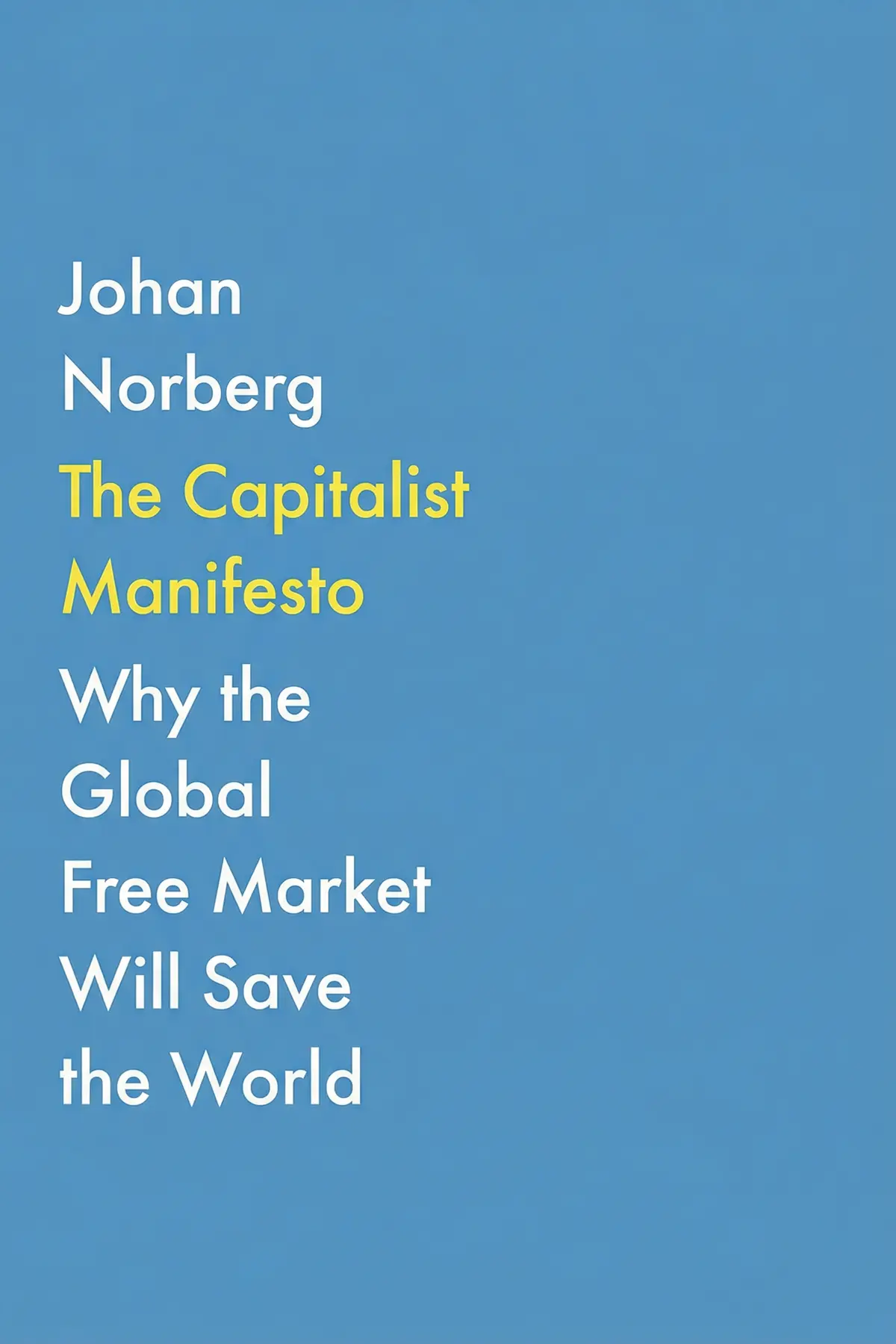
Table of Content
1. Introduction
1 min 05 sec
If the news has convinced you that the global economy is a machine for making most people poorer, Johan Norberg has numbers that point the other way. In The Capitalist Manifesto, the Swedish writer notes that the share of humanity in extreme poverty fell from 38 percent to 29 percent during the 1990s alone, and to around 10 percent by 2015.
Norberg’s case is that open economies, globalization and the entrepreneurs they reward drove much of that change, and that remedies such as degrowth would do little for the climate while hurting economies and livelihoods. The real dangers, he says, lie elsewhere: in populist mismanagement and in businesses that lean on government favors instead of customers.
Across six ideas he answers the commonest charges against capitalism, from vanished factory jobs and billionaire fortunes to tech giants, climate change and loneliness. Each one hands you a sharper question to ask the next time a headline announces that the system is failing.
2. Check the poverty numbers before trusting the gloom
2 min 10 sec
A popular story says the last thirty years of globalization made the world worse. The record Norberg lays out tells a very different tale, and it also shows how quickly a country can throw its gains away.
3. See where factory jobs really went
2 min 03 sec
Blame for empty factories usually lands on cheap imports from abroad. Norberg points to a different culprit, and his numbers suggest the workers who left those factories did not simply vanish into worse lives.
4. Judge a fortune by the value behind it
2 min 06 sec
Few phrases start an argument faster than the top one percent. Norberg defends some of the richest people alive, yet he is fierce about another kind of wealth, and the line he draws is easy to use.
5. Big companies stay big only by staying better
2 min 11 sec
Tech giants look untouchable, and many people fear they own the future. Norberg argues their lead is far more fragile than it appears, and that some rules meant to tame them end up protecting them instead.
6. A richer world can afford a greener one
2 min 16 sec
Shrinking the economy sounds like the obvious answer to a warming planet. The pandemic offered an accidental trial run, and Norberg reads its result as a warning about where climate solutions actually come from.
7. Markets leave room for friendship and meaning
2 min 17 sec
Critics say market societies breed loneliness, anxiety and greed. Norberg goes looking for the evidence behind the so-called loneliness epidemic, and what he reports about generosity and happiness may unsettle a few assumptions.
8. Conclusion
1 min 20 sec
Norberg’s manifesto works like a set of corrections to a story most of us absorbed without checking it. The factory that closed, the billionaire on the magazine cover, the tech giant, the warming planet, the lonely neighbor: each is real, and each, in his reading, sits inside a bigger picture in which open markets have made people richer, healthier and freer. The threats he takes seriously are specific ones. Populists who mismanage an economy, as in Venezuela. Companies kept alive by bailouts and cheap money. Rules that shield incumbents from newcomers. Bans that block the lithium and copper a greener economy needs.
That gives you a new way to read the news. When a headline says the system is failing, look for the long trend before the single story, and ask whether the problem came from markets or from politics bending them. Judge wealth and size by what customers received in return, and weigh climate plans by whether they make clean options cheaper.
A single figure shows the scale of what he describes. Global extreme poverty fell from 38 percent in the 1990s to around 10 percent by 2015, a decline he credits in large part to capitalism and globalization.
About this book
What is this book about?
Many people now take it for granted that capitalism is failing: that globalization emptied factories, billionaires got rich at everyone else's expense, tech giants crush competition, growth is wrecking the planet and market societies leave people lonely. Johan Norberg sets out to test each of those claims against the record. His starting point is the fall in extreme poverty since 1990, from 38 percent of humanity to around 10 percent by 2015. He links that change to economic openness, with Botswana and Mauritius as success stories and Venezuela as a warning. He then argues that automation explains most lost factory jobs, that entrepreneurs keep only a small share of the value they create, that big firms hold their lead only by staying better, and that richer societies are the ones that clean up. Norberg also names what he sees as the real dangers: crony capitalism, bailouts, zombie companies, regulation that shields incumbents and bans that block green materials. Readers get a sharper set of questions to bring to any headline about the economy.
Book Information
Who it's for
Professionals wanting economic evidence
Professionals tired of doom headlines who want the economic record behind them.
Founders and business owners
Founders and small business owners weighing how markets, regulation and big rivals really interact.
Wanting capitalism's strongest case
Students and debaters who want the strongest case for capitalism, including its limits.
About the Author
Johan Norberg
Johan Norberg is a Swedish writer, born in 1973, who studied the History of Ideas at the University of Stockholm. He became a senior fellow at the Cato Institute in Washington, D.C. in 2007, and in 2017 joined Free To Choose Media as an executive editor making documentaries for US public television. His books have appeared in more than 25 countries, and his 2016 book Progress was named a book of the year by The Economist and The Guardian.

Progress: Ten Reasons to Look Forward to the Future
Johan Norberg
Ratings & Reviews
Ratings at a glance

What people think
Listeners find the work outstanding for simplifying intricate economic principles and offering a wealth of data. They value its straightforwardness, with one listener highlighting how it aids in demystifying capitalism. The title earns praise for its accessibility, with one listener describing it as essential reading for those interested in economics.
Top reviews
Pairot
This book is a refreshing breath of air in an era where 'capitalism' has become a dirty word used by people who don't understand it. Norberg manages to take incredibly dense economic theories and break them down into something digestible for the average reader without losing the nuance. I especially appreciated the data-driven approach to how global trade has actually reduced extreme poverty over the last few decades. While some might find his optimism a bit much, it’s hard to argue with the sheer volume of facts he presents. It really clarifies how the free market acts as a catalyst for human progress rather than just a tool for the elite. This is essential reading for anyone who feels like they’re losing the plot in current political debates.
Show moreAom
Finally got around to finishing this, and I have to say the title isn't just clickbait. Norberg provides a robust, modern defense of the market that feels like a necessary update to classical liberal thought. He addresses the '1%' head-on in Chapter 4, arguing that inequality isn't the primary evil if the floor is rising for everyone. Frankly, it’s a bold take that will definitely ruffle feathers, but he backs it up with impressive global statistics. The writing is punchy and moves at a fast pace, making complex topics like carbon taxes and property rights easy to grasp. My only gripe is that he occasionally treats 'socialism' as a monolith, ignoring some of the more successful mixed-economy models. Still, it’s an essential piece of the puzzle for understanding why our world looks the way it does.
Show morePenelope
Wow, this really puts the 'manifesto' back in capitalism. Norberg writes with a passion that is contagious, making a data-heavy subject feel like a thrilling defense of human freedom. He successfully demystifies how markets actually function on the ground versus how they are portrayed in textbooks or on the news. Personally, I think this should be required reading in every introductory economics course to balance out the more pessimistic theories out there. It’s concise, well-argued, and provides a much-needed positive vision for the future of global trade. If you are tired of the constant doom-and-gloom about the economy, read this book immediately. It provides exactly the kind of wide-eyed analysis we need to counter modern stagnation.
Show moreThongchai
One thing Norberg gets absolutely right is the distinction between true free markets and the cronyism we see today. He doesn't shy away from the problems of the current system, but he argues persuasively that the solution is more competition, not more government control. The book is incredibly effective at breaking down why state-controlled economies in places like China are eventually doomed to stagnation. I found the sections on upward mobility and how innovation requires a level of 'freedom to fail' to be particularly inspiring. Frankly, it’s a refreshing change of pace from the usual anti-market rhetoric that dominates the media. The book is packed with facts that help demystify how wealth is actually created and distributed across the globe. Highly recommended for anyone who wants a fact-based look at the benefits of openness.
Show morePruet
Ever wonder why the 1970s look so different from a policy perspective than we were taught? Norberg highlights the surprising reality that it was often center-left leaders like Jimmy Carter who kickstarted the deregulation that saved failing industries. I found the section on the deregulation of aviation and even craft beer to be particularly eye-opening and fun to read. To be fair, he does gloss over some of the harsher social consequences of these shifts, which might rub some readers the wrong way. However, the core argument that openness beats isolationism is incredibly well-supported throughout the text. It’s a compelling polemic that challenges the current drift toward protectionism in both the US and China. Even if you don't agree with everything, the historical context is worth the price of admission.
Show moreDiego
The chapter regarding environmentalism within a free-market framework was the highlight of the whole experience for me. Most people assume capitalism and the planet are natural enemies, but Norberg argues that market-based solutions like carbon taxes are actually more effective than top-down bans. He shows a lot of clarity in explaining how innovation is driven by the freedom to fail and the incentive to improve efficiency. Truth is, some of the arguments about the '1%' saving lives felt a bit hyperbolic and might lose more skeptical readers. Regardless, his defense of globalism over protectionism is timely given the current geopolitical climate we are seeing today. It's a highly readable survey that manages to demystify why trade is a win-win rather than a zero-sum game. Definitely worth picking up if you want to sharpen your understanding of global economics.
Show moreTaw
After hearing so much buzz about Norberg's latest work, I was surprised by how accessible the prose actually was. He centers his argument on the idea that capitalism is truly about the freedom for individuals to make their own economic choices. This perspective is a great way to reframe the discussion away from just 'money and greed' toward human agency and innovation. Not gonna lie, I think he ignores how student debt and low wages can limit that 'freedom' for a lot of people in the middle class. However, his points about how the market has lifted billions out of poverty globally are impossible to ignore. It’s a sophisticated defense of neoliberalism that avoids the typical dry jargon of the genre. It’s a solid four-star read for the clarity and the sheer volume of facts provided.
Show moreNit
Not what I expected from a book with such a provocative title. I thought it would be a dry, ideological rant, but it’s actually a very calm and data-driven exploration of world economics. Norberg’s ability to explain why things like property rights are essential to a functioning society was a nice surprise. Gotta say, his defense of the top earners in the fourth chapter was a bit hard to swallow at times, even if his logic was internally consistent. The book really excels when it shows the human side of capitalism—how it empowers the poor to improve their own lives through trade. It’s a clear, engaging read that avoids the typical traps by acknowledging where current systems are failing. A great addition to any library for those who want to understand the modern economic conjuncture without the fluff.
Show moreFelix
As someone who leans more toward a social democratic model, I found myself arguing with this book on every other page. Norberg is an incredibly talented writer, and his ability to synthesize data is top-notch, yet his perspective feels one-sided. He makes a fascinating case about how Jim Crow laws were actually undermined by 'greedy' capitalists seeking black customers, but it feels like he’s cherry-picking rare exceptions to prove a rule. Look, the book is great at showing how capitalism creates wealth, but it fails to adequately address how that wealth is often used to lobby and distort the very 'free' market he loves. I gave it three stars because it’s a brilliant articulation of the neoliberal worldview, even if I think his dismissal of state intervention is far too hasty. It’s a useful read to understand the 'other side' of the economic argument.
Show moreDao
Picked this up to broaden my horizons, but I left feeling a bit unconvinced by the lack of deep causal analysis. Norberg is great at showing charts where 'Capitalist Country A' is doing better than 'Planned Economy B,' but he doesn't spend enough time on the underlying why. Is it just the market, or is it also a history of stable institutions, geography, or education? To be fair, his writing style is excellent and he makes a very strong case against the recent trend of protectionism. He also provides some really interesting historical tidbits about how various socialist parties were actually the ones to de-socialize places like India and New Zealand. It’s a good book for a specific viewpoint, but it feels more like a polished lawyer's brief than a neutral economic study. Still, it’s a valuable read for anyone interested in the debate.
Show moreQuestions about this book
What is the main argument of The Capitalist Manifesto?
Johan Norberg argues that open markets, free trade and entrepreneurship have driven huge gains since the 1990s, including a fall in extreme poverty from 38 percent of humanity to around 10 percent by 2015. He answers common criticisms one by one and says the real dangers come from populism, crony capitalism, bailouts and regulation that protects incumbents, not from markets themselves.
What does Johan Norberg say about automation and lost factory jobs?
Norberg says automation, not trade, explains 87 percent of manufacturing job losses. Factories became more productive, so output grew even as jobs fell, and spending moved toward services where new work appeared. He reports rising job satisfaction in the United States, frequent moves into better-paid jobs, and cheaper goods that helped low and middle income households most.
Does The Capitalist Manifesto defend billionaires?
Partly. Norberg argues that entrepreneurs keep only a small share of the value they create, and that many former luxuries of the rich are now widely available thanks to figures like Bill Gates and Jeff Bezos. He criticizes Thomas Piketty for overlooking this. But he condemns crony capitalism, bailouts, subsidies and zombie companies kept alive by cheap money and government help.
How does Norberg think capitalism can solve climate change?
He rejects degrowth, noting that pandemic cuts to travel and production lowered emissions only slightly while hurting livelihoods badly. Instead he points to rich countries using fewer resources per unit of output, phasing out freons and replanting forests. He favors carbon taxes, cheaper solar power and trade that spreads green technology, and warns against blocking lithium and copper mining.
How can I apply the ideas in The Capitalist Manifesto?
Use his questions as filters. Check long-term trends before trusting a single alarming story. Ask whether a fortune came from customers or from political favors. Judge big companies by local prices and choice. Assess climate plans by whether they make clean options cheaper. And at work, build skills that complement machines rather than repetitive tasks they can take over.
Readers also enjoyed




A Warning
Miles Taylor

Adults in The Room: My Battle With Europe’s Deep Establishment
Yanis Varoufakis




Abolish Rent: How Tenants Can End the Housing Crisis
Tracy Rosenthal

Abortion: Our Bodies, Their Lies, and the Truths We Use to
Jessica Valenti
AUDIO SUMMARY AVAILABLE
Listen to The Capitalist Manifesto in 15 minutes
Get the key ideas from The Capitalist Manifesto by Johan Norberg, plus 5,000+ more nonfiction titles.
- 5,000+ titles
- Listen as much as you want
- 7-day free trial
- Cancel anytime









