
15 min 28 sec
Available in: English
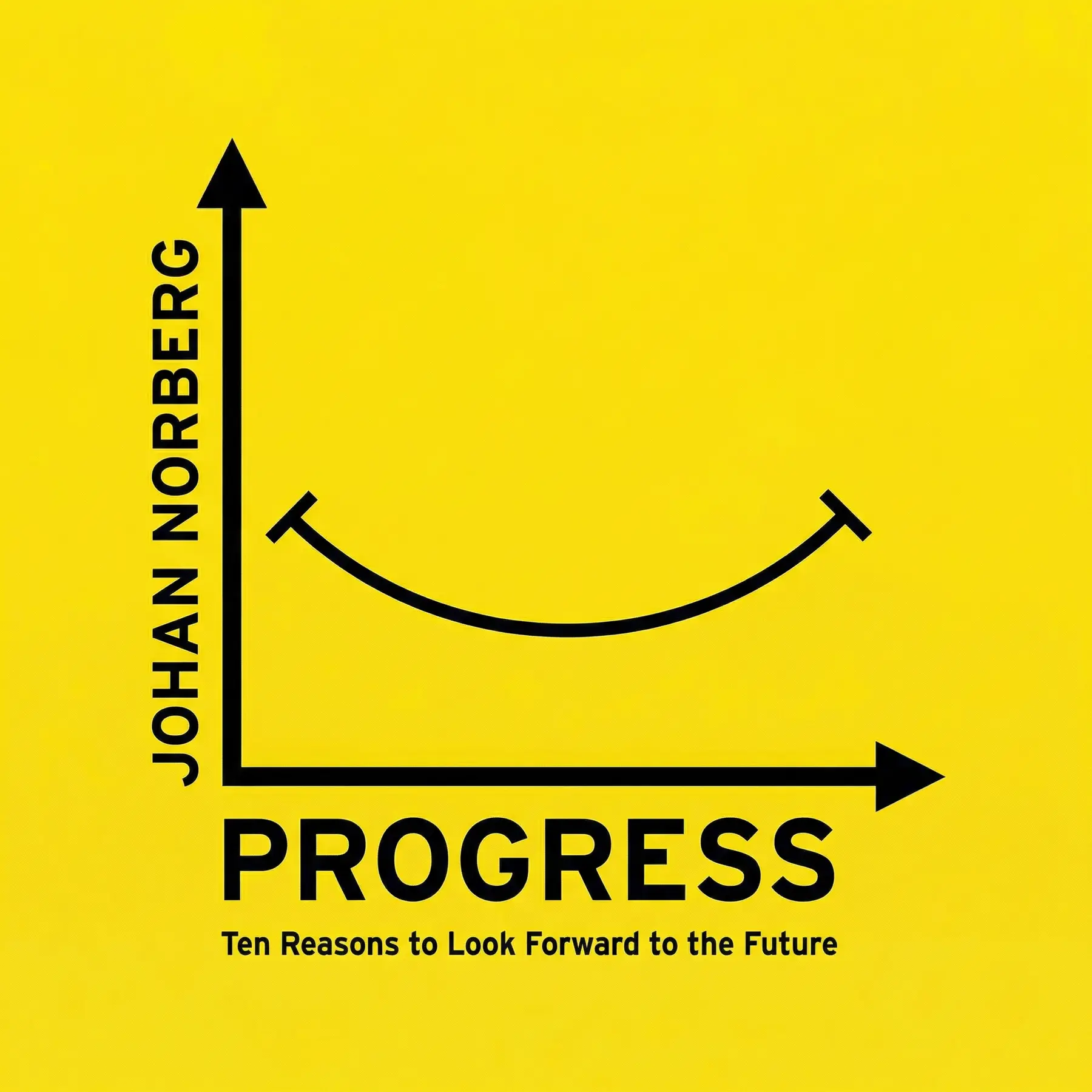
Progress: Ten Reasons to Look Forward to the Future
Johan Norberg uses long-run data on food, health, wealth, violence, pollution, literacy and freedom to show how much life has improved, and argues that growing wealth, open trade and spreading knowledge drove the change.

Table of Content
1. Introduction
1 min 02 sec
If the daily news leaves you sure the world is falling apart, Johan Norberg offers a correction backed by numbers. In Progress, he notes that a person born in the early 1900s could typically expect a lifespan of just 31 years. By 2015 the world average was 71. Pessimists, he says, look at the glass and complain that it is not full. Norberg looks at the glass itself and finds that it keeps growing.
He makes the case across food, health, wealth, peace, the environment, literacy and freedom, and the throughline holds in each one: humanity’s old miseries are shrinking, mainly because growing wealth, open trade and spreading knowledge push them back. Norberg says plainly that the work is unfinished. But we know which forces work. By the end, you will be able to meet a doom-laden headline with the long-run figures behind it, and to name what actually made life better.
2. Learn what actually ended mass famine
1 min 47 sec
Three centuries ago, Europeans ate less than people in today’s hungriest region, and some were driven to the unthinkable. The change that followed came from a mix of forces most people never connect with food.
3. Clean water and evidence doubled our lifespans
1 min 50 sec
For thousands of generations, human life barely changed in length. Then, in little more than a century, it more than doubled. A doctor with a map of one city’s sick shows where that leap began.
4. Ask what creates wealth, not what causes poverty
1 min 59 sec
Most debates about the poor start from a question Norberg thinks is backward. Flip it, and two centuries of economic history start to make sense, including a dramatic fall in extreme poverty.
5. See the news for what it is, and fear less
1 min 47 sec
News of atrocities now travels fast, so we are more aware of violence than ever, even as it declines. A five-century record of murder and war tells a very different story, and a tailor and a baker help explain it.
6. Richer countries end up with cleaner air
1 min 45 sec
Economic growth is often blamed for wrecking nature, and Norberg admits industry did real harm. Yet a deadly London fog and a curve shaped like a bell suggest the story has a second half few people hear.
7. Literacy rises with income, peace and campaigns
2 min 01 sec
Two centuries ago, almost nobody could read. The turnaround needed more than schools: it needed children free to sit in them, and a reason for parents to give up their wages.
8. Learn how financial security builds a more tolerant society
1 min 58 sec
In 1900 not one country let every adult vote, and slavery had only recently been legal almost everywhere. Norberg traces how freedom spread, and why a full wallet may make people kinder to strangers.
9. Conclusion
1 min 19 sec
Norberg’s ten reasons add up to one claim about perspective. Up close, the world is full of hunger, disease, cruelty and dirty air, and all of it is real. Step back a few centuries and each of those problems is smaller than it has ever been. The same forces pushed them back again and again: wealth, trade, working institutions and knowledge reaching more people. Norberg does not call the job done. Undernourishment, preventable epidemics, poverty and bigotry remain. His point is that today’s children inherit a richer, healthier and more tolerant world, with better tools for what is left. In Newton’s day, knowledge belonged to a small elite. Now billions can reach new ideas, so more people than ever can add to the work.
That suggests a habit worth keeping. When someone mourns the good old days, ask which year they mean, and what life expectancy, literacy or the murder rate looked like then. When a story makes things sound hopeless, find the long trend before deciding what it means. And when you weigh any plan to help, ask whether it lets people grow richer, because so much else followed from that.
The glass is still not full. It just keeps getting bigger.
About this book
What is this book about?
Turn on the news and the world seems to be falling apart. Johan Norberg argues that this feeling comes from looking too closely. Step back a few centuries and nearly every great human misery is smaller than it has ever been. Famine once killed a third of Finland's people. Life expectancy sat around 30 years for thousands of generations. Murder in sixteenth-century Europe was roughly nineteen times more common than it is today. Norberg works through food, health, wealth, peace, the environment, literacy and freedom, and in each one he looks for causes as well as figures. Again and again the same forces appear. Farmers gained property rights, nations opened to trade, medicine began testing what works, cities cleaned their water, and rising incomes gave people room to care about rivers, schooling and the rights of others. He does not claim the job is finished. Hunger, preventable disease, poverty and bigotry remain. His point is that the tools for beating them are known and already working. Readers get a clear, numbers-based way to answer doom-laden headlines and a sharper sense of what has actually made life better.
Book Information
Who it's for
Tired of bad news
Readers worn down by bad news who want long-run evidence on how the world is changing.
Curious what drives prosperity
Students and professionals in economics, policy or development looking for a clear argument about what drives prosperity.
Leaders thinking about risk
Managers and founders who want a calmer, data-based view of risk and the future.
About the Author
Johan Norberg
Johan Norberg was born in Sweden in 1973 and studied the history of ideas at the University of Stockholm. In 2007 he became a senior fellow at the Cato Institute in Washington, D.C., and in 2017 he joined Free To Choose Media as an executive editor, making documentaries for US public television. His books have appeared in more than 25 countries. The Economist and The Guardian both named Progress a book of the year, and he later wrote The Capitalist Manifesto.
Ratings & Reviews
Ratings at a glance
What people think
Listeners find this title to be an excellent, brisk read that offers a comprehensive examination of humanity’s advancement, focusing especially on the greatest improvement in global living standards. They value the startling evidence and meticulous research, finding the narrative heartening and optimistic about what lies ahead. Listeners prize the book’s outlook, with one listener emphasizing how it clarifies every facet of human progress, and another remarking on its significance given the current climate of digital/cable news sensationalism.
Top reviews
Pong
Wow, this book is exactly what my mental health needed after months of doomscrolling through 24-hour news cycles. Norberg manages to condense complex socioeconomic trends into a series of punchy, readable chapters that prove the 'good old days' were actually pretty miserable for most people. I was particularly struck by the data on global poverty and how quickly it has plummeted in just my lifetime. Frankly, it makes the constant negativity of journalists look almost irresponsible by comparison. While he might be a bit too rosy regarding the environment, the sheer weight of his evidence on life expectancy and literacy is undeniable. This isn't just a book; it's a necessary shift in perspective for anyone feeling hopeless about the future of our species. It really puts the greatest improvement in global living standards into a sharp, undeniable focus.
Show moreMaria
Every page of this book feels like a slap in the face to our collective pessimism in the best possible way. Did you know that 200 years ago, not a single country had a life expectancy over 40? Norberg flips the script on the 'everything is falling apart' narrative by looking at the long-term trends instead of the daily tragedies. I particularly appreciated the focus on literacy and how the internet has connected humanity to a collective pool of knowledge that was previously inaccessible. Look, it’s easy to be a cynic, but it’s much harder to argue with the fact that global child mortality has plummeted. This is a quick, fantastic read that provides a much-needed sense of scale for our current problems. I’m buying copies for all my most pessimistic friends this Christmas to give them a positive outlook.
Show moreWoramet
Picked this up on a whim and was surprised by how quickly I flew through it; it’s incredibly accessible for a book filled with so many stats. Norberg manages to make topics like nitrogen-based fertilizer and open defecation genuinely interesting, which is no small feat for any author. The book serves as a powerful reminder that our ancestors lived lives that were short, brutal, and filled with hunger, whereas we live in relative luxury. I loved how he challenged the 'rosy glasses' view of the past by showing just how filthy and dangerous cities like London and New York used to be before modern sanitation. Frankly, we have a lot to be thankful for, and this book provides the receipts to prove it. If you’re feeling depressed about the direction of the world, do yourself a favor and read this immediately.
Show moreYongyut
The chapter on sanitation alone makes this worth the price of admission, if only for the terrifying descriptions of what city life was like before modern plumbing. Norberg has a gift for taking dry social science data and turning it into a compelling story about human resilience and triumph over nature's limitations. I found his 'Reason to Be Cheerful' message to be incredibly infectious, especially the parts about the global rise in literacy and equality. While I agree with other reviewers that he’s a bit weak on the climate change front, his broader point about our capacity for problem-solving is hard to ignore. We’ve managed to beat back smallpox, polio, and extreme poverty; why should we assume we've suddenly lost our ability to innovate? This book is a loud, data-driven shout of 'we can do this' into the void of modern despair.
Show moreNina
Finally got around to reading this after seeing it compared to Hans Rosling’s work, and it definitely lives up to that reputation for data-driven hope. Norberg uses a barrage of statistics to show that we are living in the most peaceful and prosperous era in human history, despite what our social media feeds tell us. I loved the specific details, like the history of the Haber-Bosch process and how artificial fertilizer literally saved billions of lives. To be fair, the book can feel a bit repetitive as he hits the same 'things are getting better' note over and over across ten different categories. However, the chapter on freedom and the decline of slavery was deeply moving and reminded me how far we've actually come. It’s an essential antidote to the modern culture of misery that dominates our digital news.
Show moreChokdee
As someone who struggles with the constant barrage of negative news, this was a necessary palate cleanser for my brain. Norberg argues that the news only reports bad things because they are rare and dramatic, while the slow, steady march of progress goes unrecorded because it's boring. I found the chapter on sanitation particularly eye-opening, especially the stats on how many millions now have access to clean water compared to just twenty years ago. Personally, I think he skims over the complexities of modern politics a bit too easily, acting as if technology and entrepreneurs operate in a vacuum. But the core message—that we should stop worrying and start working on making things even better—is incredibly empowering. It is a well-researched work that will definitely make you rethink your assumptions about the state of the world today.
Show moreNathan
Is the world perfect? No, and Norberg doesn't claim it is, though he definitely skims over the messy parts to keep his narrative moving forward. He builds a solid case for human ingenuity, showing how scientists and entrepreneurs have consistently solved the 'impossible' problems of previous generations. I was particularly fascinated by the section on violence and how much safer the average person is today compared to the Middle Ages. To be fair, the tone can get a bit 'preachy' regarding liberal values and free markets, which might put off some readers. But if you can look past the political subtext, the underlying data is genuinely shocking in its positivity. It’s a short, sharp shock of reality that makes you realize just how skewed our perception of 'normal' has become. Definitely worth a read for the perspective shift alone.
Show moreHiroshi
It is hard to deny the sheer volume of data Norberg presents, but I found myself questioning his underlying motives more than once. As a senior fellow at the Cato Institute, he definitely has a specific ideological lens that prioritizes market solutions over almost everything else. The chapters on food and sanitation are brilliant and well-documented, yet the section on the environment felt alarmingly naive to me. He seems to suggest that we can simply 'grow' our way out of climate change, which feels like wishful thinking given the current rate of biodiversity loss. Truth be told, I appreciate the optimism, but the lack of discussion regarding wealth inequality makes this feel a bit like bourgeois propaganda. It’s a fast read, but take the conclusions with a healthy grain of salt if you care about environmental constraints.
Show moreManee
The central premise—that things are better than they seem—is well-supported but often feels like it's ignoring the elephant in the room. Norberg is an excellent writer who knows how to keep the reader engaged with fascinating anecdotes, like the story of Satto in the Indian village and her changing memories. However, his unyielding optimism regarding the environment and climate change borders on the delusional at times. He admits that pollution is a problem but then basically says 'don't worry, we'll invent our way out of it eventually.' In my experience, that kind of rhetoric can lead to a dangerous level of complacency that we simply cannot afford right now. It’s a good book if you want to feel better for an afternoon, but it lacks the depth required to address our most systemic global threats. Great for trivia, less great for solutions.
Show moreHemp
While Norberg’s command of statistics is impressive, I couldn't help but feel there’s a massive agenda lurking behind the optimism. He paints a picture of progress that seems to completely ignore the permanent under-culture and the growing gap between the super-rich and everyone else. The chapter on equality was especially frustrating because it focused almost entirely on civil liberties while ignoring the crushing economic pressures facing modern workers. Not gonna lie, his dismissal of environmental concerns as something only 'rich countries' can afford to fix felt incredibly dismissive of the looming climate crisis. To me, this felt less like a balanced analysis of history and more like a carefully curated cheerleading session for global capitalism. It's a readable book, but the cherry-picking of data to support a libertarian worldview was too much for me to ignore.
Show moreQuestions about this book
What is the main idea of Progress by Johan Norberg?
Norberg argues that by almost every long-run measure, from hunger and life expectancy to violence, literacy and freedom, humanity is better off than ever. Pessimism comes from focusing on what is in front of us instead of the long view. He credits growing wealth, open trade, working institutions and spreading knowledge for pushing old miseries back, while admitting that serious problems remain.
Does Progress say economic growth is good for the environment?
Norberg argues that industrialization caused real damage, but that wealth eventually repairs it. He describes a bell-shaped curve: pollution rises as poor countries start to grow, then falls once they reach a certain level of wealth. London’s air, for example, returned to pre-industrial levels after the 1970s, with sulfur dioxide down 94 percent. Richer countries can also afford better protection against disasters.
How much has life expectancy improved according to Progress?
Norberg notes that for about eight thousand generations the average human life lasted around 30 years. In the early twentieth century it was still 31, and by 2015 the world average had reached 71. He credits sanitation, such as the clean water systems London built after John Snow traced cholera to polluted water, and medicine that moved to evidence-based methods.
How can I apply the ideas in Progress?
Treat claims about a lost golden age with doubt, and ask what life was really like in the year someone has in mind. When news makes the world sound hopeless, look for the long-term trend before drawing conclusions. When judging any plan to fight poverty, hunger or pollution, ask whether it lets people produce more, trade and learn, since Norberg finds those forces behind most past gains.
Who should read Progress?
It suits anyone who feels anxious or cynical about the state of the world and wants evidence instead of headlines. Students of economics and development get a compact case for what drives prosperity. Professionals and managers get a long-run frame for judging risk, and parents get a reasoned basis for hope about the world their children will inherit.
Readers also enjoyed


A History of the World in 6 Glasses
Tom Standage

A Splendid Exchange: How Trade Shaped the World
William J. Bernstein

A Long Way Gone: Memoirs of a Boy Soldier
Ishmael Beah






AUDIO SUMMARY AVAILABLE
Listen to Progress in 15 minutes
Get the key ideas from Progress by Johan Norberg, plus 5,000+ more nonfiction titles.
- 5,000+ titles
- Listen as much as you want
- 7-day free trial
- Cancel anytime









