

13 min 41 sec
Available in: English
The Algebra of Happiness: Notes on the Pursuit of Success, Love, and Meaning
Scott Galloway treats a happy life as an equation with linked variables. He shows how to trade early effort for later freedom, build real wealth, choose a partner well and remember what the money is for.
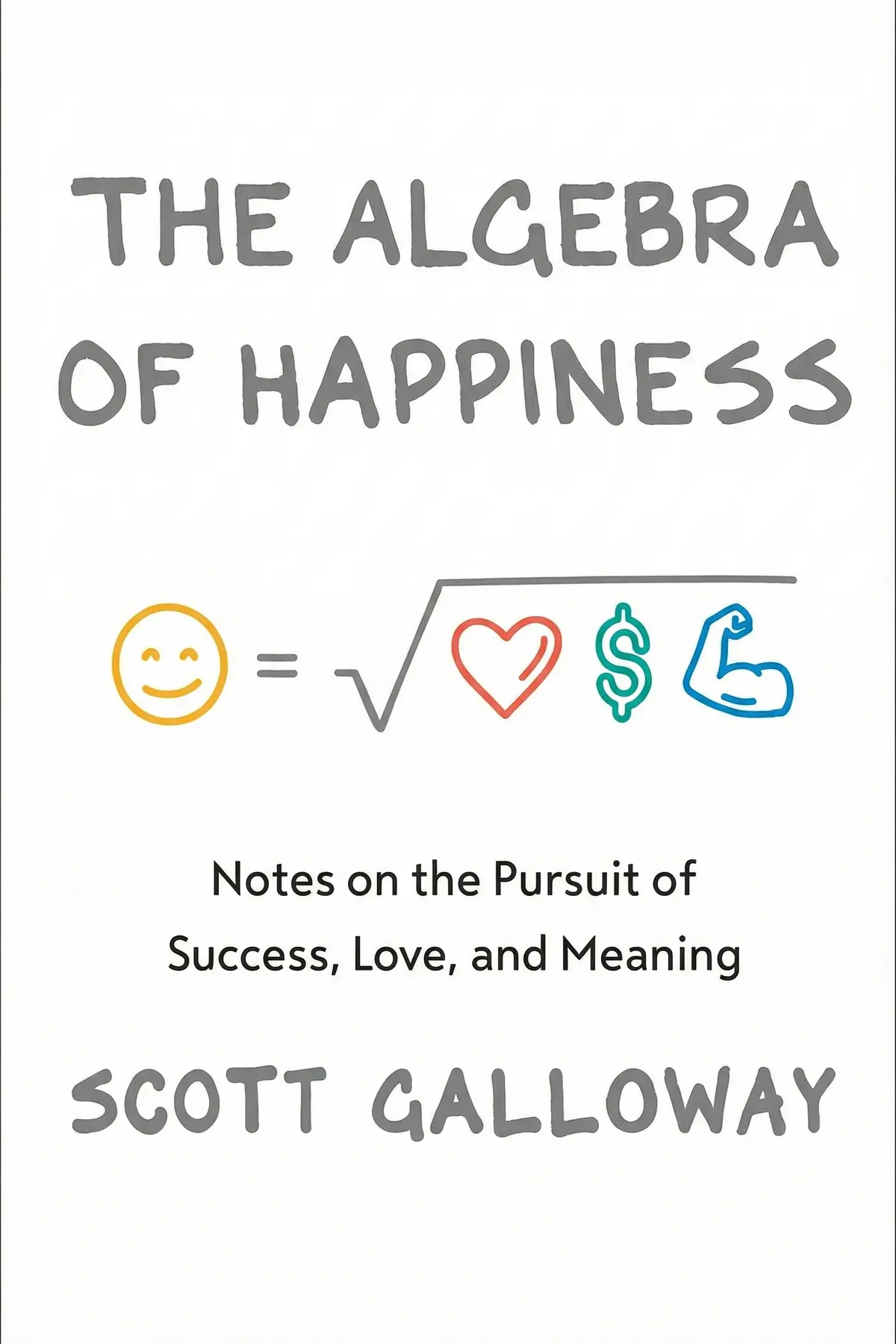
Table of Content
1. Introduction
1 min 00 sec
Many ambitious people work flat out on the assumption that happiness will be waiting at the finish line, then discover that the people they meant to share it with have drifted off. In The Algebra of Happiness, marketing professor and serial founder Scott Galloway treats a good life like a school equation: the variables are linked, so raising one lowers another. He starts with himself. His early success in banking and business cost him his hair, a marriage and, he felt, his entire twenties.
Galloway’s case is that happiness itself is simple, time spent doing what you enjoy with people you love, but paying for it takes deliberate trade-offs. That means hard work and unglamorous choices early, money that earns on its own, and the nerve to step back later. Along the way he offers concrete rules, from where to live and how much of your savings to keep in one place to a single question that reveals whether your relationships are on track.
2. Know what your twenties are buying you
1 min 20 sec
Every hour you give your career early comes from somewhere, and every relaxed year has a price that arrives decades later. Galloway paid one version of that bill and argues that nobody gets to skip it entirely.
3. Ask who would sit by your deathbed
1 min 19 sec
Many people plan to make up for lost evenings with family once they retire. Galloway thinks that plan has a flaw, and he offers one uncomfortable question that exposes it in seconds.
4. Put money to work for family time
1 min 23 sec
The old sayings about money and happiness are half right, according to Galloway. Sorting out which half matters changes what you work for, and his own answer to why he is here is strikingly traditional.
5. Find a partner, then stop keeping score
1 min 28 sec
A few qualities in a partner matter for everyone, and the rest depend entirely on you. Galloway’s checklist is short, but the habit he says ruins good relationships is one most couples practice without noticing.
6. Pick a degree and city that pay
1 min 26 sec
Following your passion sounds like the obvious way to build a career. Galloway looks at where successful people actually end up working and living, and the picture is much less romantic than the graduation speeches.
7. Test yourself before you start a company
1 min 35 sec
Founders are celebrated for vision and courage, but the qualities that decide whether you should become one get far less attention. Galloway’s honest comparison may change how you see your current job.
8. Build passive income to become truly rich
1 min 28 sec
A big paycheck feels like wealth, yet many high earners stay one setback away from trouble. Galloway offers a sharper definition of rich and a simple age-based rule for protecting what you build.
9. Step back while you can still enjoy it
1 min 28 sec
The moment you can finally afford to slow down usually arrives when you are at the peak of your career. One publishing executive’s surprising resignation shows what it looks like to actually collect the reward.
10. Conclusion
1 min 14 sec
Galloway’s equation turns out to be less about money than about timing. The things that make people happy are ordinary: good company, enjoyable activities, a family that wants you around. What makes them hard to have is that each stage of life pays for the next. Effort in your twenties buys freedom later, attention to people now decides who sits with you at the end, and wealth only turns into happiness when you finally stop chasing it.
His most usable tool comes from business. Companies judge their health with numbers such as profit margins and retention rates, and Galloway suggests choosing a few numbers for your own life. He watches two. Fifteen years of teaching multiplied by 400 students a year tells him how many young people he has reached, and he is satisfied with it. The number of times a year he visits his sick, dying father, two, tells him how he is doing as a son, and he is not satisfied at all. That second number does more than sting. It tells him exactly what to change.
Pick one number that measures the part of your life you have been neglecting, and start raising it before the equation is settled for you.
About this book
What is this book about?
Ambitious people often assume happiness will arrive once the career is secure, and only later notice what the long hours cost them. Scott Galloway, a marketing professor and serial founder, paid that price himself: early success brought hair loss, a divorce and the feeling that his twenties had vanished. In The Algebra of Happiness he treats a good life like an equation from school, where the variables are linked and raising one lowers another. Balance in your young adulthood trades against balance later in life. What you give friends and family now sets what they give back later. Money matters, but only as the means to time with people you love. From there Galloway gets practical. He argues for in-demand degrees, big-city careers and unromantic industries. He offers a test for deciding between a job and a startup, a definition of rich built on passive income and low spending, a rule for how much to keep in any one asset, and advice on choosing a partner and keeping the relationship strong. Readers get a frank framework for deciding what each stage of life is for.
Book Information
Who it's for
Weighing work against life
Young professionals weighing long hours now against the life they want at fifty.
Employees considering a startup
Employees tempted to start a company who want an honest test of whether they should.
Successful on paper
High earners who feel successful on paper yet see their family, friends and savings slipping.
About the Author
Scott Galloway
Scott Galloway, born in 1964, is a professor of marketing at New York University's Stern School of Business, where he teaches brand strategy and digital marketing to second-year MBA students. In 2012 Poets and Quants named him one of the world's top 50 business school professors. He has founded nine firms, including L2, Red Envelope, Prophet and Section4, and hosts the Prof G and Pivot podcasts. He also writes the weekly No Mercy / No Malice blog. His other books include The Four and Post Corona.
Ratings & Reviews
Ratings at a glance

What people think
Listeners describe the work as insightful, viewing it as a necessary guide for identifying life's priorities, and they appreciate how its readability makes gaining wisdom feel effortless. Furthermore, the content is deeply moving and relatable, blending engaging humor with practical advice appropriate for high school graduates. Listeners express admiration for the writing style, with one listener highlighting the author's perfect clarity, and others commending the sense of honesty and vulnerability throughout.
Top reviews
Samart
Wow, this hit me harder than I anticipated. I went in expecting dry business advice but found a deeply moving reflection on what actually makes a life worth living. Galloway’s writing style is punchy and clear, making complex emotional truths feel accessible and even humorous at times. His advice on the 'easy stuff'—like showing up early and having good manners—is something I want to buy for every high school graduate I know. The way he discusses the 14% net worth growth for married couples provides a fascinating economic argument for commitment. This isn't just a book about wealth; it's a book about the compound interest of kindness and hard work. It’s rare to find an author this successful who is willing to be this honest about his own failures.
Show moreAdam
Finally, a self-help book that doesn't feel like it was written by a monk or a life coach with no real-world experience. Galloway is a successful entrepreneur who tells it like it is: life is hard, work is exhausting, and you need to be smart about your choices. I loved the section on why you should seek out 'boring' industries if you actually want to make money and find fulfillment. His vulnerability regarding his mother's illness was incredibly touching and felt very authentic. It’s a masterclass in 'no-BS' wisdom that balances the harsh realities of capitalism with the tender realities of being a father and a son. I’ve already recommended this to three of my colleagues who are struggling with work-life balance.
Show morePong
The most striking thing about Galloway’s writing is his brutal clarity. He doesn't waste your time with flowery language or vague promises of 'finding your passion.' Instead, he provides a roadmap for building a stable, meaningful life through discipline and emotional intelligence. The concept of the 'U-shaped' happiness curve was particularly enlightening for me as I head into my forties. In my experience, most business books ignore the domestic side of life, but Scott leans into it, proving that your home life is the ultimate foundation for your career. It’s a brilliant, funny, and occasionally heartbreaking look at the variables that actually matter in the equation of a life well-lived. Buy it for the career tips, but keep it for the lessons on love.
Show moreOrm
The chapter on the 'Algebra of Money' alone was worth the purchase for me. Galloway frames happiness through the lens of economic security and partnership, which is a pragmatic approach you don't often see in the self-help aisle. I appreciated his honesty about how much 'shit gets real' between the ages of 25 and 45. He doesn't sugarcoat the fact that building a life requires an immense amount of sweat equity and sacrifice early on. To be fair, some of the anecdotes feel a bit repetitive if you already follow his podcast, but having them distilled into these bite-sized lessons is helpful. It’s a touching, surprisingly human look at what it means to provide for a family while trying not to lose your soul in the process.
Show moreFon
As someone who follows his newsletter, I recognized a lot of the material, but the curation here works well. The book is remarkably easy to digest, with a layout that allows you to jump around to different life stages. I specifically resonated with the idea of 'giving someone a good death' and the responsibilities we have toward our aging parents. It’s a heavy topic handled with a mix of pragmatism and genuine emotion that caught me off guard. Not gonna lie, his brash delivery can be polarizing, and he definitely leans into the 'alpha' persona a bit too hard at times. Despite that, the core message about prioritizing relationships over toys is one that more people in high-stress careers need to hear before they burn out.
Show moreTar
Is this book for everyone? Probably not, as it definitely targets a specific demographic of ambitious professionals. But for those of us in the thick of the 'work-stress-build' phase of our thirties, it’s a necessary reality check. He cuts through the corporate BS to remind us that our relationships are the only things that truly scale in the long run. I liked the analytical breakdown of why being an employee is often a better risk-adjusted bet than being an entrepreneur. Personally, I found the section on 'sweat vs. balance' to be the most honest take on career progression I've read in years. It might come off as a bit chest-thumping to some, but the underlying sentiment is deeply grounded in the reality of the modern economy.
Show moreTern
After hearing Scott on several podcasts, I finally picked up the physical copy to see if the hype was real. The book is beautifully designed and the content is remarkably candid for a business-adjacent memoir. He doesn't shy away from his own 'asshole' tendencies, which makes the advice to be better feel more earned. Look, the guy is definitely wealthy and privileged, and he doesn't pretend otherwise, which I actually found refreshing compared to authors who try to hide it. The focus on 'investing in experiences' over things is a tired trope, yet he gives it new life with his specific data points. It’s a great read for anyone feeling lost in the middle-age grind who needs a reminder to invest in their social capital.
Show moreNiphon
Scott Galloway has a very specific brand, and you either buy into it or you don't. This book is essentially a collection of his blog posts and newsletter musings, which makes for a very quick, breezy read. I found the section on 'boring' companies being better investments than 'sexy' ones to be a refreshing take on career growth. However, the tone is undeniably ego-driven and often feels like he’s shouting from a yacht. Truth is, while the advice to 'not be an asshole' is solid, it isn't exactly revolutionary wisdom. The chapter about his mother’s passing was the only moment that felt truly vulnerable and stripped of his usual persona. It's a decent enough gift for a recent business school grad, but don't expect deep psychological research here.
Show moreWaree
This felt more like a collection of blog posts than a cohesive book. While the insights are sharp, the narrative jumps around quite a bit without a clear through-line. I can’t help imagining his big ego jumping out of the paper while reading it, especially when he talks about his younger years. Still, there are some absolute nuggets of gold regarding professional fulfillment and the importance of choosing the right partner. The idea that marriage is a financial engine was a perspective I hadn't fully considered before. It’s a quick read, perfect for a flight or a long commute, but it lacks the scientific depth of a true psychology book. Take the career advice and leave the 'manly' posturing behind.
Show moreNattapong
I really wanted to like this, but the level of unexamined privilege is staggering. Galloway writes from a very narrow, heteronormative perspective that assumes every reader is an aspiring millionaire with a traditional family structure. Frankly, his 'no-BS' attitude often crosses the line into blatant smugness and condescension toward anyone who hasn't 'made it' in the corporate world. He talks about his kids and his sexual history with a weird sort of frat-boy bravado that feels incredibly dated in today's world. If you aren't a high-earning male looking for a pat on the back, you’ll likely find this advice unhelpful or even offensive. It’s less of a guide to happiness and more of a manual on how to be a successful businessman who eventually realizes he should probably be nicer to people.
Show moreQuestions about this book
What is the main idea of The Algebra of Happiness?
Scott Galloway argues that happiness is simple, doing what you enjoy with people you love, but paying for it requires trade-offs. Like variables in an equation, balance in early adulthood trades against balance later, and what you invest in relationships now decides what you get back. He pairs that frame with practical advice on careers, cities, investing, choosing a partner and knowing when to step back from work.
What does Scott Galloway mean by rich?
Galloway defines rich as having a high passive income relative to low spending, not simply a lot of money. Passive income comes from owning equity such as property or shares, while a salary is less reliable because people raise their spending as their pay rises. He advises investing early and diversifying: under 40, no more than a third of assets in one class; over 40, no more than 15 percent.
Should I become an entrepreneur or stay an employee, according to Galloway?
Galloway suggests checking your traits first. Good employees are dependable, civil and emotionally secure enough to live with uncertainty. Founders must be willing to fund their own business and spend much of their time selling to recruits, investors and customers. If you have the employee skills and dislike paying to work or constant selling, he suggests reconsidering a startup, since it is the riskier path.
What is the deathbed question in The Algebra of Happiness?
Galloway asks readers to imagine who would show up at their deathbed if they carried on living exactly as they are now. Someone who ignored everyone for success might die with only doctors and nurses nearby, while a loving partner, parent or friend would be surrounded. An answer of no one, he argues, reveals a shortage of love, friendship and happiness in the life you are living today.
How can I apply The Algebra of Happiness to my life?
Start by naming the trade-off you are making between work now and freedom later. Ask the deathbed question to audit your relationships. Check your investments against Galloway’s age-based diversification limits. Then borrow his habit of personal metrics: he measures how many students he has taught and how often he visits his father, and a low number shows him exactly what to change.
Readers also enjoyed

A Guide to the Good Life: The Ancient Art of Stoic Joy
William B. Irvine


A High-Performing Mind: Strengthen Your Mind and Live Your Best Life
Andrew D. Thompson


Abundance: The Inner Path to Wealth
Deepak Chopra


60 Seconds & You’re Hired!
Robin Ryan



59 Seconds: Change Your Life in Under a Minute
Richard Wiseman
AUDIO SUMMARY AVAILABLE
Listen to The Algebra of Happiness in 15 minutes
Get the key ideas from The Algebra of Happiness by Scott Galloway, plus 5,000+ more nonfiction titles.
- 5,000+ titles
- Listen as much as you want
- 7-day free trial
- Cancel anytime









