

15 min 17 sec
Available in: English
 ไทย
EnglishไทยThe Four: The Hidden DNA of Amazon, Apple, Facebook and Google
Shows how Amazon, Apple, Facebook and Google rose by feeding basic human needs, what they take from us in return, how to spot the next giant and how to build a career in their world.
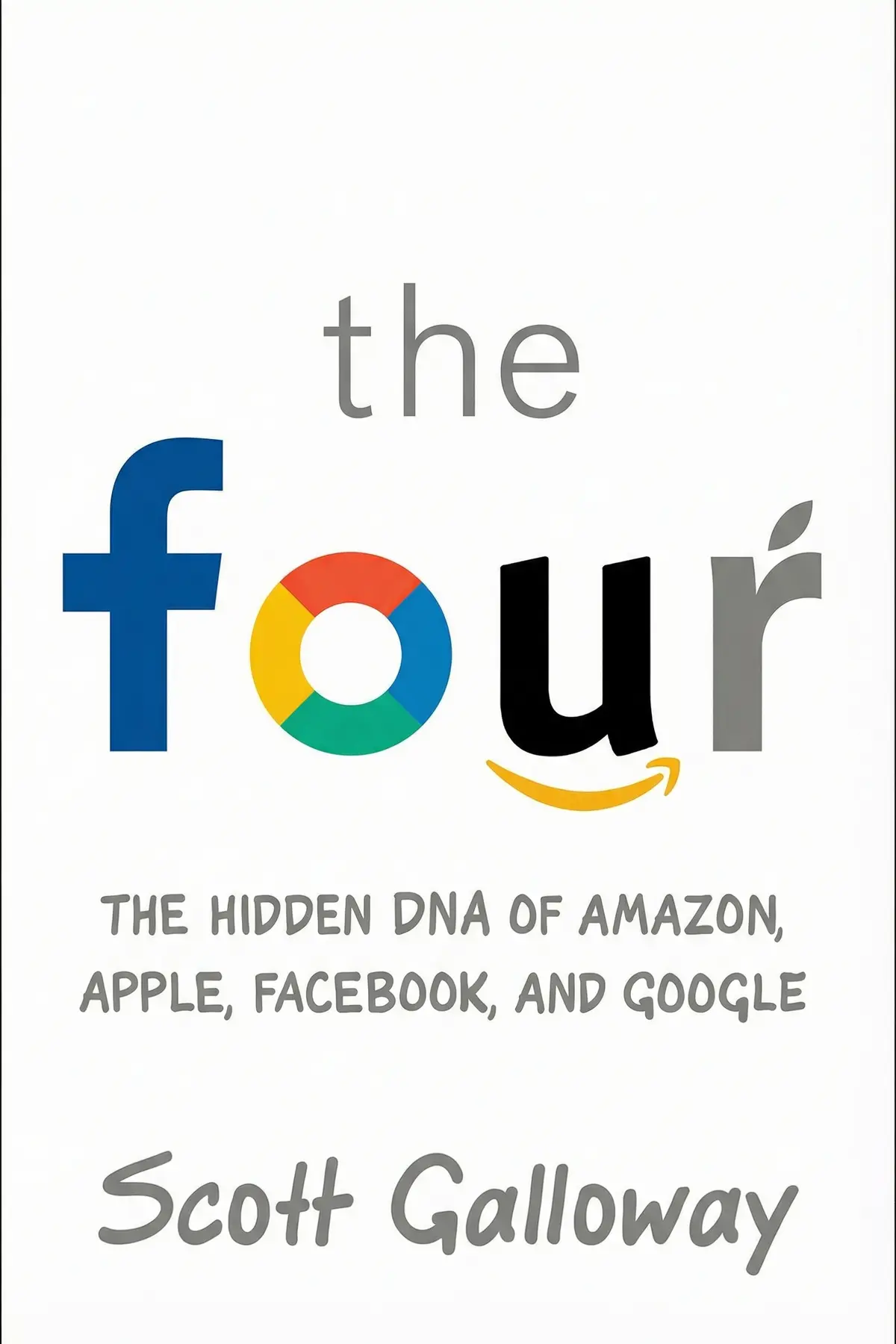
Table of Content
1. Introduction
54 sec
Most of us use Amazon, Apple, Facebook or Google every day without asking why we keep coming back. In The Four, NYU marketing professor Scott Galloway gives a blunt answer: each company feeds one ancient human need. Google answers our questions the way we once hoped God would, Facebook supplies love and belonging, Apple sells sex appeal, and Amazon serves our appetite for consumption.
Galloway calls them the Four Horsemen. His throughline is that their power comes from serving those instincts at enormous scale, and that they grew by borrowing what was never theirs while passing many costs onto workers, rivals and society.
Follow his argument and you can see what these companies take in exchange for convenience. You can also test which newcomer might join them, and shape a career that fits the world they built.
2. Read each giant by the need it feeds
1 min 39 sec
Four companies reach almost everyone, every single day. The common story calls them good citizens of the economy. Galloway thinks the reasons we love them, and the price we pay, sit somewhere much older than technology.
3. Understand what Amazon's convenience costs everyone else
1 min 51 sec
A package arrives the next day and the price is the lowest anywhere. Galloway traces that ease back to the Stone Age, then follows the bill to people who never placed an order.
4. Learn what makes people pay Apple luxury prices
1 min 54 sec
After a deadly attack, a court ordered Apple to open a killer’s phone, and the company refused. The public cheered. That same strange immunity explains how Apple earns most of an industry’s profits with a small share of its sales.
5. Know what Facebook earns from your friendships
1 min 49 sec
A young company gathered as many daily followers as one of the world’s great religions in a fraction of the time. The warmth people feel there is real, and so is the business that runs underneath it.
6. Spot the borrowed fuel behind every giant
1 min 56 sec
People tell a search box what they would never tell a doctor or a priest. Galloway shows what that trust is worth, then points to a habit all four companies share that rarely makes their official histories.
7. Eight tests for spotting the next giant
2 min 04 sec
Every dominant company looks permanent until a challenger appears. Galloway lists what that challenger would need, then runs well-known names through the test. Likability is the weak spot he flags for both Uber and Walmart, while Alibaba faces limited global reach and its government ties.
8. Build a career that thrives in their world
1 min 52 sec
A handful of companies now shape where the jobs are and who gets noticed. Galloway’s advice for getting ahead is practical and sometimes blunt, and it ends by rejecting one of the most repeated pieces of career wisdom.
9. Conclusion
1 min 18 sec
The four look like technology companies, yet Galloway reads them as something much older: businesses built on prayer, friendship, desire and the gathering urge, delivered at a scale no temple, club or market ever reached. In his account, that aura helps explain why Apple escapes the backlash a rival would likely face. When Apple refused a court order to open a shooter’s iPhone for investigators, it still drew public support, which Galloway credits to Jobs’s icon status and the near-sacred aura of its products.
Seeing this changes how you use them. Before a search, a like or a one-click order, remember that you are also handing over a confession, a data point or a sale some smaller business will not make. When a newcomer is hailed as the next giant, put it through the eight tests, starting with likability, the trait that tripped Uber and may yet slow the four.
For your own work, Galloway’s advice is to stay calm, keep learning, own what you do, move toward the cities where jobs appear, and build on the talent you already have. The horsemen will keep riding, and the choice left to you is whether to ride with them or simply be carried along.
About this book
What is this book about?
Most people use at least one of four companies every day, and few stop to ask why. Scott Galloway, a marketing professor at NYU Stern, argues that Amazon, Apple, Facebook and Google did not win only on better technology. Each one feeds an old human need. Google answers questions like a god, Facebook supplies love and belonging, Apple sells sex appeal and Amazon serves our urge to gather things. Galloway calls them the Four Horsemen. He follows the money behind each one, from Apple's record profits to Google's advertising income, and he looks hard at the fine print: lost jobs, data sold to advertisers, a polarizing news feed and ideas taken from others. He then offers an eight-part test for spotting which company could join them and become the first worth a trillion dollars, weighing candidates such as Alibaba, Uber, Walmart and Microsoft. He closes with direct career advice for anyone working in the economy these four have shaped.
Book Information
Who it's for
Professionals questioning big tech
Professionals who use Amazon, Apple, Facebook and Google daily and want to know what those services take in return.
Founders and backers
Founders and investors judging which company could become the next tech giant.
Students and new professionals
Students and early-career workers looking for direct advice on getting ahead in a tech-shaped economy.
About the Author
Scott Galloway
Scott Galloway, born in 1964, is a professor of marketing at the New York University Stern School of Business, where he teaches brand strategy and digital marketing to second-year MBA students. In 2012, Poets & Quants named him one of the top 50 business school professors in the world. He has founded nine firms, including L2, Red Envelope, Prophet and Section4, and he hosts the Prof G and Pivot podcasts and writes the weekly No Mercy / No Malice blog.
Ratings & Reviews
Ratings at a glance

What people think
Listeners consider this work vital for corporate executives, applauding its knowledgeable perspectives and approachable prose. They value the author's sharp examination of technology giants and the humor provided, with one listener highlighting its wry commentary. The text is dense with data, and listeners describe it as stimulating, including one who specifically pointed out its observations on human behavior. Views on the narrative's tempo are varied among listeners.
Top reviews
Ladawan
Finally got around to reading Galloway’s breakdown of the tech giants and it’s a total game-changer for anyone in marketing. This book is essential reading because it moves past the typical 'tech is great' narrative to show how these firms exploit our primal, evolutionary instincts. I found the 'Google as God' metaphor particularly striking—it’s an observation that feels obvious once stated but is profoundly deep. Galloway’s humor and wry observations kept me engaged through the more data-heavy sections. While he’s certainly brash, his analysis of how Apple uses sex appeal and luxury branding to maintain its margins is brilliant. The pacing is quick, almost like a high-speed lecture from a professor who has actually been in the trenches. Frankly, if you're an executive trying to navigate the next decade, you cannot afford to ignore the 'analog moats' concept he describes here.
Show moreChiw
Ever wonder why we’re so obsessed with the iPhone even when it doesn't fundamentally change our lives? Galloway's deep dive into the psychology of the 'Four' is terrifying and hilarious in equal measure. He perfectly captures how these platforms have become the new religion, with Google answering our prayers and Facebook providing the 'love' (or at least the social validation) we crave. The author's background as an entrepreneur shines through in his analysis of capital markets. He explains why Amazon can get away with zero profits while everyone else has to play by different rules. I appreciated the bluntness regarding Jeff Bezos and the 'job killer' narrative. It’s not a comfortable read, especially when he discusses the impending disappearance of middle-class retail jobs. This is a well-informed, punchy, and necessary wake-up call for anyone who thinks tech is still just about 'connecting the world.'
Show moreKan
Galloway has written an essential manual for understanding the digital era, even if his brash personality rubs some people the wrong way. The way he deconstructs the 'trillion-dollar race' is both brilliant and deeply unsettling. I especially loved the section on 'Apple as Sex'—the idea that we pay an irrational premium for their products as a form of biological signaling. It’s a unique take that you won’t find in a standard business textbook. The book is dense with information but feels light because of the humor and the fast-paced delivery. Yes, he’s arrogant, and yes, he’s a bit of a provocateur, but he’s also right about the 'analog moats' that these companies are building to protect their digital empires. Whether you love or hate the Big Four, this book will change how you see the world around you. Truly thought-provoking stuff.
Show morePun
As someone who follows the tech sector closely, I found the insights into 'analog moats' and visionary capital absolutely fascinating. Galloway has a knack for making complex economic shifts feel personal and urgent. He doesn't just look at the software; he looks at the physical distribution networks and retail stores that make these giants untouchable. The chapter on the 'T-Algorithm' provided a great framework for identifying who the next trillion-dollar company might be. I did find the writing a bit 'hyper-masculine' at times, which might be off-putting for some readers. His obsession with comparing every business move to procreation and sexual selection is a bit much. However, the core message about income inequality and the terrifying power of these four horsemen is too important to ignore. It’s a thought-provoking read that will make you rethink your relationship with your iPhone and your Prime account.
Show moreNiramai
The chapter on how to survive in the age of the Four was worth the price of admission alone. While the first part of the book is a dark look at the monopolies of Amazon, Apple, Facebook, and Google, the latter half provides a surprisingly practical roadmap for personal career growth. Galloway emphasizes 'grit' and emotional intelligence over just being 'tech-savvy.' I liked his take on why women are the future of leadership due to higher emotional maturity. Not gonna lie, his tone can be incredibly smug, especially when he’s talking about his NYU classes or his consulting work. But if you can get past the ego, the information is packed with value. His description of how these companies 'age in reverse' is a concept I’ve already started using in my own investment strategy. It’s a polarizing book, but one that definitely sparks conversation.
Show moreDylan
What a terrifying yet hilarious look at how four companies have basically hacked the human brain to dominate the global economy. Galloway doesn't hold back, calling out the 'Four Horsemen' for avoiding taxes while destroying the very social fabric they rely on. The analysis of Amazon’s quest for world domination was eye-opening, even if it was a bit one-sided. He frames Jeff Bezos not just as a genius, but as someone who is enactively hollowing out the middle class. The writing is snappy and full of the kind of 'whip-smart' commentary you'd expect from a top-tier business professor. I did find the Bruce Jenner joke and some of the other 'edgy' comments a bit dated and unnecessary. Despite that, the core thesis about how these companies leverage 'visionary capital' to outspend the competition is spot on. It’s a necessary read for anyone concerned about rising income inequality.
Show moreMason
Look, there is no denying that Galloway is a smart guy, but his writing style is definitely an acquired taste. It’s very 'American academic'—that mix of being overly casual and slightly arrogant at the same time. The first half of the book is a solid, albeit somewhat familiar, deconstruction of how GAFA dominated their respective fields. I enjoyed the concept of the 'Benjamin Button' economy where products get better with more usage. However, the last third of the book devolved into a generic self-help guide for career success. He tells you to move to a city and work harder, which isn't exactly groundbreaking advice. Personally, I found his fixation on his own business failures a bit distracting from the actual subject matter. It’s a fast-paced read with some sharp wit, but it often prioritizes being provocative over being nuanced. It’s good for a flight, but maybe not the definitive text on tech monopolies.
Show moreGiulia
Truth is, I expected a rigorous deep dive but ended up with a collection of provocative hot takes that often lack hard data. The author makes some massive leaps in logic, especially when he claims Facebook is constantly listening to your microphone without providing solid proof in the citations. The whole book is fueled by a sense of FUD—fear, uncertainty, and doubt. While I agree that these companies have too much power, Galloway’s 'crusade' feels a bit personal because his own businesses were crushed by them. He belittles Apple’s stance on privacy by comparing it to James Bond villains, which totally misses the point about the Fourth Amendment and government overreach. Still, the book is incredibly easy to read and has some very funny moments. It’s a mix of brilliant market analysis and rambling blog posts. Take the business advice with a grain of salt, but enjoy the ride.
Show moreNathan
Not what I expected from an NYU professor, as it reads more like a long-form cynical blog post than a scholarly text. To be fair, it is very engaging and I finished it in two sittings. Galloway has a talent for pithy metaphors, like equating the iPhone to a luxury Rolex that signals our fitness to potential mates. However, the intellectual consistency is lacking. One minute he’s calling the Four 'evil,' and the next he’s telling you to invest in them so you can build a nest egg. It’s a bit of an 'intellectual inconsistency' as one of the other reviewers mentioned. He also seems quite bitter about the New York Times not listening to his ideas a decade ago. It’s a decent overview of the current tech landscape, but it feels like it’s trying a bit too hard to be 'cool' and 'disruptive' rather than providing a balanced view.
Show moreZoe
This book feels less like an objective business analysis and more like a platform for Scott Galloway to vent his personal frustrations. I was looking for a balanced critique, but instead, I got a series of sensationalist claims without much substance. His take on Amazon as a 'job killer' is incredibly one-sided, failing to mention how automation lowers costs for the average consumer. Worse yet, the author's ego is constantly center-stage; he spends an exhausting amount of time talking about his failed attempt to take over the New York Times. Some of his comments come across as blatantly misogynistic, particularly when he tries to explain consumer behavior through the lens of 'men thinking with their genitals.' The SPECTRE and Terminator references during the Apple privacy discussion were just silly and undermined his credibility. To be fair, there are a few decent insights about 'Benjamin Button' companies, but you have to dig through a lot of salt to find them.
Show moreQuestions about this book
What is the main idea of The Four by Scott Galloway?
Galloway argues that Amazon, Apple, Facebook and Google dominate because each serves a deep human need at huge scale. Google acts like a god that answers questions, Facebook supplies love and connection, Apple sells sex appeal and Amazon feeds consumption. He also argues that all four borrowed ideas and information from others and pushed costs onto workers, competitors and society.
Why does Galloway say Apple is a luxury brand?
He says Apple shares three traits with brands like Porsche and Prada: an iconic founder in Steve Jobs, craftsmanship shown through simple design, and premium prices on products that cost little to make. That luxury appeal, in his view, lets Apple take 79 percent of smartphone profits in 2016 with only 14.5 percent of the market.
What is the T Algorithm in The Four?
It is Galloway’s eight-part test for the company that could become the fifth horseman and the first worth a trillion dollars. It covers a superior product, an inspiring vision, global reach, likability, vertical integration, artificial intelligence built on data, a reputation for accelerating careers, and a location near a strong university that supplies talent.
Which companies could become the fifth horseman?
Galloway considers Alibaba, Uber, Walmart and Microsoft. Alibaba is the largest retailer in the world but lacks global reach and has close ties to the Chinese government. Uber has reach and data skills but a likability problem. Walmart has 12,000 stores but a poor image. Microsoft has Windows and LinkedIn, which could carry it far if LinkedIn grows.
What career advice does The Four give?
Galloway recommends building emotional maturity, curiosity and ownership. He urges college if possible, or any certification if not, and moving to a city, where about 90 percent of new US jobs appear. He advises promoting your skills on platforms like LinkedIn, and following your talent over your passion, since becoming great at something leads you to love it.
Readers also enjoyed










AUDIO SUMMARY AVAILABLE
Listen to The Four in 15 minutes
Get the key ideas from The Four by Scott Galloway, plus 5,000+ more nonfiction titles.
- 5,000+ titles
- Listen as much as you want
- 7-day free trial
- Cancel anytime









