
15 min 24 sec
Available in: English
 ไทย
EnglishไทยThe 7 Habits of Highly Effective People: Powerful Lessons in Personal Change
Shows why borrowed techniques rarely change much, and how seven principle-based habits build the character that lasting effectiveness depends on. They run from choosing your response and planning by priority to listening with empathy and renewing yourself.
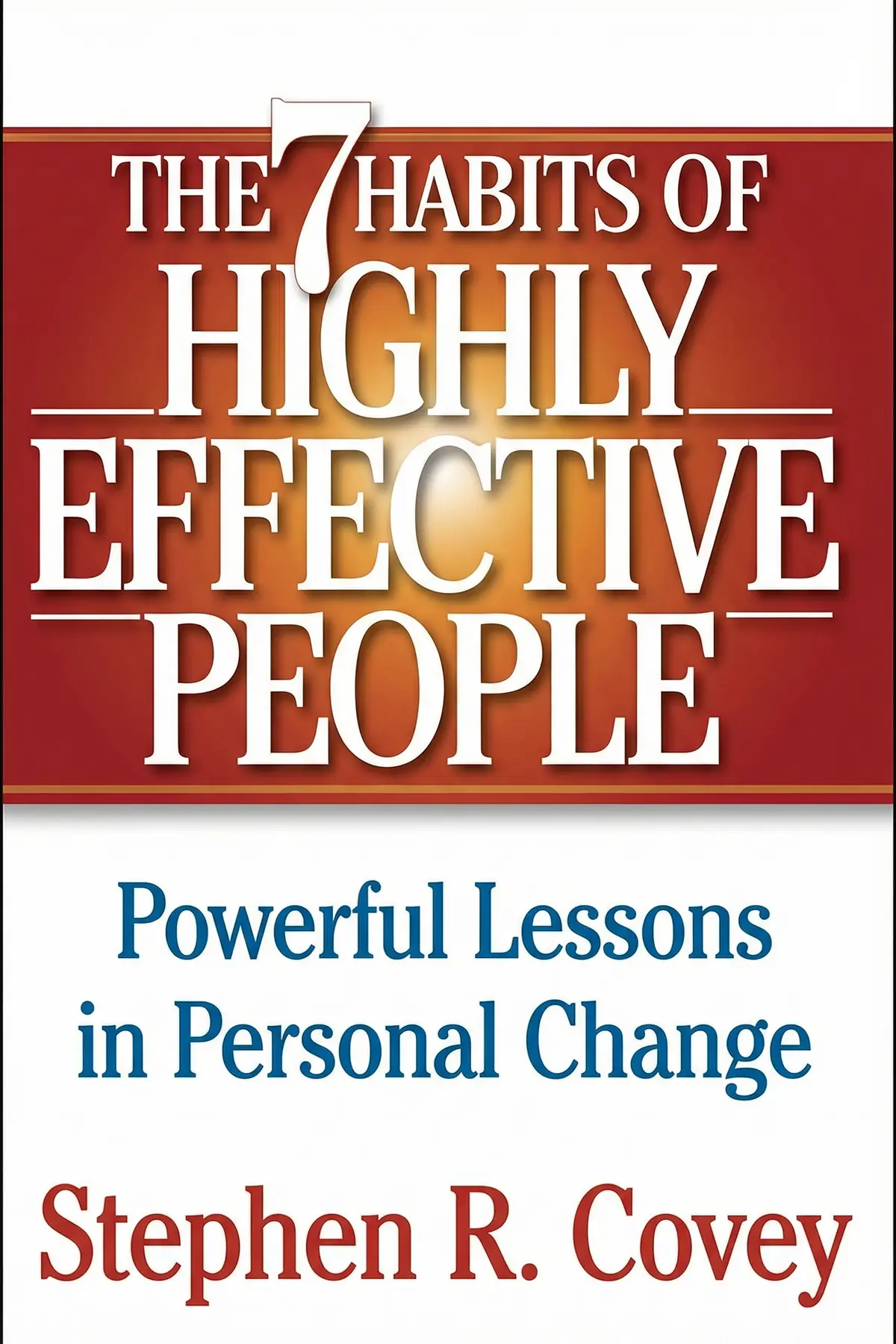
Table of Content
1. Introduction
1 min 01 sec
Most people who feel stuck have already tried the tips: a new planner, a script for a hard conversation, a trick for waking earlier. In The 7 Habits of Highly Effective People, educator and business leader Stephen R. Covey argues that such tips rarely last, because they change behavior on the surface while the person underneath stays the same. Lasting results, he says, come from character: a few unchanging principles, practiced until they become habits.
Covey reached that view after reviewing 200 years of self-help writing, and his seven habits work as a map for living by principle. They start with how you respond, what you aim for and where your hours go. They then reach other people, through fair deals, real listening and shared creativity, and they finish with keeping yourself fit for all of it. Each habit arrives with the story or exercise Covey uses to make it stick, and with something to try this week.
2. Build character that outlasts any technique
1 min 37 sec
A stranger’s directions get you one block, and a map gets you anywhere. Covey found two centuries of success advice split along exactly that line, and only one side produces change that lasts.
3. Choose your response when life goes wrong
1 min 39 sec
A prisoner in a World War II camp had no say over his conditions, yet he kept one freedom his captors could not reach. That same freedom is available on every bad day.
4. Write the ending first, then plan
1 min 35 sec
An uncomfortable exercise about your own funeral turns out to be one of the most practical planning tools Covey offers, useful for anything from a weekly schedule to the shape of a whole life.
5. Give your best hours to important work
1 min 46 sec
Ringing phones and jammed printers demand attention, while the tasks that matter most wait patiently and get ignored. A simple four-box grid shows where your hours really go and where they should.
6. Turn rivals into teammates with win-win deals
1 min 43 sec
A bonus meant to reward the best seller ends up shrinking the whole team’s sales. Covey explains why it backfires, and what kind of arrangement turns competitors back into colleagues.
7. Listen first and people will open up
1 min 40 sec
An eye doctor who handed every patient her own glasses would soon have no patients. Many of us give advice in exactly that way, and one small habit in conversation can change it.
8. Make a group smarter than its members
1 min 41 sec
A team of brilliant, opinionated experts kept clashing in the years after World War II. Their leader’s slow, patient fix turned a room of colliding views into a creative and productive culture.
9. Rest that keeps every other habit working
1 min 32 sec
A lumberjack who works harder every day fells fewer trees each afternoon. The reason is simple, and it applies to anyone whose energy, focus or patience keeps running lower as the weeks go by.
10. Conclusion
1 min 10 sec
The seven habits describe one person seen from different sides. Someone who chooses their response, knows the ending they want and protects important work that never shouts is also the person others trust to look for a deal that serves both sides, to listen before advising and to help a group think better than any member alone. Covey’s claim is that such a person is built slowly, from principles that hold in every setting, and that tricks borrowed for one situation cannot carry that weight.
So the work is patient and specific. Draft a personal mission statement, letting the funeral exercise show you what matters. Each evening, sort the next day’s tasks into the four boxes and keep time for the second. In conversation, name the other person’s feeling before giving your answer. Covey also suggests listing the qualities you want to grow and rating yourself on them week after week, so that progress stays visible and keeps you rising on what he calls the upward spiral.
A stranger on the street can still point the way. A map lets you find it yourself, again and again.
About this book
What is this book about?
Most people know what they want: a better career, a stronger family, a sense of accomplishment. Many have tried the tips, the scripts and the planners, and found that the change faded. Stephen R. Covey argues that this happens because most advice works on the surface, teaching techniques while leaving the person underneath untouched. After reviewing 200 years of self-help writing, Covey separates the Personality Ethic, success as a set of tricks, from the Character Ethic, success as the result of living by principles that hold true everywhere. His seven habits turn that second approach into daily practice. They cover choosing your response to events, starting from the outcome you want and ordering your time by importance. They also cover seeking deals that benefit everyone, listening before advising, building creative teamwork and renewing body, mind, spirit and relationships. Readers get memorable tools to carry out of the book: the funeral exercise and a personal mission statement, a four-box time management matrix, a bonus design that turns rivals into teammates, and the simple practice of reflecting another person's feelings.
Book Information
Who it's for
Professionals wanting lasting principles
Professionals who keep trying productivity tricks and want principles that hold up week after week.
Managers facing team conflict
Managers and team leads dealing with rivalry, poor listening or clashing experts on their teams.
Juggling work and family
Anyone stretched thin by work and family who wants a clearer sense of priorities and time to recover.
About the Author
Stephen R. Covey
Stephen R. Covey was an educator, businessman and speaker who co-founded FranklinCovey. Born in Salt Lake City, Utah, in 1932, he was a professor at the Jon M. Huntsman School of Business at Utah State University at the time of his death in 2012. Besides The 7 Habits of Highly Effective People, his best-known work, he wrote First Things First and The 8th Habit. In 1996, Time magazine named him one of its 25 most influential people.
Primary Greatness: The 12 Levers of Success
Stephen R. Covey
The 7 Habits of Highly Effective Families
Stephen R. Covey
The 8th Habit: From Effectiveness to Greatness
Stephen R. Covey
The Speed of Trust: The One Thing That Changes Everything
Stephen R. Covey
Ratings & Reviews
Ratings at a glance
What people think
Listeners view this title as essential reading, especially for teenagers and corporate professionals, praising its educational merit as one of the top 10 books of all time. They also find the material to be life-changing and motivating, with one listener noting how it offers practical guideposts for living a more productive life. Additionally, the content receives high marks for its quality and comprehensive nature, and listeners appreciate the affordability, calling it a great used book for the price. However, listeners have varying views on how easily the advice can be implemented; while some find it simple to understand, others struggle to apply the principles in their own lives.
Top reviews
Thanit
Finally got around to reading this staple of the business world, and I can see why it’s stayed relevant for decades. Unlike modern self-help books that offer shallow 'hacks,' Covey focuses on a character-based approach that feels sustainable for the long haul. The concept of the 'P/PC Balance'—the goose and the golden egg—really resonated with my current state of burnout. To be fair, the writing can be a bit dry and academic in certain chapters, but the depth of information is unparalleled. I found myself highlighting the sections on personal mission statements and planning my week around roles rather than just tasks. It is an educational journey that forces you to work from the inside out. Even if you only implement two or three of these habits, your productivity and sense of purpose will likely skyrocket.
Show moreMia
As someone who has struggled with chronic burnout, the concept of 'Sharpening the Saw' was exactly what I needed to hear. We often think that working harder is the only way to get ahead, but Covey argues that taking time for renewal is a requirement for effectiveness. Not gonna lie, I was skeptical of the 'emotional bank account' metaphor at first, thinking it sounded a bit cold. However, once I applied it to my relationship with my teenage daughter, the results were almost immediate and very moving. This book provides a practical guide for anyone looking to build better relationships and a more focused life. It’s dense, yes, but the quality of the insights makes it worth every hour spent reading. It truly earns its reputation as one of the best books of all time.
Show moreWitthaya
This book should be required reading for every teenager entering the workforce or starting college. It moves you from a state of dependence to independence and finally to the peak of interdependence. I loved the distinction between being proactive and reactive; it’s a simple shift in language that changes your entire reality. Instead of saying 'I have to,' you start saying 'I choose to.' The chapter on 'Seeking First to Understand' is probably the most important lesson in communication ever written. While some people might find the tone a bit too 'earnest' or traditional, I found the sincerity refreshing in our cynical age. It’s an investment in yourself that pays dividends across every area of your life. Buy it, read it, and then actually do the exercises at the end of each chapter.
Show moreMalee
Wow, the chapter on 'Seeking First to Understand, Then to be Understood' completely changed how I approach arguments with my spouse. In my experience, most conflicts happen because we are just waiting for our turn to speak rather than truly listening. Covey’s focus on empathic listening isn't just a 'tactic'—it’s a way of showing deep respect for another human being. This book is far more than a productivity guide; it’s a manual for becoming a better person. I found the 'inside-out' approach to be the only real way to achieve lasting change. It’s inspirational without being fluffy, which is a very rare balance to strike in the self-help genre. This is one of those rare books that actually lives up to the massive hype surrounding it.
Show moreSook
Ever wonder why some people seem to navigate chaos with total calm while the rest of us are drowning in emails? This book holds the answer by teaching you how to build a center based on principles rather than shifting emotions or circumstances. The '7 Habits' aren't just a list; they are an integrated system that builds on itself. I was particularly struck by the idea of 'Beginning with the End in Mind' and visualizing your own funeral to determine your true values. It’s a heavy exercise, but it provides a level of clarity that no app or calendar ever could. This is a must-read for anyone who feels like they are running fast but not actually getting anywhere. It provides the practical guideposts needed to live a more productive and meaningful life.
Show moreSumalee
After hearing my boss quote 'Put First Things First' for the thousandth time, I decided to see what the fuss was about. This isn't just a book; it’s a full-scale operating system for your life that requires serious mental effort. Frankly, the middle section about 'Think Win-Win' changed how I view my professional rivalries entirely. I used to operate from a scarcity mentality, fearing that someone else's success took something away from me. Covey’s argument for an abundance mentality is probably the most life-changing shift I've experienced this year. My only gripe is that the book is quite long-winded and some of the examples feel a bit dated for a modern reader. Still, the core principles of proactive living and deep listening are timeless guideposts that I plan to revisit often.
Show moreJirapat
Frankly, some of the corporate lingo like 'synergize' makes me cringe a bit, but the underlying psychology is rock solid. I appreciated how the author emphasizes that you can't have 'public victories' before you have 'private victories' with yourself. It is a humbling reminder that we often try to fix our external circumstances while ignoring our own lack of discipline. The section on weekly planning was a game-changer for me, helping me move away from the 'urgent' fires and toward the 'important' goals. To be fair, it takes a lot of willpower to maintain these habits once the initial excitement of the book wears off. I gave it four stars because it is undeniably effective but can be a bit of a grind to get through. It is definitely more of a textbook than a beach read.
Show moreViolet
Picked this up as a used copy for a few bucks, and it might be the best value-for-money purchase I've made all year. The principles are universal and grounded in what Covey calls 'natural law,' which gives the advice a weight that other books lack. I particularly enjoyed the focus on the 'circle of influence'—focusing on what you can control rather than wasting energy on things you can't. Not gonna lie, some of the 1980s anecdotes feel a little cheesy today, and the 'Win-Win' section can feel idealistic in a cutthroat business environment. Regardless, the core message about personal responsibility and integrity is something we all need to hear. It’s a comprehensive, educational tool that I’ll likely keep on my shelf for years to come.
Show moreTantipat
The information quality here is undeniably high, yet the actual application of these habits feels much more complicated than the charts suggest. Covey provides a comprehensive framework that sounds foolproof on paper, but trying to 'Begin with the End in Mind' while juggling a toddler and a full-time job is easier said than done. Truth is, the book is quite repetitive and feels dated in its delivery. I appreciate the focus on character-based growth rather than quick-fix personality hacks, which is a refreshing change from modern influencers. However, the sheer volume of 'application suggestions' and circular diagrams can be overwhelming for a casual reader. It is a solid educational resource for business professionals, though it lacks the simplicity I was hoping for. It's a three-star experience for me because of the slog.
Show moreBank
Look, I know this is considered the 'holy grail' of self-help, but I found the tone incredibly condescending and borderline religious. To be fair, there are some decent kernels regarding personal responsibility, yet they are buried under mountains of corporate 'synergy' drivel and enough flow charts to make a middle manager weep with joy. The whole 'Win-Win' philosophy sounds great on a PowerPoint slide, but in the real world, it feels like a manipulative tactic dressed up in new-age platitudes. If you enjoy being lectured by a man who uses the phrase 'production capability' to describe human beings, this is for you. Personally, I found it more nauseating than inspirational. It felt less like a guide for living and more like a manual for a very specific, stiff kind of corporate culture.
Show moreQuestions about this book
What is the main idea of The 7 Habits of Highly Effective People?
Stephen R. Covey argues that lasting success comes from character, not from techniques. After reviewing 200 years of self-help writing, he contrasts the Personality Ethic, which offers tricks and scripts, with the Character Ethic, which asks you to live by principles such as fairness, empathy and trust. His seven habits turn those principles into daily practice, from choosing your response to events to renewing your body, mind, spirit and relationships.
What is Covey's time management matrix?
It is a grid of four boxes that sorts tasks by urgency and importance. Quadrant one is urgent and important, like a crisis. Quadrant two is important but not urgent, such as building client relationships. Quadrant three is urgent but minor, like a ringing phone, and quadrant four is neither, like solitaire. Covey urges extra attention to quadrant two, because tending it early prevents new crises.
What is the difference between the Personality Ethic and the Character Ethic?
The Personality Ethic treats success as a matter of saying the right things and completing the right tasks, which Covey says tends to produce shallow change. The Character Ethic holds that success rests on deep principles true in every situation. In a marriage, the first suggests a new communication style or a special vacation, while the second asks you to become a person built on fairness, empathy and trust.
How can I apply The 7 Habits in daily life?
Start small. Use the funeral exercise to draft a personal mission statement. Sort tomorrow’s tasks into the four boxes of the time management matrix and protect an hour for important, non-urgent work. In conversations, name the other person’s feeling, for example by saying it sounds frustrating, before offering advice. Book time each week for exercise, reflection, learning and the people you care about.
Who should read The 7 Habits of Highly Effective People?
It suits people who have tried quick fixes for productivity or relationships and found them fading. Managers get tools for team rewards, listening and collaboration, such as bonuses tied to everyone’s targets and David Lilienthal’s weeks of open meetings. Anyone feeling worn out gets Covey’s case for regular renewal in four dimensions, illustrated by a lumberjack who forgets to sharpen his ax.
Readers also enjoyed

59 Seconds: Change Your Life in Under a Minute
Richard Wiseman





A Guide to the Good Life: The Ancient Art of Stoic Joy
William B. Irvine


A High-Performing Mind: Strengthen Your Mind and Live Your Best Life
Andrew D. Thompson


Abundance: The Inner Path to Wealth
Deepak Chopra
AUDIO SUMMARY AVAILABLE
Listen to The 7 Habits of Highly Effective People in 15 minutes
Get the key ideas from The 7 Habits of Highly Effective People by Stephen R. Covey, plus 5,000+ more nonfiction titles.
- 5,000+ titles
- Listen as much as you want
- 7-day free trial
- Cancel anytime









