
14 min 30 sec
Available in: English
 ไทย
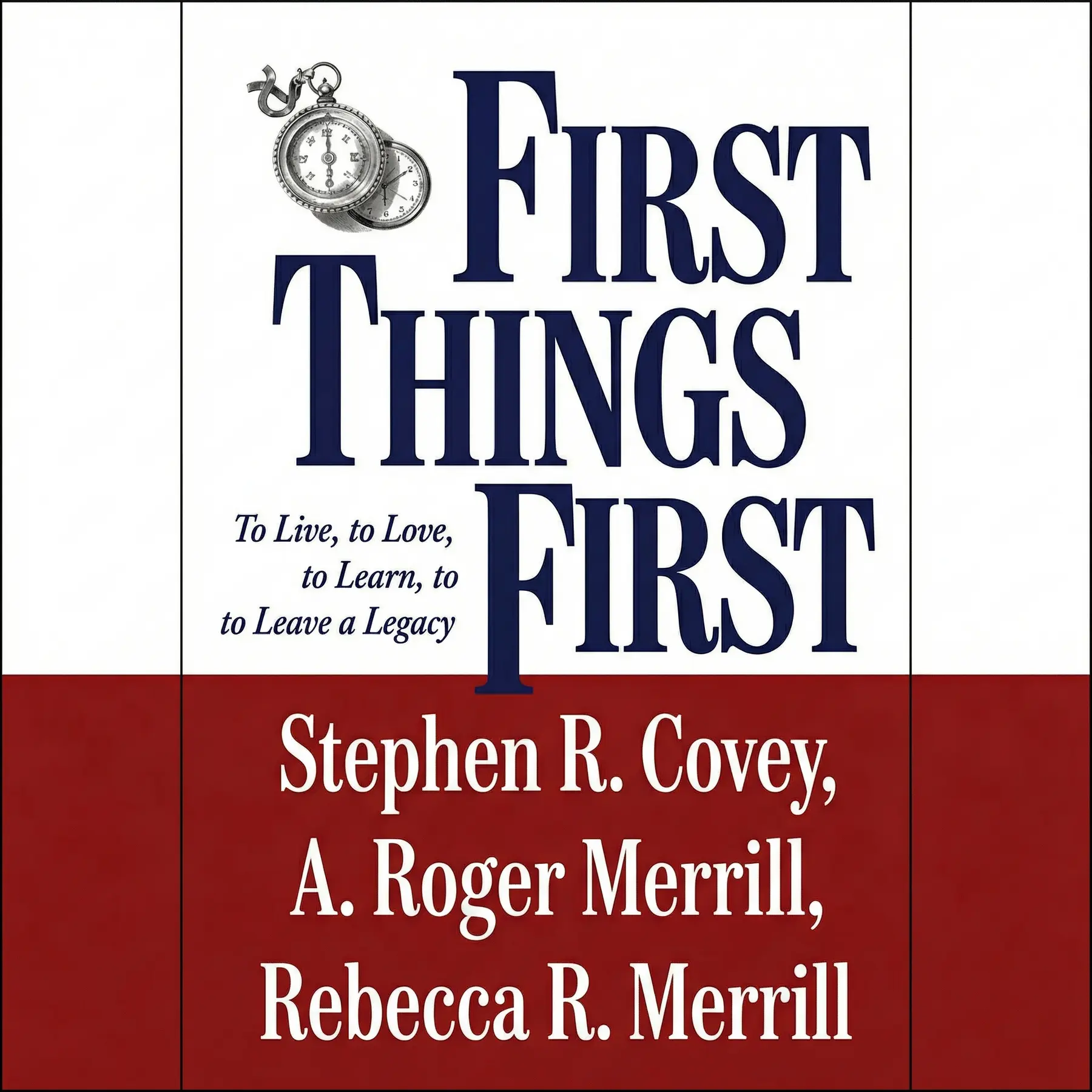
EnglishไทยFirst Things First: To Live, to Love, to Learn, to Leave a Legacy
Shows how to stop letting urgent demands crowd out what matters, by identifying your deepest needs and principles, building a clear vision, setting sound goals and planning each week around your most important commitments.
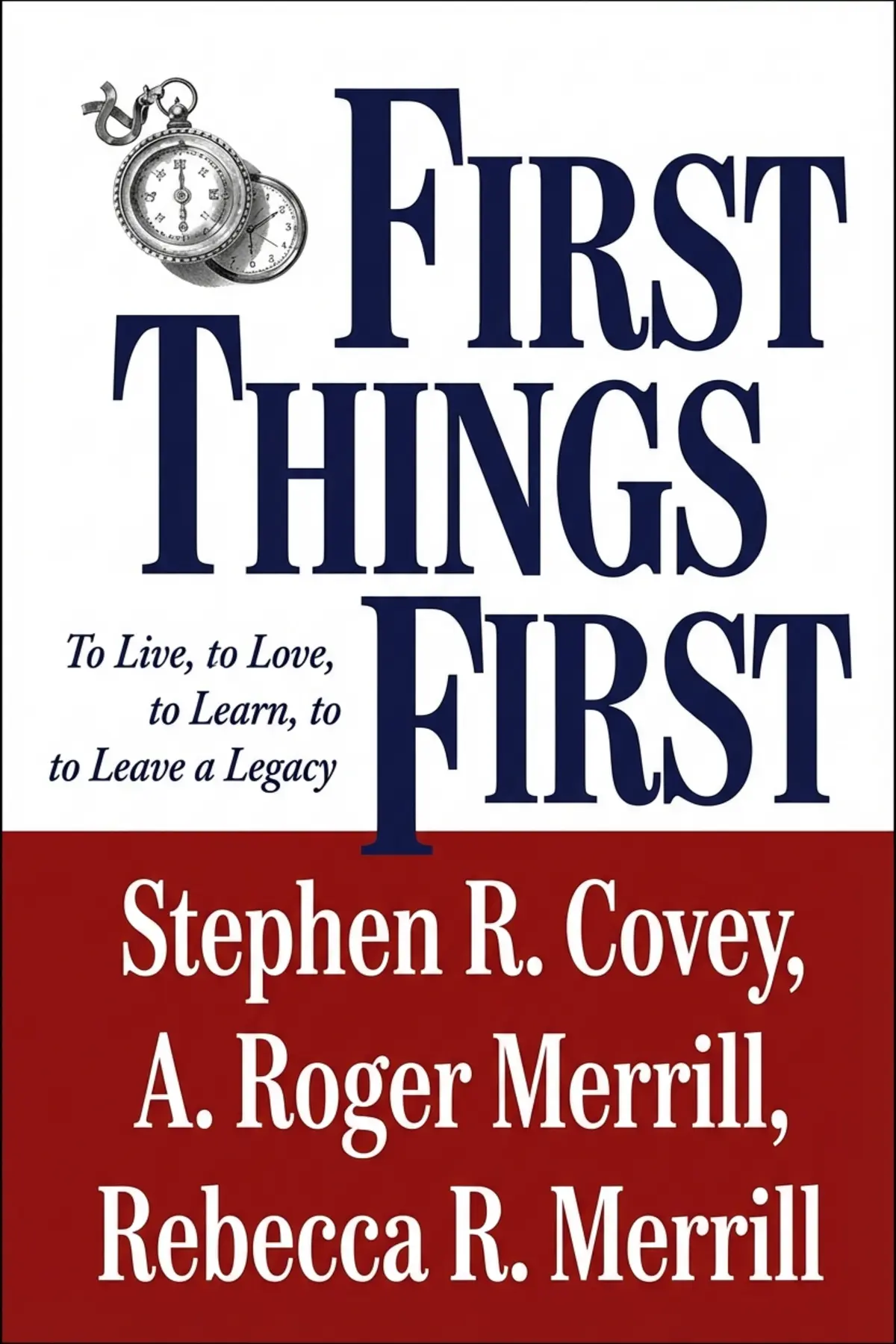
Table of Content
1. Introduction
1 min 00 sec
If your days are full but your life still feels thin, doing things faster will not fix it. In First Things First, Stephen R. Covey, A. Roger Merrill and Rebecca R. Merrill argue that the usual time management advice, with its lists, speed and ticked boxes, treats the wrong problem. What counts is whether your hours go to the things that give life lasting meaning, which the authors call first things.
Their case moves from a fairy’s tempting offer to a professor filling a jar with rocks, by way of four basic human needs, a business dinner that clashes with a family evening and a Soviet policy that hit its target and still backfired. One idea holds it together: decide what is important, plan your week around it, and the urgent will have to fit around that. The reward is a practical way to choose, every week, between what shouts loudest and what you will be glad you did.
2. Trade a faster clock for a truer compass
1 min 36 sec
A fairy offers to make you 20 percent faster at everything, and most people would probably say yes. The authors explain why accepting could leave you busier than ever and still unhappy, and what to reach for instead.
3. Protect what matters from what merely shouts
1 min 23 sec
An invitation from the boss lands on the one evening you saved for your family. Most people make the same choice, for reasons rooted in status and body chemistry, and the cost appears much later.
4. Four needs that reveal your real priorities
1 min 48 sec
Stress and anxiety often point to something specific that is missing. A simple map of what every person needs, and a would-be marathon runner, show how to find the gap in your own week.
5. A clear picture of your future eases decisions
1 min 44 sec
A shy young lawyer became a fearless public figure, and Holocaust survivors shared one surprising trait. Both stories point to an exercise involving your eightieth birthday that makes everyday choices far simpler.
6. Avoid the hidden cost of goals you reach
1 min 40 sec
A government set out to cut drinking and succeeded, then watched a worse problem grow. Three tests can tell you in advance whether a goal will improve your life or only tick a box.
7. Plan your week as one connected life
1 min 51 sec
Most planning looks either at tonight or at five years from now. A new recipe, a busy executive and a tennis court show the time frame that works better, and why splitting life into boxes backfires.
8. Cooperation takes you further than competition ever will
2 min 10 sec
Rushing through meals and relationships has a hidden cost. A single question asked of a struggling employee, and a lost promotion seen differently, show what changes when you stop treating people as rivals.
9. Conclusion
1 min 18 sec
The book’s lasting image is a jar. A professor filled one with rocks and asked his students whether it was full. They said it was. He poured in gravel, which settled between the rocks, then sand, then water, until no gap remained. For the authors, the jar is your time. The rocks are the important things; the gravel, sand and water are daily chores and everything else. Put the small things in first and the rocks will not fit. Put the rocks in first and the rest finds its place around them.
That image also answers the fairy. A faster life is still a jar that fills up, and being full says nothing about what went in first. The authors offer an order instead: know your needs and principles, picture yourself at eighty, choose goals you can influence, and book the important things before the urgent ones arrive.
Start with next week. Name your rocks, perhaps an evening with your family, a long run, a conversation with someone you lead, and put them in the calendar before anything else. When the next business dinner appears, it can fit around them. The jar will fill either way, so choose what goes in first.
About this book
What is this book about?
Most time management advice promises to help you do more, faster: longer lists, quicker checkmarks, tighter schedules. Stephen R. Covey, A. Roger Merrill and Rebecca R. Merrill argue that this misses the point. A full calendar can still leave you stressed, disconnected and unhappy if it is filled with the wrong things. Their alternative is to put first things first. The authors contrast the clock of your life, meaning appointments and commitments, with its compass, meaning values, principles and conscience. They show how urgency crowds out importance and describe four basic human needs: to live, to learn, to love and to leave a legacy. They also explain why a clear vision of the future makes decisions easier, drawing on Gandhi and on Victor Frankl's observations of Holocaust survivors. Readers get practical tools: a personal mission statement, a what, why and how test for every goal, weekly planning that combines roles instead of separating them, and a way of leading others through trust. The book closes with the image of a jar filled with rocks first, a reminder of how to order a life.
Book Information
Who it's for
Busy professionals
Professionals with full calendars who feel family and health keep getting postponed.
Managers and parents
Managers and parents who want to lead through trust instead of constant supervision.
Tired of fading resolutions
People whose New Year's resolutions fade and who want goals tied to their values and their week.
About the Author
Stephen R. Covey
Stephen R. Covey (1932 to 2012) was an educator, businessman and speaker from Salt Lake City, Utah, and a co-founder of FranklinCovey. He wrote The 7 Habits of Highly Effective People and The 8th Habit, and in 1996 Time magazine named him one of its 25 most influential people. At his death he was a professor at the Jon M. Huntsman School of Business at Utah State University. A. Roger Merrill, a co-founder and vice president of the Franklin Covey Company, writes, consults and teaches on leadership around the world. He and his coauthor Rebecca R. Merrill live in Salt Lake City.
Primary Greatness: The 12 Levers of Success
Stephen R. Covey
The 7 Habits of Highly Effective Families
Stephen R. Covey
The 8th Habit: From Effectiveness to Greatness
Stephen R. Covey
The Speed of Trust: The One Thing That Changes Everything
Stephen R. Covey
Ratings & Reviews
Ratings at a glance
What people think
Listeners find this book to be a superb resource that offers valuable advice for managing time and setting priorities. They value the robust framework for life organization and its transformative effects, while one listener highlights its specific utility for individuals with Attention Deficit Disorder. However, the book's length draws mixed feedback, as some find it too long. Additionally, several listeners mention missing sections, specifically Appendix A, which diminishes the overall experience.
Top reviews
Win
This book completely shifted my perspective on what it means to be 'busy' versus being 'effective.' Rather than just teaching you how to run faster on the treadmill of life, Covey asks you why you’re on the treadmill in the first place. The 'compass over clock' metaphor is powerful because it emphasizes direction over speed. I’ve stopped obsessing over my to-do list and started looking at my life through the lens of my primary roles. It’s not just about getting things done; it’s about doing the right things for the right reasons. To be fair, it is a dense read that requires focus, but the payoff for your mental health and productivity is immense. If you feel like you're drowning in urgency, this is the life raft you need.
Show moreSomchai
As someone who has struggled with Attention Deficit Disorder my entire life, finding a system that prioritizes principles over rigid schedules was a godsend. Traditional time management always felt like a cage to me, focusing on every minute and hour. Covey’s 'Fourth Generation' approach is much more fluid and forgiving for the neurodivergent brain. It teaches you to listen to your conscience and focus on your relationships rather than just checking off boxes. The concept of 'urgency addiction' was a total epiphany for me; I realized I was living for the adrenaline of deadlines. I'm finally learning how to put first things first without the constant anxiety of a ticking clock. It’s truly transformative.
Show moreOm
Wow. I didn't think a book about time management could make me cry, but the focus on family mission statements really hit home. It made me realize I was giving my 'best self' to my coworkers and my 'leftover self' to my wife and kids. This isn't just a book about being more productive at the office; it’s a manual for living a life you won't regret. The authors challenge the Western obsession with speed and remind us that some things, like building trust and raising children, cannot be 'efficient.' You have to put people ahead of schedules. It took me a while to finish because I kept stopping to reflect on my own values. This is essential reading for anyone feeling burnt out by the rat race.
Show moreGun
Finally got around to reading this after years of loving '7 Habits,' and it feels like the deep-dive expansion I always wanted. While the original book introduced the concept of putting first things first, this one provides the practical tools to actually do it. The focus on 'living, loving, learning, and leaving a legacy' provides a beautiful framework for a balanced life. I especially appreciated the advice on saying 'no' to the good so you can say 'yes' to the best. It’s a life-changing impact if you’re willing to put in the work to redefine your priorities. Yes, it’s verbose, but the wisdom is worth the extra pages. This is a classic for a reason and highly recommended for young adults starting their careers.
Show moreTom
After hearing so much about the 'Big Rocks' analogy, I finally dove into the source material. It’s a solid method for organizing your life that moves beyond the typical daily checklist. The focus on Quadrant II activities—those things that are important but not urgent—has helped me carve out time for long-term planning and relationship building. My main gripe is that it feels significantly longer than necessary. Truth is, the authors repeat themselves quite a bit to drive home points that were clear by the second chapter. I also noticed that my copy was missing sections in the back, specifically Appendix A, which was frustrating. Still, the core philosophy is life-changing if you can slog through the fluff.
Show moreKwan
The core message here—prioritizing Quadrant II—is absolutely brilliant, even if the delivery is a bit dry at times. Most of us spend our lives reacting to the 'urgent' (Quadrant III) and wondering why we feel unfulfilled at the end of the week. This book provides a roadmap for breaking that cycle. I particularly liked the section on 'synergy of interdependence' and how our roles should complement rather than compete with one another. It’s an analytical look at life management that treats the reader like an adult. Just be prepared for a slow read. The authors use a lot of lengthy examples that can feel a bit dated or overly sentimental. Regardless, the logic is sound and the framework is one of the best I've encountered.
Show moreArthit
Personally, I found the distinction between the 'urgent' and the 'important' to be the most valuable takeaway from Covey’s framework. We live in a world that demands instant responses, and this book is a great reminder to step back and look at the bigger picture. The weekly planning process is much more realistic than daily scheduling. It allows for the 'interruptions' of real life—like a child needing attention or a sudden work crisis—without ruining your entire sense of accomplishment. I do think the book is a bit repetitive, and some of the terminology like 'True North' feels a bit cheesy. But if you actually apply the 'Big Rocks' method, you will see immediate improvements in your stress levels.
Show moreSureerat
Look, this isn't your typical productivity guide filled with hacks to squeeze more out of your day. It’s more of a philosophical shift. Instead of focusing on the clock—doing things fast—it focuses on the compass—doing the right things. I’ve started using the quadrant system to evaluate my weekly tasks, and it’s been eye-opening to see how much time I was wasting on Quadrant III 'emergencies' that didn't actually matter. My only complaint is the length. The book could have been 150 pages and lost none of its impact. Still, the message of quality over quantity is something I think everyone needs to hear right now. It provides a solid method for reclaiming your schedule from the noise of the world.
Show morePraepimon
Ever wonder why self-help books have to be four hundred pages when they could be eighty? First Things First has some incredible nuggets of wisdom buried under mountains of unnecessary text. The 'Big Rocks' story is a classic for a reason, and the shift from efficiency to effectiveness is a vital lesson for any professional. However, I found myself skimming large sections just to get to the actual 'how-to' parts. To make matters worse, my Amazon copy was missing Appendix A, which several other reviewers mentioned as well. It’s a decent book for those who like deep philosophical dives, but if you want quick productivity hacks, you’ll likely find this frustrating. It’s a bit too 'high-level' for its own good.
Show moreHarper
Not what I expected from such a highly-rated bestseller. While I appreciate the sentiment of living a principle-centered life, the writing style is painfully verbose and repetitive. It feels like a diet book that spends three hundred pages telling you to 'eat less' while using fancy terminology like 'nutritional legacy.' Frankly, the advice seems geared toward corporate executives who have the luxury of delegating their chores. If you're a middle-class worker struggling to pay bills, telling your boss 'no' because of your personal mission statement might just get you fired. I found the 'quadrant' stuff useful, but you can get that from a ten-minute YouTube summary. It’s just too much fluff for a very simple message.
Show moreQuestions about this book
What is the main idea of First Things First?
The authors argue that doing more, faster, does not create a meaningful life. Instead, you should identify your first things, usually relationships with family and friends, and give them priority. That means following the compass of your values and principles as well as the clock of your schedule, and choosing what is important over what is merely urgent. When the important things go in first, the rest of life fits around them.
What are the four human needs in First Things First?
The book names four. The need to live is physical and covers food, shelter and health. The need to learn is mental stimulation. The need to love is about having trusted people in your life whom you also care deeply about. The need to leave a legacy is a spiritual sense of purpose. When these go unmet, the authors say, stress, anxiety and fear follow, and principles are what help you meet and balance them.
How do you apply First Things First to weekly planning?
The authors suggest planning by the week instead of only by the day or the five-year horizon. Give work, family and leisure their share of attention on a weekly calendar without fixing every hour. Then look for ways to combine goals and roles, such as testing a new recipe at dinner and sharing the extra with neighbors, or exercising by playing tennis with your children.
What is the jar of rocks story in First Things First?
A professor filled a jar with rocks, and his students agreed it was full. He then added gravel, sand and water into the gaps. The authors treat the jar as your time: the rocks are the important things and the rest are daily chores. If the small things go in first, the rocks will not fit; if the rocks go first, everything else finds room.
Readers also enjoyed






A Guide to the Good Life: The Ancient Art of Stoic Joy
William B. Irvine


A High-Performing Mind: Strengthen Your Mind and Live Your Best Life
Andrew D. Thompson


Abundance: The Inner Path to Wealth
Deepak Chopra
AUDIO SUMMARY AVAILABLE
Listen to First Things First in 15 minutes
Get the key ideas from First Things First by Stephen R. Covey, plus 5,000+ more nonfiction titles.
- 5,000+ titles
- Listen as much as you want
- 7-day free trial
- Cancel anytime









