
14 min 54 sec
Available in: English
Primary Greatness: The 12 Levers of Success
Covey separates the visible success of money and status from inner character. He shows how twelve practical principles, from integrity to renewal, build the inner kind that brings fulfillment and peace.
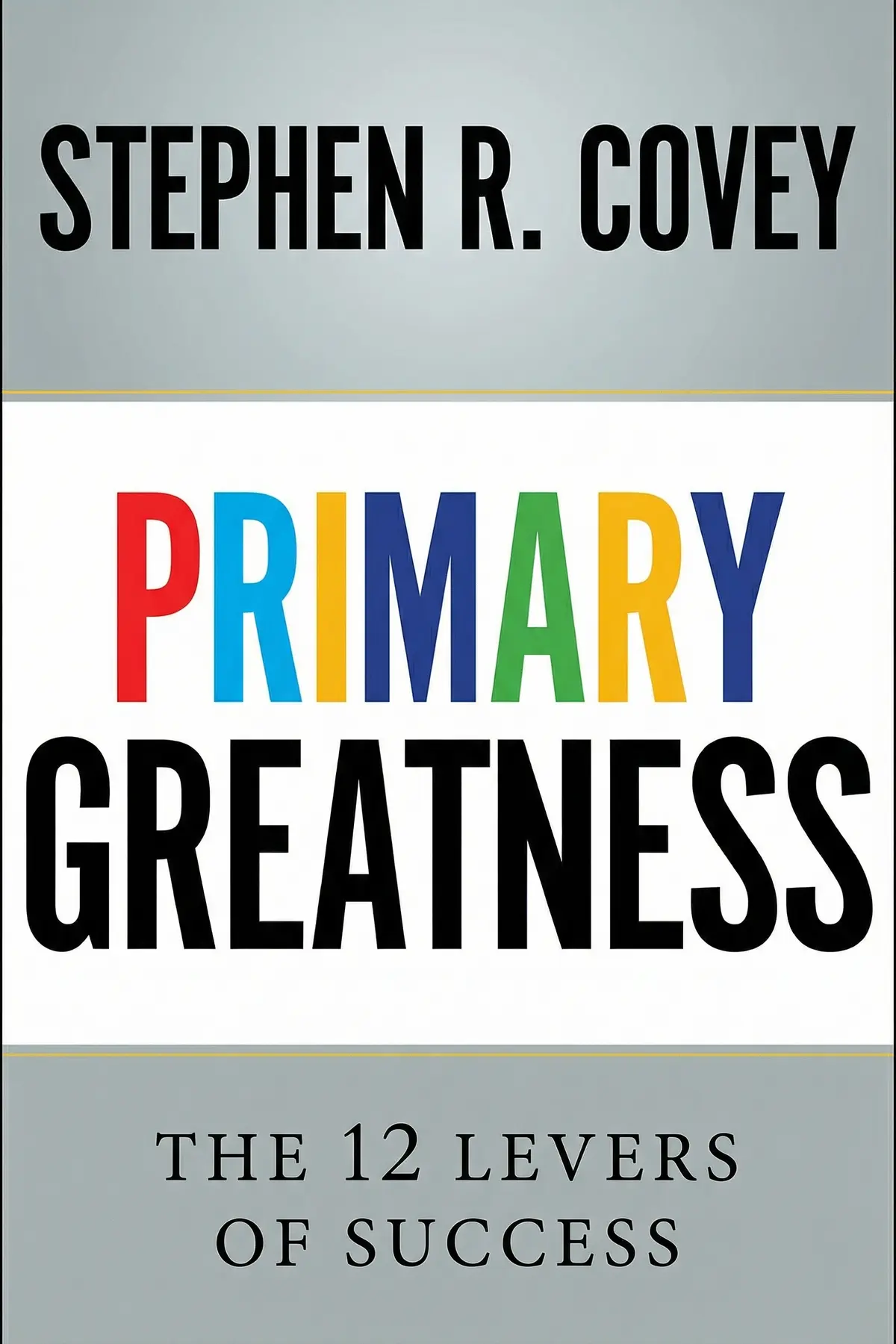
Table of Content
1. Introduction
1 min 04 sec
Fast cars and designer clothes say a lot about a bank balance and very little about whether a life is going well. In Primary Greatness, Stephen R. Covey, author of The 7 Habits of Highly Effective People, separates the visible success of money and status from an inner kind he calls primary greatness. It is made of integrity, selflessness, persistence and a purpose bigger than yourself.
His claim is that this inner kind can be trained, and that it brings the fulfillment and peace that trophies never do. Covey turns the training into twelve levers, running from integrity and contribution to learning, teaching and renewal.
The argument underneath is simple: real success is built from character, and character grows through daily practices aimed at other people. Along the way come a rule for sorting important work from urgent noise, an apology that actually earns forgiveness, and three imagined crises that keep body, mind and relationships healthy.
2. Measure success by what nobody can see
1 min 50 sec
A red sports car and a tailored suit look like proof that someone has made it. Covey thinks we are reading the wrong evidence, and a fifty-year study of preschoolers suggests the real proof can be trained.
3. Trade the win-lose lens for a win-win one
1 min 33 sec
A talented basketball player can still be the reason his team keeps losing. The fix has nothing to do with skill, and it starts with a belief about how much there is to go around.
4. Earn trust with apologies that cost your ego
1 min 34 sec
A friend who had hurt Covey deeply came back and did something that turned anger into forgiveness. He later explained the private choice he faced, and it reveals what integrity is actually made of.
5. Let a clear purpose decide what comes first
1 min 34 sec
Very few people ever write down what their life is for, and many who search look too far away. A film about a reluctant music teacher and a surgeon’s phone call show what happens when you know.
6. Small acts of humility that bring people closer
1 min 31 sec
A company president did something on a business trip that looked completely wrong for his rank. His vice president never forgot it, and an actor losing his audience learned a similar lesson from a friend in the seats.
7. Inner security makes room for honest disagreement
1 min 36 sec
Some people hear a new idea and lean in, while others hear the same idea as an attack. Covey traces the difference to one inner quality, and teams pay for it when it is missing.
8. Defend the people who are not in the room
1 min 16 sec
A label you never say out loud can still change how a colleague behaves toward you. Covey explains how that happens, and offers a simple test for every comment you make about someone absent.
9. Teach to learn, and imagine the worst to stay well
1 min 54 sec
A hotel founder pays for daily training, and a professor’s three children all earned doctorates after a dinner-table habit. The last levers also ask you to picture a heart attack, on purpose.
10. Conclusion
1 min 02 sec
Covey’s twelve levers can sound like a list of virtues, but they work more like a compass. Each one turns attention away from the scoreboard of cars and salaries and toward other people: the friend who receives a real apology, the colleague defended while absent, the child who learns because a parent asked to be taught. His wager is that a life built this way pays out in fulfillment and inner peace, which status alone never delivers, and the Michigan preschoolers suggest the habits behind it can be taught.
The book’s own suggestion is a journal. Write down your purpose and your self-affirmations, and record each moment you chose the visible kind of success over the inner kind. Over time, those entries show you your blind spots. Pair the journal with the face test, saying nothing about anyone that you would not say to them directly, and with one important task each week that no deadline is forcing.
The car in the driveway tells you what someone owns. The way they apologize tells you who they are.
About this book
What is this book about?
Expensive cars, designer clothes and big houses are easy to mistake for success. Stephen R. Covey calls them secondary greatness: real enough to buy pleasure and financial security, but unable to deliver fulfillment or inner peace. Those come from primary greatness, a character built on integrity, persistence, selflessness and a purpose larger than yourself. Covey's central claim is that this character can be trained, and he points to a Michigan preschool study that followed children for fifty years as evidence. He arranges the training around twelve levers: integrity, contribution and priority, then sacrifice, service and reciprocity, followed by diversity, responsibility and loyalty, and finally learning, teaching and renewal. Each one comes with a story, from a company president shining his own shoes to a professor whose children taught him their lessons over dinner. Readers get concrete practices: three questions for finding a purpose, a rule for choosing important work over urgent noise, a way to apologize that earns forgiveness, a test for what you say about people who are absent, and three imagined crises that keep body, mind and relationships healthy.
Book Information
Who it's for
Successful but unfulfilled professionals
Professionals who have the salary and title but still feel something is missing.
Leaders wanting trusting teams
Managers who want teams that trust each other, disagree openly and stop gossiping.
Those wanting clearer priorities
Anyone who wants a practical way to choose important work over urgent noise.
About the Author
Stephen R. Covey
Stephen R. Covey was an educator, businessman and speaker, and a co-founder of FranklinCovey. He wrote The 7 Habits of Highly Effective People, his best-known book, along with First Things First and The 8th Habit. In 1996 Time magazine named him one of its 25 most influential people. When he died in 2012, he was a professor at the Jon M. Huntsman School of Business at Utah State University.
The 7 Habits of Highly Effective Families
Stephen R. Covey
The 8th Habit: From Effectiveness to Greatness
Stephen R. Covey
The Speed of Trust: The One Thing That Changes Everything
Stephen R. Covey
Ratings & Reviews
Ratings at a glance

What people think
Listeners describe this work as a gripping read that offers profound perspectives on achieving genuine greatness. They value the featured life lessons, with one listener highlighting how the content clarifies what is truly significant, while another observes that the principles are adaptable to any person's unique life path and aspirations.
Top reviews
Pierre
Picked this up during a difficult career transition and it completely shifted my perspective on what success actually looks like. Covey distinguishes between "secondary greatness"—the stuff like titles, money, and social status—and "primary greatness," which is rooted in character and integrity. It’s a compelling read that provides incredible insight into why we often feel empty even when we’re "winning" by society's standards. Personally, the chapter on the abundance mentality was a total game-changer for me because it challenged my scarcity-based fears. While some might find the twelve levers a bit overwhelming at first, the application tips at the end of each section make the concepts feel manageable. Essentially, it’s the kind of book you’ll want to revisit every year to keep your priorities in check.
Show moreOn
Ever wonder why some people seem to have everything but still aren't happy? This book answers that question by exploring the concept of primary greatness—a life built on contribution and sacrifice rather than superficial rewards. I found the section on "Service" especially moving because it reframes the way we look at our daily interactions with others. The writing style is vintage Covey: accessible, warm, and deeply convicting without being overly preachy. It helps you focus on what really matters in a world that is constantly screaming for your attention to be placed on "secondary" goals. Look, it’s not reinventing the wheel, but it puts the wheel in such a clear light that you can finally see where you're going. It’s an essential read for anyone trying to build a legacy that actually lasts.
Show moreNadia
As someone who has always struggled with a scarcity mindset, the sections on abundance and reciprocity were exactly what I needed to hear. This book inspired me to take a leap of faith and start contributing more to my community, even when I felt like I didn't have enough to give. It’s amazing how focusing on "Primary Greatness" actually leads to more inner peace than chasing the superficial rewards we're usually told to want. The distinction Covey makes between character and competence is so important because we live in a world that rewards what you can do over who you are. This book provides a clear path for anyone who wants to flip that script and live a more authentic, meaningful life. I can say this has genuinely changed the way I approach my business.
Show moreViroj
After hearing so much about Covey's later writings, I finally dove into this one and found it to be a very solid expansion of his core philosophy. The book functions almost like a sequel to his most famous work, focusing heavily on the foundational element of character over mere competence. I appreciated the distinction between just being "good at your job" and actually being a person of integrity and responsibility. The lessons on urgency versus importance are always a great reminder, though I’ve heard them from him before in other formats. Not gonna lie, some chapters are stronger than others, and the "twelve levers" framework feels a bit clunky compared to the streamlined seven habits. Still, the actionable advice provided for each lever helps bridge the gap between abstract theory and real-life application.
Show moreArthit
Wow, the focus on living on principle as a "liberating" framework really hit home for me while reading this. It’s easy to think that following strict rules or values would be restrictive, but Covey argues that it actually simplifies decision-making by removing the constant internal debate. Instead of weighing every choice against your ego or potential popularity, you just weigh it against your core principles like loyalty and responsibility. The book is very easy to read and works well as a quick daily devotional if you just take one "lever" at a time. My only minor gripe is that the tone can be a bit repetitive, as he hammers the same "primary vs secondary" point in nearly every chapter. Despite that, it’s a great tool for anyone looking to align their actions with their true intentions.
Show moreElias
The chapter on the "Loyalty" lever was particularly insightful and forced me to re-examine how I treat people when they aren't in the room. This book is essentially a guide to becoming a better human being through small, consistent shifts in character and mindset. I really liked the balance between the theoretical "big ideas" and the practical "how-to" tips included at the end of each section. It makes the lofty goals of "primary greatness" feel attainable rather than just something for saints or CEOs. In my experience, most people focus so much on skills and systems that they forget the character foundation, and this book serves as a perfect corrective to that imbalance. It’s a nice, short read that manages to pack a lot of wisdom into a relatively small number of pages.
Show moreMingkwan
Finally got around to reading this after a colleague recommended it for our management book club, and I’m glad I did. It’s a very accessible read that breaks down complex moral questions into actionable "levers" that anyone can apply to their life or career. I particularly enjoyed the discussion on the balance between courage and consideration, which is a vital skill for any leader. While some of the essays feel a bit shorter and less developed than others, the overall message is powerful and incredibly timely. It’s a reminder that true greatness isn't about the awards on your wall, but the integrity you show when no one is watching. Gotta say, even the bits that felt a bit "old school" had a kernel of truth that stayed with me long after I finished the last page.
Show moreDream
To be fair, this feels more like a curated collection of essays than a cohesive, ground-breaking manifesto like his earlier work. It’s clear that Covey was working on these ideas toward the end of his life, but they lack the sharp, systematic depth that made 7 Habits so iconic. Some of the twelve levers, like reciprocity and renewal, feel a bit repetitive or even contrived in their presentation. I also struggled with the Western bias that permeates many of the anecdotes; the examples can feel a bit trivial for a global audience. That said, there’s still value in examining these principles through a modern lens even if the writing isn't quite at his peak level. It’s a light read that doesn’t require much deep thinking, making it okay for a quick management seminar prep but maybe not a deep-dive study.
Show moreSamira
Not what I expected from a Covey book, mostly because it feels a bit like a "Greatest Hits" remix rather than new material. The core message is simple: be a good human and focus on integrity rather than fame or money. While these are essential principles, the presentation feels a bit recycled if you’ve already read The 7 Habits or Principle-Centered Leadership. The structure is okay, with the twelve levers providing a decent roadmap, but it lacks the cohesive "punch" of his earlier work. In reality, it’s a pleasant read and would be great for someone new to his philosophy, but seasoned fans might find it a bit redundant. It’s definitely not valueless, but it serves better as a gentle reminder than a life-altering revelation.
Show moreAna
This book was a bit of a disappointment for me, as it felt like a collection of leftover ideas that didn't quite make the cut for a primary publication. Twelve levers is simply too many to focus on effectively, and several of them feel like reaches or forced categories. Covey presents a lot of false dichotomies where you have to choose between his specific definition of "greatness" or a life of superficiality, which feels intellectually dishonest. Frankly, the principles are fine, but they aren't exactly ground-breaking or original if you’ve read any other self-help literature in the last thirty years. The anecdotes are extremely dated and often feel too contrived to be truly relatable in a modern, diverse workplace. I struggled to stay engaged because the lack of deep thinking required made the whole experience feel a bit shallow.
Show moreQuestions about this book
What is the main idea of Primary Greatness by Stephen Covey?
Covey distinguishes secondary greatness, the visible success of money, fame and status, from primary greatness, an inner character built on integrity, persistence, selflessness and a purpose beyond yourself. He argues that only the inner kind brings fulfillment and peace, that it can be trained, and that twelve principles he calls levers, from integrity to renewal, are the way to build it.
What are the 12 levers of success in Primary Greatness?
Covey names integrity, contribution and priority, then sacrifice, service and reciprocity, followed by diversity, responsibility and loyalty, and last learning, teaching and renewal. Integrity is the foundation. Contribution and priority come from finding your purpose. Sacrifice and service build relationships, reciprocity and diversity make them productive, loyalty and responsibility keep you accountable, and learning, teaching and renewal keep you growing and healthy.
How does Covey say you should prioritize tasks?
He separates tasks that are important but not urgent from tasks that are urgent but not important, and says importance always wins. His example is a surgeon in the middle of heart surgery who is told about an urgent phone call. The call waits, because the patient’s life matters more. A clear purpose, he argues, makes these choices obvious.
How can I apply Primary Greatness in daily life?
Covey recommends keeping a journal with your purpose and self-affirmations, and noting each time you chose status over character. Other practices from the book include apologizing without excuses, never saying anything about someone you would not say to their face, teaching others what you learn, and imagining a health crisis or obsolete skills to push yourself toward better habits.
Is there evidence that character can be developed?
Covey cites the Perry Preschool Project, which began in Michigan in 1965 and followed 123 inner-city preschoolers. One group practiced delaying gratification through dull, low-reward tasks. Fifty years later, compared with the control group, more of them had graduated and found jobs and fewer had been arrested. Covey takes this as evidence that traits like persistence and integrity can be trained.
Readers also enjoyed

59 Seconds: Change Your Life in Under a Minute
Richard Wiseman





A Guide to the Good Life: The Ancient Art of Stoic Joy
William B. Irvine


A High-Performing Mind: Strengthen Your Mind and Live Your Best Life
Andrew D. Thompson


Abundance: The Inner Path to Wealth
Deepak Chopra
AUDIO SUMMARY AVAILABLE
Listen to Primary Greatness in 15 minutes
Get the key ideas from Primary Greatness by Stephen R. Covey, plus 5,000+ more nonfiction titles.
- 5,000+ titles
- Listen as much as you want
- 7-day free trial
- Cancel anytime









