
14 min 05 sec
Available in: English
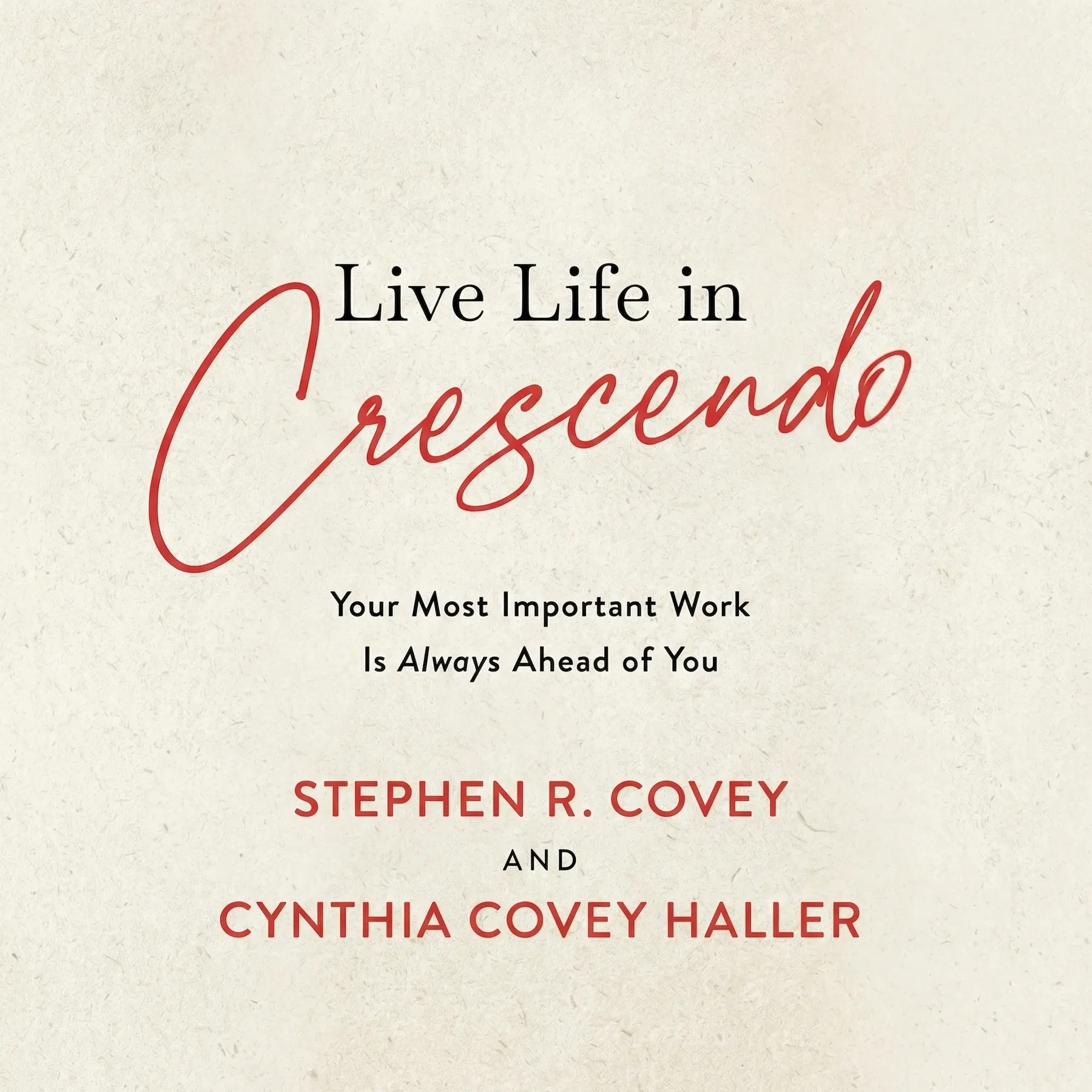
Live Life in Crescendo: Your Most Important Work is Always Ahead of You
Shows how to keep growing and giving through midlife doubts, big successes, sudden tragedies and retirement, by judging your life by your contribution to people and believing your most important work is still ahead.
Table of Content
1. Introduction
1 min 04 sec
If you suspect your best years are already behind you, Stephen R. Covey and Cynthia Covey Haller think you are hearing the music wrong. In Live Life in Crescendo, published as Covey’s final book after his death, they borrow two terms from classical music. A crescendo keeps swelling in volume and power, while a diminuendo fades until the piece ends.
Most people slide into diminuendo at some point: after a disappointing middle age, a big success, a tragedy or retirement. The authors argue that at every one of those stages you can choose the crescendo instead. Their case rests on one claim. Your most important work is always still ahead, as long as you measure your life by what you give to the people around you.
The evidence includes a desperate small-town man in an old film, a couple who survived a plane crash, a prisoner on death row and a scientist who lost his whole family. Each stage also leaves you with something to try this week: a page to write, a kind word to say, a need to meet.
2. Measure your life by the people you touched
1 min 38 sec
A man on a bridge believes his life has added up to nothing. One evening with an unlikely guide shows him a scoreboard he never thought to check, and most of us ignore it too.
3. Write the eulogy you want, then live it
1 min 34 sec
One exercise asks you to picture your own funeral. It sounds morbid, yet the authors use it to show, on a single page, the distance between the life you want and the one you lead.
4. Treat your biggest success as a starting line
1 min 35 sec
A daughter’s innocent question stung one of the best-known authors of his time. His reply shows why a big win can stall growth as surely as a loss, and what keeps that from happening.
5. Help others find the voice you found
1 min 29 sec
Fifteen years after his most famous book appeared, Covey decided it was missing something. The habit he added changes what skill and experience are for once you have them, at work and at home.
6. Choose your response when your plans collapse
2 min 06 sec
A badly burned young mother and a man wrongly sent to death row both saw their lives fall apart overnight. Each reached the same decision, and it began with something that looked very small.
7. Turn grief into a reason to get up
1 min 43 sec
A scientist lost his wife and children in a single bombing and spent the next three years stumbling through life. What he did next now serves six districts, and it answers a question every grieving person eventually faces.
8. Switch from career to contribution after retirement
1 min 43 sec
Researchers have studied what happens to people once nobody needs them anymore. Their findings suggest that how you spend the years after work may shape how many of those years you actually get.
9. Conclusion
1 min 13 sec
The Coveys offer a direction to face at every stage of life. Midlife, success, catastrophe and retirement each hand you an excuse to let the music fade, and each can be met the same way, by turning toward the people you can still serve. Life’s purpose, in the book’s final pages, is to be given away.
The authors close on memory. J. M. Barrie, who wrote Peter Pan, said memory was given to us so that we could have roses in December. Not every memory is a good one, yet the authors insist we are not victims of our past and can always start again. So they urge readers to make good memories on purpose, saying yes to the camping or hiking trip, because shared moments bind families and friends together.
Start with what is closest. Write the funeral tribute you hope to earn and notice where today falls short of it. Tell one person the kind thing you were only thinking. Then find one need nearby that your experience fits, at whatever age you are now.
George Bailey had to see his town without him to understand his worth. You can see yours with you in it, and keep adding to it.
About this book
What is this book about?
Many people reach a point where life seems to have peaked. A career stalls in midlife, a great success leaves nothing obvious to aim for, a tragedy wrecks every plan, or retirement arrives with the expectation of winding down. Stephen R. Covey and Cynthia Covey Haller call that slow fade a diminuendo, and they argue that nobody has to accept it. Their alternative is the crescendo, a musical passage that keeps growing in power. Living that way means believing your most important work is always still ahead. It also means judging success by your most important roles and by the good you do, rather than by your job. The authors walk through four stages of life and support each with real stories: a burned mother whose blog now reaches millions, a man freed after decades on death row, a scientist who turned grief into a school and an eye hospital in India. Readers get simple tools for each stage. These include a funeral tribute to write, the habit of saying kind thoughts aloud, steps for rebuilding after loss and concrete ways to contribute after retirement.
Book Information
Who it's for
Midlife professionals
Professionals in midlife who feel their dreams slipped away and want a better measure of success.
Unsure what comes next
High achievers unsure what comes after their biggest win.
Facing loss or retirement
People facing a painful loss or approaching retirement who want a reason to keep contributing.
About the Author
Stephen R. Covey
Stephen R. Covey (1932 to 2012) was an educator, businessman and speaker who co-founded FranklinCovey and was teaching at the Jon M. Huntsman School of Business at Utah State University when he died. He wrote The 7 Habits of Highly Effective People, First Things First and The 8th Habit, and Time magazine named him among its 25 most influential people in 1996. Cynthia Covey Haller, a Brigham Young University graduate, contributed to The 3rd Alternative and to two books by Sean Covey. She has held leadership roles in women's organizations, served as a PTSA (Parent Teacher Student Association) president and volunteered in refugee aid and at a food pantry.
Primary Greatness: The 12 Levers of Success
Stephen R. Covey
The 7 Habits of Highly Effective Families
Stephen R. Covey
The 8th Habit: From Effectiveness to Greatness
Stephen R. Covey
The Speed of Trust: The One Thing That Changes Everything
Stephen R. Covey
Ratings & Reviews
Ratings at a glance
What people think
Listeners find the work deeply inspiring, including one who notes it is ideal for jump-starting life after the pandemic. The central theme earns favorable feedback, as one listener especially values the suggestion of a crescendo mindset. Listeners commend the remarkable narratives and actionable guidance, with one remarking that it acts as the perfect final chapter to the 7 Habits series. They appreciate the book's focus on daily living, with one highlighting its relatable examples from various walks of life.
Top reviews
Wanida
This book arrived at the perfect moment for me as I navigate the complexities of my late fifties. The core message—that our greatest contribution always lies ahead—is exactly the kind of re-ignition many of us need in a post-pandemic world. Stephen Covey’s legacy is preserved beautifully here, reminding us that life is truly about contribution rather than mere accumulation. While some of the anecdotes feel a bit polished, the overarching crescendo mentality is deeply inspiring for anyone feeling stuck. I found myself highlighting dozens of passages that encouraged a shift from retirement to active renewal. It’s a gentle yet firm nudge to keep planning and keep growing regardless of your age.
Show moreJoshua
Ever wonder if your most impactful years are actually behind you? This book provides a resounding "no" to that question by reframing the entire trajectory of a human life. It’s an incredible resource for anyone looking to reignite their passion after the stagnation of the last few years. The shift from a "diminuendo" mindset to a "crescendo" one is a total game-changer for how I view my career and family legacy. I love how it encourages you to plan your later years while you’re still young, ensuring that you never stop contributing. This isn't just a book about aging; it’s a manual for living with purpose until your very last breath.
Show moreEli
Picked this up on a whim and walked away with a completely shifted perspective on my personal trajectory. The Victor Hugo quote about one's day's work beginning again the next morning in the grave really stuck with me. It’s rare to find a book that addresses the fears of aging with such practical optimism and vigor. The authors do a fantastic job of packaging great truths into phrases that stay in your head long after you close the cover. Whether you are twenty or sixty, there is a clear benefit to adopting this proactive stance toward your future contributions. It’s about building a legacy that grows in intensity rather than one that slowly withers away.
Show moreSiriporn
Truth is, Cynthia Covey Haller did an incredible job carrying her father’s torch and bringing this final vision to life. The book is packed with easy-to-remember phrases that make the lofty concept of a "crescendo life" feel attainable. I found the stories about people reinventing themselves in their eighties particularly moving and grounded. It’s a perfect antidote to the mid-life crisis traps that so many of us fall into when we feel our peak has passed. My only minor gripe is that the audio book narration felt a bit flat compared to the vibrant energy of the prose. Regardless, the message that we are always in preparation for our next great act is something I’ll carry forever.
Show moreBua
After hearing about the 'crescendo mentality' for years, I finally dove into the full text and found it a worthy successor to the 7 Habits series. Cynthia Covey Haller deserves immense credit for finishing her father’s work with such grace and clarity. The book serves as a perfect capstone, bridging the gap between professional effectiveness and lifelong fulfillment. I particularly enjoyed the section on the stages of life, emphasizing that the final third should be our finest hour. Some might find the structure a bit loose, as it jumps between disparate examples, but the underlying principles remain remarkably consistent. It’s a call to action for anyone who refuses to simply fade away into a quiet retirement.
Show moreCaleb
As someone who grew up on the 7 Habits, this felt like a necessary capstone to a lifetime of learning. The Coveys provide a relatable lifestyle approach that feels less like a business seminar and more like a warm conversation. I appreciated the inclusion of stories from various walks of life, even if some of them felt a little bit too perfectly resolved. The distinction between retiring from a job and retiring from life’s work is a crucial nuance that many people miss. Cynthia’s voice blends well with her father’s, though you can definitely tell where his original notes end and her expansion begins. It’s a beautiful final message from a man who truly lived what he taught.
Show moreSing
Not what I expected in terms of structure, but the core philosophy is rock solid and incredibly timely. It functions less like a textbook and more like a collection of parables intended to shift your internal compass. This lifestyle approach makes the advice feel more digestible, even if the lack of a strict methodology might frustrate some readers. I loved the emphasis on renewal and the idea that our preparation in the first two-thirds of life leads to our finest contributions in the last. It’s a wonderful reminder that we aren't defined by our past successes or failures. For those of us looking for a post-pandemic restart, this is the ideal guide to finding new meaning.
Show moreCharlotte
Look, the message is undeniably powerful, but the execution felt a bit disjointed at times. The book functions more as a thematic anthology of stories rather than a cohesive guide with a clear, step-by-step practice. I often felt like the examples were tossed together without enough transition, making it difficult to maintain momentum through the middle chapters. However, the recurring theme of choosing renewal over stagnation is a truth worth repeating. Even though it lacks the 'instruction manual' feel of his previous books, the emotional resonance is high. It’s a solid read for those seeking occasional inspiration but perhaps not a book you’ll read cover-to-cover in one sitting for tactical advice.
Show moreHassan
The chapter on mid-life transitions offered some decent nuggets, though it felt geared toward a specific demographic of stable, family-oriented individuals. Frankly, if you don't fit into the "married with children" mold, some of the advice might feel a bit alienating. The examples provided are often lacking in nuance, presenting life’s challenges as hurdles that are easily cleared with just a little bit of gratitude. While the "crescendo" philosophy is an excellent way to frame one's future, I wish there had been more recognition of the systemic barriers some face. Still, the core idea that we can always start fresh is a comforting thought that I’ve taken to heart lately.
Show moreSupranee
To be fair, I struggled to find the substance here among the endless sea of short stories. While I appreciate the optimistic tone, the book lacks the rigorous methodology found in Covey’s earlier, more iconic works. It feels very much like a collection of anecdotal evidence where every problem is solved by a simple shift in attitude. If you aren’t coming from a place of relative privilege and stability, many of these examples might feel out of reach or even somewhat condescending. I wanted more practical steps and less "happily ever after" storytelling that avoids the messy reality of modern life. It’s a pleasant enough read, but it lacks the depth I expected from the Covey name.
Show moreQuestions about this book
What is the main idea of Live Life in Crescendo?
Stephen R. Covey and Cynthia Covey Haller argue that your most important work is always still ahead of you. Instead of fading after midlife, a big success, a tragedy or retirement, you can keep growing and contributing. The key is to judge your life by your most important roles and by the good you do for others, rather than by your career or other people’s expectations.
What does living in crescendo mean?
The term comes from music. A crescendo is a passage that grows louder and more intense, while a diminuendo fades until the music stops. Applied to life, diminuendo means you stop learning, growing and contributing. Crescendo means you keep expanding, holding the belief that the best is yet to come and looking forward to what the future holds.
How can I apply Live Life in Crescendo in retirement?
The authors suggest shifting your focus from career to contribution. Look for a need close to home, for example a neighborhood school, a charity drive, an election campaign or a refugee family. Mentor people with what your work and family life taught you, and give financially if you can. They cite Hans Selye’s work on beneficial stress and a study of ikigai linking purpose to longer life.
What exercise does the book recommend for a midlife crisis?
Write down what you would want people to say about you at your funeral: what they will remember, your greatest accomplishments and the legacy you leave. Then compare it with your life now. The gap shows which goals to set. The authors then apply Covey’s principle of first things first, putting the people and things that matter most at the top of your plans.
Readers also enjoyed

59 Seconds: Change Your Life in Under a Minute
Richard Wiseman





A Guide to the Good Life: The Ancient Art of Stoic Joy
William B. Irvine


A High-Performing Mind: Strengthen Your Mind and Live Your Best Life
Andrew D. Thompson


Abundance: The Inner Path to Wealth
Deepak Chopra
AUDIO SUMMARY AVAILABLE
Listen to Live Life in Crescendo in 15 minutes
Get the key ideas from Live Life in Crescendo by Stephen R. Covey, plus 5,000+ more nonfiction titles.
- 5,000+ titles
- Listen as much as you want
- 7-day free trial
- Cancel anytime









