Emotional: How Feelings Shape Our Thinking
Leonard Mlodinow
 English
 ไทย
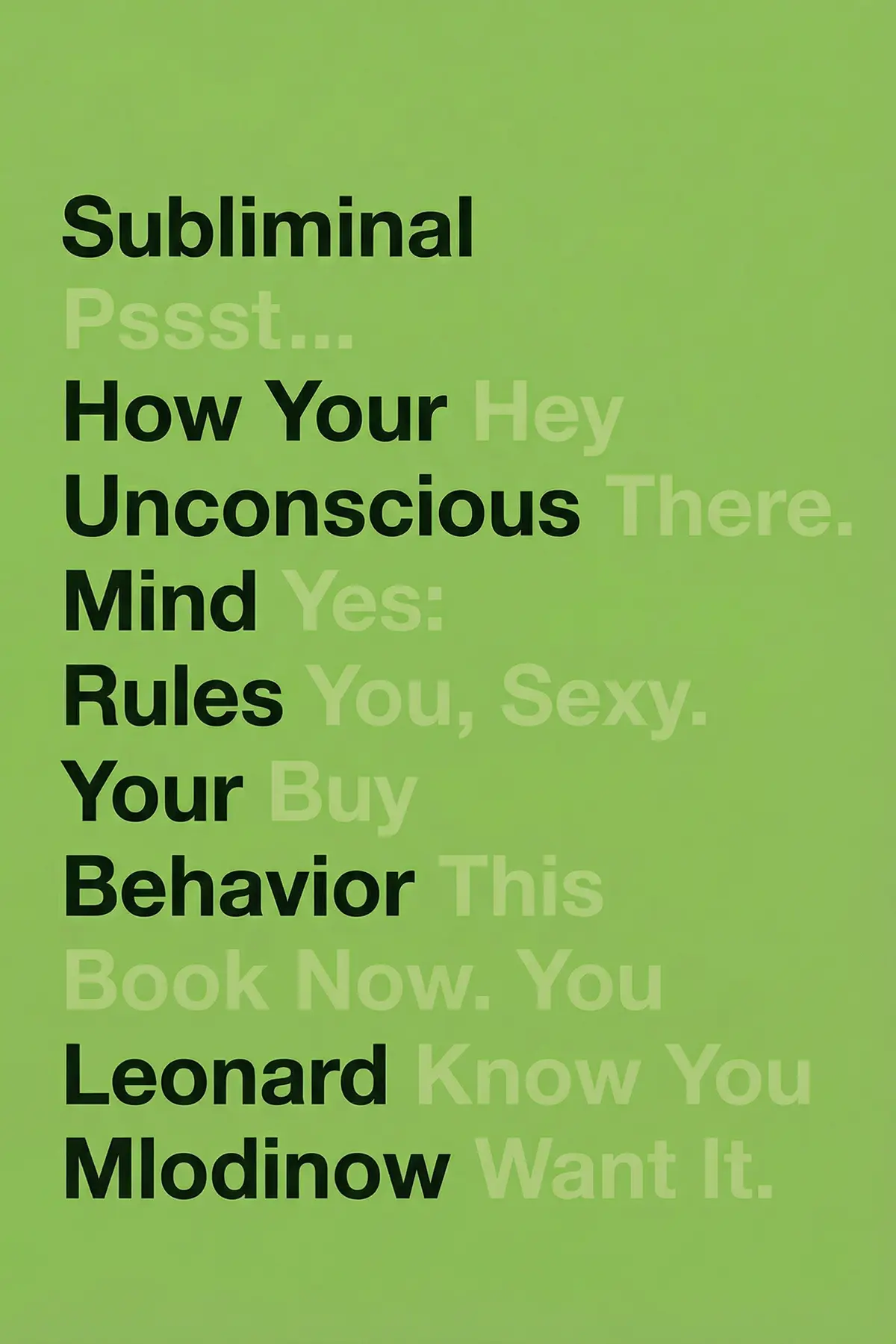
Shows how an unconscious mind built for survival shapes what you see, remember, feel and choose. It explains why your confident explanations are often wrong and offers practical checks for decisions, purchases and judgments of people.
1 min 04 sec
Most of us assume we pick what to buy, whom to trust and whom to vote for by weighing the facts. In Subliminal, physicist Leonard Mlodinow argues that most of that work happens out of sight. In one study, men interviewed by an attractive woman while standing on a tall bridge were more inclined to call her afterward, because they took their pounding hearts as a sign of attraction.
Mlodinow’s case is that an unconscious mind, shaped by evolution to keep us alive, builds what we see, remember and feel. Then it hands the conscious mind a finished story, and the conscious mind believes it wrote that story. The system serves us well, yet it leaves us sure of explanations that are often false.
His evidence runs from a blind man crossing an obstacle course to wine shoppers swayed by background music. Follow it and you get a working map of your hidden biases. You also get practical checks for interviews, purchases and snap judgments about other people.
1 min 42 sec
A man left completely blind by a stroke could still walk an obstacle course without a stumble. His case shows how much of what you call seeing is put together before you are aware of anything at all.
1 min 58 sec
Colleagues once mocked a young politician’s voice as a danger to sparrows, and changing it helped change her career. Your own gaze and tone send messages too, and one simple ratio shows how others read them.
1 min 44 sec
A witness picked the same innocent man twice, even after seeing the real attacker in court. Her mistake had nothing to do with honesty, and the reason behind it applies to everyone’s memories.
1 min 54 sec
Men questioned on a high bridge were more eager to call the interviewer afterward. What they felt was real, but what they believed had caused it was not, and the same confusion can steer decisions at work.
2 min 09 sec
Volunteers took sides in a mock rerun of a real lawsuit, with a cash bonus for guessing the true settlement, yet the plaintiffs guessed double what the defendants did. Even scientists, the book shows, fall into the same trap.
2 min 11 sec
Volunteers gave more money to strangers who shared a favorite painter they had been assigned at random. The urge to belong runs deep enough to cause physical pain, and it bends fairness in ways few people notice.
1 min 45 sec
Shoppers insisted the music playing in the store had nothing to do with which wine they took home. The sales figures disagreed, and the same blind spot shapes how we judge strangers and political candidates.
1 min 06 sec
Subliminal leaves you with an unsettling picture of the self. The voice that explains why you chose, liked or remembered something is often a commentator describing a game it never played. Mlodinow insists the hidden player is good at its job. It kept our ancestors alive, filled the holes in our sight and pulled us toward one another. The trouble starts when we treat its stories as facts.
Since the unconscious can’t be controlled, he suggests trying to manage it instead. Before a big decision, wait until your heartbeat settles, so leftover alarm from a hurried morning does not say yes for you. Before an important judgment, let your body and mind settle first. When you size up a stranger, ask which label is doing the thinking, and seek out the people you would quickly file away. In an interview, hold eye contact while you speak as well as while you listen.
The men on the bridge believed they had met someone special. Mostly, they had met the height.
We like to think we decide by weighing facts. Leonard Mlodinow argues that most of the work happens below awareness. An unconscious mind evolved to keep our ancestors safe, fed and connected, and it still edits what we see, rebuilds what we remember and produces the feelings we later try to explain. Mlodinow draws on brain imaging and a wide range of experiments to show that hidden system at work. A blind man could still read faces. Eyewitnesses sent innocent people to prison. Men mistook the thrill of a high bridge for attraction. Volunteers favored strangers assigned to the same painter, and wine shoppers were swayed by the music in the store. Along the way he explains motivated reasoning, the above average effect and the implicit stereotypes most of us deny holding. Readers get a clear picture of how much their choices rest on cues they never notice, along with practical checks. Calm the body before big judgments, treat memory as a reconstruction, watch your eye contact and voice, and buy on substance rather than packaging.
Professionals who make hiring, buying or investment decisions and want to know what sways them.
Managers and team leads who suspect bias in how people are judged and grouped.
Curious readers who want the science of the unconscious told through vivid experiments.
Leonard Mlodinow was born in Chicago and holds a doctorate in theoretical physics from the University of California, Berkeley. His physics work spans the large N expansion and quantum theory of light in dielectric materials. He has taught at Caltech and written for television, including Star Trek: The Next Generation. He has written five New York Times best sellers for a general audience, and he also co-wrote The Grand Design with Stephen Hawking. Subliminal won the PEN/E. O. Wilson literary science writing award in 2013.

Listeners find this work to be a captivating and eye-opening experience that offers deep understanding into the inner workings of our minds. The prose is approachable for beginners, simplifying intricate ideas, and listeners enjoy the engaging psychological studies mentioned. They consider the book funny and skillfully composed, with one listener highlighting how the author connects advanced theories to daily life. Listeners appreciate the informative nature, especially for individuals just starting to explore psychology.
Mlodinow has a gift for translating dense neuroscience into something that feels like a late-night conversation with a very smart friend. I've always been skeptical of the Freudian subconscious, but this book presents a much more modern, data-driven view of how our brains handle the heavy lifting behind the scenes. The discussion on how we perceive reality—or rather, how our brains construct a useful fiction for us—was genuinely mind-blowing. Honestly, the way he explains our blind spots and how the brain fills in the gaps makes you question every single thing you see. It’s accessible, funny, and grounded in actual research rather than just self-help fluff. If you're looking for a rigorous yet readable entry point into social psychology, start here. It’s an enlightening journey into why we do what we do without even knowing it.
Show moreWow, this was exactly the kind of science writing I’ve been craving lately. Mlodinow manages to balance complex evolutionary biology with hilarious anecdotes about human behavior that kept me turning pages way past my bedtime. I particularly loved the exploration of "theory of mind" and how our brains are essentially social calculators constantly reading nonverbal cues from everyone around us. The science feels robust, yet the author’s voice remains light and engaging throughout the entire narrative. It’s rare to find a book that discusses fMRI scans and the reptilian brain without feeling like a textbook, but he pulls it off with ease. If you enjoyed Thinking, Fast and Slow, you’ll find this to be a much more conversational and digestible companion piece. It’s a brilliant look at the hidden architecture of the human experience.
Show moreThe chapter on group dynamics alone makes this book a mandatory read for anyone interested in social psychology or human behavior. Mlodinow explores how our subliminal minds are constantly sorting people into "us" vs. "them," even over the most trivial differences. It’s fascinating and a little bit scary to realize how much our unconscious biases dictate our political and social interactions. The author’s background as a physicist brings a refreshing level of precision to the psychological concepts without making the prose feel stiff or unreachable. I especially loved the section on how we justify our actions after the fact—our brains are basically just high-end lawyers for our subconscious whims. This is top-tier science writing that manages to be both profoundly educational and consistently entertaining.
Show moreEver wonder why you pick one laundry detergent over another, or why you're so convinced your memories are 100% accurate? Mlodinow dives deep into these quirks, using the Pepsi vs. Coke blind tests to illustrate how our brand preferences are literally hardwired into our pleasure centers. While I found the sections on memory and eyewitness testimony slightly terrifying, they were incredibly necessary for understanding human fallibility. The writing is punchy and stays away from overly dry academic jargon, though it does get a bit technical when discussing the prefrontal cortex. Personally, I would have liked a few more tips on how to actually override these biases in daily life. Regardless, it’s a fascinating read that will make you rethink every gut feeling you've ever had. Truth is, we aren't nearly as in control as we like to think.
Show moreAfter hearing so much about the invisible forces shaping our lives, I finally picked this up to see if the hype was real. Mlodinow’s breakdown of the three regions of the brain—reptilian, limbic, and neocortex—is one of the clearest explanations I’ve ever encountered in popular science. He shows how these layers often work in concert, sometimes to our benefit and sometimes to our total confusion. I found the section on in-groups and how easily we form prejudices based on superficial markers to be particularly sobering and relevant to today’s world. The book is well-written and flows smoothly, though some of the experiments mentioned have been covered in other popular psych books. Still, the way he ties everything back to our evolutionary survival makes the concepts stick in a way others don't.
Show moreAs someone who isn't a scientist, I really appreciated how Mlodinow broke down the complexities of the dorsal striatum and other brain structures. The experiment involving the Xerox machine and the mental scripts we follow was a highlight for me because it's so relatable. We really do operate on autopilot most of the time, and this book provides a solid roadmap for understanding those automatic processes. My only minor gripe is that the tone oscillates between being very casual and suddenly very technical, which can be jarring. But frankly, the insights into how we perceive others based on their voice or appearance made the whole thing worthwhile. It’s an eye-opening read that proves we’re all just woolly around the edges when it comes to logic.
Show morePicked this up on a whim during a long flight and ended up finishing it before we landed. The truth is, I’ve always known my memory wasn't perfect, but seeing the data on how we reconstruct the past to favor our own self-image was a real wake-up call. Mlodinow’s discussion on how we see ourselves as above average in almost everything is both funny and deeply humbling. The book is packed with interesting studies, like the one about gifted children and how teacher expectations literally change a student's IQ over time. It’s a well-paced read that manages to be informative without being overwhelming, making it perfect for a general audience. I walked away with a much better understanding of the hidden part of my personality.
Show moreFinally got around to reading Subliminal, and I have to say, Mlodinow is a master at making the mundane feel miraculous. He takes everyday experiences—like why we trust a certain doctor or how we fall in love—and peels back the curtain to reveal the complex neural machinery underneath. The book is witty, well-researched, and doesn't shy away from the fact that our conscious minds are often the last to know what's actually going on. While I agree with some reviewers that it’s heavy on the science and light on the how-to, the content is so fascinating that I didn't mind much. It’s an excellent bridge between hard neuroscience and human interest. Definitely worth the read if you want to understand the invisible forces driving your daily choices.
Show moreTo be fair, the author does a decent job of explaining the new unconscious through various studies and historical context. However, for a book titled about how the mind rules your behavior, it feels frustratingly light on actionable advice or application. I felt like I was wading through endless descriptions of brain physicality and evolutionary history without ever reaching a "so what?" moment. If you're looking for something that helps you change your habits or influence others, you’re better off sticking with Dan Ariely or The Power of Habit. The anecdotes are folksy and fun, but the heavy focus on the weeds of neuroscience eventually became a bit of a slog for me. It’s definitely educational for a novice, but seasoned readers of the genre might find it a bit redundant.
Show moreLook, I enjoyed the trivia and the humorous way Mlodinow presents these experiments, but I couldn't help feeling like I'd read half of this before. If you've spent any time with Blink or Strangers to Ourselves, many of the core concepts like blindsight and implicit bias will feel very familiar. To be fair, the writing style is more accessible than some of the more academic alternatives, which is a plus for newcomers. But for me, the middle sections felt a bit repetitive, and I found myself skimming through the more minute descriptions of brain anatomy. It's a good primer, but it doesn't quite break enough new ground to be a standout in the field. I'd recommend it to someone just starting their journey into psychology.
Show moreMlodinow argues that an unconscious mind does most of the work of seeing, remembering, feeling and judging. It was shaped by evolution to keep us safe and help us find food and mates. The conscious mind receives a finished story and believes it wrote it. The system works well, but it makes us misread our emotions, misremember events, overrate ourselves and favor our own group, often while feeling entirely rational.
In the study Mlodinow describes, an attractive female researcher questioned men about a school project while they stood on a high bridge. Those men were more likely to call her later. The height raised their heart rate and alertness, and their conscious minds took that bodily arousal for attraction. Mlodinow uses the study to show that emotions start as physical responses whose causes we often guess wrongly.
Mlodinow suggests letting your body calm down before important judgments, since leftover adrenaline from rushing can push you into agreeing. He describes a visual dominance ratio: looking at someone’s eyes as much while speaking as while listening signals authority. He advises buying on substance rather than price, packaging or flowery menus. To reduce stereotypes, name them and spend more time with the people you tend to label.
Mlodinow argues it often is not. Memory keeps the gist of events, and the unconscious fills the gaps with a plausible story. Research he cites finds that 25 percent of witnesses pick the wrong suspect from a lineup. It also finds that 75 percent of people later cleared by DNA evidence had been convicted on mistaken eyewitness accounts. In one case a victim chose the same innocent man twice.
It suits readers who want to understand why their choices are less rational than they feel. That includes professionals making hiring, buying or investment decisions, managers concerned about bias and group favoritism, and anyone curious about the brain. Its evidence ranges from a blind man reading faces to shoppers swayed by in-store music and the 1960 debate between Nixon and Kennedy.



Steven C. Hayes


Deborah Gruenfeld


Anthony Pratkanis



AUDIO SUMMARY AVAILABLE
Get the key ideas from Subliminal by Leonard Mlodinow, plus 5,000+ more nonfiction titles.