

1929: Inside the Greatest Crash in Wall Street History--and How It
Andrew Ross Sorkin
 English
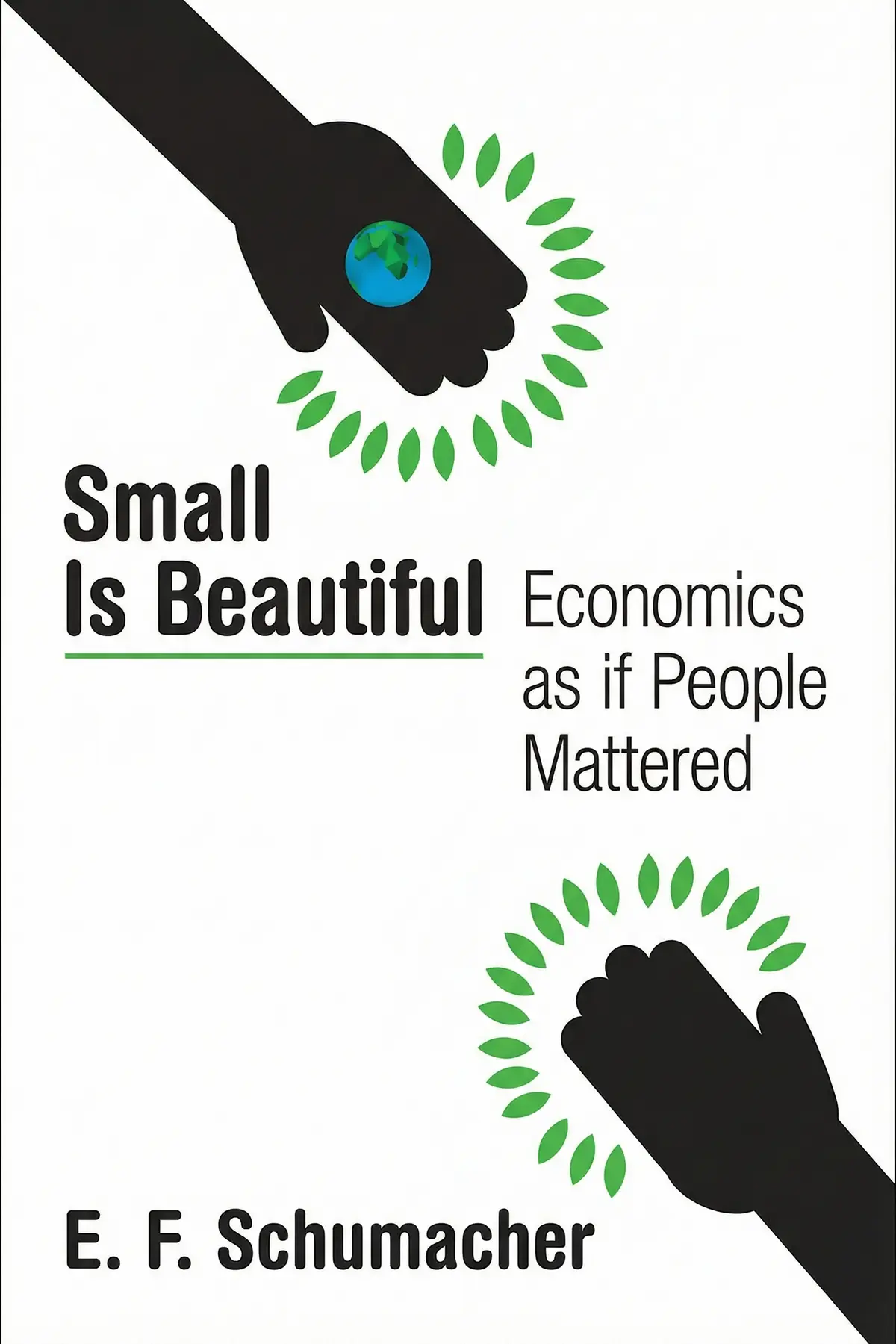
Schumacher shows how an economy that judges everything by profit burns through fuel, nature and meaningful work. He then argues for smaller, people-centered alternatives in technology, education, foreign aid and the way large companies are run.
1 min 04 sec
Most of us learned to read a rising number as good news: more output, more income, more growth. In Small is Beautiful, the British economist E. F. Schumacher argues that this habit hides an accounting error, because the modern economy spends fuel, nature and human energy as if they were income when they are really capital that cannot be replaced. Published in 1973 with the subtitle A Study of Economics as if People Mattered, the book asks economists to put life on Earth ahead of profit.
That single error, Schumacher believes, explains a great deal. It shows why growth can destroy, why wealth alone will not make the world peaceful, why nuclear power was approved on cost, and why so much work feels empty. He then looks for remedies in schools, foreign aid and large companies. What the listener gets is a way to question any decision, from a purchase to a reorganization, about what it costs people and the planet beyond the budget.
1 min 35 sec
Some resources refill every month and some are a store that only runs down. Schumacher believes the modern economy has confused the two, and the mistake reaches from oil fields all the way to the people doing the work.
1 min 32 sec
A shopkeeper who cuts prices for poor customers and a shopper who buys local are both making mistakes, according to one familiar way of thinking. Schumacher asks what that way of thinking quietly removes from view.
1 min 38 sec
History suggests that the wealthy fight less than the poor, which makes prosperity for all sound like a path to world peace. Schumacher tests that hope one step at a time and finds a flaw at every stage.
1 min 38 sec
When fossil fuels began to look finite, a new energy source arrived at just the right moment. Schumacher argues that the way it was chosen reveals more about our priorities than any speech about progress.
1 min 32 sec
Machines were supposed to free people for more enjoyable tasks. Schumacher looks at which tasks actually disappeared and which ones replaced them, and the answer helps explain a feeling many workers know well.
1 min 27 sec
Modern societies trust education to drive progress, and Schumacher agrees, with a condition. Knowing about electrons and the newest devices, he argues, leaves out the one thing a student most needs.
1 min 38 sec
Wealthy nations send money and goods to poorer ones, yet the gap keeps widening. Schumacher points to two blind spots in how aid is designed, one about the causes of poverty and one about geography.
1 min 36 sec
Giant companies keep growing, and the individuals inside them keep shrinking. Schumacher does not call for breaking them up. He describes a different design, along with two things senior managers tend to get wrong.
1 min 12 sec
Schumacher’s book reads like an audit of a household that has confused its savings with its salary. Fuel, the planet’s ability to absorb damage and people’s capacity for meaningful work all looked like income, so they were spent freely, while a single test of profit decided everything from what we buy to how we make electricity. His title names the cure: smaller units, closer to the people they serve, whether that means aid reaching small towns instead of capital cities or a semi-autonomous team instead of a towering hierarchy.
The book’s own advice is to step outside economic thinking and stop scoring every action by whether it pays. That can begin this week. Before a purchase or a project decision, name what the price leaves out. Sort the resources you rely on into those that renew and those that only run down. And if you manage people, give them trust and a real challenge, since pay alone will not keep them engaged.
Prosperity stays welcome in this picture. The task is to count what a balance sheet cannot see, which, for Schumacher, was nearly everything that matters.
Rising output is usually treated as good news. E. F. Schumacher, a British economist who spent two decades as chief economic adviser to the National Coal Board, argues that this reflex hides a basic accounting mistake. The modern economy spends things that cannot be replaced, from fossil fuels to the planet's ability to absorb damage to people's need for satisfying work, as if they were a steady income. From that starting point Schumacher questions some of the most comfortable assumptions of economic life. He doubts that prosperity for everyone would bring peace, and he warns that calling an action uneconomic often just means it ignores profit in favor of people. Nuclear power, in his view, shows money deciding a question of survival. He also shows how technology has taken away the work people enjoy most. The book then turns to remedies: schooling that teaches values along with skills, aid aimed at the rural majority in poor countries, and large organizations rebuilt from small, trusted, semi-autonomous groups. Readers get a set of questions to put to any economic decision, about what it costs beyond the price.
Professionals uneasy that their company's numbers ignore people and the environment.
Managers of large teams looking for ways to keep staff trusted, challenged and creative.
Students and donors who want a people-first view of growth, technology, education and foreign aid.
Ernst Friedrich Schumacher (1911 to 1977) was a German-born British statistician and economist. From 1950 to 1970 he held the top economic advisory post at the British National Coal Board, giving him a close view of energy and industry. In 1966 he founded the Intermediate Technology Development Group, now called Practical Action. The Times Literary Supplement listed Small is Beautiful in 1995 among the 100 most influential books since the Second World War. He also wrote A Guide for the Perplexed, a critique of materialistic scientism.

Listeners find this work to be essential reading that broadens their economic perspective and offers brilliant insights. They value the non-traditional economic outlook and the emphasis on social justice, with one listener observing how closely it matches Catholic social principles. The text receives praise for its worth and focus on environmental longevity, as one listener points to its method for organizing a sustainable economy. While listeners admire how easy it is to read and its ability to spark deep thought, they do remark that the material is somewhat dated.
Finally got around to Schumacher's masterpiece and I’m kicking myself for waiting so long. It offers a profound shift in how we view the 'religion of economics.' Rather than worshiping growth for growth’s sake, he argues for a system that actually serves human needs and fosters social equity. I was especially struck by how his arguments mirror Catholic social principles regarding the dignity of labor and the importance of localized community. In a world obsessed with AI and massive automation, his push for 'intermediate technology' feels more relevant than ever. Sure, some of the data from the early 70s is dated, but the metaphysical foundation is rock solid. It’s not just an economics book; it’s a manual for building a more sustainable and humane society. If you're tired of the 'bigger is better' mindset, this is the antidote.
Show moreThis book should be required reading for every policy maker. Most economic theories treat the world like a giant machine, but Schumacher brings the focus back to human-scale reality. He argues convincingly that the constant cultivation of new needs is the antithesis of wisdom and freedom. Why are we working harder just to buy things that don't make us happy? I loved the focus on 'intermediate technology'—finding the middle ground between primitive tools and giant, soul-crushing machines. It aligns perfectly with my own views on sustainability and local resilience. While it’s been 50 years since it was first published, the call for a 'peace and permanence' economy is exactly what we need right now. It definitely deepened my perspective on global equity.
Show moreWow, it’s rare to find an economics text that feels so deeply personal and ethical. Schumacher doesn't just talk about numbers; he talks about the soul. He sees work as a creative necessity for the human spirit, not just a 'factor of production' to be minimized through automation. This perspective on dignified labor is something we’ve completely lost in the gig economy. I also found his critique of large-scale corporations to be spot-on. He proves that 'bigness' often leads to dehumanization and environmental ruin. The book is a beautiful blend of practical wisdom and spiritual insight, pulling from both Western and Eastern traditions. It’s a must-read for anyone feeling burnt out by the relentless pursuit of 'more' at the expense of the planet.
Show moreIn my experience, most business and economics books are dry, but this is a breath of fresh air. Schumacher understands that economics is a subset of ecology—something we too often forget. He dismantles the fallacy that infinite growth is possible on a planet with limited resources. What I found most valuable was his emphasis on social equity and aid for the 'developing world.' He argues for helping people help themselves through 'intermediate technology' rather than dumping high-tech, expensive equipment they can't maintain. It’s a vision of a world where human scale actually matters. Despite being written in 1973, it feels like it was written for the specific ecological and social crises we are facing today. Excellent insights all around.
Show moreAs an engineering student, I found the chapter where Schumacher dismisses the importance of science quite frustrating. He has this tendency to put down hard sciences while elevating the humanities as the only path to finding the 'meaning of life.' However, if you can look past that particular bias, the core message about technology is brilliant. He champions the idea that tools should be designed to help people work better, not just to replace them entirely. This 'Buddhist economics' perspective—valuing the person over the output—is a necessary challenge to our current corporate culture. Personally, I found the section on education to be incredibly thought-provoking, even if I disagreed with his tone. It’s an essential, albeit imperfect, read for anyone interested in sustainability.
Show moreTruth is, I have mixed feelings about the delivery, even though the message is vital. On one hand, it’s one of the founding texts of the environmental movement and makes excellent points about the finitude of natural resources. Schumacher rightly critiques the idea that we can have infinite growth on a finite planet. On the other hand, the writing style is incredibly declamatory. He often presents his own opinions as absolute certainties and treats statistics with a weird level of disdain. To be fair, he was writing in a different era, but his occasional comments on social roles feel a bit dusty. It’s an important historical document for understanding 'green' thinking, but you have to sift through some dated rhetoric to find the gems.
Show morePicked this up because of the title and stayed for the fascinating alternative view of economics. Schumacher manages to weave together ecology, spirituality, and finance in a way that feels organic rather than forced. He isn't afraid to ask what 'progress' actually means for the average person. I particularly appreciated the chapters on the 'metaphysical foundation' of our society. He argues that no system stands on its own; it always reflects our basic outlook on life. It’s a bit of a dense read at times, and he does lean quite heavily on biblical and Buddhist references which might not be for everyone. Still, for anyone interested in structuring a sustainable economy that values people over profits, this is gold.
Show moreAfter hearing about Schumacher for years, I finally tackled this for its 50th anniversary. It’s amazing how many of his predictions about resource depletion and the hollowness of consumerism have come true. His 'Buddhist economics' chapter is easily the highlight for me. It shifts the goal from 'maximum consumption' to 'maximum well-being with minimum consumption.' That's a radical flip! My only real gripe is the tone. He can be quite preachy and dismissive of anyone who disagrees with his philosophical starting points. Look, I’m all for sustainability, but his rejection of modern statistics makes it hard to use his work in a modern policy debate. Definitely a thought-provoking read, though, and still very relevant to today's climate crisis.
Show moreThe chapter on education really threw me off because it felt so ungrounded. Schumacher spends a lot of time on abstract concepts like 'levels of being,' but he never really gets down to concrete specifics. He seems more interested in writing a theological treatise than a book on economics. I agree with his premise that we are consuming our 'capital' (natural resources) as if it were 'income,' which is a vital distinction for sustainability. But the execution is just so uneven. One minute he's making a brilliant point about localized production, and the next he's rambling about biblical metaphors. It’s a foundational text for the green movement, sure, but it’s more of a philosophical manifesto than a rigorous economic guide. It hasn't aged particularly well in terms of presentation.
Show moreI really yelled at the pages during the science and statistics chapters. As a chemistry major, I found his dismissal of the scientific method to be incredibly arrogant and short-sighted. He claims only the humanities teach us 'the meaning of life,' which is a massive eye-roll moment for anyone who finds beauty and meaning in the physical world. Furthermore, his views on unemployment are archaic; he essentially implies that women should stay at home to 'fix' the labor market statistics. That’s not just dated—it’s sexist. While I appreciate the effort to save the world from over-consumption, such an effort deserves more academic rigor than this simplistic garbage. This was assigned for a symposium, and frankly, I'm just glad to be done with it. It's forgettable despite the hype.
Show moreE. F. Schumacher argues that the modern economy treats irreplaceable things as income. It burns fossil fuels, exceeds nature’s ability to recover and wears people down, all because profit is the only test of value. He calls for economics that puts people and life on Earth first, with smaller units, better values in education, aid aimed at rural areas and organizations built from trusted, semi-autonomous groups.
He splits the hope into three claims and rejects each. Prosperity for all would require burning more scarce fossil fuels and causing more pollution. Pursuing it through the advice to enrich yourself runs on greed and envy, which breed frustration, alienation and insecurity. And because those emotions destroy happiness and meaning, endless growth carries the seeds of conflict instead of guaranteeing peace.
Schumacher argues that the main causes of poverty are not material but weak education, government and legal systems, so money and goods alone cannot fix them, and development takes time. He also notes that in a typical developing country about 85 percent of people live in small towns, while most aid goes to the cities. Aiming help at rural areas would reach more people and slow migration to cities.
Start by questioning the word uneconomic: next to the price of any option, note its cost to people and the environment. Sort your resources into those that renew and those that only run down. If you lead people, split large teams into smaller groups with real autonomy, trust those below you instead of taking over their work, and give every role a genuine challenge, since pay alone does not create meaning.
It suits readers who suspect that rising profits and output do not tell the whole story. Managers will find advice on balancing structure with freedom in large organizations. People interested in energy, education or development will find Schumacher’s arguments about nuclear power, value-based schooling and rural-focused aid. Anyone whose work feels empty will recognize his account of how technology removed the most satisfying kinds of work.
Andrew Ross Sorkin

Ha-Joon Chang
Niall Kishtainy


William J. Bernstein




AUDIO SUMMARY AVAILABLE
Get the key ideas from Small is Beautiful by E. F. Schumacher, plus 5,000+ more nonfiction titles.









